Imagine, if you will, that you work at a breast cancer center with moderately good results, but you have decided, as a group, to not offer therapy to women with stage 4- triple negative lesions. Survival is so low, you have decided, and the therapy so aggressive, that women should not be put through such a “futile” therapy.
But reports come in of other centers with survival well over 50%, long term outcomes which are excellent (as good as other types of breast cancer), and the short term complications of therapy which are similar to those of less aggressive cancer.
For the next woman who arrives in your center, what do you say? I think you would have 3 options:
1. “I know that in Superville they get good results, but they practice some sort of black magic: here in Ordinaryton we have decided that this is futile therapy so I am afraid you are going to have to die. We do have great palliative care though!”
2. “In Superville they are getting good results, so we are going to go ahead and do our thing too, let’s go!”
3. “In Superville they are better than us with other high-risk breast cancers also. We should gear up to offer therapy to women with triple negative cancers, let’s learn from Superville, and from the other centers who have also reported good results. Let’s make sure all of our team is up and ready. Let’s make sure we know how to do this the best we can. Let’s discuss each case individually with the patient, including all the details of the staging, and the risks of therapy and be ready to treat the next one who opts for intervention.”
It is fairly obvious what we should do to offer the best care (if transfer to Superville is not an option!) Just deciding that all such patients should die, while in several centers they can survive with a good quality of life, is not morally defensible.
Back to neonatology:
About a year ago I published a post talking about survival at 22 weeks gestation, a gestational age which is considered “pre-viable” by many practitioners, I noted that survival rates were high enough that “futility” could not be used as an argument against offering active support for such babies.
That post showed that several centers were achieving good survival at 22 weeks gestation. Total numbers of survivors were small, and very little follow up data was available.
The group in Iowa have just published detailed information regarding their outcomes, short and long term, over a 10 year period. Watkins PL, et al. Outcomes at 18 to 22 Months of Corrected Age for Infants Born at 22 to 25 Weeks of Gestation in a Center Practicing Active Management. J Pediatr. 2019. During that period active intervention was offerred whenever live birth at 22 weeks best-guess gestational age (BGGA), or more, was expected. The obstetricians offerred antenatal steroids and active surveillance. During that period there were 24 infants born alive at 22 weeks (I will concentrate on that subgroup, even though I know that intervention at 23 weeks is still not offered in many places. Some of the data are only available for the combined group of 22 and 23 weeks). Of those 24, 2 died before admission to the NICU, and 2 families opted for no resuscitation. None of the 22 week BGGA babies were delivered by Cesarean. This being from the USA, 7% of the mothers had no antenatal care prior to being admitted for threatened preterm delivery.
The obstetric team had time to give antenatal steroids to over 90% of the mothers, and half had more than 48 hours of coverage. Of the 20 babies admitted to the NICU, 14 survived to go home, and the list of in-hospital morbidities and their frequencies for the 22 and 23 week babies together are similar to what you would expect for extremely immature babies, and are not noticeably different from the 24 and 25 week cohort, that they also report.
Survival to discharge is remarkably good for the overall 22-23 weeks cohort, as well as for the 24-25 weeks group, 78% and 89% respectively.
With regard to long term outcomes at 18 to 24 months corrected age, the majority of infants evaluated had no or mild “NDI”. In this study the Bayley 3 test was done, and if the cognitive score was over 85, and the child was free of CP (or had a GMFCS of 1), hearing or visual impairment, that was considered no or mild impairment. 70 to 84 on the cognitive scale, or CP with a GMFCS of 2 or 3, was considered moderate impairment, and lower scores or worse CP was considered severe. 82% of the 22 week group were no, mild, or moderate, “NDI”, with 2 of the 11 evaluated survivors having severe NDI. The proportions between the different weeks of BGGA are similar, but do look a bit worse at 22 weeks, the numbers are small to evaluate statistically, however.
As you might realize if you have seen Annie Janvier’s recent contribution to John Lantos’ ethics rounds series in Pediatrics. (Janvier A, et al. Does It Matter if This Baby Is 22 or 23 Weeks? Pediatrics. 2019). We have offered active intervention to several babies at 22 weeks BGGA at our center, with a few hiccups during the hospital course of the first one, which you can read about in those rounds, but there has been a gradual acceptance in the NICU that survival and outcomes are good enough to offer NICU care.
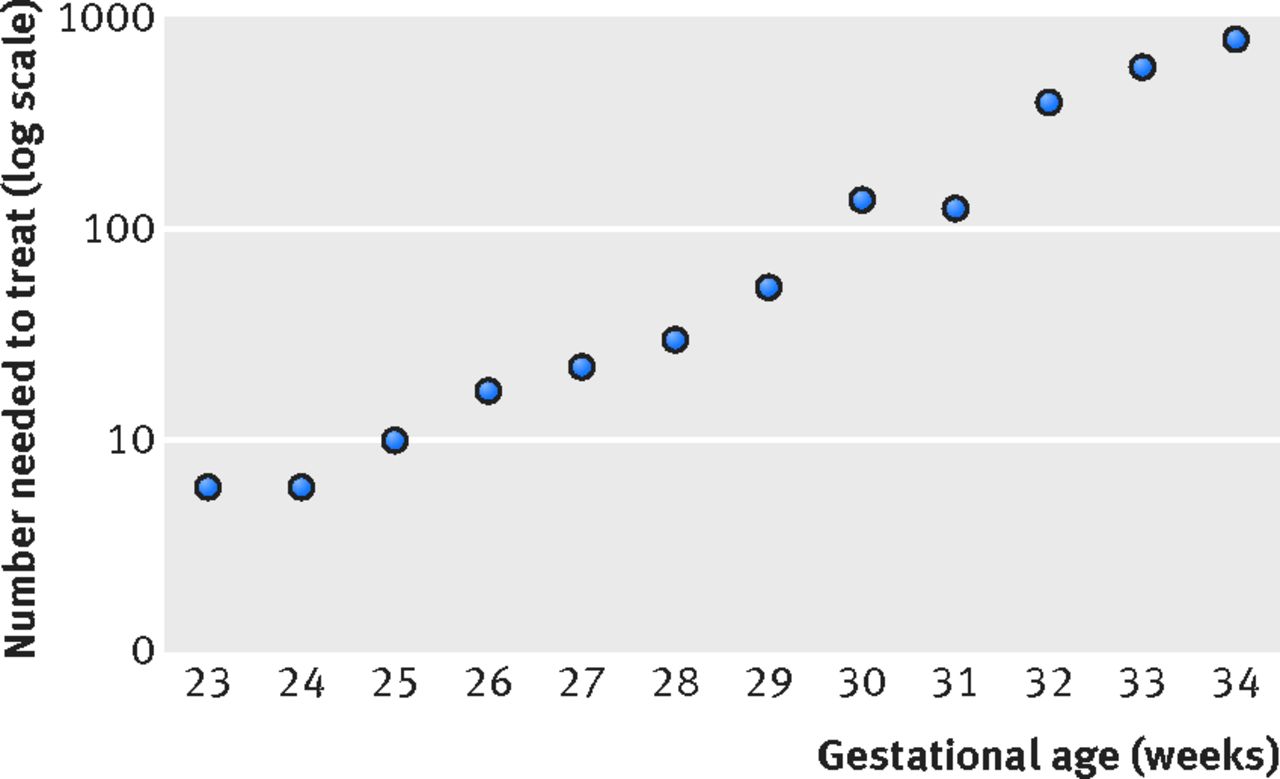
Starting to do this, and getting good enough at it that you can get good survival (both numbers and quality), requires an integrated approach with Obstetrics. Offering NICU care if the obstetricians are not prepared to give steroids, is not a reasonable approach and will not likely be successful. No center is going to have many such babies, even in Iowa they only average 2 per year at 22 weeks, so having pre-existing protocols and a joint approach, all ready for the next mother who arrives is essential. If your obstetricians are reluctant to give steroids, you can show them this figure from (Travers CP, et al. Exposure to any antenatal corticosteroids and outcomes in preterm infants by gestational age: prospective cohort study. BMJ. 2017;356:j1039).
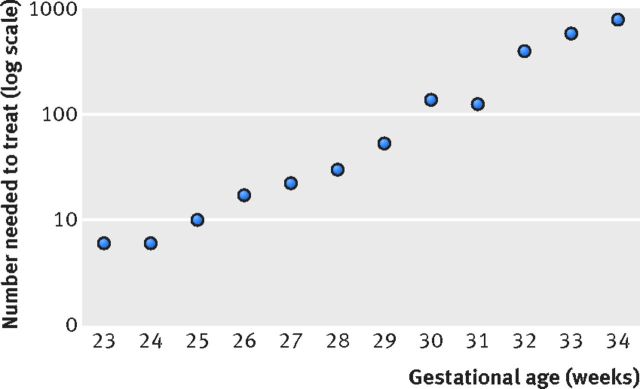
This is a graph of the number needed to treat per extra survivor, according to GA at birth. Data are from the Pediatrix data warehouse, and the total n is about 120,000.
At 23 weeks you only need to give 8 courses of steroids per extra survivor, compared to almost 1000 at 34 weeks! That study collected no data at 22 weeks gestation, but I can’t see any reason why the curve, which seems to flatten off a bit at the bottom, would suddenly leap upwards again.
In addition to the collaboration with obstetrics, consistency of the clinical approach, and a positive attitude seem to be essential. Having visited both Iowa and Uppsala recently, I can tell you that those 2 centers clinical approaches have multiple differences. Incubator care, ventilation, blood work, just about everything, seems different. The most important factor that they seem to have in common is that the people looking after the most immature babies believe in what they are doing, talk together frequently about how to improve their care, and expect that the large majority of the 22 and 23 week babies will survive. That has to include the entire team, from nurses to admission clerks to respiratory therapists (if you are lucky enough to be in a country with RTs), and of course integrating the parents.
I don’t think it is morally defensible to just tell parents ‘we don’t do that here’, and particularly not ‘it is futile’. Decision-making based on individual risk assessment, with a realistic option of high-quality committed active care should be offered.