Meat the Munch Bunch

Being in a bilingual family has many great pleasures, but there are also extra opportunities for misunderstanding. Tonight, when reading a sequel to ‘Meet the Munch Bunch’ one of the kids asked me, ‘what does it mean (qu’est-ce que ça veut dire), la viande  munch bunch?

I thought they had understood the title of the first episode, part of a group of stories for young children, originally written by a young girl; characters include Professor Peabody (knowledgeable pea-pod) Sally Strawberry (gifted artist, likes the colour red) and Spud (potato with delusions of grandeur). The first book, which introduces the characters, I had read the previous night. The kids had just listened and nodded, it wasn’t till 24 hours later that I discovered they hadn’t understood the title, and maybe not much else either. Probably their little brains were wondering all along why the whole book was about talking vegetables, but the title was about ‘meat’!

Posted in Not neonatology | Leave a comment

Transfusion Associated Necrotizing EnteroColitis?

I’m still not absolutely sure about TANEC, as it now seems to be called. It is certainly possible that transfusions could trigger gut injury in very preterm babies, but how to prove it? Even if the temporal association was absolutely clear, does the transfusion just change the timing of NEC rather than increasing incidence? And then what do you do about it?

The 2 RCTs of differing blood transfusion thresholds that I recall, Ed Bell’s study, and the PINT trial did not report any difference in NEC. There was no mention in Bell’s study, and the frequency of NEC was actually slightly lower in the high transfusion threshold PINT group (not significant) who got transfused more frequently as a result of their assigned group.

A recent systematic review of observational studies illustrates to me the difficulties in figuring this all out, their first question was ‘Are neonates who develop NEC more
likely to be exposed to PRBC transfusion within previous 48 hours compared
with those who do not develop NEC?’. My question is, for those who do not develop NEC, which 48 hours do you mean?

One study from the CNN (the database not the news channel) used a case control design, the controls were all patients who did not develop NEC at all, the controls had a transfusion within 2 days before their diagnosis. For the controls they examined the 2 days before the median age of developing NEC in the same birth weight stratum. According to this study 9% of cases of NEC occur within the 2 days after a transfusion. Of course, babies who get NEC as well as babies who have transfusions are smaller, more immature and sicker. You can try and correct for such things, but it is hard to convince me that you can eliminate all the confounding.

Even if it does exist what do you do about it? I have written on this blog on numerous occasions that there is no evidence that feeding patterns affect NEC. You can advance feeds fast or slow, feed trophically or advance immediately, or whatever you want to do, don’t expect any effect on NEC. Probably the only thing that you should not do is keep babies nil by mouth, to be honest there isn’t much evidence that this affects NEC, but it does affect growth, subsequent feeding tolerance and the duration of TPN and central catheter use.

Despite this, several individuals have suggested putting babies npo, to use the usual english-latin abbreviation. One stopped feeds during the transfusion and then started them again immediately afterward. They had a decrease in NEC from 9 cases of 171 LBW, to 2 out of 155. Which of course is a far bigger decrease than you could get from just preventing TANEC.

The most recent study, and the one which triggered this post, showed something quite similar. The authors instituted a policy of withholding feeds for 4 hours before and after the transfusion, and then half the previous volume for 12 hours, then advanced to the previous volume. They showed a  reduction in NEC after introducing this (from 12% of VLBWs to 7%). However, they showed just as much reduction in NEC not related to transfusion as in TANEC, and the actual reduction in TANEC was not significant. So clearly the change in the policy of withholding of feeds was just coincidental with something else that happened (I don’t know what, they don’t seem to either).

And to come back to the overall feeding management issue. As I understand the data, and Bill McGuire, who does many of these Cochrane reviews, can correct me if I am wrong, early commencement of trophic feeds has a number of advantages over keeping babies npo, but in terms of the most clinically important outcomes of death or NEC there is no proof of benefit. Many of the studies actually had 2 or 3 days of being npo even in the trophic group, though, so good data about starting feeds immediately after birth are lacking. Secondly, the data compare trophic feeds to no feeds. I don’t think there are good trials comparing trophic feeds, initiated early, to immediately starting to increase feed volume. That is a trial that I think we do need, infants would be randomized shortly after birth to a schedule which gives 3 or 4 days of trophic feeds, or would start at the same volume for the first feed, but immediately be on a schedule of increasing by 20 to 30 mL/kg/day.


 

Posted in Neonatal Research | Tagged , | 2 Comments

Septic Shock; 3 negative trials

Three trials back to back in the PNEJM (that’s the prestigious New England Journal of Medicine for any new readers) in adults with septic shock are disappointing:

Early Goal Directed Therapy has become a dogma in recent years; it even appeared on an episode of ER, as I recall. It promotes a protocol of early insertion of central catheters, fluid administration to certain hemodynamic measurements, and monitoring of central venous saturation. The original trial was a single center RCT of moderate size (260 adults with severe sepsis, septic shock, or sepsis syndrome) and had significantly more survivors in the intervention group than the usual treatment controls. I think the study was well-done, but includes individual items that could be, and were, challenged. In total there were about 20 more deaths in the control group than the intervention. Considering that this modest size single center trial, with a significant result, but a relatively small numerical difference in survival led to changes in approach that have affected many 10’s, maybe 100’s of thousands of patients, makes me pause. Smaller trials often tend to have results that are more impressive than larger ones, and the control group mortality in Rivers’ trial was very high, at 46.5%.

The new trial in the PNEJM, is a larger multicenter comparison of early goal directed therapy (a very similar protocol to Rivers et al) to 2 other approaches, one was another protocol which did not mandate a central catheter, and even if you needed a central venous catheter for venous access you weren’t supposed to measure CVP or central venous oxygen saturation, transfusions were given at much lower hemoglobin levels, management was based on clinical evaluation of the patient, including the ‘shock index’ (heart rate divided by systolic BP), and also the clinical signs of poor perfusion. The third arm was usual care, which has of course changed over the years since the original Rivers study. 1341 adults were randomized, they all were in shock, and the study found very little difference in outcomes. The primary outcome, which was whether you survived for 60 days, was not different. There were some minor differences between the groups, but nothing earth shattering. It seems that careful clinical evaluation and judicious standard care is as good as anything else. Of note the mortalities in the 3 groups were around 20%, much lower than the control group in the earlier study which was 44%.

The second study was a comparison of different blood pressure targets. In a multi-center trial from France of adults in septic shock, the 776 subjects were randomized to a target mean BP of 65 to 70mmHg, as recommended by the surviving sepsis campaign, or 80 to 85 mmHg. BP was raised for the most part using norepinephrine, if the patients were below target after fluid resuscitation. The high target group had more norepinephrine used, and some more atrial fibrillation, but no differences in survival to 28 days were seen, which was about 65% in each group. They also had less renal impairment in the high BP group. These patients seem to have been sicker at baseline than the first study, with shock refractory to fluid boluses and already receiving norepinephrine at 0.1 microg/kg/min or more when randomized. Observational data had previously suggested that you did better if the blood pressure was kept higher, which shows the importance, once again, of doing these sorts of trials.

The third trial was an Italian multi-center trial of adults with severe sepsis or septic shock, 1818 patients were randomized to either get crystalloid solution, or 20% albumin and crystalloids, with a goal of achieving a serum albumin of 30 g per liter. 28 day mortality was just over 30% in both groups. The only effect of giving albumin was that the serum albumin was higher!

As I said above, disappointing, as we don’t find clear advantages of one intervention (or bundle) over the other. The really important message from these trials is that we need to keep doing large pragmatic trials in septic shock, they are feasible, and they point out that septic shock is common, still has a high mortality, and we don’t have a lot of evidence based methods to treat it.

There is a message here for neonatology:  trials in critically ill unstable patients are feasible, and are absolutely essential if we are to move forward.


Posted in Neonatal Research | Tagged , | 1 Comment

I think our spring is broken

Spring officially started already (who decided that spring starts at the same time all over the northern hemisphere and lasts exactly 3 months? To me, spring starts when the snow is gone, the trees are budding and the birds start to return, in Montreal it lasts about 6 weeks, in Edmonton it was about 6 days).

In any case, by mid March spring should be starting, but we had 25 cm of snow last week, 10 cm on Saturday, and the temperature this morning is -16 degrees (that’s Celsius, fortunately).

I am getting fed up with this, I think I will ask whoever is in charge to warm things up a bit.

Here are 2 of my kids profiting from the snow fall, making a snowman, and a snow-preemie

IMG_1932

Posted in Not neonatology | 1 Comment

Worms are beautiful

I found these amazing pictures of Marine Worms just stunning

I won’t copy them here as I think the photographer deserves the clicks!

https://www.behance.net/gallery/Worms-Renaissance/15109599

Well maybe just one…

Posted in Not neonatology | Leave a comment

Pressure-Volume loops are not consistently interpreted

In case you remember my little Survey Monkey questionnaire on pressure volume loops, and were wondering about the responses, there were about 100 people who wasted a few minutes on the survey. Most were from medical professionals, (mostly neonatologists and fellows, but also residents, nurses and a few RTs) almost all were from centers that currently use ventilator graphics in managing their patients.

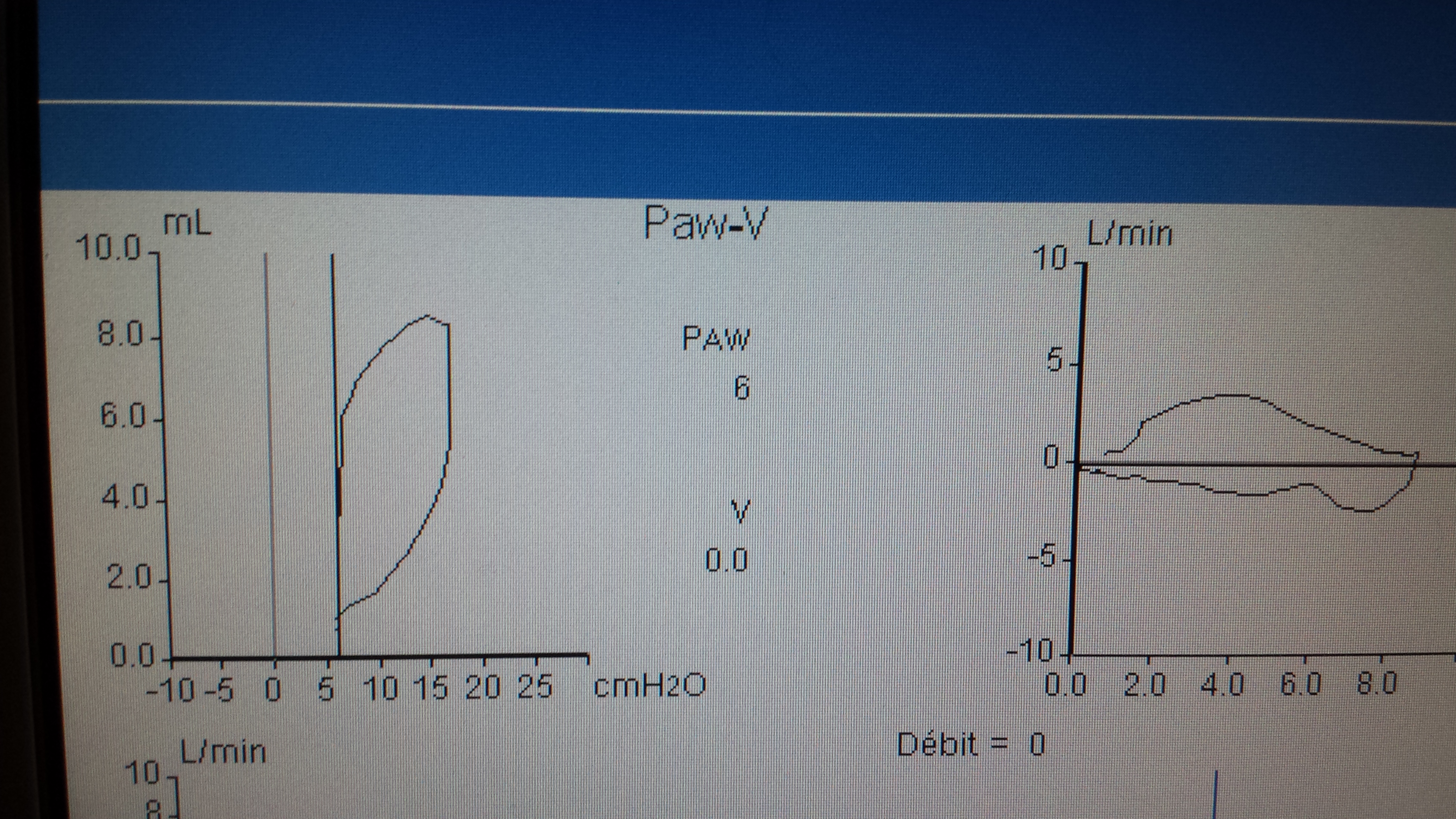
So I selected just those medical professionals that currently use graphics in their practice, and, as I expected, there was no consistency whatsoever in their evaluation of the curves.  For example, the last curve was considered to be needing an adjustment by 85% of the respondents, 56% thought it was over-distended, and needed some sort of reduction in ventilation assistance, 28% thought it was under-inflated and needed an increase in ventilation assistance. Here is the loop:

20140130_104323

And here are the answers:

Choix de réponses
Réponses
It shows over-distension and I would reduce the set volume
40,48%
It shows over-distension and I would reduce the PEEP
16,67%
The loop is perfect, I would make no changes
14,29%
It shows under-inflation and I would increase the set volume
9,52%
It shows under-inflation and I would increase the PEEP
19,05%

I looked at those responses from people who did not use graphics, and they were about the same.

Makes you think…

Posted in Neonatal Research | Leave a comment

Publishing research results, can do better.

Trial registration was supposed to reduce publication bias, and also improve the quality of publications. Ensuring that what investigators say they did, is what they actually did.

Becker JE, Krumholz HM, Ben-Josef G, Ross JS. Reporting of results in ClinicalTrials.gov and high-impact journals. JAMA. 2014;311(10):1063-5. Results are also supposed to be reported on the registration databases, specifically on the database mentioned in the title of this article, (which was written by a medical student). The authors compared what was put in the database to what actually appeared in the publication, which they limited to major medical journals. They noted that nearly all of the 96 studies had at least 1 discrepancy in the results between the publication and the record on ClinicaTrials.gov. Many had differences in the primary outcome, and 6 of them changed the interpretation of the major outcome of the trial. 

Kasenda B, von Elm E, You J, Blumle A, Tomonaga Y, Saccilotto R, et al. Prevalence, characteristics, and publication of discontinued randomized trials. JAMA. 2014;311(10):1045-51. This study looked at just over 1000 RCTs that were started in 3 different countries. They got the identification from ethics committees that had approved them, and then searched what had happened to them. 253 were discontinued, most often trials were discontinued because of poor enrollment (n=101). Other reasons included interim analysis showing no benefit, and interim analysis showing harm in one of the groups. Half of the discontinued trials were never published, but 21% of completed trials were never published either. Discontinuing a trial because of poor enrollment predicted a greater likelihood that no-one will ever see the results. It is very important to publish discontinued trials, other researchers, granting agencies, and patients can benefit from the data accumulated, even if you had to stop early. Once patients have volunteered to participate in a trial, it is an ethical failure to not publish the data that they provide.

Posted in Neonatal Research | Leave a comment

Neonatal Updates : Therapeutic hypothermia

Three recent articles dealing with the effects of therapeutic hypothermia:

Drury PP, Gunn ER, Bennet L, Gunn AJ. Mechanisms of Hypothermic Neuroprotection. Clin Perinatol. 2014;41(1):161-75. the first is an excellent review article describing how hypothermia works, SPOILER ALERT, its mostly about apoptosis.

Hochwald O, Jabr M, Osiovich H, Miller SP, McNamara PJ, Lavoie PM. Preferential Cephalic Redistribution of Left Ventricular Cardiac Output during Therapeutic Hypothermia for Perinatal Hypoxic-Ischemic Encephalopathy. The Journal of pediatrics. 2014. Left ventricular outputs during cooling were much lower than health controls, and increased with re-warming. SVC flows in contrast were similar to health infants, and didn’t change during re-warming. Suggesting that there is a redistribution of blood flow to the upper body, probably the brain. Maybe the lack of a decrease in SVC flow during cooling shows that the cerebral vessels are reacting abnormally to hypothermia, and maybe that is a good thing.

Nestaas E, Skranes JH, Støylen A, Brunvand L, Fugelseth D. The myocardial function during and after whole-body therapeutic hypothermia for hypoxic–ischemic encephalopathy, a cohort study. Early Human Development. 2014. A comparison of features of myocardial function by echocardiography between hypothermic babies, and a historical control group treated before hypothermia became standard, and a group of healthy controls. Most of the data presented are derived from tissue doppler studies. The indices of function were similar between the 2 asphyxiated groups, even though the hypothermia treated seemed to probably have a more severe insult. All the indices recovered to be near normal after re-warming.

Posted in Neonatal Research | Tagged , | Leave a comment

Hypotension after PDA ligation

A new prospective multi-center evaluation, of cardiac function and the causes of hypotension after PDA ligation, has just published data about adrenal function.

Clyman RI, et al: Hypotension following patent ductus arteriosus ligation: The role of adrenal hormones. The Journal of pediatrics.

The babies all had a serum cortisol measured before the surgery, and had a 1 microg/kg ACTH stimulation test. They had cortisol measured post-op also, at between 10 and 12 hours postop, which is the average time of peak use of inotropes, and the time when El-Khuffash, Jain, and McNamara have demonstrated the worst left ventricular dysfunction. (that link is to a very nice, fairly brief, review article about the important issues).  The new study found no difference in the cortisol levels or the ACTH response between normotensive and hypotensive infants (about half were in each group). They did, however, show that the worst infants, who needed at least 15 mics of dopamine or dobutamine total dose per kg per min, had substantially lower post-operative cortisol concentrations. Although there was some overlap with the less sick infants.

This is somewhat different to a previous study (El-Khuffash A, McNamara PJ, Lapointe A, Jain A. Adrenal function in preterm infants undergoing patent ductus arteriosus ligation. Neonatology. 2013;104(1):28-33) published last year from the Sick Kids group, (including Anie Lapointe who is now my colleague at Sainte Justine). That previous study also did ACTH stimulation tests before PDA ligation, and showed that infants who had lower responses (<750 nmol 1 h after 35 microg/kg ACTH) were more likely to have postoperative hypotension, and more likely to have post-operative deterioration of their respiratory function as well. Interestingly in that study, the left ventricular output (LVO) was not associated with the pre-op cortisol responses. So perhaps less cortisol reserve s associated with an inability to maintain SVR, leading to hypotension rather than low cardiac output. Patrick McNamara’s group at Sick Kids uses a lot of milrinone in the babies with lower LVO, which might also be implicated in these responses.

I am not sure why the differences between these 2 studies, they are of course both observational, the differences may just be random variations. The much lower dose for the ACTH test in the new study might be one reason. (By the way to convert from the ‘american’ units of ng/ml to nmol/ml multiply by 2.8 (or to be precise by 2.759) I just had to look that up). But what test is preferable, and how to define relative adrenal insufficiency is still a mystery to me.

One other interesting aspect of the new study is that they measured other cortisol precursors and metabolites, and they were all low in the severe hypotension babies. Which implies that the problem is not with the adrenal gland but with the responsiveness of the entire hypothalamo-pituitary-adrenal axis.

Posted in Neonatal Research | Tagged , | Leave a comment

S’il suffisait d’aimer

Sainte Justine is a unique hospital, we are a ‘full-service’ children’s hospital with an integrated maternity service. The obstetricians, of course, think that we are a maternity hospital with a children’s hospital tacked on!

We have a fund-raiser at the present.

The foundation has asked various choral groups to submit entries, the winning group will get to sing with Céline Dion. Many of the entries are spectacular, and show how creative we are  in Quebec. Two or three of the groups have sung the Jean-Jacques Goldman song which is called ‘S’il suffisait d’aimer’ (if it was enough to love). It is a very moving song; one of the best versions is currently in the lead for overall votes. Another version of the song is performed by a school where a child of 12 years of age died of leukemia. If you are like me, you will need a least one box of kleenex to get through that one. The chorales have to choose one of 4 songs that Céline has recorded, one of them is in English ‘because you loved me’, the other 3 are french.

J-J Goldman is not known all that well outside of the ‘francophonie’ which I think is a shame, and I don’t remember having heard of him before becoming a francophone…(or at least someone who lives and works in french). Some of his songs are great, such as the one in the title of this post, as well as ‘on ira‘ which I think is one of the best contemporary love songs of all. ‘Pour que tu m’aimes encore’ is another of his songs, of which there is a video of him singing with the very same Céline Dion. Some  of these songs I think are better than any English songs of the same period, they are not as well known, simply because they are in French…As a critic of uncontrolled IVF I also like ‘elle a fait un bébé toute seule‘.

So in case anyone thinks I am a music snob, because I was very rude about ABBA in a recent post, you can see from these links that I have no problem with pop.

Posted in Neonatal Research | Leave a comment