Choosing Wisely

Many of you will have heard of the “Choosing Wisely” campaign, an attempt to improve decision making, by clarifying efficacy and risks of common procedures or therapies. Many specialty societies have come up with lists of the Top-5 questionable practices that should be reconsidered. The AAP has just published a list of 5 neonatal practices that they say should be avoided. It is interesting that some of the other societies have made very clear recommendations to not do certain things (“Don’t do….” a particular test, for example). The AAP list instead states to “Avoid Routine…” for each one of the 5 practices. I think for a couple of their practices they could have been more forthright.

  1. Avoid routine use of antireflux medications for treatment of symptomatic GERD or for treatment of apnea and desaturation in preterm infants.

This is one where that prior comment applies. I think this should have been stated “Do not use antireflux medications in the newborn”. The reason being that there is no such animal. There is no medication that has been shown to reduce reflux. There is no way clinically to diagnose abnormal reflux. There is no effect of antireflux medication on apnea or desaturation. All the medications in use are toxic.

Now if by antireflux medications, they include anti-gastric acidity medications (and when you look at the supplemental materials it seems that they do) then I guess you could temper those comments a little. It is possible that sometimes acid-caused reflux disease is an issue, and the agents are effective at reducing gastric acid production, even in the newborn. Whether they improve any acid-related disease findings is less certain, most of the rare small RCTs have shown no clinical benefit. They are also associated with more infections, more NEC and increased mortality. So maybe in a baby after diaphragmatic hernia repair, or after Oesphageal Atresia repair they could be indicated, but it would be great to have some actual data.

  1. Avoid routine continuation of antibiotic therapy beyond 48 hours for initially asymptomatic infants without evidence of bacterial infection.

Again I think this could be a stronger statement, given the 2 provisos that the babies are initially asymptomatic and that they have no evidence of bacterial infection. In other words it is for babies with risk factors for infection, but who develop no clinical signs. In those babies you could appropriately say “Stop antibiotics at 36 hours”.

  1. Avoid routine use of pneumograms for predischarge assessment of ongoing and/or prolonged apnea of prematurity.

I think this is appropriately stated, there may be indications for selective predischarge pneumograms, for diagnostic rather than screening purposes, so “Avoid routine” is about right.

  1. Avoid routine daily chest radiographs without an indication for intubated infants.

I agree with this, I didn’t know it was a common practice in the NICU. Some babies are intubated for months, that would be an awful lot of radiation.

  1. Avoid routine screening term-equivalent or discharge brain MRIs in preterm infants.

Again I agree with this, as many of you will already know! The justification given however, is that there is no evidence that they improve long term outcome. While that is true, I don’t think that is why they are being done, not many people think a few minutes in a magnet will make the babies better. The data show a poor positive predictive value of abnormal findings for long term outcomes, which make them of questionable value.

Posted in Neonatal Research | 1 Comment

For Father’s Day

Two links for Father’s Day, the first a narrated graphic story by a cartoonist whose baby had HIE. A wonderfully told touching story of becoming a Dad in the most difficult circumstances:

http://s.telegraph.co.uk/graphics/projects/fathers-days/index.html

The other is to a website where you can read a couple of poems by an uncle of very preterm twins. There are 3 sample poems, and a link to buy the book, which I have bought, and there are many other moving poems in the volume.

http://www.prematurepoems.com/

Posted in Neonatal Research | Leave a comment

Long term effects of surgery in the infant

To follow on from a study in a recent “neonatal updates”, there is a new publication from an Australian group that have been pursuing a prospective cohort of full term infants who had major surgery in the first 90 days of life.

In contrast to the other study, this was prospective, population based, and only included major surgery (defined by opening of a body cavity). The early developmental results have already been published Walker K, et al. Early developmental outcomes following major noncardiac and cardiac surgery in term infants: a population-based study. The Journal of pediatrics. 2012;161(4):748-52 e1.

Now the authors have been testing the infants at 3 years of age. Walker K, et al. Developmental outcomes at 3 years of age following major non-cardiac and cardiac surgery in term infants: A population-based study. J Paediatr Child Health. 2015. They examined 62 infants who had cardiac and 124 who had non-cardiac surgery, and 162 controls, all from New South Wales. The Bayley scales of infant development, version 3 were used. Basically the non-cardiac surgery babies tested lower than the controls on just about all the subscales, and the cardiac surgery babies tested lower than the controls on just about all the subscales.

The proportion of babies whose scores fell into the mild, moderate and severe delay definitions were also increased. Most, as you would expect, were mildly affected, but nevertheless they were affected, and for expressive language and gross motor delay the proportions affected are substantial, 1/3 of the cardiac, and 1/6 of the non-cardiac surgery infants, compared to 1/20 of the controls (all of which were mild except fro 3 babies in the expressive language subscale who were moderate). With proportions like that these babies should all be followed up in order to identify those who may benefit from intervention. If we could identify them early then follow up could be selective. It seems (from other data) that more than 1 surgery increases the risk (Wilder RT, et al. Early exposure to anesthesia and learning disabilities in a population-based birth cohort. Anesthesiology. 2009;110(4):796-804.), and longer anesthesia also seems a risk factor.

Several studies of specific types of surgery usually have shown similar results, (for example for oesophageal atresia and gastroschisis) so it is presumably just the fact of having surgery/anesthesia that is important, and not pre-existing associated CNS anomalies. Although some details of how the surgery is done have been studied, such as circulatory arrest times, and hemodilution (both in cardiac surgery), most of the details of the surgical or anesthetic techniques have not been evaluated.

A good recent review is available Sinner B, et al. General anaesthetics and the developing brain: an overview. Anaesthesia. 2014;69(9):1009-22.


Posted in Neonatal Research | Tagged , | Leave a comment

Cannulae for CPAP and nasal ventilation

Mukerji A, Belik J. Neonatal nasal intermittent positive pressure ventilation efficacy and lung pressure transmission. J Perinatol. 2015.

This is a lung model study, in which the authors compared the pressure transmission and CO2 elimination effects of nasal IPPV with 2 different interfaces: the neotech RAM cannula and Fisher-Paykell short binasal prongs.

The model they used was a neonatal intubation model, with a soother in the mouth to reduce oral leaks, and they measured the pressures in the distal “trachea”. A Draeger VN500 was used to deliver ventilation and the pressures were varied with a PEEP of 5 and inspiratory pressures from 14 to 34. They measured CO2 removal from the lungs by filling the balloons (“lungs”) with CO2 and then measuring how much was washed out by the nasal ventilation.  They also measured the resistance of the interfaces.

One of the things that bugs me greatly, and there are many, is that a great deal of medical equipment has never been appropriately evaluated. For example, the neotech RAM cannula was introduced, and is sold, without, as far as I am aware, a single study evaluating whether pressure transmission actually occurs in newborn infants.

This study suggests that the resistance of the RAM particular system is far too high, and there is very little pressure transmission; although they don’t report on the CPAP generated in the pharynx, if any. The ventilator will of course continue to show good pressures, as the ventilator measures what is on the ventilator circuit side of the cannulae. This study shows that when you measure the pressures actually getting to the lung during simulated nasal ventilation, the pressures are much lower than you might think. Especially with the RAM cannula. When the set pip was increased from 14 to 34 cmH2O the ventilator measures pressures (in the circuit) increasing from about 12 to about 25, but the pressure in the lung goes from just under 0.5 cmH2O to just over 0.5 cmH2O.

With the Fisher Paykell prongs the ventilator measures circuit pressures which are significantly lower, due to the much lower resistance of the prongs, but much greater pressures are transmitted to the lung.

With both sets of prongs, the tidal volumes obtained were very small, but were much higher with the Fisher Paykell prongs. Also with both sets of prongs there was some CO2 washed out of the “lungs” despite the very small tidal volumes. The authors suggest that this means that maybe there are “non-conventional gas exchange mechanisms” I suggest that it shows the limitations of this kind of model, the findings are interesting, but you certainly can’t start talking about gas exchange, when you are washing CO2 out of  a balloon. In the discussion the authors state:

Several factors have been suggested as determining the NIPPV-dependent gas exchange. These include an increase in tidal ventilation, improved recruitment of alveoli, a washout effect of anatomical dead space and increasing stimulation of the respiratory center. The fact that effective CO2 clearance could be demonstrated in this study despite a small fraction of delivered VT leads credence to the importance of non-VT-dependent alternate factors postulated by others.

Now increased tidal ventilation, recruitment of alveoli and stimulation of the respiratory center are clearly irrelevant in a patient that looks like this: intubationtrainer

This patient doesn’t have any tidal ventilation, respiratory drive or alveoli!  The only one of those mechanisms which might be important is washing out the dead space.

The study clearly suggests that there is a very limited place for the neotech RAM cannulae, at least for nasal ventilation. It also suggests that the resistance of cannulae should be printed on the packaging, so that we know that what we are buying is fit for purpose.

Posted in Neonatal Research | Tagged | Leave a comment

Neonatal Updates

Bilgin A, Wolke D. Maternal Sensitivity in Parenting Preterm Children: A Meta-analysis. Pediatrics. 2015. “Mothers of preterm children were not found to be less sensitive or responsive toward their children than mothers of full-term children.” Quite.

Boss RD, et al. Decisions regarding resuscitation of extremely premature infants: Should social context matter? JAMA Pediatrics. 2015;169(6):521-2.
This is a discussion of two cases of extremely preterm infants, and the decision-making surrounding them in 2 different social contexts. An interesting article, and I don’t agree with everything they say, but I certainly do agree with this statement:

Delivering a monologue of medical detail and a menu of treatment options can seem a simpler path…… Yet allowing the delivery of medical information to monopolize conversations with families, even in urgent situations, rarely affects parents’ immediate decisions

Harris DL, et al. Lactate, rather than ketones, may provide alternative cerebral fuel in hypoglycaemic newborns. Archives of disease in childhood Fetal and neonatal edition. 2015;100(2):F161-4. The authors measured a ketone (beta-hydroxybutyrate) and lactate in the blood of infants with hypoglycemia. The ketone was very low, and the lactate much higher in most, although low in 17%. They didn’t actually measure whether the brains of the babies were using the lactate, but they note that there is good evidence that brains can use lactate, and will do so if the levels are high enough (including a study in adults where they made them hypoglycemic enough to have symptoms and then infused lactate, showing an improvement in symptoms. Which sounds like a very scary thing to volunteer for!) and that when ketone concentrations are low the brain doesn’t use them much. The supposition that the brain can use the increased lactates found in this study, and wouldn’t get much from the ketones,  seems reasonable.

Mian Q, et al. Spontaneously Breathing Preterm Infants Change in Tidal Volume to Improve Lung Aeration Immediately after Birth. The Journal of pediatrics. 2015. 30 preterm infants receiving face mask CPAP had measurement of tidal volume and CO2 excretion over the first 100 breaths. ETCO2 was at first low, with tidal volumes of 5 to 6 mL/kg. Vt then increased over 30 breaths to 7-8 mL/kg and ETCO2 increased also, then the tidal volumes fell back to 4-6, but ETCO2 continued to increase. Which seems to mean that the babies are initially clearing their lung fluid and establishing an FRC and good aeration, then they can eliminate CO2 with smaller tidal volumes.

Baserga MC, et al. Darbepoetin Administration to Neonates Undergoing Cooling for Encephalopathy (DANCE): A Safety and Pharmacokinetic Trial. Pediatr Res. 2015.30 babies being cooled fro HIE were randomized to darbepoetin, the long acting erythropoietin analogue, or placebo. No adverse effects were noted, and the elimination was very long, meaning you could give a weekly dose, if we can show it actually helps. Maybe a couple or 3 weekly doses might help in cerebral repair, we need to know!

Posted in Neonatal Research | Leave a comment

Recent pain/analgesia articles

Several very recent articles have addressed issues of pain and analgesia in the newborn.

van Ganzewinkel CJ, et al. Chronic pain in the newborn: toward a definition. The Clinical journal of pain. 2014;30(11):970-7. This article describes a consensus building expert-based process, to develop a definition of chronic pain. An interesting process.

Taddio AP, et al. Teaching Parents to Manage Pain During Infant Immunizations: Laying the Foundation for Better Pain Management Practices. Clinical Journal of Pain. 2014;30(11):987-94. Anna Taddio and the group at Sick Kids in Toronto have previously published a parent information tool to help parents understand what they can do to reduce pain associated with vaccination. In this study the 4 groups of parents all receive the pamphlet, but 2 of the groups got the pamphlet after tests evaluating their knowledge. The study showed an improvement in knowledge in the groups that got the pamphlet. They also examined what pain interventions the mothers used around the 2 month vaccination of their infants. The study didn’t have a lot of power for this outcome, and didn’t show any real differences. In fact the major strategies that mothers in all groups used were “acting calm” followed by “”holding”. Other proven strategies such as breast feeding or sugary solutions were little used, which is a real shame as they are cheap, harmless and effective.

Maitra S, et al. Epidural anesthesia and analgesia in the neonate: a review of current evidences. J Anesth. 2014;28(5):768-79. A well done systematic review. Almost no RCTs, so the authors describe and review the other kinds of evidence available. We should probably use regional anaesthesia more frequently, but the potential CNS toxicity of the agents needs more work. Which is also true for “systemic” anaesthetic agents.

As shown in this study: Backeljauw B, et al. Cognition and Brain Structure Following Early Childhood Surgery With Anesthesia. Pediatrics. 2015. In this study children who had an MRI as part of a study of MRIs among “volunteers” who were generally in good neurologic health. MRIs were done between 5 years and 18 years of age, the word “volunteers” therefore presumably refers to the subjects or to their parents. Among the subjects there were 53 who had previously had at least one surgery before the age of 4, many,  where ENT surgeries, a few general surgeries and no cardiac or neurosurgery in this group.  A battery of neuropsychologic tests were performed. The subjects had lower scores on a wide range of tests compared to matched controls. There were no overall differences in MRI volumetric measures between the groups, but there was a correlation between lower IQ scores and smaller grey matter volumes. Almost all of the anesthetics were with inhaled, volatile agents. A study with many limitations, acknowledged by the authors, but which has results consistent with many other studies showing adverse effects of early surgery with anaesthesia, and adding the MRI data.

Valeri BO, et al. Pain reactivity in preterm neonates: examining the sex differences. European Journal of Pain. 2014;18(10):1431-9. A prospective evaluation of pain responses to a skin puncture in preterm infants found little difference between males and females. Boys heart rate responses were a little more marked, but not enough difference to really make much of.

Posted in Neonatal Research | Tagged , , | Leave a comment

Neonatal Updates

Deshmukh M, et al. Effect of gastric lavage on feeding in neonates born through meconium-stained liquor: a systematic review. Archives of Disease in Childhood – Fetal and Neonatal Edition. 2015.

When I first went to one of the hospitals I have worked at I discovered that the nurses were routinely performing gastric lavage of infants in the NICU who had meconium aspiration, or a history of meconium in the amniotic fluid. I put a stop to the practice as I couldn’t see any rationale, and I had worked in other hospitals where this was not done, and babies in general seemed fine without it. I now find that this is a not uncommon practice, frequent enough for randomized controlled trials and a systematic review, performed by my friend and colleague Sanjay Patole and his co-workers.  The SR suggests that maybe there is a benefit in terms of reduced feeding intolerance, but most babies did not have significant feeding problems, and the only individual trial which showed a significant benefit was of poor quality, caregivers were unmasked, and allocation was unmasked, and the outcome is rather subjective. Basically this is an unpleasant procedure for the babies, with no reliable evidence that it does anything.

Nobile S, et al. Are Infants with Bronchopulmonary Dysplasia Prone to Gastroesophageal Reflux? A Prospective Observational Study with Esophageal pH-Impedance Monitoring. The Journal of pediatrics. 2015.

No.

OK, I was just going to stop after the “No” but I can’t be that brief, or dismissive. 12 babies with BPD off respiratory support and 34 babies without BPD had esophageal impedance monitoring for an average of about 24 hours. There were no differences in the numbers or characteristics of reflux events. Only when a multivariate regression was performed did the authors find that one of the 5 indices that they calculated was different between groups. Which is pushing it, as they say. The association could easily be due to chance, the authors have really inflated the risk of a type 1 error, and should have been made to tone down their discussion.

They also showed that most “symptoms of reflux” were not temporally related to reflux (even though one of the symptoms was regurgitation, which probably was related!) Which is again not how they report the data.

The authors talk about anti-reflux medication, and the importance of proving reflux before using the medications. I would agree…. if there were any such thing as anti-reflux medication. The only therapies used for reflux in the newborn are toxic placebos. Please stop.

Anti-acid medications, on the other hand, may well be effective for reducing acid production, but the only clearly demonstrated effect of them is to increase sepsis, chest infections and necrotizing enterocolitis.

If you click on gastro-oesophageal reflux on the word cloud to the right, you can see some of my other posts on these agents which are used for reflux.

Kersbergen KJ, et al. Corticospinal Tract Injury Precedes Thalamic Volume Reduction in Preterm Infants with Cystic Periventricular Leukomalacia. The Journal of pediatrics. 2015.

Many of you will know that I think the clinical value of routine MRI imaging of very preterm infants is unproven. Maybe I should say that differently; there is good evidence that routine MRI imaging has very poor positive predictive value for adverse outcomes in very preterm infants.

On the other hand this is the kind of research that can be done with fancy forms of MRI, that can give some indication of the pathophysiology of brain injury in the preterm infant. The authors looked at fractional anisotropy (I guess I am going to have to learn how to say that word) of the cortico-spinal tracts on MRI from babies with cystic PVL and without. FA was higher in the controls than among the PVL babies, and among those PVL babies was not associated with the presence or severity of cerebral palsy (which as you will know is the major long term consequence of cystic PVL). The later a scan was done, in terms of post-menstrual age (that is, if it was done at or after term equivalent age) the smaller was the thalamus. Which suggests that the damage to the corticospinal tracts occurs when the PVL is developing, and the thalamic abnormality is a consequence of that. As usual the babies with cystic PVL were not generally extremely preterm, they were moderately preterm infants who often had perinatal sepsis, or other inflammatory conditions.

Schuurmans J, et al. Neonatal morphine in extremely and very preterm neonates: its effect on the developing brain – a review. The Journal of Maternal-Fetal & Neonatal Medicine. 2015;28(2):222-8. This is an excellent review, the unfortunate thing is that they are unable to reliably address the issue in the title, really, as there is little good quality evidence. They note:

Considering all above-mentioned results together, it can be concluded that morphine does not seem to have a negative effect on neurodevelopmental outcome. None of these studies were prospectively designed to investigate the long-term neurodevelopmental outcome, thus, the power of these studies to show a more specific effect of morphine on neurodevelopment was too low. Also, selection bias and loss to follow up could play a key role in the evaluation of the results, since most studies used a smaller subset from the original population.

Posted in Neonatal Research | Tagged , , , | Leave a comment

Echocardiography is painless

Lavoie PM, et al. Oral glucose during targeted neonatal echocardiography: is it useful? Archives of Disease in Childhood – Fetal and Neonatal Edition. 2015.

Echocardiography can sometimes disturb unstable babies. In this randomized controlled trial the investigators wanted to see if glucose helps to keep the babies stable and pain free during an echocardiogram. Specifically a functional echocardiogram performed by neonatal caregivers (not cardiologists or cardiology techs necessarily) in sick newborn infants.

I really don’t understand why this is reported only as a letter, and not a full report of an RCT. It certainly appears to be a better quality trial than many full publications that get published. Because it is a letter there is no CONSORT figure, and many CONSORT details are not in the manuscript.  This was a factorial study, randomizing 2 interventions: both glucose and wrapping the babies up (facilitated tucking). Neither intervention was effective, compared to just being careful, and gentle, using a soother, and warming the ultrasound gel.

I didn’t think, before the study, that echocardiography was painful, this study tends to confirm it, and shows that you can perform a study with very little disturbance of the baby.

The only problem I have with the study (apart from not having all the details because they didn’t publish it as a proper manuscript, such as a good description of the participants, a good description of the randomization methodology and so on) is a sentence in their discussion of the results, where they say the following: “concerns have been expressed that repeated use of oral sweeteners in itself may have long term neurodevelopmental effects particularly in preterm infants”. They give an incorrect reference to this, to a publication on a completely different issue, which was that although oral sucrose decrease PIPP scores after a heel lance, there was not an obvious effect on “pain-specific” EEG responses.

I think what the author of this letter are really referring to is this study, one of Celeste Johnston’s studies of sucrose use in the preterm infant. I’m guessing it must be this study as it is the only one,as far as I am aware, that has raised any questions at all about adverse consequences of sucrose use.

In the manuscript reporting the Johnston study, there was a secondary analysis of the data, which was inappropriately reported and has since been blown out of all proportion. In that study, 107 preterm babies were randomized to get sucrose every time they had a painful procedure during the 1st week of life, they were compared to babies who got water (placebo). The “long term neurodevelopmental outcome” was no such thing, it was a NAPI (neurobehavioural assessment of the preterm infant) performed at discharge, or, to be more accurate, the investigators picked out 2 items of the 7 items in the NAPI, and examined babies at 32, 36, and 40 weeks post-menstrual age, they got to just over half of the babies at 40 weeks (67 of the 107 in the study).

That study showed no difference at discharge between the groups. I repeat no difference, that is, there were no “adverse” effects of sucrose on the MDV score of the NAPI. A secondary analysis, looking at the number of sucrose doses, was only performed in the sucrose group, and showed a significant correlation between results on the MDV (motor development and vigour) item of the NAPI (but not the other one that they tested, the AO, alertness and orientation) and more doses of sucrose. The authors unfortunately did not examine the effects of numbers of doses of placebo, which they clearly should have done. More sucrose means more painful procedures, which could certainly have been the potential link between the changes in NAPI scores and the sucrose doses; testing the same effect in the placebo group would have been appropriate.

What the authors did examine in the placebo group was the number of painful procedures, and they found a very strong correlation between numbers of painful procedures and the nursery neurobiologic risk score (NNBRS) a score invented by Jane Brazy several years go which has a reasonably good correlation with longer term outcomes. In the sucrose group, the babies who received more doses of sucrose had a worse NNBRS, which confirms what I was saying about the probable reason for the association on secondary analysis between sucrose doses and the subscale of the NAPI at discharge. Sucrose doesn’t affect any of the items in the NNBRS, so there is no reason whatsoever to think that the association is causative, sicker babies had more sucrose, had a higher NNBRS and a slightly different score on one item of the NAPI.

I am taking this long excursion into the results of an older study because it has been quoted many times as perhaps showing an adverse effect of sucrose on what is often referred to as “neurodevelopmental outcome”. So lets be completely clear, on secondary analysis of a small RCT, data from 2/3 of the preterm babies enrolled showed a statistically significant correlation between the number of sucrose doses given and one item of the 7 items of the NAPI at 40 weeks PMA.

This mildly interesting result, perhaps being hypothesis generating, and perhaps being worthy of a better evaluation, has been seized on as an indication of potential adverse consequences of sucrose.

It is no such thing.

There has never been any data to show an adverse neurodevelopmental effect of sucrose, all of the data available shows that it is safe.

So, it appears, is functional echocardiography.

Posted in Neonatal Research | Tagged , | 2 Comments

Maureen Hack’s contributions to neonatology, or at least, some of them.

Since the death of Maureen Hack last week, I have been thinking a little about some of her important contributions to neonatology. In part because whenever I present, or write, about the prediction of outcomes in very preterm babies, I include a table from one of her publications. (Hack M, et al. Poor Predictive Validity of the Bayley Scales of Infant Development for Cognitive Function of Extremely Low Birth Weight Children at School Age. Pediatrics. 2005;116(2):333-41.)
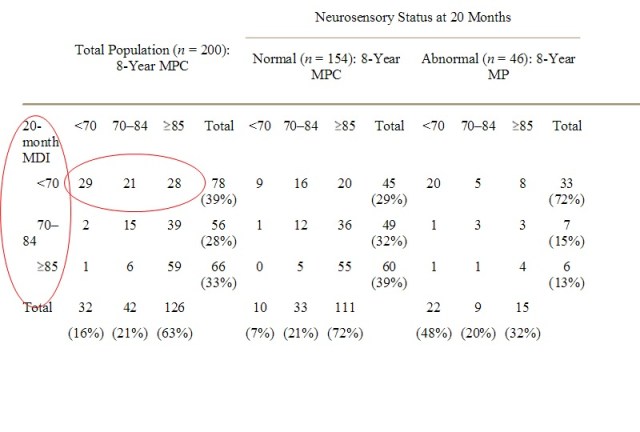
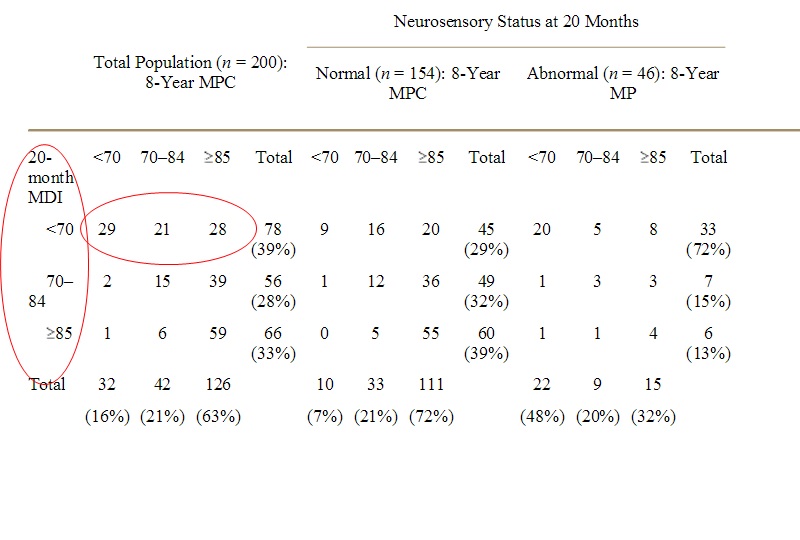
Bayley MPCWhat Maureen and her team did was to compare the scores on the mental development Index (MDI) of the Bayley Scales of Infant Development version 2 at 20 months of age in a cohort of 200 very low birth weight babies, to the scores on the Mental Processing Composite (the MPC in the table) of the Kaufman Assessment Battery for Children performed at about 8 years of age. The MPC is a test of cognitive function. The Bayley MDI is often referred to as a test of cognitive function also, and children with a low score are often referred to as “cognitively impaired” which is a terminology which drives me bonkers as it is very inaccurate. As this table shows better than anything. Children with a 20 month Bayley MDI more than 2SD below the mean, that is less than 70, only 1/3 of the time had low scores on the MPC. The results also show that infants with neurological impairments and a low Bayley score were more likely to have a low MPC at 8 years than those without.

Very very few children (3) who were above that threshold at 20 months had poor cognitive function at 8 years. Which I think shows the real, limited, value of performing a Bayley at this age, as a test to identify infants who may need intervention, and conversely, those who will probably do just fine.

You can see the difference in the proportion of infants of VLBW who are defined as having a problem from the total percentages of low scores: at 20 months of age using the Bayley 2 MDI, 39% had low scores. At 8 years of age it is only 16%. Which has huge implications if you think that “cognitive impairment” is important, which I think most of us do.

Maureen was also one of a small group of investigators who have followed very premature babies out to adolescence and adulthood, and have also included a control group. One of the many striking publications from her cohort, born in 1977 to 1979, was this one, (Hack M, et al. Outcomes in young adulthood for very-low-birth-weight infants. The New England journal of medicine. 2002;346(3):149-57.) The VLBW subjects, were functioning very well in general, most having finished high school (66% of boys and 81% of girls) somewhat fewer than the controls (75% and 90%) and another 9% of the VLBW boys and 5% of girls were trying to get high school equivalency certificates. Many were in higher education, although fewer than the controls.

One of the things that I found most striking in her data, was the social deprivation of the group that Maureen was studying, one part of the evidence of that was the rate of incarceration of both the VLBW and the controls. 26% of each group had been in jail or youth detention at some point (including overnight). In addition VLBW boys were less likely to have actually broken a law, VLBW girls were less likely to be sexually active, and both sexes were less likely to have taken illegal drugs.

One of Maureen’s older studies that I think is still very pertinent is from 1989, (Hack M, et al. Differential effects of intrauterine and postnatal brain growth failure in infants of very low birth weight. American journal of diseases of children. 1989;143(1):63-8). She showed that VLBW infants who had postnatal growth failure, especially in terms of head growth, had substantially worse outcomes, and this was not necessarily the case for VLBW infants who were growth restricted at birth. Which points out the importance of good postnatal nutrition, aimed at ensuring good head growth.

Maureen and her group enrolled and studied  another cohort, this time of extremely low birth weight infants (<1000g) born in 1992 to 1995.

Litt JS, et al. Academic achievement of adolescents born with extremely low birth weight. Acta Paediatr. 2012;101(12):1240-5. The average IQ in adolescence of the ELBW infants was 87, again the importance of a matched control group was demonstrated by this study, the controls had a mean IQ of 96. There were many more mathematics learning disabilities in the VLBW infants, and more executive function difficulties. Many more required special assistance at school. Hack M, et al. Self-Reported Adolescent Health Status of Extremely Low Birth Weight Children Born 1992-1995. Pediatrics. 2012. The overall self-reported health status of the ELBW adolescents was very similar to the controls. There was less risk-taking behaviour, and less physical activity, but overall they were doing well.

Finally (and I could do this for a while, but I am just picking out a few of what I think are highlights, there are many others that someone else might choose instead): Wilson-Costello D, et al. Improved Neurodevelopmental Outcomes for Extremely Low Birth Weight Infants in 2000-2002. Pediatrics. 2007;119(1):37-45. This study compared the 20 month outcomes of ELBW infants during 3 different time intervals, the 80’s, the 90’s, and 2000-2002. The survival improves progressively reaching 71% in the 3rd period. Neurodevelopmental outcomes improved also, the “neurodevelopmental impairment” was lowest in the latest cohort.

I have decided that from now I on refuse to use that term. I will call it neurological impairment and developmental delay, NIDD.

In this publication, the rate of NIDD fell from 35% to 23%, developmental delay did not change much, the MDI scores were similar, but there was less cerebral palsy and less deafness and blindness. The study didn’t use the GMFCS system, but states that they only included moderate and severe CP. I think using the term impairment for CP, deafness and blindness is appropriate, (although including hypertonia and hypotonia might inflate the numbers a bit) they tend to persist, although the diagnosis of CP might occasionally change, and they satisfy WHO definitions of “impairment”. Low Bayley scores are not an impairment, overall 2/3 of the infants will not be impaired on later cognitive testing, as Maureen showed.

The largest component of the NIDD is low Bayley scores, 21 of the 36 infants with NIDD in this study met the definition because of a low MDI. We can therefore estimate how many will still be considered impaired at 8 years of age. As I noted above, infants with a low Bayley score who did not have a neurological impairment were more likely to have higher scores on the 8 year MPC. Only 9 of the 45 infants  with a Bayley2 MDI less than 70 but who did not have a neurological abnormality had an MPC of under 70 in the 2005 article from Pediatrics at the top of this post, and could be considered to have a cognitive impairment.   If that still holds true (and there is other evidence that it does) then the total frequency of neurological or cognitive impairment of this group at 8 years will be about 12%.

How can we further reduce this proportion? Maureen also studied the impacts of sepsis, of necrotizing enterocolitis, of postnatal steroids, and of bronchopulmonary dysplasia, and confirmed their negative impacts on outcomes. Reducing the incidence of those complications, and improving postnatal nutrition and growth will reduce their negative effects on NIDD, and eventually on NCI.

Thank you Maureen, farewell.


Posted in Neonatal Research | Leave a comment

Death In Simulation

Our group at Sainte Justine has just published an article, now available on-line in Pediatrics. (Lizotte M-H, Latraverse V, Moussa A, Lachance C, Barrington K, Janvier A. Trainee Perspectives on Manikin Death During Mock Codes. Pediatrics. 2015) We had originally called the article “Should the manikin die during mock codes?” but the editors didn’t like the question in the title.

The basic idea was to try and deal with one of the unrealistic characteristics of mock codes, which is that usually, during a simulated resuscitation scenario, if you follow guidelines and act correctly, the patient gets better. So if you follow NRP standards, the heart rate will come back, the patient will improve and you send them on to the NICU.

In real life, not always.

We are teaching trainees to have unrealistic expectations of the responses to their interventions. This has been addressed theoretically before, but I don’t think anyone has doe what the team here did, which is to evaluate how caregivers respond when the manikin dies, even after they have done everything correctly, and what they thought of the experience. A simulated baby was born pulseless, and residents were randomized to either have a baby that responded to NRP interventions, or one that did not, and remained pulseless. They were then exposed to the other scenario.

Firstly, we found it was difficult for people to stop, NRP teaches that after 10 minutes of asystole, once you have performed the appropriate steps, you should stop resuscitation, as survival is extremely uncommon. Many of our participants were still trying to resuscitate after 20 minutes (at which time the scenario was shut down).

Our participants were surprised that the manikin died, after they had done things well. They thought they must have made a mistake or missed something. They also appreciated the experience and thought they had learned something valuable, and did not want to have a “death disclosure” warning them before the simulation that the manikin might die. Even though they found the death of the manikin to be more stressful on a subjective stress scale.

I think occasional death of a manikin during resuscitation scenarios should be the norm. Residents and other trainees could learn that good interventions don’t always lead to good outcomes, about how to deal with stopping an unsuccessful resuscitation, and most importantly, how to deal with the family. Although it would make the simulation much more difficult and expensive than just an “NRP drill”, having a simulated mother and/or father could be a very valuable learning experience.

Posted in Neonatal Research | Tagged , , | 2 Comments