Surfactant without intubation, where are we?

A recent trial from Germany tried to answer the question of whether giving surfactant through a thin catheter while the baby was on CPAP would reduce “death or BPD” compared to intubation for surfactant. Kribs A, et al. Nonintubated Surfactant Application vs Conventional Therapy in Extremely Preterm Infants: A Randomized Clinical Trial. JAMA Pediatr. 2015;169(8):723-30. Infants of less than 28 weeks gestation, who were spontaneously breathing and needing more than 30% oxygen at between 10 and 120 minutes of age were enrolled, both groups received the same dose of Curosurf.

The main result of the trial is that to answer important questions like this in the early 21st century, you need big trials. This one was underpowered to find all except very large effects, with just over 100 babies per group. So although the primary outcome was improved in the LISA (less-invasive surfactant application) group, 67% surviving without BPD compared to 59% in the controls, this may have been due to chance, (p=0.2). If this was a real effect of the treatment, it would certainly be clinically worthwhile. The trial was high quality, just too small.

This brings me to another general point, the sample size was calculated on the estimate of a control rate of survival without BPD of 47% and an improvement to 69% with LISA. Apparently this was based on “data from an earlier feasibility study” but the reference they give was not to an earlier feasibility study, so I tried to find it, and the previous studies of LISA that I can find do not produce the figures they present. In any case using small pilot studies as a way of estimating a treatment effect is inherently unreliable, the smaller a study, the wider the confidence intervals around any result; sample sizes should be based on a realistic and clinically important estimate of an effect. William Tarnow-Mordi’s article in a recent Seminars in Fetal and Neonatal Medicine is a good place to read about some of these issues. For a trial of LISA if the expected control group outcome is around 50%, and increase in survival without BPD to 60% would be worthwhile, especially if there are no adverse consequences. To have an 80% chance of detecting such an effect you need around 400 per group, to have a 90% chance of doing so you need around 500 per group.

To return to the new trial, the secondary outcomes looked better in the LISA group, with less severe intraventricular hemorrhage, fewer intubations and fewer pneumothoraces. The main secondary outcome was pre-specified as survival without “major morbidity” which was BPD, severe IVH, cystic PVL, surgically treated retinopathy, or surgical NEC or perforation. That outcome was increased in the LISA group.

I would say the answer to the question in the title, is “not there yet” so far there seems to be no downside, none of the studies have shown an increase in any adverse outcome, but there is no clear evidence of benefit for BPD.

I am still concerned about performing a laryngoscopy for the procedure without premedication; laryngoscopy is very unpleasant, and is responsible for most of the adverse physiologic response seen during intubation. Apparently premedication was not routine in either group in this trial, which I think is very inappropriate. Once a baby has vascular access, there is no good reason for not premedicating prior to endotracheal intubation;  finding an analgesia/sedation routine to use during LISA (or MIST if you prefer that acronym) is, I think, a priority.
Posted in Neonatal Research | Tagged , , , | 1 Comment

When to deliver after Preterm Ruptured Membranes

I have often wondered why my obstetrical colleagues would often induce labour once a woman with ruptured membranes reached 34 weeks. I wasn’t aware of any data to support doing this, or, on the other hand, any good data to say that you shouldn’t.

It turns out that I was well-informed, there just wasn’t any good data, until now. Morris JM, et al. Immediate delivery compared with expectant management after preterm pre-labour rupture of the membranes close to term (PPROMT trial): a randomised controlled trial. Lancet. 2015;387(10017):444-52. In this study over 1800 women with singleton pregnancies and ruptured membranes without labour, who were between 34 and 37 weeks gestation, were randomized to either immediate delivery (induction or cesarean) or expectant management, in which case the woman and her obstetrician waited for spontaneous labour or another indication to deliver. Women whose membranes ruptured before 34 weeks became eligible when they hit that mark.

This remarkable study took 10 years to recruit their subjects. It was run out of Sydney, and funded by the NHMRC of Australia and enrolled mothers from 11 different countries.

What did they find? Well, neonatal sepsis occurred in 23 (2%) of the babies in the immediate delivery group, 29 (3%) of the expectant group, a difference which could easily be due to chance. There were 3 neonatal deaths in each group. On the other hand, expectantly managed pregnancies ended up with a significantly higher gestational age and birthweight, not surprisingly, and as a result less NICU admission, less respiratory distress, less assisted ventilation,  and fewer days in hospital, all of which were highly statistically significant. For the mothers there were some downsides, there was a slight increase in  antepartum or intrapartum haemorrhage from 3% to 5% and they had one day more of hospital stay with expectant management, but they had many fewer cesarean deliveries. 19% in the expectant group compared to 26%.

This is very high quality evidence that we should not be doing what ACOG currently states, which is to deliver immediately because of the risk of neonatal sepsis. If things are going well, and there is no sign of infection, pre-labour preterm rupture of membranes can be followed closely, with delivery for other obstetric indications.

Posted in Neonatal Research | Tagged , , | 2 Comments

How frequent is Acute Kidney Injury in the NICU? Not as frequent as some publications would have you believe.

One recent publication states that 30% of all their babies under 30 weeks gestation had Acute Kidney Injury (AKI from now on). Another from a couple of years ago reports 40% of all their babies under 1500g had AKI.

Both of these publications based their definition of AKI on an increase in serum creatinine concentrations, an increase of over 0.3 mg/dl (that is about 26 micromol/L in modern units). Both of them included very preterm babies in the first couple of days of life. Both of them ignored the usual increase in creatinine that occurs during the first 2 to 3 days of the very immature infant.

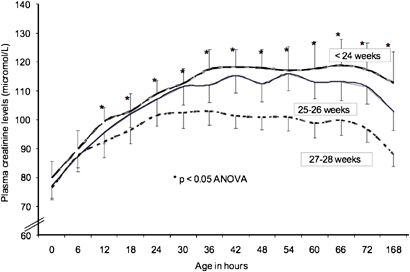
The increase in serum creatinine has been described for several years, (Miall LS, et al. Plasma creatinine rises dramatically in the first 48 hours of life in preterm infants. Pediatrics. 1999;104(6):e76.) the mechanisms have been investigated (they include creatinine re-absorption from the tubules) and the usual profile of creatinine clearly described. This is what normal creatinine values in very preterm babies look like, according to (Thayyil S, et al. A gestation- and postnatal age-based reference chart for assessing renal function in extremely premature infants. J Perinatol. 2008;28(3):226-9).
.

Creatinine 1st week

As you can see, on average plasma creatinine increases by about 40 micromol/L in the first 48 hours of life, which means, according to the definitions used in several recent articles, on average all very preterm babies have AKI!

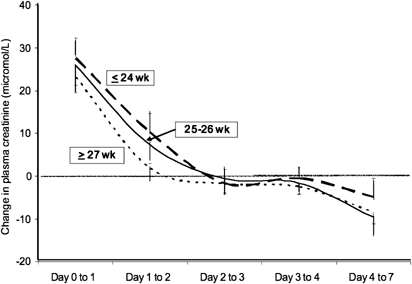
The day to day changes were plotted like this (in the same publication).

creatinine changes

So you can’t use a definition based on creatinine alone to diagnose AKI in very immature infants. According to one recent publication, 100% of babies at 22 and 23 weeks gestation had AKI, and 80% of 24 week infants. Most of those babies have good urine output, follow the usual postnatal weight loss trajectory, do not become hyperkalemic, in short they have no sign of renal dysfunction.

By day 2 to 3 tubular creatinine reabsorption is ending, and the creatinine starts to fall, after that you might be able to diagnose AKI from changes in the creatinine concentration alone, but it would be great to have some definition of AKI in the preterm that actually reflected renal injury and which was correlated with later renal problems, without that, it is hard to know what to do about a creatinine increase. Certainly creatinine increases in the first 2 days of life are almost universal under 28 weeks and do not mean Kidney Injury. Some years ago it was suggested that an increase in creatinine over 0.5 mg/dl, or 44 micromol/L could be used in the first 3 days, these graphs show that would be a more appropriate threshold, at least from a statistical point of view, if such a threshold is a good discriminator between those babies with and without true AKI needs to be investigated.


Posted in Neonatal Research | 8 Comments

All results must be published, and all data available.

Support for the All trials campaign has been growing, but progress seems to be slow. There are still many trials that are not published, and the impacts on science based medicine are substantial.

Recently, two articles by former participants in trials have been published, a viewpoint that is very important for these campaigns, I believe.

The first is called “The Outcome of My Clinical Trial Is a Mystery” it is by someone who was part of a trial to evaluate an intracardiac device to close an ASD, the author says :

It’s more than a little unsettling to think that I’ll live for another 70 years or so with this device in my heart, but may never know what the research said about how it works.

The second is called “A Broken Covenant with Patients” from a woman who was part of a preliminary evaluation of a drug for ovarian cancer, and who gives other examples of “broken covenants”.

As for sharing of data, the International Committee of Medical Journal Editors are proposing new rules, the meat of their proposal is here:

As a condition of consideration for publication of a clinical trial report in our member journals, the ICMJE proposes to require authors to share with others the deidentified individual-patient data (IPD) underlying the results presented in the article (including tables, figures, and appendices or supplementary material) no later than 6 months after publication. The data underlying the results are defined as the IPD required to reproduce the article’s findings, including necessary metadata.

I agree with this approach, and I plan to comply, there are details to be worked out, but one that I think is important is how will this be policed and enforced? Many rules of ICMJE are not well followed, including, for example, the requirement for registration of trials, and that publications should follow CONSORT guidelines. There is no point adding new rules if they are just going to be ignored, as happens already with data sharing, in those situation where it is already required.

As one example of this failure you could look at the COMPare website. Ben Goldacre has, with a few colleagues, started to review the randomized controlled trials published in 5 leading medical journals. His team compare the outcomes published in the articles describing the research results to those available in the trial registration documents, or in a published protocol, if published before the trial started. Of course the outcomes described should be those that were initially planned, and if for some reason that was not the case, then any difference should be explained in the trial report. Changing outcomes for a trial means that it cannot necessarily be trusted to answer the question that was initially asked. That is particularly true when the primary outcome is changed when the investigators look at the results. Clearly, if the initially planned primary outcome is not significantly different between groups, but the authors find something else which looks cool, and then claim that was the primary outcome, the risks of making type 1 errors are enormously increased.

Journals are not doing a very good job of comparing reported outcomes to the pre-specified outcomes, nor of insisting that CONSORT standards are followed, and any changes clearly described and justified. The COMPare group as of today have checked 67 trials, they have found only 9 of them reported all the outcomes that were planned. There were 301 outcomes that were planned to be reported by the trials that were not reported, and there were 357 outcomes that appeared for the first time in the published articles.

The editors of the Annals of Internal Medicine have answered in a very haughty and inconsistent way to the letters from COMPare that pointed out the problems in several publications. At one point pointing out their “long experience”, as if that somehow makes them less fallible.

I can only hope that the COMPare team are successful in making journals check publications more carefully for consistency with the CONSORT standards. There are already some signs that they are having an impact.


Posted in Neonatal Research | Leave a comment

Medium Term outcomes after neonatal hypoglycemia

A new publication from the CHYLD program that I blogged about previously:

Harris DL, et al. Outcome at 2 Years after Dextrose Gel Treatment for Neonatal Hypoglycemia: Follow-Up of a Randomized Trial. The Journal of pediatrics. 2015.

In this paper the authors describe the outcomes of infants who were in their Sugar Babies study, when they reached 2 years of age. The infants had Bayley scales of infant development version 3 performed, as well as tests of executive function and neurological exams.

To recap, the Sugar Babies study took infants at risk of hypoglycemia, and when the blood sugar was below 2.6 mmol/L (47 mg/dl) they were randomized to either get dextrose gel, or placebo. They could get treated more than once if necessary, and if the blood glucose fell to more severe levels the received standard therapy. 237 babies were in the original study, 78% of them returned for follow-up.

The babies of course, as mentioned, all had risk factors for hypoglycemia, so there were 40% whose mothers were diabetic, 1/3 were late preterms, 16% SGA, 8% LGA. The outcomes were not different between the two groups, but they were not very reassuring. 34% of the infants had a Bayley cognitive or language composite less than 85, (1 SD below the standardized mean value of 100, which we know is not the mean of the general New Zealand population) The mean language and cognitive composite scores of the subjects were between 94 and 96, Full term controls in a recent Australian study had means of 108 to 109.

So these babies, in both groups look like they did substantially worse on the Bayley test than you might expect. There were also a few babies with other problems, including 9 with seizures, and their executive function scores were abnormal also. Is this because the risk factors that they had select a group of babies who are higher risk? Is it because mild hypoglycemia, even if you treat with a rapidly effective intervention, such as the dextrose gel, has a direct adverse effect on the newborn brain? We know that infants who are small for gestational age, and late preterm infants are at risk for developmental delay, but there seems to be remarkably little data about the risks of infants of diabetic mothers.

It certainly looks like being a newborn infant in a group at risk for hypoglycemia, who then has a blood sugar under 2.6 is a risk factor for developmental delay and for executive function disturbances.

Posted in Neonatal Research | 1 Comment

Back to Blogging, and publishing!

A prolonged break, which occurred for various reasons, is at an end. I have a few posts lined up for the next few days, but will start with news about a new publication, an editorial I wrote with one of our fellows, Marie Janaillac (Barrington KJ, Janaillac M. Treating hypotension in extremely preterm infants. The pressure is mounting. Archives of Disease in Childhood – Fetal and Neonatal Edition. 2016). The editorial was written to accompany another article about the outcomes of very preterm infants with low blood pressures. That article appeared on-line in the Archives in November, (Batton B, et al. Early blood pressure, antihypotensive therapy and outcomes at 18–22 months’ corrected age in extremely preterm infants. Archives of Disease in Childhood – Fetal and Neonatal Edition. 2015).

We summarized the paper like this :

… the authors examined survival without neurological injury or developmental delay at 18–22 months in their cohort of infants less than 27 weeks gestation. They divided infants into 4 groups: those who received or did not receive antihypotensive therapy, and within each of those groups, those who had a slower than average rise in their blood pressure, and those with a faster increase. The primary outcome was not associated with a slower rise in blood pressure among untreated infants, but was strongly associated with hypotension treatment. Babies who received antihypotensive treatment, those with a good, and those with a poor response, were more likely to die, to have motor dysfunction, or to have developmental delay (in cognitive and language domains) than untreated infants. A potential mechanistic explanation is that the treated patients had a much higher incidence of brain injury on ultrasound (severe IVH or periventricular leukomalacia). These associations remained after adjusting for severity of illness measures.

You can never, of course, be sure that there is a causative relationship between the use of an intervention and an adverse outcome based on observational data alone. But the data are worrying, they follow on the heels of data from the German Neonatal Network (Faust K, et al. Short-term outcome of very-low-birthweight infants with arterial hypotension in the first 24 h of life. Archives of disease in childhood Fetal and neonatal edition. 2015;100(5):F388-92), that defined hypotension differently, but also showed that treatment of hypotension was associated with an increase in severe intraventricular hemorrhage and bronchopulmonary dysplasia. In the German study there was also an association with lower blood pressure and more complications also among infants who were not treated, but the associations with treatment were much stronger than the associations with lower BP. Odds Ratios for treatment effects were between 1.5 and 2.4, but for low blood pressure they were 0.94 to 0.97 (all significant at <0.01).

Where does this leave us? With the necessity to perform prospective trials. As we put it in the editorial

For hypotension treatment, there are many who will say that they do not have ‘equipoise’; those who are convinced that not treating, in the face of poor autoregulation, risks cerebral ischaemia, and others who are convinced that treating the numbers is irrational and risks drug toxicity. But we should all be able to agree that, if reasonable people hold differing opinions, there is real uncertainty. Even if we have strong hunches or preferences for one treatment approach over another, the lack of certainty should enable us, indeed force us, to perform the research we need to reduce that uncertainty and improve care for our babies.

We end the editorial with a plea to perform trials like HIP, and others that are needed to be able to provide an evidence base for future care.

Posted in Neonatal Research | 1 Comment

Proud to be a Canadian, again.

As a lifelong socialist, I couldn’t bring myself to vote Liberal in our last election. I would have been severely tempted, but I was fortunate to live in the constituency of Tom Mulcair, my primary motivation was “anybody but Harper”. Justin Trudeau took the liberal party platform to the left, and if he follows through on everything in their election platform, well the many years of destruction of Canadian values by Harper and the Tories should be erased from history.

Trudeau is already fulfilling some of his promises, and in a way that gives me some hope for the future of Canada.

This is what he said to a group of Syrian refugees a couple of nights ago as they arrived in Canada:

This is a  wonderful night where we get to show, not just a plane load of new Canadians what Canada’s all about, we get to show the world how to open our hearts and welcome in people who are fleeing extraordinarily difficult situations. They step off the plane as refugees, but they walk out of this terminal as permanent residents of Canada. With social insurance numbers, with health cards and with the opportunity to become full Canadians. This is something we are able to do in this country because we define a Canadian not by his skin color or language or religion or background, but by a shared set of values, aspirations, hopes and dreams that, much like Canadians, people around the world share.

Trudeau

Posted in Neonatal Research | 1 Comment

The best outcome variable for very preterm newborns?

Death or ‘neurodevelopmental impairment’ (NDI) as a combined outcome has become a sort of de facto standard as the primary outcome for neonatal clinical trials. Because many very preterm infants have developmental delay, intellectual and learning difficulties, and some have neurological problems, it is considered valuable to know if an intervention affects those things. Increasing survival is a good thing to do, reducing long term problems is also a good goal. Obviously, if you die, you can’t have developmental delay, so these are “competing” outcomes, and there is a certain sense to combining them. The idea being that the primary outcome of a trial or of a cohort study, should be to examine “intact” survival.

In order for the follow up to be of a reasonable length and to keep follow-up rates high, the duration of the follow-up can’t be too long. Which is why we end up using tools like the Bayley scales of Infant Development. The BSID is useful as a screening tool for developmental delay (now (version 3) in 5 domains, 2 are evaluated from parent questionnaires, 3, motor, cognitive, and language, are evaluated from structured observations of the child). The BSID can be applied at different ages, and was normalized (version 3) on a US population that included (by design) 10% of subjects who had developmental difficulties. It is a useful tool for screening infants to see who needs further evaluation, perhaps referral, perhaps intervention and so on. At the ages that we usually do follow-up, that is, about 18 to 24 months for the reasons mentioned above, developmental delay, especially language delay, is very common in former very preterm infants.

But, the BSID is not a tool for defining which children are impaired. There is a large proportion, in fact a majority, of infants who are below the -2SD cut off on the BSID who do not have cognitive impairment in the long term (between 66 and 80% of them, depending on the cohort you examine for the version 2 of the BSID). There are a few who go the other way, they have scores above the threshold at 18 to 24 months, but have intellectual difficulties when seen at 5 years, but they are much less common.

Nevertheless many groups refer to having a low score as a ‘developmental impairment’. Which is a distortion of the meaning of the word impairment. (Delay may not be the best word either, it may be taken as implying that all children with low scores will catch-up, but it is nevertheless a more accurate term for the substantial majority, the majority who do indeed “catch up”).

This isn’t just a criticism of the BSID, it is the best studied of the developmental screening tests in our population, but I don’t know if other screening tests are any better, I would doubt it. The percentages quoted above are based on the BSID version 2 (which had a different structure to the BSID3 and didn’t differentiate between cognitive and language scores).

There hasn’t been nearly as much study of the BSID3 but one recent publication (not surprisingly it is from Melbourne) shows poor predictive ability of that test also. What they did was perform a Bayley 3 at 24 months on 100 very preterm infants (<30 weeks), and then a DAS2 at 4 years of age. The DAS2 being a test of cognitive abilities, which produces a number of subscales, and an overall score for GCA (General Conceptual Ability).

They found basically, that as a predictor of DAS test scores the BSID3 was not much good. Which is a polite way of saying that it was crap.

They showed, for example, that if your BSID3 score on the cognitive composite at 24 months was below 85, then only half of the infants had an age 4 year DAS2 score on the GCS of less than 85.  Even though there was a significant positive correlation between the scores, there was a huge scatter. This is another message that we have to get across, just because there is a statistically significant correlation between two scores (such as the DAS2 and the BSID3) does not mean that one usefully predicts the other.

For many of the other comparisons that they studied the proportion of those with low BSID3 scores who turned out to have long term impairments was even lower, as low as 12.5%. So, as a way of diagnosing impairment, the test is severely flawed.

Nevertheless, we use that test to make life and death decisions in the NICU. We tell parents, with a particular constellation of findings, “the chance of your baby surviving without neurodevelopmental impairment is X%” (or is very low, or is insignificant. However you want to say it). While what we mean is “a previous group of infants with similar findings, when studied at 2 years of age had either died or had scores on a developmental screening test of less than 70, scores which have very little predictive value for later cognitive impairment or in how the infants function”.

Recent guidelines have recommended that children with a high rate of not performing well on developmental screening tests should not receive active intensive care.

I hope others share my outrage at this. It is a perversion of the literature, and a perversion of good medical practice. When we counsel parents we should be talking about things which affect the lives of families. Not Bayley scales. Or other developmental screening tests.

What should we do to go forward:

  1. We should stop using the term NDI for the combination of neurologic impairment (which will often be permanent) and developmental delay (which often is truly a delay). I suggest NIDD instead, (neurologic impairment or developmental delay).
  2. We should stop lumping death and NIDD together for counselling. Completely. I understand the need to put competing outcomes together for research, even then it is artificial, and there are other approaches which have been developed. But having a baby die, or having a baby survive with disability or developmental delay, have such different meanings for many parents.
  3. We should rethink that term, NIDD and what we put into it.  A baby with spastic quadriplegia and a very limited ability to communicate because of severe intellectual disability is not the same as a child with a DQ of 68 who then goes to normal school, and ends up with an IQ of 80. Right now the definition puts them together, and makes everyone (especially obstetricians, it seems) think that a kid with “NDI” is going to have a horrible life.
  4. We should ask parents (of babies who died, and of babies who survived with and without disability) what they think are important outcomes. Some families are completely disrupted by children without NIDD but who have conduct disorder, or other emotional problems. Some are almost unaffected by a child with a hemiplegia. There will not be one answer about what is important, but unless we know the range of answers we can’t really talk to parents about what is important to them.
  5. We should focus on those babies whose health related quality of life is significantly affected. Determine whether we can discriminate between them and those with little impact, at any early age. Then we could see if we can really predict who will have severely affected QoL.
  6. We should push research focused on how parents and families adapt to children with impairments, how we can limit their disabilities and minimize the resultant handicap.
Posted in Clinical Practice Guidelines, Neonatal Research | Tagged , , , | 1 Comment

An Oldie but a Goodie

I discovered several months ago that one of my older presentations is very difficult to get on-line. It seems that at some point, when this article, Barrington K, Finer N. The natural history of the appearance of apnea of prematurity. Pediatr Res. 1991;29(4 Pt 1):372-5. was being digitised, it got mixed up with the article just before it in the journal. I wrote to the current owners of Pediatric Research (the Nature group of journals) and they told me there was nothing they could do. It was digitised before they bought the journal, and so basically they couldn’t be arsed to have someone cut the pdf in two and then index it correctly.

So if you follow the link from the Pubmed Page above it will take you to a web-page that says the article doesn’t exist. If you really try hard and pursue this amazing piece of medical science to its origins, you will eventually find that it is not listed in the table of contents of that issue of Pediatric Research, but that it is stuck onto the back half of an article by Hugo Lagercrantz. Which is never a bad place to be stuck, but still, it is a bit irritating, and deprives the world of a tiny bit of my brilliance (along with a even smaller bit of Neil Finer’s much greater brilliance).

So I have decided as a public service to make this freely available on my blog, and if the Nature journals don’t like it they can just fix the April 1991 table of contents for Pediatric Research and I will take it down.

Here for your delectation and delight is a link which I hope will let you download the article.

Barrington K Pediatr Res 1991

Posted in Neonatal Research | Tagged | Leave a comment

The last nail in the coffin of permissive hypercapnia?

Thome UH, et al. Permissive hypercapnia in extremely low birthweight infants (PHELBI): a randomised controlled multicentre trial. Lancet Respir Med. 2015;3(7):534-43.

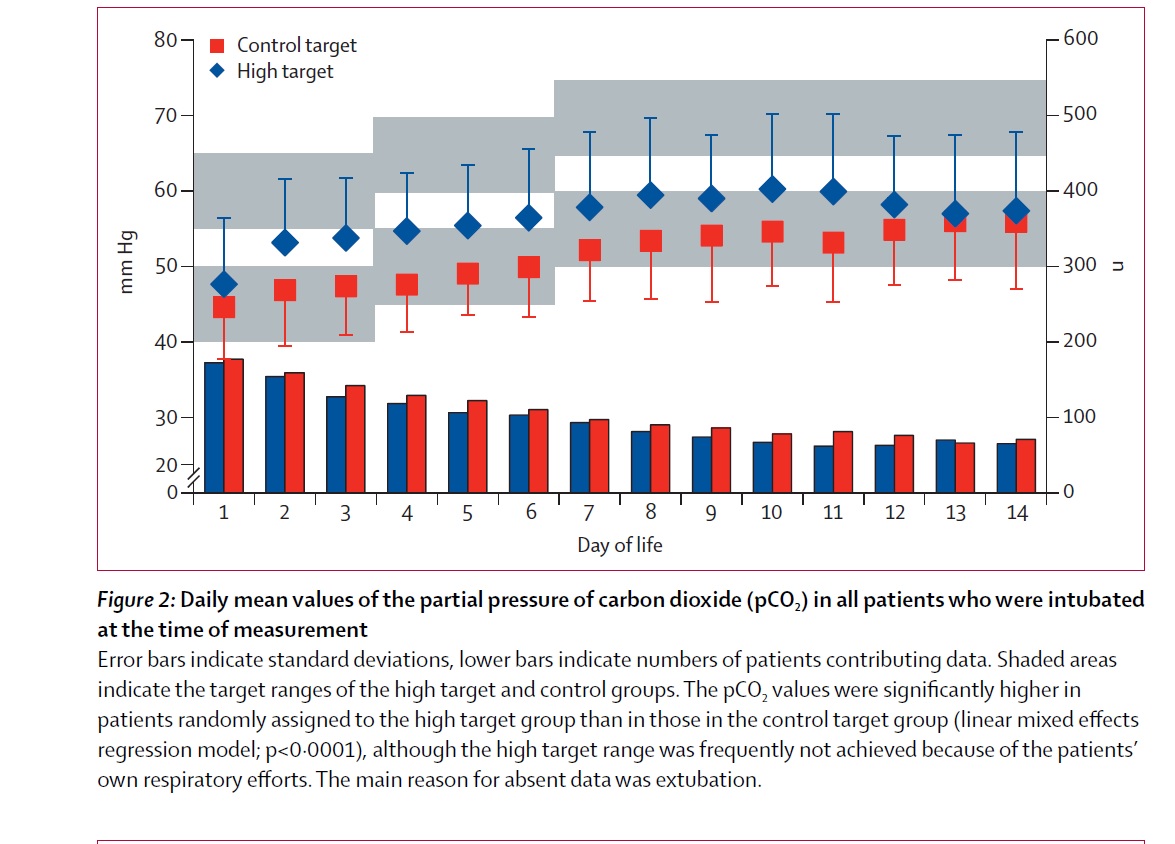
This German multi-center trial randomized infants 400 to 1000 g birth weight to 2 different CO2 target ranges. The target ranges changed over the first few days of life:

The high target group aimed at pCO2 values of 55–65 mm Hg on postnatal days 1–3, 60–70 mm Hg on days 4–6, and 65–75 mm Hg on days 7–14, and the control target at pCO2 40–50 mmHg on days 1–3, 45–55 mm Hg on days 4–6, and 50–60 mm Hg on days 7–14

The primary outcome variable was survival without BPD. Eligible infants were randomized within 12 hours of intubation and stayed in their group until 14 days of age.

This has been a difficult issue in neonatology, many have been reluctant to allow CO2 to rise in the first few days of life because of observations that infants with intraventricular hemorrhages had higher CO2’s. Prospective studies of allowing CO2 to rise however have not shown an increase in hemorrhage, so accidental or unintentional hypercarbia is a very different kettle of fish, denoting more severe events and so on. The idea of not increasing ventilation to normalize a CO2 is certainly an approach that I have taken for years, while acknowledging that there was no good evidence to say what the CO2 targets should be.

Two other related issues:

One, there is some evidence that respiratory acidosis may be protective in critical illness, so benefits of permissive hypercapnia might extend beyond less lung injury. Also attempting to buffer acidosis may well worsen lung injury. (Higgins BD, et al. Differential effects of buffered hypercapnia versus hypercapnic acidosis on shock and lung injury induced by systemic sepsis. Anesthesiology. 2009;111(6):1317-26Laffey JG, et al. Buffering hypercapnic acidosis worsens acute lung injury. Am J Respir Crit Care Med. 2000;161:141-6)

Secondly, There are many ways to ventilate an infant. Just allowing a higher CO2 does not necessarily mean lung-protective ventilation. You can have a high CO2 with one very large tidal volume every 10 seconds, or with high frequency lower tidal volumes.

This study tried to address the second issue by favouring high ventilation rates (60 to 80 or greater initially) with inspiratory times between 0.25 and 0.35 s, and PEEP between 3 and 6. Initial peak inspiratory pressure was chosen to give ‘minimal to moderate’ chest rise. Once the peak inspiratory pressure was below 14 then ventilator rates could be decreased, and once below 30 inflations per minute the baby could be extubated.

There was an enormous use of bicarbonate. Which I find really strange, as I have not given bicarb to a preterm baby for over 20 years! Half of the babies in each group received at least one bicarbonate bolus. It was ‘allowed’ only if the base deficit was more than 8 mmol/L. They say that use of bicarbonate was “discouraged” which seems a weird choice of terminology when so many actually received it.

There was much less separation between the groups than the protocol would have suggested, (similar to an older trial by Carlo), they did mange to achieve more separation that that older trial.

The sample size was calculated based on a 20% relative reduction in the primary outcome variable (from 50% to 40%) with a power of 80% and a significance level of 5%, using a two-sided group sequential test with two interim analyses, required a maximum sample size of 830 patients.

And here is the big failure of this important study, it was stopped after “only” 312 infants had been enrolled. Because of slow enrollment the funding agency wanted an interim analysis,

The sequential design’s boundaries had not been exceeded at that time (ie, there were no detectable significant differences). The study design was changed from a three-stage group sequential design into a two-stage adaptive group sequential design with one interim analysis. The amendment was approved by the DSMB and the lead investigator’s responsible institutional review board. The interim analysis was based on 312 completed infants and carried out by an independent statistician. The results were presented to the DSMB, which recommended terminating enrolment. The funding agency’s review board concurred with this recommendation and it was implemented by the study coordinator.

The study showed no significant difference in the primary outcome between the groups, 36% in the high CO2 group, and 30% in the lower target group, Relative Risk is 1·21 (95% CI of 0·90–1·63). The 20% reduction in the adverse outcome that was hypothesized by the investigators seems unlikely given those results, but the early termination does lead to a great loss of an opportunity.

You can see here the grey areas, which represent the target CO2, and the coloured diamonds/squares the actual median CO2’s achieved.

Hypercapnia 2015

What to make of this now?

Well, there are a number of reasons why this study may have shown no difference in outcomes between the groups; perhaps permissive hypercapnia as practiced like this is not protective of the lungs.

The authors screened over 1500 babies for inclusion, and over 400 were not enrolled because they weren’t intubated.

As you notice from that graph above, there was very little difference in the CO2 on the first day of life, which may be the most important period of life for initiating lung injury.

Perhaps the extensive use of bicarbonate infusions was an issue, if bicarbonate is as harmful to the lung as suggested by those experimental studies above, it may be that the use of bicarb in both groups eliminated any difference between groups.

Whatever the reasons, this study showed no clear adverse effect of permissive hypercapnia.  So we have no better idea after this study what the optimal CO2 targets are for very preterm infants. The 2 ranges studied in this trial both seem to be within acceptable limits.

Perhaps we need to think about this differently, babies who are doing well, have a good response to surfactant and can be ventilated with ease may escape serious BPD even if the CO2 is kept within the lower of these 2 ranges. What we need to know I think, is when to increase ventilator settings to try and reduce CO2 and when we should let it go, allow the CO2 to rise rather than keep pushing ventilator pressures (or volumes, or amplitudes). I think there has to be a point when further increases in ventilation cause more damage than benefit. But where that is, and how to investigate it are rather difficult questions.

We will have to find other ways of protecting the lungs of our patients, and not just allowing the CO2 to rise. Minimizing lung injury in the first couple of hours of life, avoiding invasive ventilation, using volume ventilation, and getting babies successfully extubated are a few of the things that we need to investigate further.


Posted in Neonatal Research | Tagged , | 1 Comment