
White DB, et al. Prevalence of and Factors Related to Discordance About Prognosis Between Physicians and Surrogate Decision Makers of Critically Ill Patients. JAMA. 2016;315(19):2086. This is a really cool study among families who had a family member in the adult ICU. The investigators asked surrogate decision makers (family members of incompetent adult ICU patients) and the ICU docs what they thought the prognosis was. more than half the time there was a major discrepancy between the doc and the families (almost always the families were more optimistic than the doctors). Why? The main reasons they discovered were that families felt that if they remained positive, and hopeful, that would improve the chances of their loved one. The second most common was the belief that their family member was “a fighter” was “stronger than most people” and so on, that they had unique strengths that the doctor wasn’t aware of. Finally there were religious motivations, as demonstrated by comments like this “I really believe whether someone can live or not is up to God. If God wants someone to heal, even though the doctor thinks it’s impossible, I think someone can recover.” The surrogates were fairly good at predicting outcomes, but the doctors were in fact much more accurate in their predictions than the families.
I am sure this sort of discrepancy must really have an impact on decision-making, and it needs to be understood much better. If families have a different view of the likely outcomes of their loved ones, even after they have been given the best-guess of the doctor, which is usually closer to the true outcomes than the guesses of the family, then conflict, or at least disagreement, will sometimes follow.
One of the pillars of shared decision making is to investigate the families’ (or patient’s) views and values. But so rarely done. Did the doctors of those families ask them “do you think he’s going to pull through? and why do you think so”
One of the really important investigators in this field is Peter Ubel. He was recently giving a talk in which he said the following:
“I think many physicians today think of informed consent or shared decision-making or respecting patient autonomy as meaning an [obligation to] impart a tremendous amount of information to patients so they can be fully empowered to make a choice.” But Ubel says that strategy doesn’t always work.
In one survey, urologists said they only dispensed advice after gauging which way the patient was leaning. The urologists usually asked whether the patient had normal sexual function, but only 12 percent asked whether sexual function was important to the patient. And, astoundingly, only 13 percent said this preference should factor into deciding the right treatment. Look beyond age and test results, said Ubel; consider what patients care about.
Those quotes are from an on-line summary of one of his recent talks.
What if we transpose this to the neonatal/perinatal decision-making arena. Do doctors actually ask parents what is important to them, before trying to get a decision about “resuscitation or not”? Which is the decision often seen as being the reason for the antenatal consultation, by the neonatologists at least. I think that an exploration of the wishes and values of the parents, which should often be explicit, but doesn’t necessarily need to be, is an essential part of this process, but has not been well addressed by our professional societies, who seem to be more concerned about ensuring that parents receive a “tremendous amount of information” which is in reality mostly a list of all the possible complications.
I recently counseled a couple who were likely to deliver extremely prematurely a baby with a serious congenital anomaly. As we discussed the situation, it became clear that they wanted to give the baby a chance, just in case the situation was better than we all feared, but they also wanted to be reassured that, if things went badly, we could limit the duration and intensity of the medical care that the baby received. I was able to reassure them on both counts, and also talk about our pain control approach, our concern for the distress and discomfort of the babies and their parents, the family support network in our NICU, the fact that if their baby made it, then the chances of them having a good life were very high, that they could participate in all the decisions and in much of the day-to-day care of their baby, and that their presence in the NICU next to their baby would help the baby in many ways. (I know most of my colleagues would have handled it the same way). I came out of the consultation knowing their baby’s name, knowing their wishes for the baby’s life, that they wanted their baby to survive, but not at all costs…
I think that their values were respected, and the final approach that we agreed upon was a shared decision which was totally reasonable for their baby, and for their family. I am certainly not a paragon of virtue in these situations, my approach has developed and changed over the years, and I have been able to learn a great deal from my colleagues, especially Annie Janvier.
Only about 5% of our discussion was covered by the position statements of the professional bodies, most of the things that I outline in the paragraph above are absent from those statements, but from research done, and being done in our center, such things are just as important to parents. I never mentioned the risk of retinopathy, for example, even though the baby will likely be immature enough to be at risk, it just wasn’t where we were at, at the time. Most of the vitally important discussion we had was not covered by those statements at all.
In contrast this publication is, I think, almost entirely, a description of a very good approach:
Lemyre B, et al. Shared decision making for infants born at the threshold of viability: a prognosis-based guideline. J Perinatol. 2016. The authors started with an extensive systematic literature review, went through multiple AGREE II based steps to develop some recommendations. They base their recommendations on the expected prognosis, rather than on complete weeks of gestational age, they avoid lumping together death with impairment or delay, and they give some guidelines that are appropriate for how to perform the consultation; some of which almost sound like they are based on the POST article that we published (Janvier A, et al. Ethics and etiquette in neonatal intensive care. JAMA Pediatr. 2014;168(9):857-8.). Here are some other recommendations about the process,
Share ‘balanced’ information including both positive and negative aspects, pros and cons, treatable and not treatable conditions and so on
Use different strategies to disclose the outcomes according to parents’ preferences:
Use grade such as majority, most, significant or some, a minority and so on.
Use numbers (for example, 6 out of 10 as opposed to 60%)
Use a consistent denominator to present the various options, or outcomes or event rates to make the information easier to understand, compare and be less open to misinterpretation (for example, XX out of 10, 100, 1000, depending on what we’re talking about)
….
Disclose uncertainty (that is, the limits of the meaning of the statistics for a particular baby)….
Offer time to think
Avoid interrupting the parents; keep silent when they are describing their perspective or preferences.
Let the parents lead the conversation by:
Asking them how you can help them
Inviting them to talk about how they see the situation
Asking open-ended questions with how, could you tell me more, can you describe…
Asking as often as possible if the parents have questions or need clarifications
Answering their questions
With the proviso that sometimes parents won’t want to lead the conversation. As you can see this is very parent-oriented, encouraging a transparent shared decision-making.
The big problem I have with this otherwise excellent paper is the table 3.
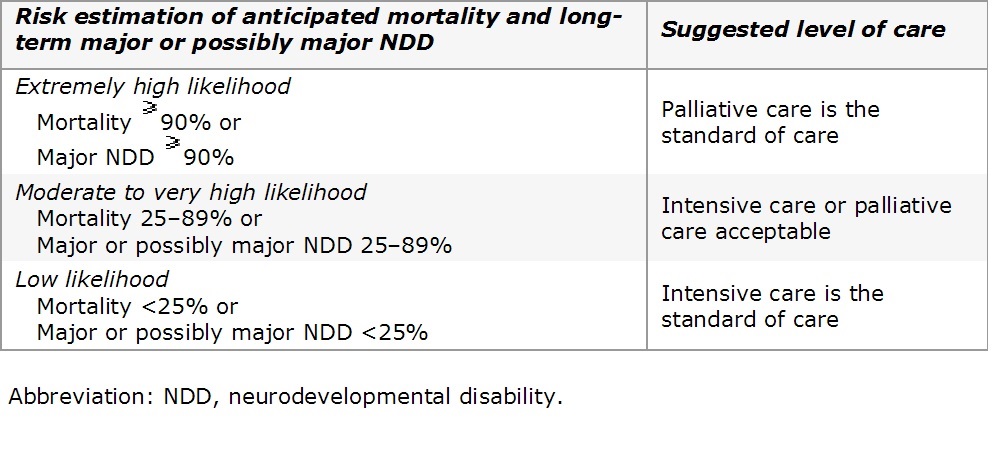
Surely preterm babies should be treated the same as babies born at full term, or older children with critical illness? But this table would suggest that, for any baby with a very high risk of major neurodevelopmental disability (NDD), that palliative care is the ‘standard of care’. The authors do not specifically describe the criteria for major NDD in this article, but refer instead to the Epicure cohort, who use this definition “A disability was defined as severe if it was considered likely to make the child highly dependent on caregivers and if it included nonambulant cerebral palsy, an IQ score more than 3 SD below the mean, profound sensorineural hearing loss, or blindness”.
This would imply that “palliative care” (which is a term which has become harder and harder to define over the last few years) is standard of care for children with trisomy 21, or blind babies, or deaf children, or with many other congenital disorders. I object to that. I think for some disorders with extremely high risk of major NDD, that comfort care may be an acceptable option, but to suggest it is “standard of care” is I think dangerous and unwarranted.
If we further examine that table, a 25% mortality risk is given as an acceptable risk for palliative care. I totally disagree. In what other area of medicine would a 25% risk of mortality be acceptable to let a patient die? “Hello Mrs A, your son has a 3 out of 4 chance of survival, so we think it is OK if we let him die.” I find that totally unacceptable. If the child was 4 years old, and parents brought him to the hospital with a severe pneumococcal pneumonia, and respiratory failure, and a PRISM score which predicts a 25% mortality (or even a 50% mortality), would anyone be prepared to let the child die?
I think this article would have been one of the better articles to appear in the perinatal high-risk counseling literature in the past few years, if it wasn’t for that damn table. The thresholds seem to come out of nowhere, to be neither evidence-based nor ethically acceptable. When all the rest of it is as evidence-based as you can get (for an area where evidence is less important than values), and ethically solid.
I do agree with the authors that we should be basing our counseling on predicted outcomes, and not on completed weeks of gestation; but the thresholds used for what are acceptable outcomes, and what are acceptable predicted proportions of babies with those outcomes should also be individualized. I am not sure that any general recommendation for thresholds of intervention, will work. Certainly not a threshold which states that a 25% risk of blindness is an acceptable criterion for forgoing intensive care. Which would mean that if the 2 parents each carried a recessive gene for a condition that causes blindness, then not resuscitating their child at birth would be within acceptable practice.
I am fairly sure (as I know these authors) that that was not their intention, but that is what the table actually says.
As I said there is much good stuff in the article, I strongly recommend it.



 Neonatal Research