
Many publications and some guidelines about the use of probiotics for NEC prevention in the preterm make the claim that the evidence is more reliable for the moderately preterm than for the extreme preterm.
Many of the RCTs have not reported outcomes divided by GA or birth weight categories, even though they included many such infants. The 2023 Cochrane review of probiotics for NEC prevention (Sharif S, et al. Probiotics to prevent necrotising enterocolitis in very preterm or very low birth weight infants. Cochrane Database Syst Rev. 2023;7(7):CD005496) included over 10,000 infants among all the trials, but was only able to analyze 1800 ELBW or extremely preterm infants (<28 weeks). Of those infants, over 600 were from the trial by Costeloe, this was a high quality trial in the UK of Bifidobacterium breve, which was unfortunately ineffective, in infants of any gestation or weight group.
Other RCTs which have been restricted to, or have reported subgroups of, extremely low birth weight infants are all quite small, except for the Australian Proprems trial, which used a preparation that included a B infantis, and had about 460 babies <28 wks. That study had a low incidence of NEC in the controls in the <28 wk GA subgroup, of 5.8%, which was reduced to 4.2% in the probiotic group, a relative risk of 0.73, but with wide confidence margins (0.33-1.6) in that subgroup. Overall the reduction in NEC in that trial was unlikely to be due to chance, RR 0.46 (0.23-0.93) and there was no significant interaction between treatment effect and birth weight.
Most of the trials, on the other hand have included very immature and extremely low birth weight infants, they have just not reported subgroup results, meaning that Systematic reviews have little power to determine efficacy specifically in that subgroup.
A recent Norwegian observational study, reports a national cohort of extremely preterm infants (<28 weeks or <1000g) covering the period, 2014-2021 (Hapnes NC, et al. Probiotics for extremely preterm infants: a Norwegian population-based study. Arch Dis Child Fetal Neonatal Ed. 2026). This period started when the Norwegians issued a recommendation to give probiotics to this group, but uptake was far from universal. It also covers a period when the commonly used preparation Infloran was available, then withdrawn from use, leading to a drop in utilisation for a year, then another preparation was used, Labinic droplets, and more recently, another preparation, Proprems which is the one used in Sweden that I discussed in my previous post, was starting to be used. All 3 preparations include a B infantis.
The outcomes of interest were mortality, late-onset sepsis, and surgical NEC; like some other databases, the concerns about the subjectivity of the diagnosis of medical NEC are such that they concentrate on surgical NEC, and all of the cases were reviewed to ensure they met diagnostic criteria. The vast majority of these babies received maternal or donor breast milk, fortified as a routine with bovine based fortifier, until 32 to 34 weeks PMA. Of note, the babies receiving probiotics had a lower birthweight average, by 100 g, and were less mature, with worse CRIB scores, meaning they had a higher baseline risk, so the adjusted analyses are important. The associations with all cause mortality and surgical NEC are shown below.
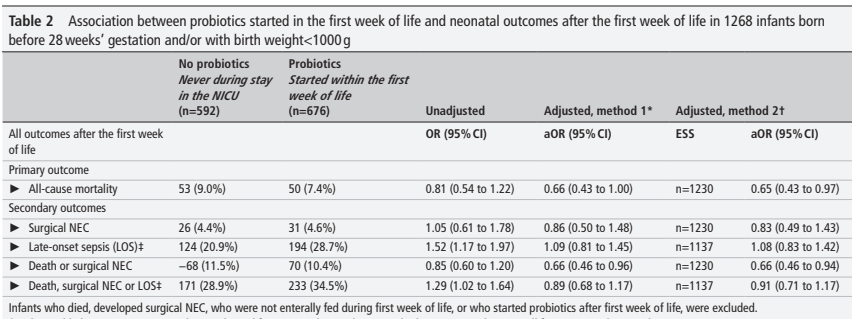
There is lower mortality, lower surgical NEC, less “death or surgical NEC”, and, importantly, very similar late-onset sepsis (LOS), even though they did have 5 cases of probiotic sepsis among the over 600 babies who received them.
Overall, from multiple systematic reviews, despite the risk of sepsis from the probiotic organisms, LOS is similar, or lower, with probiotic use than without. This recent SR, with a cute graphic Maulida R, et al. Probiotics for preventing neonatal sepsis in preterm neonates: a systematic review and meta-analysis for clinical practice. Epidemiol Health. 2025;47:e2025051, is open access, and concludes that multistrain probiotic mixtures reduce LOS.
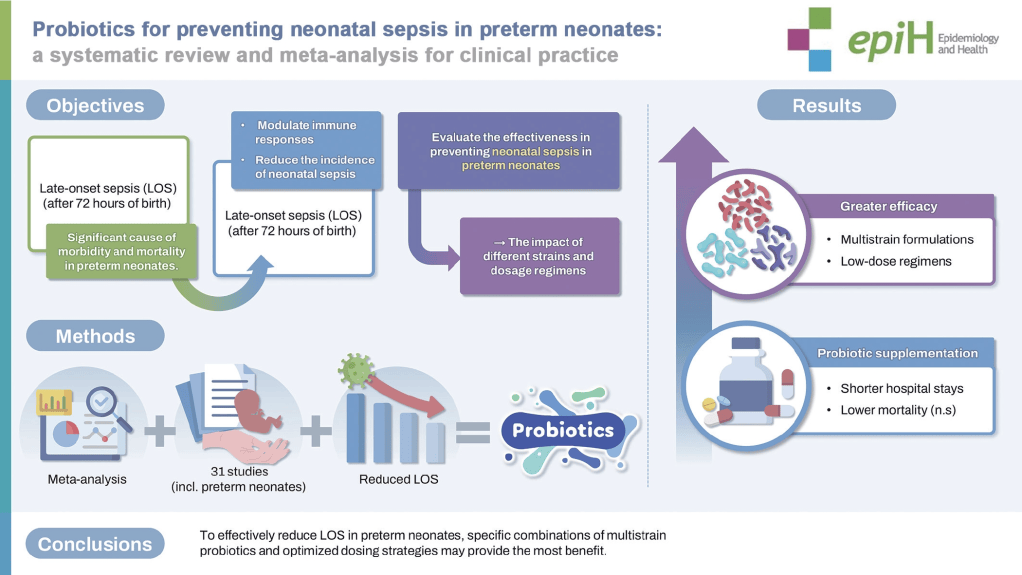
Like many SRs, the single strains are grouped by genus, even though there are major differences between the different species within a genus, but it seems to hold true that a mixture of strains are probably the most effective for reducing LOS, and mixture containing a B infantis seems to hold the best chance of both LOS and NEC reduction.
An overall review of the impacts of probiotics on sepsis, by Nick Embleton, Chris van den Akker and Belal Alsheikh (Embleton ND, et al. Probiotic supplementation – does it prevent or cause neonatal sepsis? Semin Fetal Neonatal Med. 2025;30(4):101668) comes to the clear conclusion that probiotic supplementation does not increase sepsis, it most likely reduces sepsis overall, despite the occasional case of probiotic sepsis, which makes the decision of the FDA seriously questionable.
Indeed that decision has had serious negative impacts on our babies, this analysis (Tolia VN, et al. Probiotics and necrotizing enterocolitis in preterm infants after the food and drug administration warning actions. J Perinatol. 2026) used data from the Pediatrix data warehouse. It analyses NEC incidence by NICU rather than by baby, and divided NICUs according to whether they were giving more or less than 80% of their 23 to 29 week preterm babies probiotics, before the FDA warning.
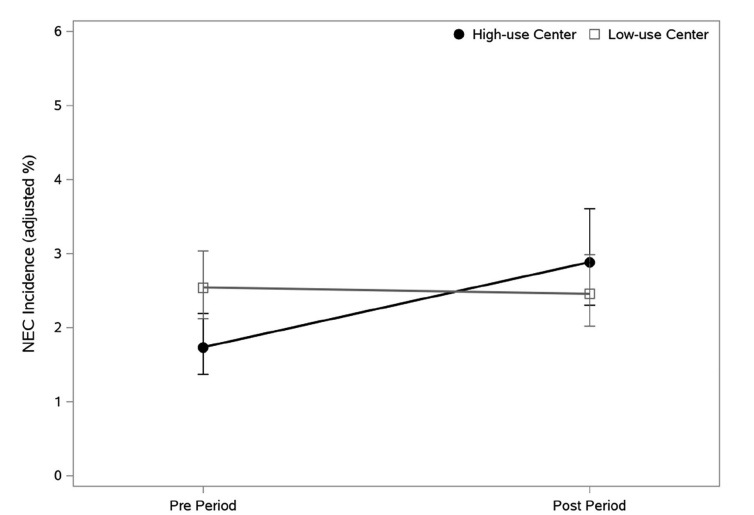
Probiotic use dropped from 86% to 7% in the high use centres, and from 13% to 0.1% in the low use centres. Both medical and surgical NEC increased when probiotics were stopped, LOS did not change.
There are several observational studies, therefore, restricted to extremely preterm infants (either <28 or <29 weeks GA) which show the same impacts of probiotic therapy on NEC as are seen among more mature preterm infants.
It seems to me that there is no good evidence to exclude the most immature babies from the benefits of routine probiotic supplementation. Putting everything together, a multistrain preparation containing a B infantis probably has the greatest benefit for preventing NEC, and likely has a modest impact on overall LOS also.


Thanks. interested in 1) your interpretation of the connection study and 2) your views on what the company/FDA should do/claim and 3) whether the ‘pharmaceutical’ grade means this product should be used in preference to existing products with proven safety and effectiveness in observational studies. How does the connection study help? Conflict of interest – I am just finishing a large narrative review on “which product and why” !
The connection study was a null result. The primary outcomes were NEC, which was similar between groups, and feeding tolerance, which was just about identical. The specified secondary outcomes were radiographic NEC and surgical/autopsy NEC (equivalent to stage 2 and stage 3) which were also similar between groups.
There were many secondary outcomes, of which the only one which was significant was mortality. Of course mortality is the most important, but with 2 primary outcomes and about 10 secondary outcomes, the chance of a type 1 error is high.
I think that they are clutching at straws, having spent a great deal of money developing the wrong probiotic, they want to be able to charge pharmacologic prices for their preparation!
I think the trial design was appropriate, but I don’t know how the L reuteri is supposed to have decreased mortality without decreasing NEC!
Keith, I agree that neither primary endpoint reached statistical significance and that the mortality finding requires caution because it was a secondary endpoint in a trial with multiple comparisons. However, describing the study as simply “null” seems too categorical.
The primary NEC endpoint combined radiograph-confirmed NEC with surgical/autopsy-confirmed NEC. Most events depended on radiographic assessment, yet agreement between radiologists was poor (κ=0.36).
The prespecified sensitivity analysis excluding events during the first 14 days showed NEC rates of 5.7% with IBP-9414 and 7.7% with placebo (RR 0.74; p=0.067). This was not statistically significant, but it was directionally supportive. Surgical/autopsy-confirmed NEC also favoured IBP-9414 overall (0.8% versus 1.4%) and in the post-hoc analysis after day 14 (0.3% versus 1.0%). All-cause mortality was 6.2% versus 8.5% (RR 0.73; p=0.036).
Would it not therefore be more accurate to describe the trial as negative on its primary endpoints, but with supportive-although non-confirmatory-signals in severe NEC and mortality? Also, what evidence from this trial supports the conclusion that IBT developed the “wrong probiotic”? That statement appears to go beyond the data.
A further reason not to dismiss IBP-9414 as the “wrong probiotic” is the overall pattern of product-level, safety and exploratory efficacy data.
The trial randomised 2,158 very-low-birth-weight infants at 95 sites in 10 countries. Of these, 2,117 received at least one dose of IBP-9414 or placebo. Median gestational age was 27 weeks and median birth weight was 850 g. Treatment began within 48 hours of birth and continued once daily until 34 weeks and 6 days postmenstrual age, using a fixed dose of 1×10⁹ CFU.
The post hoc analyses restricted to events occurring more than 14 days after the first dose consistently favoured IBP-9414:
*Surgical- or autopsy-confirmed NEC occurred in 3 infants receiving IBP-9414 and 10 receiving placebo (RR 0.29; nominal P=0.046).
*The composite of surgical- or autopsy-confirmed NEC or death caused by NEC occurred in 6 versus 17 infants (RR 0.35; nominal P=0.018).
*All-cause mortality was 2.2% versus 4.2% (RR 0.52; nominal P=0.007).
*Death attributed to NEC or intestinal perforation occurred in 5 versus 13 infants (RR 0.40; nominal P=0.0497).
*The analysis of deaths caused by NEC or sequelae of NEC found 7 versus 16 events (RR 0.42; nominal P=0.049).
These analyses overlap and must not be treated as five independent confirmations. They are exploratory and cannot replace the primary analyses. Nevertheless, the direction of effect was consistent across several closely related measures of severe intestinal disease and mortality. Combining NEC with intestinal perforation also had a clinical rationale: a death caused by NEC may be classified as intestinal perforation, while cause of death was established by autopsy in only 15.5% of the infants who died.
The safety dataset is also relevant. Serious adverse events occurred in 22.5% of the IBP-9414 group and 26.1% of the placebo group. Discontinuation because of an adverse event occurred in 4.2% and 4.9%, respectively. Fatal treatment-emergent adverse events were reported in 5.8% versus 8.0%, and no fatal event was judged by the investigator to be treatment-related. L. reuteri was not detected in blood cultures obtained because of suspected bacteraemia. Weight and head circumference increased at the same rate in both groups.
Pharmaceutical quality and manufacturing consistency are particularly is important for a live biotherapeutic administered to extremely premature infants. Identity, purity, viable potency, contaminant control, stability and lot-to-lot consistency determine whether patients reliably receive the intended product. The study provides substantial clinical exposure to a defined dose administered for several weeks, using multiple active-product batches across different geographical regions, without a detected L. reuteri bloodstream infection. This is clinically reassuring, but it does not establish formal comparability between batches or demonstrate that the complete commercial CMC package is adequate.
None of this proves efficacy or reverses the failure of the primary endpoints. It does, however, leave open a credible possibility that IBP-9414 has a clinically important effect on severe intestinal outcomes and mortality.