
Many of you will know that I have been convinced for some time that probiotics can reduce the frequency of NEC. Once the data became strong enough, and safety seemed to be assured, we were, I think, the first Canadian centre to routinely administer probiotics to our very preterm babies.
Until recently we were using a mixture, which included several bifidobacteria, and a lactobacillus, called “Florababy”, but there were some corporate changes, which led to the new owners deciding that they no longer wanted to help our babies. We sought a commercial mixture containing the best strains, and have settled on a new preparation, which, has a Bifidobacterium animalis, and a Lacticaseibacillus rhamnosus, it is not, I think, optimal, but was the best available to us.
There are clearly differences between the different preparations in impacts on NEC; most vital are the quality control to ensure that the bugs are viable, and more importantly that there are no pathogens in the mix. The identity of the strains is important, and probably the single most important strain in Bifidobacterium longum subspecies infantis (which I will call B infantis for simplicity). Some of the systematic reviews suggest strongly that a mixture of strains is preferable, rather than a single strain, but they did not include any RCT with a single strain B infantis. It is uncertain if you need a mixture if you have B infantis, or not. The reason this germ might be the most important is that it is the only strain that can digest all the HMOs.
For those who are new to this subject, HMOs (Human Milk Oligosaccharides) are the third most important component of breast milk, after lactose and fat. And humans cannot digest them, they exist only to feed the intestinal microbiome. Historically B infantis was the most prevalent probiotic organism in the infant intestinal microbiome, but that has changed in modern industrialised societies.
The fact that B infantis alone, of all the organisms tested, is the only one that can digest every HMO suggests that it has co-evolved with us to colonise the infant gut. B infantis, and other probiotic organisms, interact with Toll-like Receptors TLRs, of various types, to reduce inflammation and protect the GI tract. There may be other actions, such as the metabolism of breast milk amino acids to anti-inflammatory mediators.
In a SR dividing the probiotic RCTs into those that included B infantis and those that did not, (Batta VK, et al. Bifidobacterium infantis as a probiotic in preterm infants: a systematic review and meta-analysis. Pediatr Res. 2023;94(6):1887–905) the impact of a mixture containing B infantis was more marked (and was consistent, the I2 being 0) with a major reduction of NEC incidence (RR 0.38, 95% CI 0.27, 0.55).
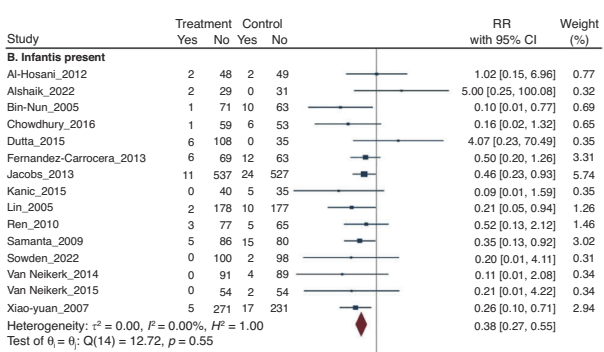
Probiotic preparations (single strains or mixtures) that did not contain B infantis were less effective, and although the calculated I2 was still zero, you can see looking at the results of all 48 (!) studies that some showed no impact, and others, especially some very small studies, had a large effect.

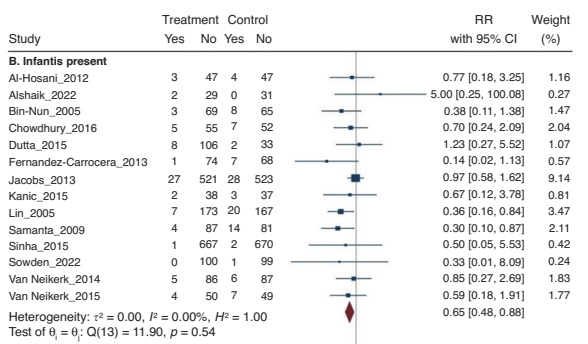
The next Forest plot shows the impact on mortality, which is substantial with preparations containing B infantis, RR 0.65…
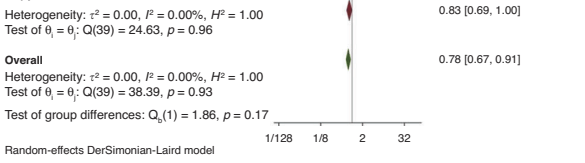
but less evident with other preparations. The top line of the next Forest plot showing the impact of probiotic preparations without B infantis, and the lower part is the overall impact of all probiotic preparations.
Probiotics are very safe, live organisms given to preterm infants with their limited immune development require surveillance, of course, and we have shown that the incidence of sepsis caused by these organisms is about 0.6% of treated infants. Sepsis was more common among the more immature infants, but was uniformly mild, and no infant died of sepsis. Other recent publications have calculated even lower risks.
The balance between this risk, and the benefits of NEC reduction is extremely important. The FDA in the USA published an advisory, warning against routine probiotic use, in which they made no mention of any analysis of the risk-benefit balance, and indeed no mention of the benefits at all.
Several new publications of the real-life benefits of probiotic supplementation have been published. One is a study from the Netherlands (Imren C, et al. Probiotic Implementation and Necrotizing Enterocolitis Risk in Preterm Infants. JAMA Netw Open. 9. 2026. p. e26316010 from 2 large centres, before and after probiotic routine use introduction.
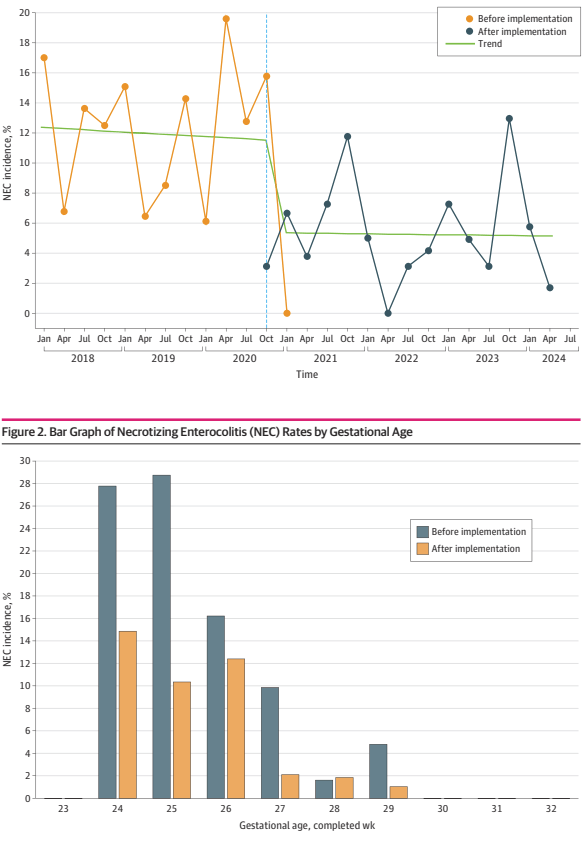
You can see the immediate, dramatic fall in NEC with the use of a daily dose of the probiotic, which was a mixture containing B infantis Bb-02, B lactis BB-12, and S thermophilus TH-04. As you can see, the reduction was most marked among the group at highest risk, the most immature babies.
Another publication, this time from a national database, in Sweden, where use is variable, but has been increasing. This study only addresses babies between 28 and <33 weeks, who were recommended, by the Swedish neonatal group to receive probiotics. The received the same preparation as in the Ducth study above.
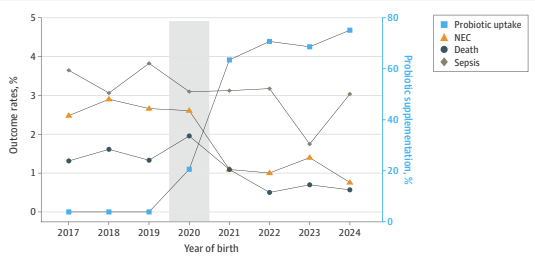
you can see the dramatic increase in uptake after 2019, to over 70% of this group in 2024. The figures for NEC death and sepsis in this graph are for the entire population, with and without probiotics. When comparing between those 2 groups of babies, who almost all received with maternal or donor breast milk, the results are below, with 3124 babies without probiotics, and over 1500 who received them.
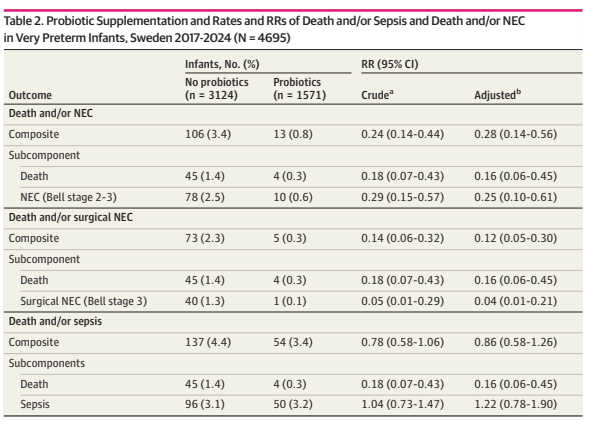
Mortality, NEC and surgical NEC were all strongly associated with probiotic use, and sepsis was unchanged. The combined, competing outcomes of death or NEC (medical or surgical) were also therefore dramatically lower. Death or sepsis was also reduced, because of the reduction in mortality, but this was less clearly significant.
More immature babies in Sweden are eligible for the ongoing PEPS trial, evaluating the same probiotic mixture.
The FDA directive came after a B infantis preparation had been developed and was being marketed in the USA. Some centres had started using it, and then stopped again. Which led to a sort of (un)natural experiment, and some of the most convincing observational data on the impacts of the probiotic (Selesner L, et al. Increase in Necrotizing Enterocolitis with Cessation of Bifidobacterium longum Subspecies. infantis Administration in Very Low Birthweight Infants: A Single-Center Retrospective Cohort Study. J Pediatr. 2025:114961). There were just over 400 babies with and without probiotics, and all received either maternal or donor breast milk.
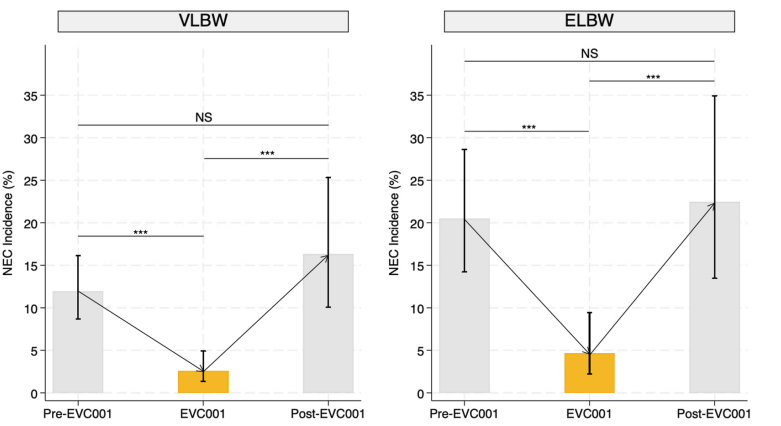
EVC001 is, of course, the name of the strain strain of the B infantis that was used. Although this is retrospective data, it is hard to think of any other reasonable explanation than a causative one. There was a similar decrease in stage 2 and in surgical NEC, and the data remained equally significant when corrected for known risk factors, such as SGA and antenatal steroids. All cause mortality was lower during the probiotic epoch, 4% vs 6.5%, but the confidence limits overlap.
These 3, admittedly observational, studies add the overwhelming evidence of the benefits of probiotic supplementation, and tend to confirm the probable importance of B infantis as a component of that therapy. Not just NEC, but mortality is reduced by probiotic supplementation. An occasional case, of usually mild and easily treatable bacteraemia is surely not a reason to stop probiotic supplementation. It is a reason to continue to investigate the most preferable strain, and combinations with other interventions.
The risk benefit balance is clearly in favour of the routine use of probiotic preparations in the very preterm infant.


Agree with this comment. Our study (natural experiment) from Norway among EPT/ELBW infants also support using probiotics (B. infantis ++) in this most vulnerable population
https://pubmed.ncbi.nlm.nih.gov/42055795/