
Reducing the incidence of prematurity is a goal that we have had little success with. The incidence differs greatly around the world, which leads me to think that there are probably underlying mechanisms that could be attacked to reduce the incidence in high-risk populations. If the rate is 14% in Malawi and 5% in Sweden, there should be something anything we can do in Malawi (as one example) to reduce this enormously high rate?
But, most of the variation around the world (and between Sweden and Malawi) seems to be linked to maternal health and socio-economic status, which are rather difficult to address. One thing I hadn’t realized was that there is prior evidence that vaccination against HPV might reduce some adverse pregnancy outcomes, in particular preterm labour and premature delivery, but intra-uterine growth restriction also.
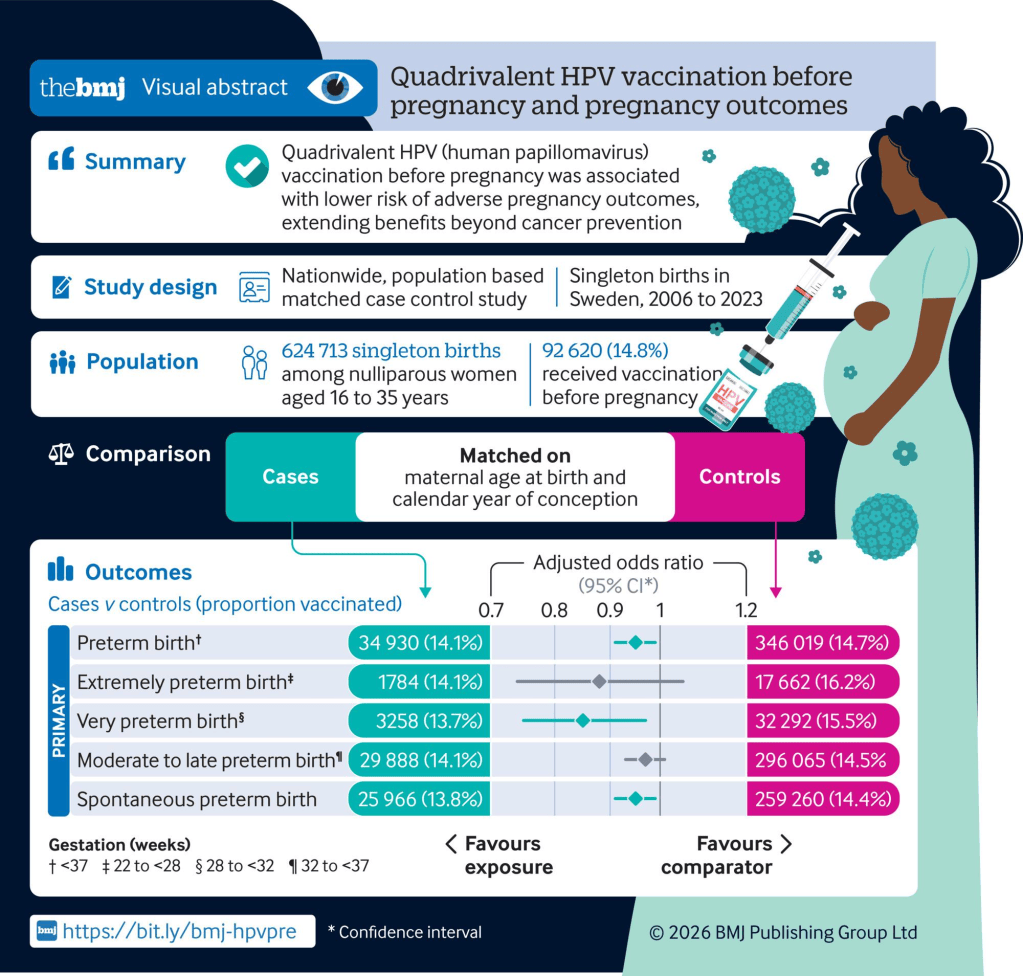
A new population-based case-control study from Sweden, (Zhang Z, et al. Quadrivalent human papillomavirus vaccination before pregnancy and pregnancy outcomes: nationwide, population based case-control study. BMJ. 2026;395:e100739) shows a measurable reduction is preterm birth among women vaccinated against HPV, compared to the non-vaccinated. Over the years of the study (2006-2023) there have been several changes in the program “From 2007 subsidised human papillomavirus vaccination was offered to girls aged 13-17 years, and in 2012 a free school based programme for girls aged 10-12 years was introduced alongside catch-up vaccination for girls born in 1993-98” Since 2020 boys and girls have been vaccinated. These progressive changes introduce a potential bias in the data, if there were some other reason for a progressive reduction in prematurity, it could appear to be due to the vaccine, but the authors have performed covariate adjustments for many variables, including year of birth.
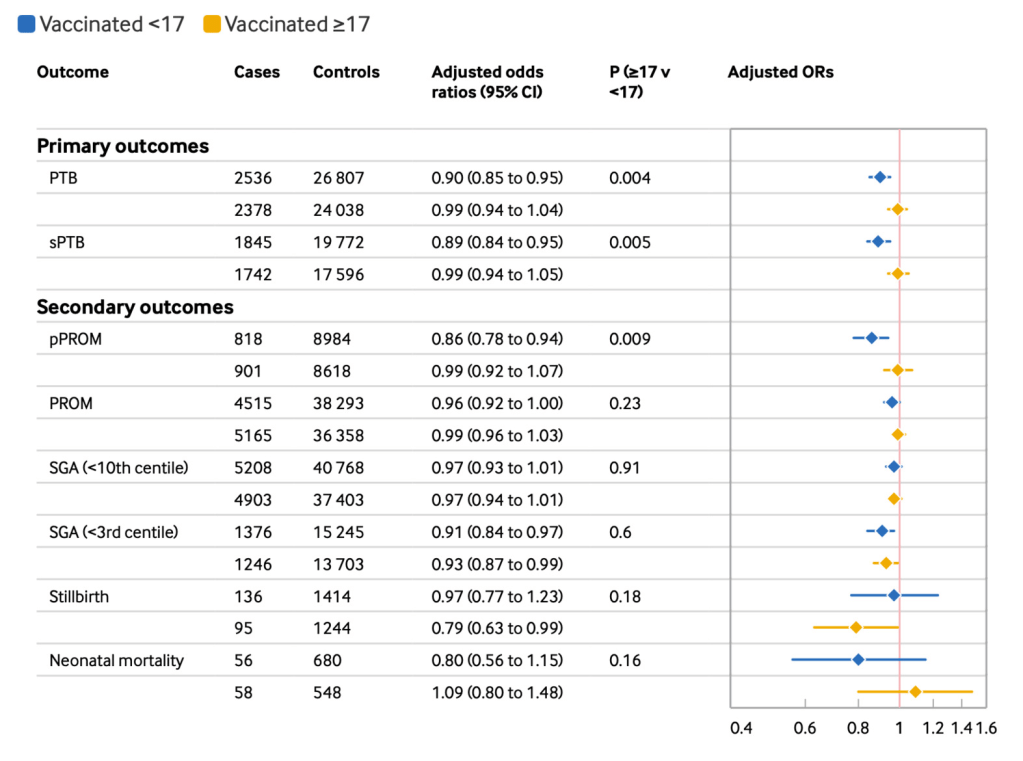
There is, after all adjustment, a measurably lower rate of prematurity among vaccinated women, and in addition a lower rate of IUGR and pPROM
Vaccination at an earlier age (<17 yrs) seems more effective than 17 years or older for reduction of preterm and very preterm delivery, and for pPROM.
There is already excellent evidence that routine vaccination dramatically decreases cervical cancer, to the extent that elimination of the disease is being discussed. With 90% vaccination, and changing the screening standards, an incidence below 4/100,000 is expected.
I can understand why not having HPV in the cervix could decrease preterm delivery and pPROM, but I don’t really understand why there would be an impact on IUGR. Whatever the mechanism, this adds another excellent reason for routine universal vaccination in the early teen years.


