Photos of preterms

A Québec photographer by the name of Red Méthot has posted a series of photographs of children and adults who were formerly preterm babies. Each holding a black and white photograph of themselves as a baby. Check it out.
Posted in Neonatal Research | Leave a comment

Treating seizures: bumetanide doesn’t seem to work

One of the many frustrating things in neonatology is the treatment of convulsions.

As Gerry Boylan and Ronit Pressler wrote in the introductory section of the excellent issue of Seminars in Fetal and Neonatal Medicine which was all about neonatal seizures,

“Neonatal seizures continue to pose a challenge for clinicians worldwide because they are difficult to diagnose and treat and are associated with poor outcomes.” We have been using this statement, or something very similar, to introduce the topic of neonatal seizures when we give lectures or write papers for the last fifteen years and in that period of time, unfortunately, very little has changed in the management and outcome of neonatal seizures.

It is hard to know if the treatments we give are much use. Does phenobarbitol actually work? A truly evidence-based answer to that question would be “who the hell knows?” It might be a bit less useless than some other drugs, but I don’t think there is good evidence that it works at all. Clinical seizures stop in around 50% of babies after phenobarb, but maybe they would have stopped anyway. EEG documented, electrical seizures often don’t stop after phenobarb, and babies can even have non-convulsive status epilepticus after phenobarb.

Bumetanide is a loop diuretic that is an effective anticonvulsant in neonatal rats. Unfortunately it doesn’t seem to work in human neonates. Pressler RM, et al. Bumetanide for the treatment of seizures in newborn babies with hypoxic ischaemic encephalopathy (NEMO): an open-label, dose finding, and feasibility phase 1/2 trial. The Lancet Neurology. 2015;14(5):469-77. Although they only entered a small number of infants (14) into the study, they were unable to show efficacy, and they had a higher than expected rate of hearing loss.

I think this is great.

Not the result, of course, it would have been really great to find an effective, safe anticonvulsant. But I think it is great that this study was done, that the group was put together and the infrastructure created to get this very high quality investigation performed. Lets hope that the group will stay active, and will be able to evaluate other agents that are creeping into use without good studies. Like levetiracetam, that I can never spell correctly, (so I hope that the site I just copied that from was correct) or topiramate, that I would vote for as I can remember how to spell it.


Posted in Neonatal Research | Tagged , | Leave a comment

NRP Works!

When the neonatal resuscitation program was first introduced I think many of us had mixed feelings. I was concerned that some of the initial recommendations were opinion-based rather than evidence-based  (and they weren’t all consistent with my opinions, which are the correct opinions). On the other hand to have a universal standard that could then progressively be improved upon was a good thing, and that has generally happened, NRP has become generally more and more evidence based, and has stimulated the production of more and more evidence. But does it actually work? Does training people in such a standardized, formal program help them to resuscitate better, and most importantly, does it then lead to more babies surviving, and fewer with serious complications.

A group of us, Gene Dempsey, Mohan Pammi, Tony Ryan and I, have just published a Cochrane review addressing that question. The primary question of interest was whether training programs lead to lower perinatal mortality, and lower neonatal morbidity. The secondary questions were to examine how the training is performed; whether boosters or videos or apps or teamwork training, for example, might improve skills and knowledge acquisition and retention, or performance or clinical outcomes.

We found the following: (SFNRT is the rather ponderous acronym I came up with to avoid saying NRP, it stands for standardized formal neonatal resuscitation training; we didn’t limit the searches to just the NRP program, but any similar training approach)

We identified three community-based cluster-randomised trials in developing countries comparing SFNRT with basic resuscitation training (Early Newborn Care). In this setting, there was moderate quality evidence that SFNRT decreased early neonatal mortality (typical RR 0.88, 95% CI 0.78 to 1.00; 3 studies, 66,162 neonates) and when analysed by the approximate analysis method (typical RR 0.85, 95% CI 0.75 to 0.96; RD -0.0044, 95% CI -0.0082 to -0.0006; NNTB 227, 95% CI 122 to 1667). Low quality evidence from one trial showed that SFNRT may decrease 28-day mortality (typical RR 0.55, 95% CI 0.33 to 0.91) but the effect on late neonatal mortality was more uncertain (typical RR 0.47, 95% CI 0.20 to 1.11). None of our a priori defined neonatal morbidities were reported. We did not identify any randomised studies in the developed world.

There were some problems with the analysis, because cluster randomized trials do not always report the ICC, the intra-cluster correlation coefficient, which you need to do all the analyses, the Cochrane collaboration has some ways around this, but it introduces a bit of extra uncertainty into the results.

We identified two trials that compared SFNRT with team training to SFNRT. Teamwork training of physician trainees with simulation may increase any teamwork behaviour (assessed by frequency) (MD 2.41, 95% CI 1.72 to 3.11) and decrease resuscitation duration (MD -149.54, 95% CI -214.73 to -84.34) but may lead to little or no difference in Neonatal Resuscitation Program (NRP) scores (MD 1.40, 95% CI -2.02 to 4.82; 98 participants, low quality evidence).

These two trials were from the same group, and used the same scale of team activity so we could meta-analyze them. The teamwork training improved team behaviour, but didn’t lead to improve scores on the NRP checklist (which didn’t specifically score team behaviours).

We identified two trials that compared SFNRT with booster courses to SFNRT. It is uncertain whether booster courses improve retention of resuscitation knowledge (84 participants, very low quality evidence) but may improve procedural and behavioural skills (40 participants, very low quality evidence).

We identified two trials on decision support tools, one on a cognitive aid that did not change resuscitation scores and the other on an electronic decision support tool that improved the frequency of correct decision making on positive pressure ventilation, cardiac compressions and frequency of fraction of inspired oxygen (FiO2) adjustments (97 participants, very low quality evidence).

The cognitive aid was a poster in the delivery room, it didn’t make a difference mostly because the participants ignored it. The electronic tool is a tablet “app” which when plugged in to the appropriate sensors tells you what to do next to follow the NRP algorithms.

The NNTB that we calculated in those results, means that for every 227 deliveries occurring in a setting where healthcare workers have been trained in SFNRT programs, there is one fewer neonatal death. Which is huge, and very cost effective. SNFRT is not very expensive, but it’s not free either. The equipment, staff time, staff transportation, outreach and so on all have to come from health care budgets which in many parts of the world are severely under pressure. If you only have 10 dollars per year per member of the population to spend (like in Uganda), then you have to choose wisely. Or you could cut down on military spending and corruption, but that is another issue. High fidelity simulations do not seem to have much greater effect than standard training with a Baby Anne manikin and enthusiastic teachers, so the extra expense can be avoided in low and middle income countries.

Spending on SFNRT programs is effective, reduces death, and does not increase disability. It should be a priority for low income countries.


Posted in Neonatal Research | Tagged , | 1 Comment

Many unethical pain studies in newborns

Carlo Bellieni and Celeste Johnston (Conflict of Interest flag, I have collaborated with both of them) have just reviewed a couple of recent years research of analgesic interventions in the newborn. Of 46 randomized studies of painful procedures, 70% had an untreated control group, either placebo or without analgesic intervention.

I have ranted about this before: Pain research in the newborn, what is ethical?, well actually having re-read that post it isn’t really a rant, but a lucid, well-considered and well-argued plea to stop randomizing babies to pain.

The new review shows that the article that I was referring to was not a ‘one-off’ but a persistent pattern. A persistent pattern of unethical research. The discussion section ends like this;

we encourage researchers to perform further studies on new pain treatments by comparing them with with those that have already been validated. we are urging parents and ethics review boards to refuse studies that do not provide acceptable analgesia to all babies enrolled in studies… In addition we are calling on medical journals to refuse to publish studies that deny pain relief to control infants undergoing painful procedures.

I think that editorial guidelines of paediatric journals should be revised to include a clear statement that untreated control groups in studies of painful interventions are not ethical and that articles describing studies with such groups will not be accepted.

I only have one disagreement with the article, and it is the statement that for eye examinations there is ‘no validated treatment that exists’. In fact there are interventions which can significantly reduce pain responses, it is true that they are not perfect, and babies still experience discomfort. But there is a systematic review of local anesthetic drops which shows effect (Dempsey E, McCreery K. Local anaesthetic eye drops for prevention of pain in preterm infants undergoing screening for retinopathy of prematurity. Cochrane database of systematic reviews (Online). 2011;9(9):CD007645).

And multi-modal interventions do have some benefit also (O’Sullivan A, et al. Sweeten, soother and swaddle for retinopathy of prematurity screening: a randomised placebo controlled trial. Archives of Disease in Childhood – Fetal and Neonatal Edition. 2010;95(6):F419-F22.)

The data on sucrose alone are somewhat variable, but as many of the studies are small it is not surprising that some do not show an effect,but many do (such as : Boyle EM, et al. Sucrose and non-nutritive sucking for the relief of pain in screening for retinopathy of prematurity: a randomised controlled trial. Arch Dis Child Fetal Neonatal Ed. 2006;91(3):F166-8).

I think an RCT of pain relief for eye examination that did not incorporate most of these items would also be unethical. A control group should have sucrose, a soother, swaddling, and local anesthetic. The efficacy of this combination is not complete, so a randomized addition of other interventions would be a valuable addition to the literature and to the comfort of our babies.

Posted in Neonatal Research | Tagged , , , | Leave a comment

An astounding betrayal

Some of us may have heard of the problems with the data concerning SSRIs (a commonly used class of antidepressants) and, in particular, young people. It appears that drug companies hid and distorted data from controlled trials, in order to make it appear that the data were positive, and hide the fact that there appeared to be an increase in suicides during the initial phase, at least, of treatment in younger patients.

One study in particular stands out, study 329. This study stands out because it was a very high profile study, of which many questions have been asked, but also because Glaxo Smith Kline eventually agreed to allow complete access to all of the original patient data.

That access has resulted in a new publication in the BMJ, which shows that, in contrast to the original publication, if the data are analyzed as the original protocol specified, and if all the adverse outcome data were appropriately collated, then there was no benefit from the use of the agent in question, paroxetine. Indeed the results show no benefit but an increase in serious adverse events, including suicide attempts.

The original publication reported that the outcomes were positive, but it seems they chose outcomes that appeared positive that were never specified in any of the protocol versions. There was also incomplete, very incomplete, summation of adverse outcomes, leading to erroneous claims of safety.

How could all of this happen? Well the data were all controlled by the company (a predecessor of GSK) who organized the analyses, and employed a ghost writer to draft the first version of the paper. The physicians who eventually were listed as the authors edited the introduction and discussion (making what were mostly “cosmetic” changes). There is a fascinating case study (in a journal I wasn’t aware of called “accountability in research”) of the way this article made it to submission and publication, which contains the following “gems”

 The first draft contained a significant distortion of outcome whereby the list of primary outcomes was expanded from two to eight, four of which separated paroxetine from placebo. This change gave plausibility to the claim that “paroxetine is effective.”

And

(‘Laden’ is the second name of the ghost writer)

Our analysis of the progression of drafts shows that there are few substantial differences between the final published article and the first draft prepared by Laden (Jureidini, 2007). Large portions of the introduction and discussion were re-written, but these changes add little to the substance of the article, and most other changes are little more than copy editing. Throughout the many drafts of this article, the conclusion persists that paroxetine is safe and effective for adolescent depression despite the fact that it failed on both primary and most secondary outcome measures.

That review of the initial publication process also noted that the serious adverse events were downplayed. The new re-analysis of all the original data shows that they weren’t even counted correctly; there were several instances of breaking the blinding of the medication, and coding of the SAE’s varied from one case to another, even when similar events occurred. The evaluation of whether the SAE was related to the medication was sometimes made after the blind had been broken. So, for example, one case of an SAE was ascribed to the study intervention after it was known that the patient was in the placebo arm.

Some of the reported SAE’s were never even transcribed into the study data sheets.

The authors of this re-analysis also note the difficulties with actually performing it, they were allowed a single remote desktop to access files, were not permitted to print anything, and had huge difficulties getting it done as a result. After many thousands of hours of work, I think we can all be grateful that this re-analysis, which could be considered a case study in how to re-analyze publicly available datasets, and also an object lesson in why such datasets should be fully available to the appropriate persons, and not just the extremely limiting access that these authors had, that this re-analysis was as scrupulously done as this.

If anything points out the desperate need for the Alltrials campaign to be successful, it is this publication. How many other articles have been distorted by the sponsors to make their drug seem effective and safe, when in fact they are neither?

In a commentary in the BMJ, accompanying the publication, Peter Doshi is scathing about the response of the journal where the article was originally published, the professional association responsible for the journal, and the university where the first author (that’s the person who is listed as first author, not the person who wrote the article!) works; where he is still head of psychiatry.

The article is still in the literature, still with the same conclusions of efficacy and safety. GSK, you might remember, were sued 3 billion dollars for promoting paroxetine beyond the approved indications, including promotion for adolescents, partly based on this article.

The original article is an astounding betrayal. The authors betrayed the individuals and families who consented, the public in general, including all the subsequent adolescents who have been treated with paroxetine, and the whole world. The big phamaceutical companies are hugely profitable, but they also make huge investments to bring new molecules to market, which subjects them to enormous pressures, to make results of clinical research seem as positive as possible, and minimize the negatives. When the ‘positives’ and ‘negatives’ are the health of patients, the implications are profound. Far more so than for a new children’s toy, or new scent for a perfume range; but the same corporate thinking motivates their actions.

We cannot escape corporate funding for trials of new therapeutic agents, we have to put in place mechanisms to ensure that those trials are well designed, adequately analyzed, and appropriately reported.

Posted in Not neonatology | 3 Comments

Burping babies

It is very satisfying sometimes, to sit a baby on your knee, lean them forward slightly and rub or pat their back until a loud pleasing burp is heard.

Parenting websites, and MDs, nurses, and midwives often promote burping as way to reduce regurgitation or avoid colic, We have web-pages dedicated to the different, sometimes contradictory, techniques. But does it work? There are some communities in the world where they just don’t do it, and their babies seem very happy (as an evidence-based person I have to confess that I am not sure if that is true, it’s hard to find data, but there is at least one essay written by someone who lived in Mongolia that never saw parents burping their babies, I’ve tried searching Google to find studies, but so far no luck.)

So we should do an RCT right?

Well, fortunately, I don’t have to because these people did. (Kaur R, et al. A randomized controlled trial of burping for the prevention of colic and regurgitation in healthy infants. Child: Care, Health and Development. 2015;41(1):52-6.) they compared regurgitation and colic in babies whose mothers received parenting advice either with or without burping information. The babies in the burping group had more regurgitation, and there was no difference in colic.

This looks like a good way to reduce reflux, no more toxic drugs, just stop burping the little blighters.

Unfortunately I am pretty sure this won’t make any difference. I am sure it will take more than a few facts to change years (centuries? millenia?) of practice. There are a few voices in the wilderness, Robin Barker, the author of the best selling Australian baby care book, apparently says not to bother with burping.

I agree.


Posted in Neonatal Research | 3 Comments

Do Blood transfusions trigger NEC? This month the answer is no.

OK, not exactly this month, but “towards the end of last year” wouldn’t have been as good a title.

Three case-control studies, with some differences in design and implementation, but all 3 with the same result, no evidence that red cell transfusion causes NEC. So you could say that in Stanford, Gainesville Florida, and Riyadh transfusions don’t trigger NEC but in some other places they do, and in still other places they may even be protective.

Sharma R, et al. Packed red blood cell transfusion is not associated with increased risk of necrotizing enterocolitis in premature infants. J Perinatol. 2014;34(11):858-62.

Wallenstein MB, et al. Red blood cell transfusion is not associated with necrotizing enterocolitis: a review of consecutive transfusions in a tertiary neonatal intensive care unit. The Journal of pediatrics. 2014;165(4):678-82.

AlFaleh K, et al. Association of packed red blood cell transfusion and necrotizing enterocolitis in very low birth weight infants. J Neonatal Perinatal Med. 2014;7(3):193-8.

I think the most appropriate answer is “unproven”, I also think its great that these 3 negative case-control studies were published. There is probably less publication bias in neonatology for RCTs, although publishing negative trials can sometimes be a challenge, and sometimes doesn’t occur. Publication bias of observational studies is, I think a major problem, so kudos to these authors and journals. Even “completion bias”, a new term I just invented, is a real problem. If I run through a local database, and find no apparent association with NEC in my NICU, am I going to take the time and effort required to complete an IRB approved research project? Probably not, but if my first glance at the data looks positive, well then I might get a good publication out of it, and I’m much more likely to try to complete it.

I think that especially the first reports of an association, such as the association between NEC and blood transfusions, have a high likelihood of being biased, just because of such a completion bias. What I mean is that if someone has seen 3 babies in a row get NEC after a blood transfusion, they then might think, I wonder if blood transfusions might trigger NEC, and then search their local data and find that there are more episodes of NEC after transfusion, there is a high likelihood that it might just be due to the fact that they are searching a database that includes the cases that they have just seen.

Replications of that investigation by others would not have the same detection bias, but might well have the “completion bias” that I just described.

Many of the observational study articles have suggested that we need large randomized trials to be sure about whether this is a real effect or not, while I agree, I don’t think a trial of blood transfusion in at-risk neonates should be done just to address this issue. A randomized trial of differing threshold of transfusion would have other outcomes to investigate also, but an important secondary outcome to be prespecified should be NEC.

In the PINT trial, we did give fewer transfusions to one group compared to the other, an average of 4.9 in the low transfusion group, and 5.7 in the high group. The low group actually had more NEC 8.5% vs 5.3% (not statistically significant).

I don’t know if any future trial is likely to get more separation in hemoglobins, or in transfusion frequency than PINT, but powering such a trial to see if there is a difference in NEC would mean that the trial would have to be very large, and very expensive. Making large trials simpler, and less expensive is a major priority for the future.

Posted in Neonatal Research | Tagged , | 1 Comment

Nasal ventilation after extubation, does synchronisation matter?

When we performed the trial of nasal ventilation post-extubation in San Diego we used the Infantstar ventilator, synchronised to the babies’ respiratory efforts with a Graseby capsule stuck on the abdomen. Two other trials also used the same system, and one trial used a non-synchronised system, but did also show benefit. I thank that synchronisation is probably an advantage, as delivering a positive pressure breath while the infant makes an effort, and therefore probably has the glottis open, is probably more efficacious than delivering positive pressure while the infant is trying to exhale.

In this new study from Ulm (Huang L, et al. Effects of Synchronization during Noninvasive Intermittent Mandatory Ventilation in Preterm Infants with Respiratory Distress Syndrome Immediately after Extubation. Neonatology. 2015;108(2):108-14.) a crossover design was used with 2 hour periods synchronised (using a Graseby capsule) and 2 hours non-synchronised, immediately after extubation of small preterm infants. The synchronised periods showed improved gas exchange, and reduced respiratory effort (as defined by deflections in oesophageal pressure), the results are similar to others using similar systems. I don’t think there is an RCT comparing the 2 methods effects on clinical outcomes, but it seems logical to use synchronised nasal ventilation in preference as that has been most studied post-extubation, and shown to be preferable to CPAP for re-intubation rates. This study confirms some physiologic advantages.

The big problem is how to do it. The infantstar is no longer available, and we don’t have access to the Sophie ventilator used in the new study from Ulm. Some studies have reported using flow triggering, but I can’t see how that would work over any significant period of time, as leaks are huge and variable. The only available option looks like being the NAVA system, but that requires a substantial financial investment, both in ventilators and in the nasogastric tubes with the oesophageal electrodes. A comparative trial using the NAVA, to determine if any clinical outcomes are improved with synchronization, would permit us to know if that investment is worthwhile.

Posted in Neonatal Research | Leave a comment

Lower oxygen resuscitation for preterms?

A new publication from a group of us in the CNN, suggests that the answer to that query is ‘not so fast’. Rabi Y, Lodha A, Soraisham A, Singhal N, Barrington K, Shah PS, et al. Outcomes of preterm infants following the introduction of room air resuscitation. Resuscitation. 2015.
Around 2006 most tertiary hospitals in Canada introduced room air resuscitation for babies at term. At about the same time many then changed their practice for preterm babies, either starting in 21% or at some intermediate concentration such as 40%. We used the CNN database for babies between 23 and 27 weeks gestation, to examine the likelihood of death or a severe brain injury (grade 3 or 4 IVH or PVL), during the 2 years up to their change in practice, which was not exactly the same in the different units. We then gave each centre a 1 year washout period, and looked at the same outcome over a later 2 year period with resuscitation initiated at lower O2 concentration.

We found that survival without brain injury was reduced after lowering the initial O2 concentrations, and that was true whether the practice was to start with 21% or with some other higher concentration. The adjusted OR was about 1.33, or a 1/3 increase in the Odds of the adverse outcome (that is after adjustment for all the relevant risk factors). There was about a 4% increase in the primary outcome variable, and about 3% increase in death and 3% increase in severe brain injury (of course, a baby could have both which is why 3 and 3 don’t add up to 4!)

Now of course, these are observational data, and observational data are always questionable, as a source of truth, or to direct changes in practice.

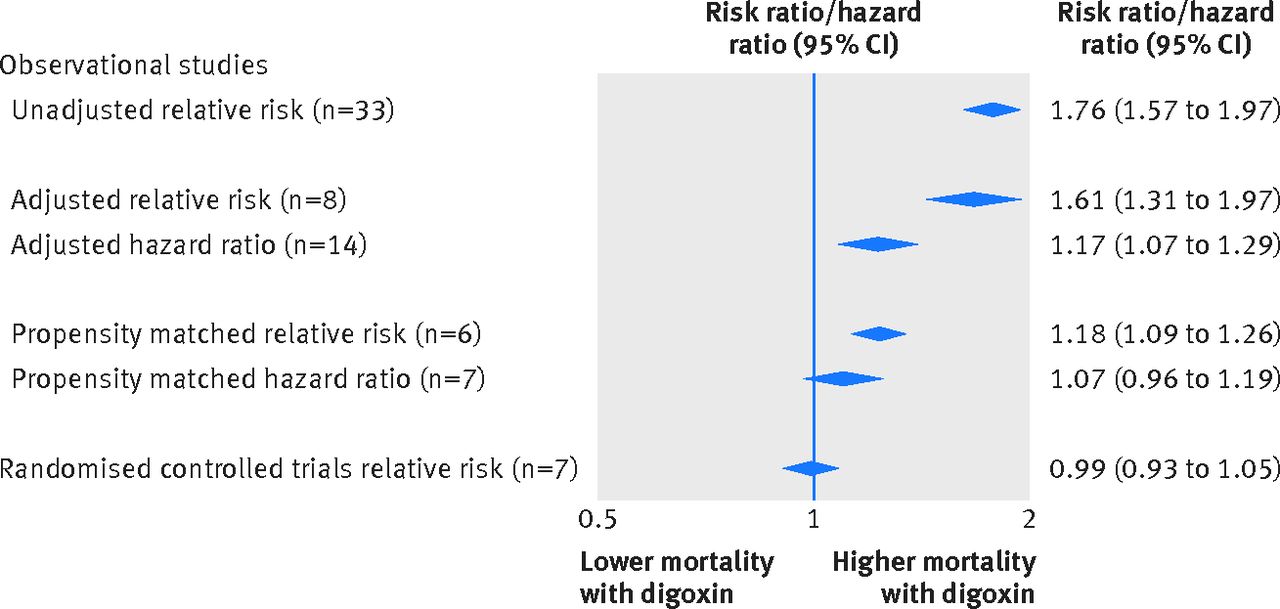
A new meta-analysis published in the BMJ is a great example of this, on a completely different topic. Ziff OJ, et al. Safety and efficacy of digoxin: systematic review and meta-analysis of observational and controlled trial data. BMJ. 2015;351:h4451. This was a review that compared the increase in mortality associated with treating congestive heart failure in adults with digoxin, between observational studies in 3 categories and the RCT data, the figure below shows a figure from their results.

As you can see observational studies show increased mortality with digoxin, in adjusted analyses there is less harm, in propensity matched analyses less harm again, and in RCTs no harm was shown.

F2.large

A commentary accompanying the article has the great title, “trials are best, ignore the rest

I guess, having just published the article with Jack Rabi, I should clarify what “ignore” means in that phrase. It doesn’t mean that the data we have just published are useless, it means that to make policy decisions, and to change medical practice you should ignore them. But for providing evidence that we should not make wholesale changes to practice based on the little data we currently have, and for providing support to do the trials that are sorely needed, I think they are worthwhile, indeed that is what we said at the end of that paper: “The contrast between the results of published systematic reviews and our observational data highlights the importance of performing adequately powered studies.”

The most important of the systematic reviews are those (here and here) which included only studies in preterm infants, they showed little detectable difference in outcomes between low oxygen and high oxygen groups, especially when studies without allocation concealment were eliminated.

On the other hand, studies like this one, Tataranno ML, et al. Resuscitating preterm infants with 100% oxygen is associated with higher oxidative stress than room air. Acta Paediatr. 2015;104(8):759-65 show much higher oxidative stress when babies were started in 100% oxygen and then titrated down, compared to being started in 21% oxygen then titrated up. This is data from a sub-study of the To2rpido study, of babies less than 32 weeks gestation, of whom about 120 had blood collection for oxidative stress analysis.

And, importantly the main To2rpido study was halted after the enrollment of nearly 300 babies because enrollment was very difficult and too slow. The interim results show a possible increase in mortality among the subgroup of babies less than 29 weeks gestation. Those interim results from an unplanned subgroup analysis (n=158), and our observational data, make a large prospective RCT an important priority.

It may be that the oxygen administration in those first few minutes after birth is very important for survival, and perhaps other outcomes of preterm babies. Even though oxidative stress is increased if you start with too much oxygen, adverse clinical outcomes might be worse with too low a starting oxygen. There really is only one way to find out.

Posted in Neonatal Research | Tagged , , , | 4 Comments

NICUs are working better: still room for improvement.

As NICUs have become more effective, any proportional incremental improvements will necessarily get smaller, so larger and larger datasets will be needed to show any trends. The NICHD has just published data about survival and major acute morbidities among extremely preterm infants, going back to 1993, and ending in 2012.

The population was infants born at 22 to 28 weeks and 400 to 1500 g, so a few larger than average 27, 28 week infants would have been excluded.

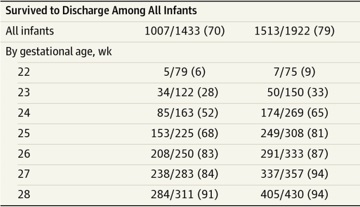
Basically there are significant upward trends in survival, and reductions in many morbidities over the entire 20 years, and  continuing between 2009 and 2012. The best survival at every gestational age that they show in the table is from 2012.

This excerpt from the table shows the results from 1993 in the first column and 2012 in the second, the number in brackets is the percentage survival.

survival

Among major morbidities, a progressive reduction in late-onset sepsis, starting in about 2006, is shown very clearly. Instead of a 34% incidence, only 24% of extremely preterm infants now have an episode of sepsis. There is a less marked but still important reduction in severe intracranial haemorrhages, from 19% to 15%, and in severe retinopathy from 13% to 11%; Most of  the reduction of those 2 morbidities was in the more mature infants, and not in the 23 and 24 week babies.

But necrotizing enterocolitis hasn’t changed (it has gone up a bit from 7% to 10%), and bronchopulmonary dysplasia is increasing (from 32% to 45%). Roger Soll has written an editorial to accompany this publication. As usual I cannot argue with anything he says.

Except for one thing, he suggests that there is no breakthrough therapy on the horizon that is likely to change these morbidities. One simple breakthrough therapy that has been shown effective, but is still underused, is already with us. Widespread us of probiotics could reverse that minor trend to more NEC and lead to somewhere around a 50% reduction in NEC.

As he notes, the reduction in late-onset sepsis has followed the introduction of quality control initiatives, which treat an invasive infection as a failure, rather than inevitable. We need to do the same thing for our other morbidities.

Retinopathy is associated with poor early postnatal growth. Improving nutrition will likely reduce the incidence.

Gentle ventilation, and more non-invasive ventilation, have not yet led to the reduction in lung injury that we might have hoped, the details of exactly how we do CPAP and non-invasive ventilation, improved nursing and RT procedures, improved CPAP interfaces, and methods for detecting and avoiding lung overdistension (mostly during invasive ventilation) are needed. They are needed much more, I think, than adding another ventilatory mode that few people really understand to our latest ventilators.

One change associated with BPD however, has been a reduction in the use of postnatal steroids. As steroids reduce oxygen requirements, it may be that reducing steroid use has led to more babies being in oxygen at 36 weeks, and therefore more having a diagnosis of BPD. Which is not necessarily a bad thing in that context. Steroids have never been shown to improve lung repair, or to improve long-term pulmonary outcomes, so an increase in the somewhat artificial diagnosis of BPD may not reflect worse pulmonary outcomes in the long-term.

Those would be my prescriptions for further improving survival without morbidities: improving nutrition, improving how we do non-invasive and invasive ventilation, and universal use of probiotics.

Posted in Neonatal Research | Tagged , , , , | Leave a comment