PAS 2018: the wrap-up.

A general comment about these PAS 2018 blog posts. I think we should be very careful about changing practice based on an abstract. We should respect peer review, with all its limitations, and we should always consider new research in terms of the quality of the trial, and how it fits in to the overall evidence base that already exists.

Sometimes there is little that already exists, and you could say, for example with the SAIL trial, that if you have already started using sustained inflations in the resuscitation of very preterm babies then you should reconsider your approach and probably stop doing it, at least as a routine. This was a high-quality trial with no real previous data on the overall clinical outcomes with sustained inflations in this population.

In contrast  for propranolol use in early retinopathy, there are previous data, but they are limited and of variably poor quality, and the quality of this new small trial is difficult to determine from the abstract. I think it would be a serious error to start routinely using propranolol in this population, there are a large number of unanswered questions, and potential risks. It is a trial that should be used to give support to a large multicenter RCT.

STOP-BPD is somewhere in the middle. A high quality trial with important clinical outcomes, and nothing quite similar in the literature, but there are many other trials of post-natal steroids and some other relatively similar trials going on right now. My response will be to wait and see, and try and analyse how this trial fits into the totality of the literature.

There were many other presentations that I found interesting at PAS. A study from Alabama with Colm Travers as the first author (1413.115) showed that it is possible to predict bradycardic episodes in preterm babies with apnea by training a neural network on previous heart rate patterns that preceded bradycardic episodes. Once trained the network could predict when the next brady was happening. I wonder how this would work if you looked at respiratory patterns, I remember some articles from the 1980’s (Waggener et al for each of them I think) where passing respiratory signals through a comb signal demonstrated multiple, otherwise difficult to see, respiratory pattern oscillations. When all the different oscillatory frequencies were at their lowest at the same time the babies had apneas. There may be some relationship between these 2 findings.

Peter Dargaville from Hobart, Tasmania, had several posters/presentations about automated oxygen control. One of them in particular (1413.112, first author Andrew Marshall) relates a little to my previous comment, they added a trick to their oxygen controller that immediately starts to increase the FiO2 at the onset of an apnea (or about 5 seconds later), rather than waiting for the infant to desaturate. Using this trick the periods of time when the infants were hypoxic was shorter. In manual FiO2 control the hypoxia lasted 30 seconds, with standard automated control it was 20 seconds, and with the added apnea-response element it was 12 seconds.This is a great trick, but I am not sure its the right thing to do. Obviously if you are not breathing, increasing the FiO2 isn’t going to do anything, so they are doing this to get the babies to re-saturate faster when they start breathing again. Is that what we really want? Release of oxygen free radicals during re-oxygenation might be worse if you reoxygenate faster, and increasing the FiO2 during apnea often leads to post-apneic hyperoxia, (I published an abstract about that several years ago, and there has since been a full publication from another group). In this study they calculated the number of seconds multiplied by the saturation percentage above target range, and there was more hyperoxia in the 60 seconds after the apnea when the new apnea-response element was switched on. I have thought about this a lot in the past, I think we should have studies looking at the best way to intervene for apneas, maybe the best way to intervene would be to immediately start assisted ventilation with the same FiO2 that the baby normal receives, but after how long? Does stimulation work (I think it probably does) and should we give a transient increase in FiO2 during recovery, or not? How can we reduce post-apneic hyperoxia? Anyway, this is a really interesting study showing you can integrate signals of respiratory activity into the FiO2 controller.

The lucinactant study group is pursuing its studies of aerosolized surfactant. Neil Finer and colleagues (abstract 2899.821) performed this blinded study looking at 2 different doses of lucinactant (40 or 80 mg/kg) in babies 28 to 32 weeks who were on CPAP for HMD. 44% of controls failed CPAP and 32% of those who received 80 mg/kg of phospholipids by aerosolization. More work to be done yet, but this is looking interesting.

There was a good observational study on premedication for intubation from the NEAR4Neos database (abstract 1414.123, first author Yuri Ozawa). It confirms what some of us have been saying for years. Not only is pain relief the humane thing to do for intubation, adequate therapy, that is “sedation” plus paralysis, makes the procedure more likely to be succesful on the first attempt and associated with fewer adverse physiologic changes. In this abstract “sedation” meant a sedative or a narcotic, which I think is a mistake. Non-analgesic sedatives should not be used for this procedure, and the authors should divide the data into analgesic or anesthetic regimes on the one hand, and sedatives (such as midazolam) on the other. In this study babies who received only “sedatives” were worse off, with fewer 1st time successes and more desaturation. An observational study to be sure, so interpret with care.

I guess I could continue for a while, there was a lot of resuscitation research, for example, including several projects presented from Edmonton, in simulation, in animal models and in babies. If you go to the website and search for Georg Schmolzer under presenters you can find those. There were many interesting things about the microbiome in preterm babies also, under the “program” heading you can filter for microbiome, you will get 67 hits, but then finding the preterm stuff isn’t difficult.

I can’t see how to place a link directly to any of the abstracts, https://www.xcdsystem.com/pas/program/2018/ is the best I can do; this URL will take you to the welcome page, and you can then find the abstracts if you know the presentation number by clicking on program, then “filter” then typing or pasting the presentation number if you know it.


Posted in Neonatal Research | Tagged , , , , | 2 Comments

PAS 2018 No7: Protecting tiny noses

#NeoEBM My blog posts are automatically tweeted. A group of twitterers got together at PAS and suggested that this hashtag should become a marker of neonatal Evidence Based Medicine posts. Great initiative! Now I have to find out how to do this…

Peter Davis was, as usual, omnipresent in the neonatal clinical research arena of PAS. You wouldn’t know that from the App but try searching for him on the website and you will find 15 abstracts on which he was an author. Interestingly though, you won’t find the MIST/LISA workshop that Ahmed Moussa from our hospital organized, and which is the only hit on the mobile App.

As I have for all of these posts, I have had to use both the website and the mobile App to write this one.

One of these abstracts trials is a modestly (but adequately) sized randomized trial of using hydrocolloid dressings to protect the noses of babies on CPAP who were less than 1250g birth weight or less than 30 weeks. Just over 100 babies were enrolled, and the incidence of nasal injury was substantially lower using the dressing (34%) than not (56%).

You can’t see the remainder of the results on the website as they are in tables that are invisible. But on the mobile App you can see that the demographics of the 2 groups were similar and other outcomes such as BPD and duration of CPAP were the same.

This is how the dressing was cut and applied with the use of Hudson Prongs.The illustrations are also not visible on the website, and you have to download them to see them on your phone, but then if you are very clever you can email them to yourself, and insert into a blog post! Many of the babies had their noses photographed in order to have an independent evaluation of the cuteness of the noses, or maybe it was to examine the nasal injury.

The big problem with this trial is the acronym, which is not as imaginative as we expect from Melbourne. PRONOSE is easy to remember, and tells you what the trial was about, but is that really what we want from an acronym?

Posted in Neonatal Research | Tagged , | 1 Comment

PAS 2018: why can’t we get the Apps/website even close to being OK?

The PAS 2018 App was an improvement over the disaster that was 2017. At least searches often worked, and you could create a schedule. But if I wanted to search for the presentations, even my own, of which I was not the presenting author, I was out of luck on the mobile App. I like the work of my friend Bill Meadow, for example, but a search of his name on the mobile App returned nothing. Even though he was author on 3 abstracts. On the website https://www.xcdsystem.com/pas/program/2018/ if you click on “presenters” you can actually search for any of the authors.

At least the mobile App allowed you to see the tables, and included a link to the figures, which you then had to download, and look at separately to the abstract if you were lucky and the download worked.

As I mentioned on the website you can at least search for the names of any of the authors, but then, if you see an abstract that is interesting you can’t see most of the tables (try it out: type ‘Onland’ for the name of the presenting author for STOP-BPD, you will find the abstract but not the tables, but if you do the same thing on the mobile app you can see the tables). There are a few tables that do appear in random abstracts; and you can see at least some of the figures. But if you want to try and save the abstract by printing it to pdf, again you’re out of luck, the print button just doesn’t work (unless you want a pdf file in which the content of the abstract is ‘loading’).

On the website also some symbols such as  ≥ show up as ? (both in firefox and microsoft edge). Reading an abstract and seeing, for example that an intervention increased death, but only in the subgroup ?26 weeks is a little concerning, is that more than, or less than..?

Finally, there is no longer any archive of the abstracts from previous PAS meetings, I often used to search old meetings for those abstracts, to remind myself of trials that I was waiting to see, or to find authors that I could email to see what was happening to the publication of their study, but that is no longer possible. It was a useful source for systematic reviews, and to find things that I had seen, which were of interest to me, but that I could not find the full paper.

Also for trainees, to have a permanent archive of their abstracts was very useful. I guess that now you could list hundreds of PAS abstracts on your CV if you are applying for a job, and no-one can check to see if they really existed!

The PAS leadership should find out what people want from their meeting. When I submit an abstract I would like there to be a permanent record of it, preferably one which is searchable in terms of topics and all the author names. We used to have that, but it no longer exists; I can’t even find abstracts from 2017.

I know I am not alone in my frustration with some recent changes, but I do not know if I am in a majority! There must be some way to recreate an archive of the abstracts from the last several years, and to ensure that there is a searchable database of all the abstracts for the future. I am a member of both SPR and APS, if all of us raise our voices, maybe we can make changes for the future and recover all the old abstracts.

The people organizing this enormous meeting are people of good will, and maybe they don’t realize that the disappearance of older abstracts, and the difficulty with using the new Apps and website, are big problems for many of us.

I am going to write a letter to the PAS program chair Thomas Shanley, from the University of Michigan. Once I find out who we should be addressing, if it is not him, I will let you know.

Posted in Neonatal Research | 5 Comments

PAS 2018 No6: Brett, the HUNTER

Brett Manley from Melbourne is now the person in the world with the greatest trial experience in the use of high flow nasal cannulae in the newborn. He has been the HIPSTER, and is now the HUNTER, I can’t find an acronym for his first, post-extubation trial, but it was probably the HEXmasTER or something cleverer than that.  This study is the latest (and he assures me the last) in his series of multicentre  trials of high flow nasal cannula use.

***UPDATE: Brett tells me that the post-extubation trial was called HIPERSPACE, which maybe he can un-acronym for us one day and explain…. or not, lets just leave it ineffable***

In this study (acronym HUNTER) infants in what I would call level 2 units (that is they don’t plan to deliver kids less than 32 weeks, and don’t keep kids who need more than transient invasive ventilation) who had respiratory distress, were randomized, as initial method for respiratory support, to receive either standard CPAP, at 6 cmH2O, or high flow cannulae at 6 liters per minute. The study was registered as ACTRN12614001203640 and the protocol published here.

Infants in level 2 centers were randomized if they were less than 24 hours old, were over 31 weeks gestation, and needed respiratory support. If they had CPAP for more than 2 hours they were excluded. This was a non-inferiority trial, which means that they thought that high-flow had some advantages (ease of use and comfort), but those advantages were only of interest if there was no inferiority in respiratory outcomes.

The primary outcome of the trial was “treatment failure”, which was defined as needing progressive increases in support up to 8 (litres or cmH2O) and any of the following within 72 hours: FiO2 of more than 0.4, respiratory acidosis (pH<7.2 with pCO2>60), severe apnea (more than 1 an hour), needing intubation, or needing transport to a level 3 NICU.

The high-flow group had more failures and was inferior to CPAP, just over 20% of the high-flow group failed as opposed to 10% of the CPAP babies. Babies needed to be on respiratory support for a longer duration (median 20 vs 15 hours) if they were started on high flow.

On the other hand, as all hospitals had to have CPAP available in order to be part of the trial; when they failed high-flow the babies could be switched to CPAP, and they were therefore not much more likely to be intubated (8.1% of high-flow vs 6.4% CPAP) or transferred to tertiary care (10.2% vs 8.6%). Duration of hospital stay was the same in each group.

I guess this means that if you are in a level 2 nursery with CPAP available, you could try high-flow first if you wished, and then switch to CPAP if it is not working well, without the babies coming to any harm. You will on average have to give the babies respiratory support for longer, but they will get home to their families at about the same time.

This is the kind of patient centered research that we need in neonatology. Thanks Brett, and all the other Hunters. (Except those with guns).

**I just updated my previous post after receiving the full text of the previous publication that I mentioned, which now looks like a separate study comparing the outcomes of 2 cohorts**

Posted in Neonatal Research | Tagged , , , | Leave a comment

PAS 2018 No5: the trial with no name… propranolol for early RoP, a proper trial.

As far as I can see, this trial has no acronym, which isn’t a big deal, but it also doesn’t show up on trial registry searches, which is a big deal. Trials must be registered before starting them, it ensures that protocols, sample sizes, outcomes, analyses, and so on, do not change without explanation. And it ensures that trials don’t end up being hidden and unpublished. The trial may have been registered, I just can’t find it.

I would call this trial PROPER, Pre-threshold RoP, Evaluation of pRopranolol! The authors can have that acronym for free if they want! How generous I am; unfortunately my Spanish is not good enough to generate a Spanish acronym.

In a single center trial, Aldo Bancalari and colleagues from Concepcion in Chile randomized 62 VLBW infants with stage 2 or 3 RoP in zone 2 or 3 (without plus disease) to oral propranolol or control (I am not sure if there was a placebo or not).

Progression to treatment thresholds (laser or intravitreal anti-VEGF treatment) was much less frequent with propanolol, with 28/31 (90%) having a favourable evolution, compared to 17/31 (55%) of controls. Which is a big difference unlikely to be due to chance alone. One of the propranolol babies was hypoglycemic on day 1, and there were no other side effects noted.

As I was creating this post, I realized that it actually looks like the authors have already published the results of this trial at an earlier stage, when they had enrolled 47 babies. That is really not appropriate; repeated analysis and presentation of results as they accumulate inflates risks of bias, dramatically. I was quite excited by this trial when I first saw it, but it looks now that it might not be a good use of my acronym, and perhaps it isn’t that proper!

**UPDATE, I have now received the full text of the previous publication, and that publication seems to refer to a cohort of treated babies that they compared to a historical control group (as mentioned by Ben Stenson in his comment below) and therefore this is probably a PROPER publication after all, I apologize to the authors if I mischaracterized this trial***

I think it is clear that we need… A Large Multicentre Trial of Propranolol in the Early Stages of RoP to Prevent Progression. Which we could call  “PREPARE” the PREvention of the Progression of REtinopathy trial. I claim priority for this acronym. PORKY would work too, if we could work out how to get the k in there.

Posted in Neonatal Research | Tagged , | 8 Comments

PAS 2108 No4: you little SCAMP!

In the part of England where I was born and spent the early years of my life, and where my parents are from, the Manchester region, ‘scamp’ was a sort of affectionate term for a young child who had done something wrong, so if a toddler emptied a milk bottle on the floor by accident they would be referred to as ‘a little scamp’.

https://upload.wikimedia.org/wikipedia/en/4/48/The_Scamp_%281957_film%29.jpg This 1950’s English movie was a lot darker than that.

The SCAMP study was also small and irritating!

It was registered at NCT01994993

I am still looking to see if the protocol was published anywhere..

This was a multicenter randomized controlled trial to answer a really important question in neonatology. What are the appropriate antibiotics in complicated intra-abdominal infections? (Disclaimer, we were part of this trial, and Julie Autmizguine of our center was one of the investigators).

This was a difficult trial to do; when an infant <34 weeks gestational age and <121 days postnatal age was eligible, with either necrotizing enterocolitis with pneumatosis, or a perforation or peritonitis associated with other diagnoses, they were randomized to one of 3 antibiotic regimens; ampicillin, gentamicin, and metronidazole (group 1); ampicillin, gentamicin, and clindamycin (group 2); or piperacillin-tazobactam and gentamicin (group 3). The study was registered at NCT01994993

Part of the rationale was Julie Autmizugine’s observational study that seemed to show an increase in intestinal stenosis among infants with NEC who received anaerobic coverage, which may have been due to the fact that mortality was a bit lower, so there were a few more babies alive to develop strictures (or maybe not, it was an observational study after all).

Of the 182 patients reported in the abstract, 2/3 were randomized, the others were a simultaneous observational cohort. Mortality was similar between groups, but differed by a maximum of 3% (between about 8 and about 11%), that is not a big numeric difference, but is a large enough difference to influence antibiotic choice if it is real.

Treatment success was defined as being alive, with a negative blood culture and “a clinical cure score >4” which I can’t see defined in the abstract, nor is it mentioned in the registration document, and, as I said, I can’t find a published protocol. After a bit of googling around I did find the clinical cure score in an online pdf of a presentation somewhere by the presenting author. Each element of the score was evaluated and assigned a score of 0 or 1. So if you were extubated, with a lower FiO2, not on dopamine, not oliguric or acidotic, and seizure free, you would score 6.

This was adjudicated 30 days after antibiotic treatment, and was similar between groups, 73%, 83% and 74% respectively had a succesful treatment because they were alive and scored less than 4. The group with the highest success though, had the highest mortality… which brings me back to, yes, composite outcomes, and what a problem they are!

If I work this out, in the 1st group, 92% were alive, but another 20% had cure scores of 4 or less, which surprises me 30 days after the antibiotics. Still being ventilated and having a higher FiO2 I would think happen frequently, but, being on inotropes or oliguric or acidotic or having seizures, to have so many with at least 2 of those is unexpected.

In the second group, there were 89% alive and another 6% with a low cure score. This is again a complicated study, only partially randomized, and unblinded. There were a lot of babies who had pharmacokinetics, and a lot of important data will come out of the trial over the next years, I think. And a design for future larger better trials, I hope. This is one of the first trials to address this difficult subject, lets hope we can move forward from this.


Posted in Neonatal Research | Tagged , , | Leave a comment

PAS 2018 No3: Should we TOLERATE the PDA?

This was another large multicenter trial, designed to determine if routine attempts to close a moderate to large PDA at the end of the first postnatal week decreases the duration of patency, and the incidence of the combined outcome “need for ligation or need for post-discharge PDA follow-up”. The comparison group, the “conservative approach” required pre-specified respiratory and hemodynamic criteria before rescue treatment.

The trial was registered as NCT01958320 but I can’t see a publication of the protocol.

At 1 to 2 weeks of age there were 855 infants of those who were screened (about half of the screened babies were eligible for the trial) who had a moderate/large PDA shunt and required at least 0.25 FiO2 and either ventilation non-invasive ventilation CPAP more than 2 L/min high-flow.

Echo criteria were internal ductus diameter ≥1.5 mm/kg (or PDA:LPA ratio ≥0.5), ductus flow velocity ≤2.5 m/s or mean pressure gradient across the ductus <8 mm, LA/Ao ratio ≥1.5, left pulmonary artery diastolic (or mean) flow velocity >0.2 (or >0.42) m/sec, respectively, and/or reversed diastolic flow in the descending aorta. Those are the criteria copied from the registration, I don’t know how many were needed to be eligible.

202 babies between 23 and 28 weeks gestation were randomized between 6 and 14 days of age half of whom were intubated. Half of them got immediate treatment, and the other half were in the conservative arm.

As fas as I can tell the pharmacologic treatment of the PDA could be either indomethacin or ibuprofen. The criteria for later treatment in the conservative arm are not in the registration document, nor in the abstract. Apparently nearly 2/3 of the conservative arm met treatment criteria (62%), but only half of the group (48%) actually received it.

The primary outcome was needing ligation (criteria not given) or being discharged with an open PDA (confirmed by a pre-discharge echo). That outcome was less common with early treatment (Relative Risk 0.72, no confidence intervals in the abstract). PDA ligation was the same in both groups at 12%, as there is no overlap between, ligation and PDA patency at discharge that means the difference is there, being in the later treatment group means your duct is more likely to stay open at discharge. I would guess that this is both among those who actually were treated (as treatment is known to be less effective later) and among those who didn’t actually receive the later treatment even though they met criteria.

In other outcomes, more of the conservative group received dopamine for 3 days or more. In our unit receiving dopamine (or another catecholamine) after 5 days of age, which was the entry limit for the study is very unusual, even among the subgroup who showed the greatest effect for this secondary outcome, those under 26 weeks. It would be interesting to know if there were standardized criteria for this, or if babies were getting dopamine because their diastolic pressures were a bit low…

Also of interest in the secondary outcomes, mortality and late onset sepsis were more frequent among the early treatment group, with relative risks of 1.79 and 1.52 respectively. These effects were more evident in infants of 26 weeks or more. Feeding progression was slower with early treatment, but again that might be because of unit specific guidelines for holding or slowing feeds during PDA treatment, rather than a problem with feed tolerance.

An important study, but the limitations of the abstract format, and the lack of a published protocol preclude much more in the way of definitive interpretation. Also there are several other trials which are in progress, examining similar questions. If earlier treatment (by these criteria) really does lead to increased mortality then the rest of the results are really irrelevant; being alive with an open PDA, I think anybody would agree, is better than being dead with a PDA firmly closed!

Should we tolerate the PDA? Probably; but how tolerant, and when to become intolerant, are still unclear.

Posted in Neonatal Research | Tagged , , | 2 Comments

PAS 2018 No2: let’s STOP-BPD

The STOP-BPD trial was a multicenter trial from Holland, (registered as NTR2768) over 180 babies were randomized to each arm of this trial, they were <30 weeks or less than 1250 g at birth, and were still ventilated at 2 weeks of age.  They had a respiratory index of more than 2 (which you get by multiplying the mean airway pressure by the FiO2). They actually changed the eligibility criteria during the trial as many infants with a respiratory index between 2 and 3.5 (the original criterion) were still developing BPD. A respiratory index of 2.1 therefore would be achieved by having a mean airway pressure of 10 in 21% oxygen, roughly, therefore, anything more than a mean airway pressure of 10 would make you eligible, or lower pressures with higher FiO2.

Infants in the hydrocortisone group received hydrocortisone 5 mg/kg/day Q.I.D for 7 days, followed by 3.75 mg/kg/day T.I.D. for 5 days, then one dose less per day every 5 days. This led to a duration of therapy of 22 days and a cumulative dose of 72.5 mg/kg hydrocortisone. The protocol was published here.

The results, as presented at PAS 2018, showed no difference in the primary outcome, which was survival without BPD. In contrast there were many fewer deaths, 16% vs 24%, and no change in moderate or severe BPD, 65% vs 66% with the hydrocortisone treatment compared to placebo. We don’t have long term neurologic or developmental follow up as yet, but to be honest I am not sure how important that is, if there is an increase in survival. Even if there are more survivors with low Bayley scores, there are more survivors! Also important, survival as reported in the abstract was survival to 36 weeks, they don’t mention survival to discharge which is much more important; with such a big difference in survival to 36 weeks, survival to discharge might well be improved. I don’t remember in the presentation if survival to discharge was reported.

These 2 studies, SAIL and STOP-BPD) illustrate really well the problem with these combined outcomes in neonatal studies. Especially this particular common outcome, combining oxygen needs at 36 weeks PMA with death, I think this is really a big problem.  The two outcomes are not of equivalent value to families, nor to me. What are you supposed to do with those data, to say to parents: “we could start steroids now, but that doesn’t change the probability of your baby surviving to discharge without needing oxygen at 36 weeks. Jacob is more likely to survive if we give him hydrocortisone, however…”

The 2 studies both have a null outcome, but in reality, the STOP-BPD trial intervention appears to be (at least potentially until the peer reviewed publication appears) a major benefit to babies. SAIL is the opposite, a study had a null outcome, but what seems to be a serious negative impact of the intervention. There are other ways of designing and analyzing these trials, analysis of survival as a first step, and then presenting morbidities among survivors would be much more useful for future families. Even profound impairments with limited communication skills, should be separated from mortality, as different families have differing attitudes to survival of the most handicapped infants.

Posted in Neonatal Research | Tagged , , | Leave a comment

PAS 2018 No1: SAIL away (and another mention by a science journalist).

For some reason there is a small epidemic (n=2, that’s a pico-epidemic) of articles about probiotics and necrotising enterocolitis this year in the mainstream press. I was interviewed, and I am mentioned again, in this article on the NOVA “next” website, which is open access ww.pbs.org/wgbh/nova/next/body/probiotics-for-preemies 

I have just returned the PAS meeting, where I sometimes get invited to lunch to eat with groups of amazing neonatal fellows, such as the fellows from Columbia, who, with the leadership of Tina Leone, are doing great work. Thanks for lunch, and the stimulating interactions.

Also it is where this year there were several large important neonatal trials being presented, I usually only post about studies after peer review, but the large clinical trials don’t usually change much between PAS presentation and final publication. So I will post about SAIL, STOP-BPD, TOLERATE-PDA, SCAMP, and a randomized trial of propranolol for treating retinopathy, which sadly doesn’t seem to have an acronym.

I decided I would write a few posts and divide them up as the mood takes me…

Here is the first, the SAIL trial, a very high quality trial of a very important issue.

SAIL is a trial of sustained inflations in preterm infants during resuscitation. This was a multicenter trial (registration NCT02139800 ) of which theprotocol has been published (and is open access); extremely preterm babies 23 to 26 weeks were enrolled at birth if they needed respiratory assistance at birth.

In the control arm the babies were ventilated as usual, in the sustained inflation arm they had one or two prolonged sustained inflations, 20 cmH2O for the first, and 25 for the second (if needed) and then they continued NRP.

An external file that holds a picture, illustration, etc. Object name is 13063_2015_601_Fig1_HTML.jpg

The primary outcome was BPD or death. The study was stopped about 2/3 of the way through, with 425 babies analyzed. At that point there was no “statistically significant” difference in the primary outcome, but an excess of early deaths in the SI group, 7.5% compared to 1.4% of controls died within 48 hours of birth, which was considered to be highly unlikely to be due to chance (p<0.002).

Death before discharge was 33% higher in the SI group (relative risk 1.33 95% CI 0.9, 2.0), BPD was not reduced (it was actually 12% more frequent in the SI group), and the primary outcome was somewhat more frequent with SI overall, about a 10% increase in “death or BPD”; which was not “statistically significant” (as  is still often said) because the 95% confidence intervals include a relative risk of 1.0 (the relative risk of “death or BPD” was 1.10, 95% CI 0.9, 1.3).

Part 2 to follow soon…

Posted in Neonatal Research | Tagged , , | 2 Comments

Important outcomes after extreme prematurity: what do parents think?

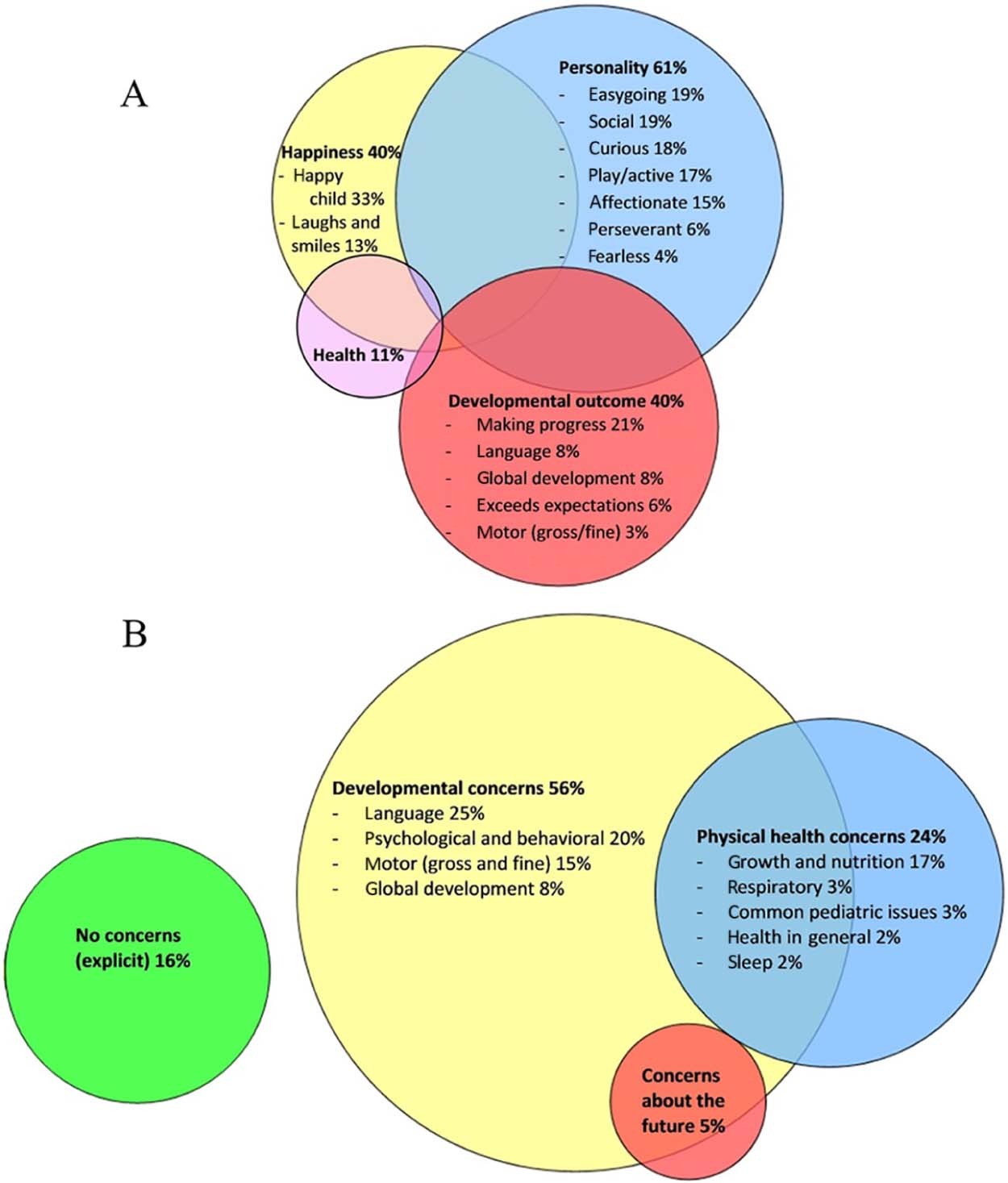
There has been remarkably little study of the response to the question posed in the title: what do parents think is important in the outcomes of the very preterm baby? Physicians have focused on developmental progress, often as measured by developmental screening tests. The group at Sainte Justine (conflict of interest report: the authors are all either friends, or colleagues of mine, or my wife) have been investigating what parents find important, a new publication (Jaworski M, et al. Parental Perspectives Regarding Outcomes of Very Preterm Infants: Toward a Balanced Approach. The Journal of pediatrics. 2018) is from a study where they asked parents about what their concerns were about their baby, and what were the most positive things about their baby.

This is the first Venn diagram I can remember seeing in a medical publication, which makes me think that “modern maths” (as we called it 50 years ago) might not have been a waste of time after all (to be honest I loved maths, and I was rather good at it, unlike latin…).  The A diagram is the positive things that parents said, the B diagram shows their concerns. What I find perhaps most interesting in this publication is the lack of correlation between whether or not the baby actually had neurological impairment or developmental delay and the parents opinions/worries.

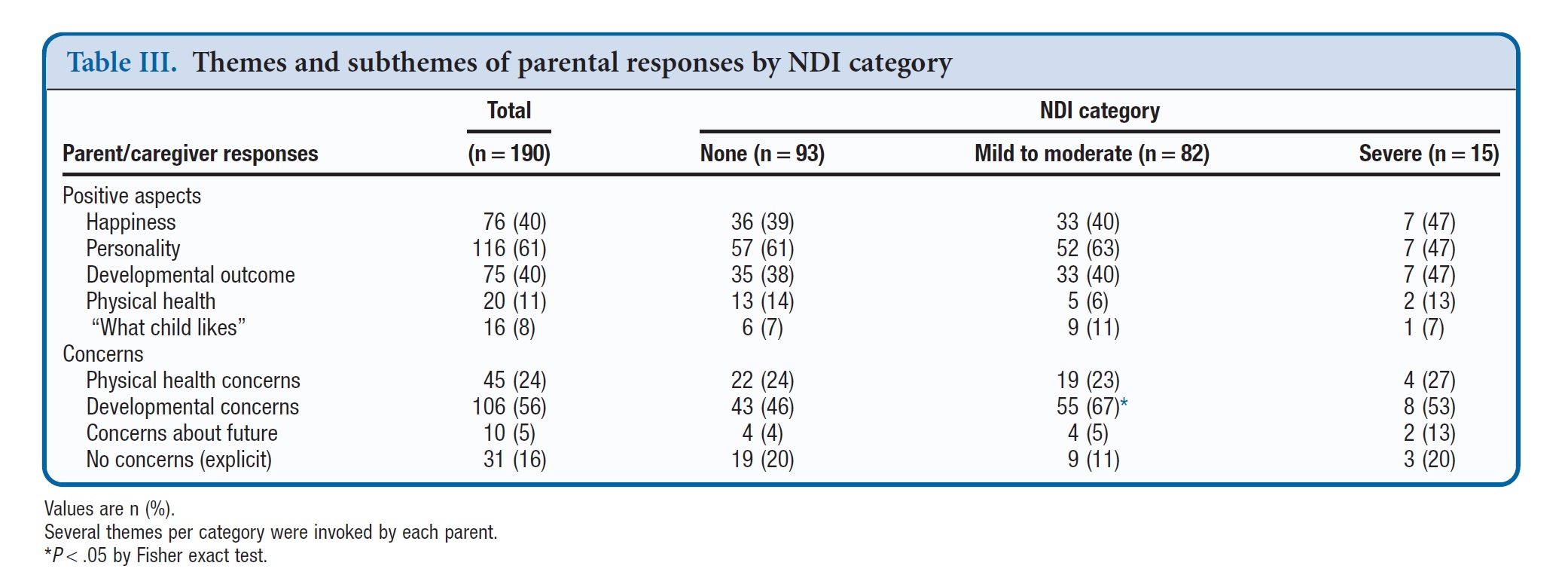
As you can see from this table, there was really no difference between the parents whose infants were doing well (by our usual medical criteria) and those who had serious issues (by our usual medical criteria) in their concerns or their positive evaluations. There are only 15 (out of 190) with what they call “severe NDI”, and among that small group there were similar responses to the other parents. The parents who were somewhat more likely to be worried about their child’s development were those in the “mild to moderate NDI” category, where 2/3 of the parents voiced this concern compared to about half of the none or severe categories.

I think the next step needs to be to ask a group of parents what they think we should be trying to measure as neonatal outcomes, both acutely and during follow-up. That next step is already being done, of course, one group that has been working on this is the COIN project, which stands for Core Outcomes In Neonatology, based in London (the UK version of London). You can see on their web page that they are developing a list of Core Outcomes, and the first stakeholder group on their list is “the parents of babies needing medical care”.

Posted in Neonatal Research | Tagged | 6 Comments