Regular universal antibiotics to reduce infant mortality?

This (Keenan JD, et al. Azithromycin to Reduce Childhood Mortality in Sub-Saharan Africa. The New England journal of medicine. 2018;378(17):1583-92 Open Access) is a new multicenter cluster randomized trial of giving all infants in a community regular azithromycin. If that sounds crazy, just wait… azithromycin (or placebo) was given to all the infants in the included communities twice a year, if they were between 1 and 59 months of age.  The study was based on observations that children in trachoma prevention trials (using azithromycin) had lower mortality; this study was designed to see if that was a real effect. Communities in Malawi, Tanzania and Niger were enrolled in this stunning, massive, effort, which included hundreds of thousands of infants.

The other stunning fact, that this study reminds us of, is the enormous post-neonatal infant mortality in these countries. In the country with the highest placebo mortality, Niger, the mortality rate was over 27 per 1000 patient years, that is nearly 3% of all their young kids die each year.

The intervention, azithromycin syrup in a single dose twice a year, was studied in the trial which was called MORDOR, which you may recognize from Lord of the Rings as Tolkien’s name for the kingdom of evil, which he derived from the old English word for murder morþor . I guess because the official language of Niger is French they tortured the acronym production machine until it came up with “Macrolides Oraux pour Réduire les Décès avec un Oeil sur la Résistance”.

The result of the trial was actually the opposite of morþor: there was a significant reduction in mortality, especially in Niger, and especially in the youngest kids, in whom the subgroup analysis showed that babies between 1 and 5 months of age had a 25% reduction in mortality with azithromycin compared to placebo. That is a reduction in mortality among all the infants in the community, which is the 3rd time I am going to use the word stunning in this post.

This intervention will probably have some impact on macrolide resistance, but with such infrequent dosing perhaps that will be minimal, and perhaps this might save many thousands of lives in the world’s poorest countries, if we can ensure that those at highest risk can have access. Azithromycin is quite cheap, and was provided for this Bill and Melinda Gates Foundation funded trial by Pfizer. I’d like to believe that their motivation was altruistic, and that they will provide azithromycin free or at production cost for future trials or usage, if the benefit can be shown to be maintained and that resistance does not become a problem. “you may say I’m a dreamer… but I’m not the only one

Posted in Neonatal Research | Tagged , | 2 Comments

Too much oxygen is bad for adults too!

The systematic review of the neonatal oxygen saturation targeting trials Askie LM, et al. Effects of targeting lower versus higher arterial oxygen saturations on death or disability in preterm infants. Cochrane database of systematic reviews (Online). 2017;4:Cd011190.
confirmed the increase in mortality with lower saturation targets (85 to 89%) compared to higher targets (91 to 95%) that was shown, in very preterm babies, by most of the individual trials, and showed very little heterogeneity between the trials. That review was limited to trials that enrolled patients at birth or soon after, and therefore excluded the first BOOST trial, and STOP-ROP. Those two trials enrolled children later in their hospital stay (for BOOST it was kids born before 30 weeks who still were on oxygen at 32 weeks, for STOP-ROP eligible babies had pre-threshold retinopathy and who needed oxygen to stay at or above 94%). They both randomly compared saturations in the low 90’s to saturations in the high 90’s

Despite the differences between the trials they both seemed to show somewhat worse pulmonary outcomes with higher saturations, including more babies on oxygen for longer, in STOP-ROP for example, at 3 months corrected age, well after the intervention had finished, there were 47% of the high saturation babies still on oxygen compared to 36% in the low saturation group. There were also twice as many babies still hospitalized at 3 months corrected (13% vs 7%), and more use of all the pulmonary medications reported. In the BOOST trial more babies went home on oxygen in the high saturation target group, but this could be predicted by trial design which maintained the target ranges for as long as the kids were in oxygen, so in the high saturation group it would be harder and take longer to be weaned off oxygen, by study design, They were also however, more likely to get steroids or diuretics, and more likely to be re-hospitalized during the first year of life and there were slightly more pulmonary deaths in the high saturation group. All of which suggests that targeting even higher saturations than the NeoPROM trials, and aiming for saturations above 94%, at least after the initial acute phase, might increase pulmonary oxygen toxicity enough to have an adverse clinical impact.


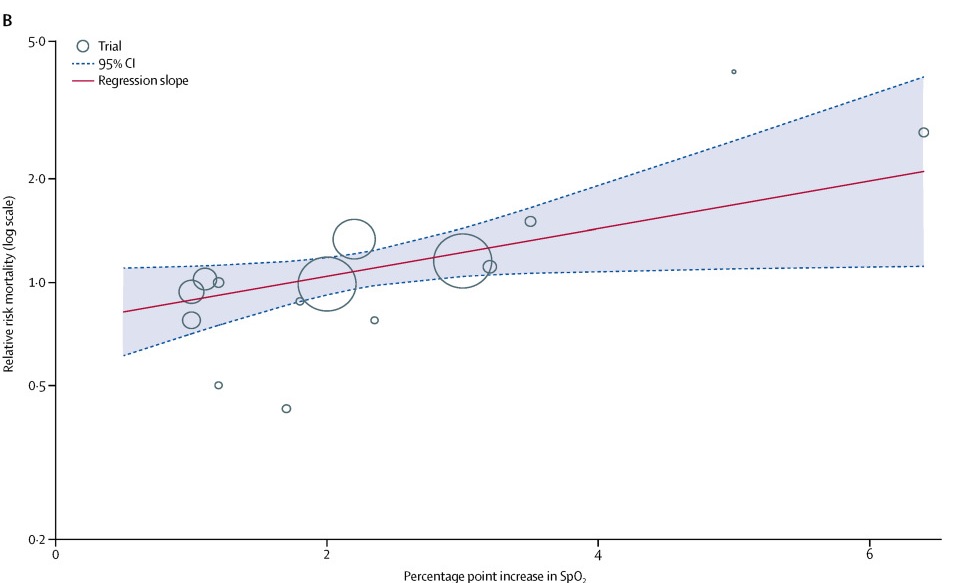
This new systematic review and meta-analysis (Chu DK, et al. Mortality and morbidity in acutely ill adults treated with liberal versus conservative oxygen therapy (IOTA): a systematic review and meta-analysis. The Lancet. 2018;391(10131):1693-705)
is one of a kind that I often criticise, studies of widely different patient populations are lumped together, so it doesn’t satisfy Barrington’s rule, that to be meta-analyzed patients should have been able to be eligible for each study. This review, however, searched for all studies of critically ill adults who were randomized to conservative or liberal oxygen strategies. It includes adults with a recent stroke, or septic shock or appendicitis, post-myocardial infarction or cardiac arrest. That makes me a bit sceptical about the applicability to all of those different groups, also the duration of the randomized intervention, and the actual oxygen concentrations administered where varied, although most of the conservative oxygen groups were on 21%. The authors found 25 randomized trials with a total of over 16000 patients, and overall, in the safety analysis, there was an increase in mortality. The benefit of doing a review like this is that you can get enough patients to find small changes in infrequent outcomes just by increasing the total numbers. In-hospital mortality was increased by 21%, which sound enormous, but in fact the increase was from about 3% to about 3.7%, 30 day mortality increased from 5.6% to 6.4%. Whether these differences really apply to all subgroups of patients is uncertain, but the review was not able to show any benefit of giving more oxygen.

Another interesting finding from this review is that there seemed to be a dose effect, as saturations increased there was a greater effect on mortality, and the impact seemed to be  significant above a saturation of about 94 to 96%.

Although we know in babies that mortality is lower with a target range of 91 to 95% than a range of 85 to 89%, we don’t know if there is a range that would have even lower mortality. In adults with varying serious illnesses, the upper limit of what you should aim for is probably around 95%, if your baseline saturation is above or close to 95% you should probably leave well alone and not give oxygen.

There are adverse effects of hyperoxia, even in full term babies and in mature experimental newborn animals, with an increase in pulmonary reactivity, and a reduction in the response to nitric oxide, as well as the generation of free radicals, and potential adverse effects on cardiac function (see this review). I think that much of what is discussed in the editorial accompanying the new systematic review could be transposed to our patients. Although the dangers of hyperoxia in very preterm babies have been appreciated for years, the potential dangers in later preterm and term babies are less well appreciated.

Posted in Neonatal Research | Tagged , , , , | Leave a comment

Glucose gel for hypoglycemia in at-risk babies? Prophylaxis no, treatment yes!

In the ongoing story of how and when to treat lower than average blood sugars in at-risk newborn infants, some clarity for some points is emerging.

We know the following:

1. some babies have lower blood sugars than others (!)

2. some babies with prolonged very low blood sugars have poor long term outcomes

3. more minor “hypoglycemia” has statistical associations with poorer outcomes, but we have no idea if this is causative.

4. Being in an at-risk group increases risk of poor long term outcomes, even if you are never documented to be hypoglycemic.

4. we have no idea if aggressive blood sugar monitoring and intervention for lower than average blood sugars improves outcomes. The best data we have (from Harding’s group in New Zealand) suggest the opposite, they found no detectable benefit of being ‘aggressive’) See this blog post for a longer discussion

5. Babies with low blood sugars might have multiple interventions, be separated from their mothers, have their breast-feeding interrupted, have multiple painful heelstick procedures, and end up in the NICU with an iv infusion, and with parents who think their babies are abnormal.

5. We should as a result minimize potential harms from our monitoring, while ensuring safe blood sugar concentrations.


The glucose gel approach first studied in the Sugarbabies trial from New Zealand at least decreases the harms of treatment, and it is now clear that that benefit can be achieved in other centers.

Makker K, et al. Glucose Gel in Infants at Risk for Transitional Neonatal Hypoglycemia. American journal of perinatology. 2018.  This US study showed a reduction in glucose infusion rates, which in their hospital also required an NICU admission, and greatly increased hospital charges. The article includes a figure showing their protocol (the figure is a bit confusing as it shows both the before and after protocols, but with a bit of persistence you could create your own protocol from it).

Rawat M, et al. Oral Dextrose Gel Reduces the Need for Intravenous Dextrose Therapy in Neonatal Hypoglycemia. Biomed Hub. 2016;1(3). This is a report from Buffalo NY, which is freely available on-line and which showed a reduction in dextrose infusions and which also includes their protocol.

Ter M, et al. Implementation of dextrose gel in the management of neonatal hypoglycaemia. Journal of Paediatrics and Child Health. 2016. This study from Melbourne also showed a reduction in dextrose infusions, and describes their protocol, but doesn’t have a pretty coloured figure like the one from Buffalo.

Coors SM, et al. Prophylactic Dextrose Gel Does Not Prevent Neonatal Hypoglycemia: A Quasi-Experimental Pilot Study. The Journal of pediatrics. 2018. In this study the authors tried to prevent hypoglycemia, they selected some at-risk infants and gave them oral glucose gel after the first feed, but the incidence of hypoglycemia and NICU admission was the same between groups.

These oral gels are easily available as they are used by diabetics for hypoglycemic episodes, unfortunately they all have colorants, artificial flavours and other additives that our babies could do without, but a single use, or occasionally 2 or 3 uses, will probably not cause any harm to a full term baby. A preparation designed in a single dose sachet without additives for full term babies could probably have a big market. If anybody reads this and decides to create such a product, I expect a cut of the profits!

Posted in Neonatal Research | Tagged | 8 Comments

Its now or… later? A good question to ask ELVIS.

This study probably wins the prize for the best trial name in neonatal history, the Early or Late Ventricular Intervention Study, ELVIS.

de Vries LS, et al. Treatment thresholds for intervention in posthaemorrhagic ventricular dilation: a randomised controlled trial. Archives of Disease in Childhood – Fetal and Neonatal Edition. 2018. This is a very important trial comparing 2 approaches to post-hemorrhagic ventricular dilatation in babies of under 34 weeks gestation. Infants who had serious intraventricular or intracerebral hemorrhage and then had progressive ventricular dilatation were randomized when they reached the 97th percentile of ventricular width (as long as the anterior horn width was at least 6 mm). At that point they either had intervention immediately or waited until they reached 4 mm more than the 97th percentile (with an anterior horn width of >10mm).

The second intervention group was consistent with usual practice in many centers, but that threshold was based on very arbitrary criteria. There had never been a good trial to find out if that is the best time to intervene, but some observational data suggested that earlier intervention might lead to better long term outcomes, and, perhaps more surprisingly, fewer permanent VP shunts. de Vries LS, et al. Early versus late treatment of posthaemorrhagic ventricular dilatation: results of a retrospective study from five neonatal intensive care units in The Netherlands. Acta Paediatr. 2002;91(2):212-7.

In the early intervention group, infants had serial lumbar punctures (maximum of 3) and then a ventricular reservoir which was tapped up to twice a day to achieve stability of ventricular size, at less than the 97th percentile. If taps were still needed after 28 days, and the baby met other criteria for shunting, a permanent VP shunt was then inserted.

In the late intervention group the same approach was taken, but starting when the ventricular index was more than 4mm above the 97th percentile.

The primary outcome for this phase of the trial was death or VP shunt placement several dutch centers were involved as was Andy Whitelaw’s group in Bristol (I think Andy has retired now, but they still let him be the last author!) 126 babies were randomized, with similar characteristics in the 2 groups. In the early intervention group they therefore started treatment with lumbar punctures immediately, and 40 of the 62 in that group (not including the 2 deaths) then had a reservoir. In the late group 36 of the 58 who survived had serial lumbar punctures, and 27 then had a reservoir. 12 in the early group, and 14 in the late group had a ventriculo-peritoneal shunt.

This flow sheet should clarify those data.

As you can see there were fewer infants who had lumbar puncture, and fewer infants who had a reservoir, in the later intervention group, but about 1 in 5 of each group had a ventriculo-peritoneal shunt.

This increase in interventions could easily be justified if the long term outcomes are improved, those results will be coming, I would guess, within the next year or so. Until then we will have to keep asking “baby, what you want me to do?”

Posted in Neonatal Research | Tagged , | 5 Comments

Teaming up with parents and ex-premies to improve care for babies

On April the XXth I will be running 10 kilometers in the Scotia Bank run, as part of the PAF-Néonat team of Sainte Justine Hospital (PAF means Partenarait Famille).

We are raising funds for the partnering with families program, which involves parents in clinical care, research and education in our neonatal service.

On the PAF- running page, please take some time to look at runners’ testimonials. Some  children-runners are running for their brother who died in the NICU 12 years ago. Others are parents with their young premies. Others are young ex-premies, some with and others without disability. Others are ex-preemies, who are now adults, that are running. Their pictures and stories are moving.

And yes, some of the others are our own kids, Annie’s and mine and the kids of other wonderful providers from our unit and hospital.

We have a quite innovative program and want to expand it further.

To make a donation click on this link neonat-paf.ca, all of the funds raised go directly to support our program. Our program is important to us and to the families we care for.


Posted in Neonatal Research | Leave a comment

Neonatal updates

This post is  a bit of a catch up, to mention articles that are worth reading, but which I didn’t have time to write a full post about, in particular studies that could have a positive impact on clinical care.

Let’s stop monitoring gastric residual volumes… please!

Measuring how much liquid is left in the infant’s stomach, just before the next feed, is a practice based on good intentions, but no evidence. Good-intention-based-medicine has, unfortunately, often been proved ineffective, or even harmful, especially when compared to evidence based medicine. This study from Israel (Riskin A, et al. The Impact of Routine Evaluation of Gastric Residual Volumes on the Time to Achieve Full Enteral Feeding in Preterm Infants. The Journal of pediatrics. 2017;189:128-34).  showed the same as other studies, that the only clinically detectable impact of measuring gastric residuals is to slow down how fast babies are progressed to full feeds, without any clinical benefit.

If you give babies more nutrition, they grow more.

One of many studies that show that being more “aggressive” in early nutrition has positive impacts on weight growth, but also head circumference growth, and, perhaps, long term body composition.

Genoni G, et al. Nonrandomised interventional study showed that early aggressive nutrition was effective in reducing postnatal growth restriction in preterm infants. Acta Paediatr. 2017;106(10):1589-95. Approaching recommended standards for nutritional intakes improves usual measures of postnatal growth restriction, which are based mostly on weight.

The word “aggressive” bugs me here, the idea that trying hard to approach an intra-uterine delivery of nutrients, and approximate intra-uterine growth is somehow “aggressive” strikes me as wrong-headed. If we are to reduce the obvious negative impacts of being born far too soon, we must ensure that corporal and cerebral growth approaches normal values; not just in terms of quantity, but also quality. You can certainly have quantity without quality, but can you have adequate good growth, without enough overall weight gain?

If they grow more, are they smarter?

The next study addresses some of the same issues: Raghuram K, et al. Head Growth Trajectory and Neurodevelopmental Outcomes in Preterm Neonates. Pediatrics. 2017. Infants who had better head growth in the neonatal and the post-discharge follow up period had better developmental outcomes, Infants with poorer head growth in the neonatal period, up to discharge, were affected (i.e. had poorer developmental outcomes), and their head growth correlated with their body weight increase.

I think the first barrier to overcome is to ensure that weight, head, and length growth are close to normal intra-uterine values, then we need to evaluate what that means for details of body composition and developmental outcomes. I will come back to this issue soon!

At last, something better than amphotericin B?

This planned phase 3 study was stopped early because of inadequate numbers. Which is  a great shame as we really needed to know if there was something better than AmphoB, which there probably is. In this study, micafungin was as effective as Amhpotericin B, and did not have more adverse events. Benjamin DK, Jr., et al. A Phase 3 Study of Micafungin Versus Amphotericin B Deoxycholate in Infants with Invasive Candidiasis. Pediatr Infect Dis J. 2018.

I have often seen minor adverse effects of Ampho B, and doses are often limited because of the concern about adverse events, most AE’s are minor, but a safer, equally effective antifungal would be a great addition. The echinocandin group, including micafungin, seem to be good candidates, with known pharmacokinetics, and a good safety profile. This phase 3 comparative trial showed little difference in efficacy or safety, but was underpowered for both, with only 30 babies in total (2:1 micafungin:amphotericin). Hats off to Danny Benjamin for trying to get this done, but a great problem in our community that we cannot do adequately powered trials to answer important question like this.


Posted in Neonatal Research | 6 Comments

Shake it up baby

When babies have respiratory pauses, the usual initial intervention is tactile stimulation of some kind. Which leads to a few questions: does it work? how does it work (if it does)? what mode of stimulation is most effective?

If you just wait and don’t stimulate an apneic baby, most of them will start breathing again, eventually. I say that from analysis of hundreds of recordings of respiratory patterns of preterm babies, of whom about half the apneic spells were detected by caregivers. In the half that were not detected, the babies all eventually restarted breathing. Including one apnea of over 2 minutes that I recorded once…

I think it is likely that shaking, rocking, flicking, or otherwise stimulating an apneic baby does get them to breathe sooner than they would if left to their own devices, but by how much?

As this is such a frequent intervention in the NICU it would be great to have some actual data, and maybe a systematic review… Voila! Cramer SJE, et al. Effect of Tactile Stimulation on Termination and Prevention of Apnea of Prematurity: A Systematic Review. Front Pediatr. 2018;6:45. This review includes, finally, a very small number of babies, mostly in cross-over studies examining mechanical stimulation devices, and suggests that yes, shaking babies who are not breathing probably gets them to start breathing again more quickly; but how?

I am not sure of the usual explanation, which is that shaking babies wakes them up, so they start breathing again. Maybe, maybe not. Spontaneous termination of apneas can certainly occur without arousal, and there is some evidence that tactile stimulation can increase respiratory drive, even in the absence of arousal. What is the most efficient and least harmful way of stimulating an apneic baby? I don’t know, I usually try to gently shake a leg, but flicking the sole of the foot, or rubbing the back might work faster, it would be nice to know. Randomized controlled trials, anyone?


Posted in Neonatal Research | Tagged | Leave a comment

Parents as Partners

One of the initiatives in our NICU is the implication of former parents of NICU patients; we have been examining ways of integrating former parents as support/resource/information sources for parents who arrive in neonatology with little idea of what to expect.

I remember, as a medical student, visiting the NICU for the first time and being blown away by how unique it was, how different to anything I had experienced before (and I had already done an adult ICU attachment), imagine how much harder it must be for a parent! Annie Janvier and her colleagues here at Sainte Justine have recently published an overview of how former NICU parents (“veteran resource parents”) are integrated into neonatal programs Bourque CJ, et al. Improving neonatal care with the help of veteran resource parents: An overview of current practices. Seminars in fetal & neonatal medicine. 2018;23(1):44-51. Parents have been involved in several different roles, in clinical care, but also in research and in education.

We have been trying to ensure that families are involved in every part of what we do, with the overall objective being to provide optimal care to babies that is consistent with the values of the community. Many of our research projects now include parents in various roles (including editing consent forms), they are also involved in teaching, including in simulations, and in helping new parents adjust to the NICU.

We have support from Prema-Quebec for some parts of the program, but parent-partners who are involved sometimes engender costs that aren’t being covered. So we have set up a fund with our foundation and are raising money to support the parent/partners initiative. I will be running a 10k this year, as I haven’t trained enough to do the half marathon, mostly as a result of my serial viral illnesses.

Please consider making a donation; it is very simple, just click here  then click on “donate now” next to my name, Scotia bank and the foundation cover all the administrative costs, so every penny donated goes to our PAF-fund. (PAF is for Parternariat-Famille) If you go to the team page you can see the names of the team members, many of whom are NICU parents, as well as some NICU patient siblings and even one or two ex-NICU patients! Along with nurses, doctors, other healthcare professionals and 3 Barrington-Janvier kids.

Posted in Neonatal Research | Leave a comment

Quoted in “nature”

An interesting and well-written article in nature (or, at least, a supplement called “nature outlook”) by a scientific journalist Sarah DeWeerdt has appeared, discussing the acquisition of the intestinal microbiome by newborn infants. She discusses premature infants and the role of the microbiome in necrotising enterocolitis, and, as well as me, she also quotes Nick Embelton and Mark Underwood, so I am in good company!

She notes that breast milk decreases the incidence of NEC compared to formula; which brings me to this analysis of data from the Domino trial Trang S, et al. Cost-Effectiveness of Supplemental Donor Milk Versus Formula for Very Low Birth Weight Infants. Pediatrics. 2018.

You may remember that this was a trial in VLBW preterm babies that randomized the infants to receive either banked human breast milk or preterm formula when mother’s milk was not available. The primary outcome was cognitive scores on Bayley3 testing at 18 months. Hidden away near the end of the results section of that article was the finding that NEC occurred in 6.6% of formula supplemented babies and 1.7% of donor milk babies, a finding not likely due to chance (p=0.02). This is among the best data available, in the era of modern neonatology, that confirms this benefit of breast milk banking for preterm infants.

The new article is a cost analysis which, of course, depends very much on how costly a case of NEC really is. Donor human milk, with all the standards that are now imposed, is quite expensive; this study asked, from a cost point of view, does using donor human milk, rather than formula (which is pretty cheap) lead to cost savings or increased costs? The answer is that overall, depending on how you cost various factors, human milk banking is probably cost-effective.  Costs under most scenarios were relatively neutral, which, in one reasonable interpretation of these data, means that preventing NEC by providing donor breast milk, is free!

Posted in Neonatal Research | Tagged , , | Leave a comment

Reducing medical errors

There has been a lot of activity recently around a case that happened several years ago. In a hospital in the UK a boy with trisomy 21 was admitted, with signs of infection, and he deteriorated and died. Several signs of his deterioration were present, but did not receive adequate response, finally he had a cardiac arrest and died. The senior trainee was eventually arrested and put on trial for criminal negligence causing death, a charge that can lead to prison time.

Several articles in a recent BMJ address the issues surrounding the case, which ended up with the trainee being found guilty, and sentenced to a 2 year suspended jail sentence. She also initially had her medical licence suspended, but it has now been completely revoked after the General Medical Council in the UK thought that temporary suspension wasn’t a severe enough punishment and appealed the suspension.

There is a very thoughtful article in The Times about the case, entitled “Are Hospitals Doomed to Repeat Their Mistakes?” The author  notes that there were multiple factors in the case that increased the likelihood of errors, the Dr involved had just returned from maternity leave, was not oriented to her new role in an acute assessment unit, was covering several other physicians who were not available, eventually covering six hospital services over 4 different physical floors of the hospital; and she actually told the covering consultant physician that the baby had a pH of 7.07 and a lactate of 11, but the supervising consultant escaped any criticism because his trainee had not emphasized that the values were worrying.

I hope that in a similar case in my hospital, the multiple problems with the case would be addressed. I think the processes in place here, in general, would have addressed many of the systemic issues, rather than blaming a trainee. In fact blaming trainees is unlikely here, and certainly a trainee who informed her supervisor of seriously abnormal results would not have been blamed.

Trainees are supposed to be just that, to be under supervision. If a resident told me that a baby had a lactate which had risen to over 11 with a consistent serious metabolic acidosis, then, as soon as I knew that, the response to the abnormalities becomes my responsibility. If I fail to respond then there should be in place processes to ensure that there is follow-up, and not with the resident, but with me!

The author of The Times article draws parallels, as has often been done before between the culture of learning from mistakes in aviation, and the risks of a blame based culture, which the courts are designed to promote.

In the aftermath Bawa-Garba (the trainee involved) talked through the case with her consultant, an important process that enables doctors to reflect and learn from their experiences. To her credit, she confided in the consultant that she could have done better. This was a tribute to her candour. Everyone can get better. Everyone can improve. Yet that one sentence from a confidential reflection was later used against her in court. Her honesty provided a key plank of the prosecution argument. If she could have done better, doesn’t that imply she was somehow negligent?

It is difficult to exaggerate the significance of this case, not just to Leicester (where the incident occurred) but the entire NHS. Preventable medical error kills thousands every year. The only way to reduce these figures is to learn from every single one. This cannot happen if professionals are so fearful of being penalised for entirely honest mistakes that they live under a cloud of fear. Why would a doctor be open, a key prerequisite for institutional learning, if they could be put through years of hell for doing their very best in the most trying of circumstances?

Matthew Syed (the author of the piece) notes that there were no fatal jet plane crashes last year in the entire world (that is right not one), a result of the aggressive quality control initiatives that seek out correctable failings in the system, and where pilots and crew are encouraged to report every minor failing in the system, knowing they will not be automatically individually blamed.

I know that I have made significant errors in my career, one of which (many years ago) led to a child having a second surgery, because a new procedure with a new use of a medication was not interpreted correctly by me. I prescribed a dose of heparin which was 10 times too high, and I then went and checked on the dose as it seemed too much, but by the time I returned to correct the prescription the nurse had already given the excessive dose (which I did not realize at the time), and during the night afterward the patient started to bleed excessively and had to go back to surgery.  The next day I clarified with the consultant that it was my error and not the nurse’s, and there were then safeguards put in place to prevent similar future events. If I had known there was a risk of a criminal prosecution, which would have ended my career, I might have been much more reticent about whose fault it was.

We can reduce medical errors if there is a culture of openness and transparency, if everyone is encouraged to report failures without a risk of individual blame, and if the response to an error is to find a solution, rather than to find the individual responsible.

Posted in Neonatal Research | 3 Comments