Probiotics in a Canadian NICU

We occasionally have parents who request ‘alternative’ therapies for their babies in my unit, not many, as I think very often parents are rather overwhelmed by the efficacy and intensiveness of a modern NICU. On two occasions in my career I have had parents of  a ‘long-stay’ patient request that we give their baby a herbal medicine. On each occasion after some discussion, and after trying to ensure that there was nothing harmful in the preparation (not an easy thing to do!), we organized to give the infant the preparation that they desired. On both occasions it was something readily available outside of the hospital for other babies, and from a probably reliable source.

More recently a parent asked us to give probiotics to her baby, an extremely immature infant who had an episode of possible NEC. The parents were users themselves of ‘alternative’ medicine and took probiotics also. The mother had been on the internet and seen the information about probiotics and NEC, and asked us, ‘if I buy some probiotics for my baby will you give them to him?’

For me the decision was easy: I had already approached our hospital committees about giving probiotics to all of our very immature infants, and had found a source of organisms that was reliable. So the response to the mother was ‘certainly’. She was very happy and then started to spread the word to other parents.

Our hospital had reasonably asked for an objective surveillance of the effects of the introduction of the probiotics and an analysis of the positive and negative effects, but while this was being prepared the situation in our NICU snowballed. Other parents asked for probiotics, I had to prepare a letter to give to all parents explaining the situation, and the hospital then got quite agitated about us giving out this letter, which helped me to finalize the plans to routinely give probiotics to infants less than 32 weeks gestation.

We had the advantage in Canada, that preparations with Health Canada approval, from approved production facilities,  with registered DNA profiles etc. were available. A mixture known as Florababy (TM) has a lactobacillus rhamnosus GG, and 4 strains of bifidobacteria (B. infantis, bifidum, longum and breve). So this is what we decided to give to the babies in our unit.

The organisms are produced in a registered facility which follows “Good Manufacturing Practice” and has a proven track record with good quality control, and which has registered the DNA of the strains in the official database. The first 6 months showed a reduction in NEC, and I am just about to analyze the second 6 months.

So it is possible, in a tertiary /quaternary university teaching hospital in North America to find ways to give a product which is effective. It requires a hospital that is open to the innovation. We also have a group of infection control who were aware of the small risks of giving probiotics (possibly having patients with infections caused by the organisms), but were also well aware that the balance of the large benefit and the tiny risks was clearly in favour of the probiotics.
Posted in Neonatal Research | Tagged | 2 Comments

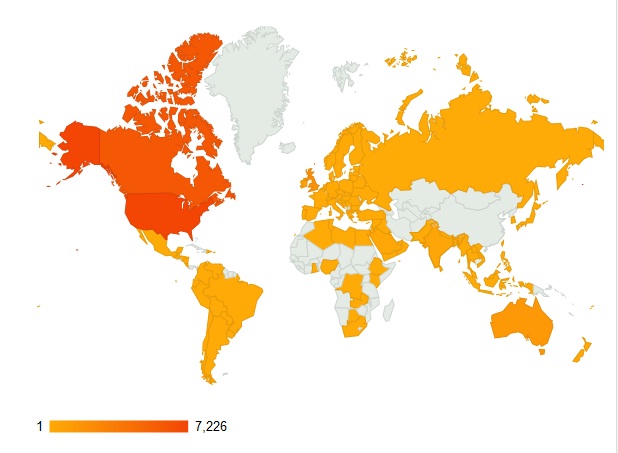
101 posts, 20,000 page views, 105 countries!

When I started this blog I intended it mostly for my own trainees, with the hope that others might find it useful, and that the energy expended for my fellows (and colleagues) could help others struggling like me to stay on top of the literature. As well as giving my own idiosyncratic interpretations of published articles, and trying to evaluate research in the context of previous published research.

Since the first posts on the 5th of May, I have written 101 posts, and the blog has just passed 20,000 page views from 105 countries.

Thanks everyone for their positive comments, I hope I can maintain the effort for another 6 months, and fill in the rest of the world map.

The grey areas on the map below are those countries that have not yet benefited from neonatalresearch.org!

Posted in Neonatal Research | 3 Comments

Slow codes, show codes, and no-codes in neonatal intensive care

This is the title of a live webinar debate, Nov 29th, 12-1pm

Organized by the Children’s mercy Hospital, Kansas City.

The Information for the Webinar is as follows:

Every NICU or PICU doctor has faced the following situation:  A baby is dying, slowly, of multisystem organ failure.  The family insists that everything be done and will not agree to a DNR order.  The doctors, nurses, chaplains and social workers have tried explaining the situation.  The disagreement has become intractable.

In such situations, doctors usually respond in one of three ways: 1) they sometimes continue discussions and try to convince the patient or family to agree to a DNR order; 2) they sometimes accede to the family wishes and do the CPR, even though they find it reprehensible to do so; and 3) they sometimes refuse to do CPR, explain this to the patient or family and, if disagreement persists, seek legal sanction to override family’s choices.

We have brought together two national experts in neonatal bioethics to discuss these situations.  Children’s Mercy Bioethics Director John Lantos, MD, will moderate and our special guests will be:

–          William Meadow, MD, PhD, Professor of Pediatrics and Assistant Director of the MacLean Center for Clinical Medical Ethics at The University of Chicago, who argues that, in some situations, there is a fourth possible response – one that allows for less than vigorous resuscitation – a “slow code” – without any explicit authorization from the family.

–          Annie Janvier, MD, PhD, Associate Professor of Pediatrics and Co-director of Pediatric Clinical Ethics at the University of Montreal, who argues that “…all resuscitations need to be taken seriously and performed in a consistent fashion every time…. performances and rituals are best left to priests, ministers and mullahs.”

They will debate and discuss different approaches to these difficult cases.  The webinar will be free, but you must register at: https://cmhbioethics.webex.com/cmhbioethics/onstage/g.php?d=660663559&t=a.  For more information on the CMH Bioethics Center and their debate series, visit their website – www.cmh.edu/cmbc.

Posted in Neonatal Research | Leave a comment

Weekly Updates #13

Tin W, Brunskill G, Kelly T, Fritz S. 15-Year Follow-Up of Recurrent “Hypoglycemia” in Preterm Infants. Pediatrics. 2012. A very long term follow up of a study by my friend Win Tin in the North East of England. They were unable to show an effect, no matter how they divided up the numbers, of recurrent hypoglycemia among preterm infants.

Grigsby PL, Novy MJ, Sadowsky DW, Morgan TK, Long M, Acosta E, et al. Maternal azithromycin therapy for Ureaplasma intraamniotic infection delays preterm delivery and reduces fetal lung injury in a primate model. Am J Obstet Gynecol. 2012(0). If you inject Ureaplasma into the amniotic fluid of rhesus monkeys they go into premature labour. If you treat them with azithromycin, premature delivery is prevented.

Miedema M, van der Burg PS, Beuger S, de Jongh FH, Frerichs I, van Kaam AH. Effect of Nasal Continuous and Biphasic Positive Airway Pressure on Lung Volume in Preterm Infants. J Pediatr. 2012(0). Increasing CPAP from 2 to 4 to 6 cmH2O increased lung volumes, and also increased tidal volumes in preterm infants, as measured by electrical impedance tomography. When infants on CPAP of 6 had BiPAP added (all this was using the InfantFlow SyPAP system) which was at an additional pressure of 3 cmH2O 50 times per minute for 0.5 seconds (non-synchromized) there was a very small further increase in lung volume, and no further increase in tidal volume. The authors were unable to consistently synchronise the device using the synchronisation module. In many parts of the world, medical devices, or new modes of ventilation can be introduced without any evidence that they are effective in improving clinical outcomes. BiPAP for preterm infants is one of those modes, this study suggests that clinical effects are unlikely with these settings.

Nyp M, Sandritter T, Poppinga N, Simon C, Truog WE. Sildenafil citrate, bronchopulmonary dysplasia and disordered pulmonary gas exchange: any benefits? J Perinatol. 2012;32(1):64-9. The authors gave sildenafil to 21 infants with BPD who also had pulmonary hypertension. They showed that according to the echocardiogram there was a reduction in pulmonary artery pressure, but there was no improvement in gas exchange after 48 hours of treatment. To be honest I don’t think that is the point; what we need to know is whether sildenafil improves survival and the long term. If the O2 needs don’t improve acutely, so what? There are may unknowns for these babies concerning the use of sildenafil, we need other good studies with clinical outcomes.

Stein H, Alosh H, Ethington P, White DB. Prospective crossover comparison between NAVA and pressure control ventilation in premature neonates less than 1500 grams. J Perinatol. 2012. This study only had 5 infants. They ventilated them with NAVA (where the ventilator is controlled by the diaphragmatic EMG) and with pressure control. The NAVA led to lower peak pressures but higher tidal volumes. Really who cares?We really need to know the comparisons between NAVA and volume ventilation, and whether there are clinically important differences.

Vento M, Cubells E, Escobar JJ, Escrig R, Aguar M, Brugada M, et al. Oxygen saturation after birth in preterm infants treated with continuous positive airway pressure and air: assessment of gender differences and comparison with a published nomogram. Archives of Disease in Childhood – Fetal and Neonatal Edition. 2012. Max Vento and his colleagues compared the pulse oximeter profiles of preterm infants who received CPAP in 21% oxygen to the published nomograms from infants who mostly did not receive CPAP. They showed that babies who get CPAP saturate higher, more quickly than published standards, especially the girls.

Ricci Z, Garisto C, Favia I, Vitale V, Di Chiara L, Cogo P. Levosimendan infusion in newborns after corrective surgery for congenital heart disease: randomized controlled trial. Intensive Care Medicine. 2012;38(7):1198-204. If you haven’t heard about levosimendan, you probably will…. It is an agent that sensitizes the myocardium to calcium, which has some theoretical value in the newborn who have reduced calcium sensitivity. It causes vasodilation and inotropism. This study randomized 63 babies to receive levosimendan or “standard post-op inotrope therapy”, which was as follows “… for CPB weaning consisted of milrinone (0.75 μg/kg/min) and dopamine (5 μg/kg/min) started at the end of cross clamp. If MAP was below 45 mmHg and filling pressures did not indicate the need for fluid replacement, dopamine was increased to 10 μg/kg/min. If such targets were not achieved, adrenaline (0.05–0.3 μg/kg/min) was added. Clinicians were allowed to decrease milrinone dose if MAP was lower than the selected cutoff after the addition of adrenaline.” The primary outcome of teh study was the development of Low Cardiac Output Syndrome, which is defined by them as “clinical signs and symptoms of the syndrome such as tachycardia (heart rate > 170 beats/min), oliguria (urine output < 0.5 mL/kg/h), cold extremities (peripheral temperature < 27 °C) with or without at least 30 % difference in arterial-mixed venous oxygen saturation or metabolic acidosis (an increase in the base deficit of greater than 4 or an increase in the lactate of more than 2 mg/dL) on two successive blood gas measurements. Postoperative cardiac arrest or the need for extracorporeal membrane oxygenation (ECMO) was also considered LCOS” Now that isn’t very clear to me, it looks like you could have LCOS just on the basis of tachycardia, or cool toes. In an unblinded study that is a bit of  a problem. the incidence of LCOS dropped from 61% to 37%, but it looks like none of the individual parts of the LCOS were different, in particular the mixed venous O2 was the same. The controls received more other inotropes than the Levosimendan group.

So I don’t know if this study really shows much effect of levosimendan, but it may be coming to an NICU near you, my colleague Po-Yin Cheung has published a few studies of levosimendan in newborn piglets, and showed that it has inotropic effects, in a hypoxia re-oxygenation model, with variable effects on regional perfusion. More work is needed before we start giving this widely in the NICU.

Posted in Neonatal Research | Leave a comment

Feeding patterns and NEC

I have discussed before evidence about whether the pattern of introduction or advancement of feeds affects NEC.  I noted that there is only one out of a large number of trials of feeding introduction and advancement which has shown an effect on necrotising enterocolitis, the large preponderance of the literature shows no such effect.

Two new studies also fail to show an effect. One is a historical cohort study, (Maas C, Mitt S, Full A, Arand J, Bernhard W, Poets CF, Franz AR: A historic cohort study on accelerated advancement of enteral feeding volumes in very premature infants. Neonatology 2013, 103(1):67-73.) the authors increased the starting feed volume and the feeding advancement volume, and compared GI complications before and after, the new protocol being to start at 20 mL/kg/d and advance at between 25 and 30 mL/kg/d, for all babies less than 1500g and less than 32 weeks gestation, during both time periods feeds were started on the first day of life. The results showed that full feeds were achieved more quickly in the later group, (6 days vs 8 days on average) and there was no increase in GI complications.

The other study is from Columbia, it is in Spanish, but with the English abstract and a smattering of Spanish, I think I have the gist, (I tried Google translate, but it kept telling me the page was already in English! Perez LA, Pradilla GL, Diaz G, Bayter SM: [necrotizing enterocolitis among preterm newborns with early feeding]. Biomedica : revista del Instituto Nacional de Salud 2011, 31(4):485-491.) The authors randomized 239 babies between 750 and 1500 grams birth weight to start their feeds either at 24 to 48 hours of age or on the 5th day. Both groups had an increase of about 20 mL/kg/d thereafter.  There was no difference in complications, but better nutrition in the early group.

Now I don’t think that routinely waiting to start feeds until after 24 hours is necessary, but the authors performed a nice trial to show that you certainly don’t need to wait 5 days, which they note was their usual practice before the study.

This is yet more data to show that the way that we feed preterm babies has no effect on NEC. So why is the belief so prevalent? I think that NEC is a serious, sometimes devastating disease, and we humans are always trying to find reasons and patterns in what happens to us. NEC usually presents after feeds are started, being relatively uncommon in babies who have never been fed, so the impact of feeds, and how they are given is a reasonable issue of concern. So if you see a baby who has NEC, and notice that the day before they had the NEC they had their feeds increased, it starts to make you think; then if you have a little run of cases, and you change your feeding protocol to become more conservative it is likely (regression to the mean) that NEC will be less frequent afterward. So confirming to you that you did the right thing. The next time you have an outbreak you become even more conservative, and low and behold, the NEC goes away again. This way you end up with some centers with extremely slow feed advancement, and others, who never bought into the association, who feed much more quickly, and year by year, no consistent relation between feeding patterns and NEC in large databases.

One further point, both of the studies above used gastric residuals to determine if the feeds were tolerated, but they used very different guidelines, one tolerated 1-2 mL and less than 30% of the feeds, the other tolerated between 25 to 50%. I previously worked in a center where we stopped measuring residuals; during a period of 8 years I was never bothered by the report of a residual, the only measurable effect was a reduction in periods of feed interruptions. Here at Sainte Justine, since our new feeding protocol was introduced we have also stopped routine measurement of residuals, and again the only obvious effect is to reduce the number of interruptions of feeds.

What would the best evidence based feeding schedule look like for a very immature infant?

1. Start feeds on day 1, at 20 mL/kg/d (should there be exceptions? I think babies in shock could wait a day or 2, otherwise probably not)

2. Use breast milk, with probiotics.

3. Increase by 30 mL/kg/d

4. Add breast milk fortifier immediately (we add after the baby is to receive 25 mL a day, as we prepare the milk every 24 hours and we don’t want to waste precious breast milk. I sachet of fortifier is mixed with 25 mL of breast milk)

5. Don’t measure residuals.

6. Don’t measure abdominal circumference.

The problem comes on day 1 if the Mother has not yet produced breast milk, what do you do? Donor milk, wait for mother’s milk, or give a couple of days of formula? We have opted to wait for mother’s milk (colostrum) as we don’t currently have a source of donor milk, but of course donor milk is not colostrum… Food for another study I think.

Posted in Neonatal Research | Tagged , , | 2 Comments

Opioids and Cerebral Development in the Newborn

An extremely interesting “ratling” study from the latest “Neonatology” (Dührsen L, Simons SHP, Dzietko M, Genz K, Bendix I, Boos V, Sifringer M, Tibboel D, Felderhoff-Mueser U: Effects of repetitive exposure to pain and morphine treatment on the neonatal rat brain. Neonatology 2013, 103(1):35-43.) The authors took baby rats on day 1 and looked at the effects  of pain and morphine treatment on cell death in their brains.

The study design is a bit complicated, they had 7 different experimental models, each of which was divided into 3 groups, 1 with severe pain, another with mild pain and a 3rd control. The 7 different models are 3 pairs of protocols, one with and one without morphine, as well as a 7th protocol performed at a later postnatal age, without morphine. All the morphine injections were given 30 minutes prior to the heelpad injections which were used to create the painful stimulus.

What they showed was that pain is bad for your brain! There was substantial neuronal cell death, mostly apoptosis in association with 3 days of severe pain, which was much worse than 3 days of mild pain, after 5 days of injections the apoptosis was equally important in the two groups. When the studies were done later in life (day 13) there wasn’t any detectable effect.

When morphine was given before the painful stimulus it substantially reduced the apoptosis, the figure below is from the publication and shows the preventive effect of morphine against apoptosis in the group that received painful injections for 3 days.


This is important because there is a lot of concern about the potential long term toxicity of various analgesic or anesthetic agents in the newborn, and previous studies of the effects of morphine in the absence of pain have shown adverse effects.

Although you obviously can’t extrapolate from this to what happens in newborn infants, it points out that the effects of various analgesic agents might be very different if the model has a painful stress or not.

Posted in Neonatal Research | Tagged | Leave a comment

The Preemie Toolkit

If you haven’t seen this and you are involved in NICU and/or follow up, I think this could be a very valuable resource. The preemie toolkit is a series of forms and web links for professionals and families designed to aid in a smooth transition from hospital to home. It includes check-lists for follow up visits, and information about everything from apnea monitors to hand washing.

Posted in Neonatal Research | Tagged | Leave a comment

Chloride is toxic

I think we have given too little attention to the nature of the crystalloid solutions we use. Not just in neonatology, but apparently in the adult ICU also,  (Yunos NM, Bellomo R, Hegarty C, Story D, Ho L, Bailey M: Association between a chloride-liberal vs chloride-restrictive intravenous fluid administration strategy and kidney injury in critically ill adults. JAMA : the journal of the American Medical Association 2012, 308(15):1566-1572) I’m a bit surprised this was published in JAMA, although it is interesting, it is not methodologically the best study, in fact it is not even a trial, it is a cohort study where the authors changed their practice in a very strict fashion, and recorded patient outcome data. They did this for a 6 months control period, then a 6 month intervention period.

First a bit about the results and the potential implications in neonatology, I will come back to the study design later.

Background: We know that normal saline has far more chloride than normal plasma, and that it’s use can lead to hyperchloremic acidosis for exactly this reason. Older patients often receive Ringers lactate, Hartmann solution or other lower chloride solutions, but there is very little use of these solutions in newborns. In my unit very often arterial lines in the past were filled with normal or half normal saline. I think neither of these are optimal, saline has relatively far too much chloride, and in fact we should avoid sodium in the first 3 or 4 days of life, as RCTs have shown worse outcomes when more sodium is administered.

Half normal saline is probably not a good idea, you give less sodium, but hypotonic solutions are problematic as when the blood is withdrawn into the catheter and syringe, there is a mixture created of the hypotonic solution and the blood which leads to lysis of the red cells. So although you give less sodium you end up giving more potassium and free hemoglobin when you re-infuse the dead space. We now often use a solution of sodium acetate in the arterial lines, which may be variably hypotonic, this has the advantage of giving less chloride and giving a buffer in its place, but there has been little study of acetate in the newborn.

To get back to this new study, the authors noted that high chloride administration in experimental animals causes renal dysfunction. So during the intervention period they changed their usual fluid administration practices, eliminating normal saline and 4% albumin and using lower chloride solutions (Hartmanns solution, plasma-lyte and 20% albumin) instead. They found significantly less acute kidney injury, and less need for renal replacement therapy (dialysis and the like).

I think this does not have direct implications for our practice, but should stimulate us to think a bit more about the fluids that we use, and whether they are optimal or not.

Finally to return to the study design, I think this is the worst of both worlds. I know it is a pain to design randomized controlled trials, and it can be horrendous getting them through the ethics review committees, but this study (which was approved by the ethics committee without the need for consent) could have been much more important, had much more impact and saved (or not depending on the findings) many future adults in ICU from kidney failure if they had randomized the subjects. As it is, people will discount this because they didn’t do it right; the patients were exposed to exactly the same risks as if they had been in an RCT, and people will go on using high chloride solutions, or will change to lower chloride when we really don’t know the probable effects.

An editorial in JAMA accompanying this study noted “A more definitive study examining the composition of intravenous fluids is now justified and necessary to scientifically test for potential adverse effect” how much better if they had done that straight away.

Posted in Neonatal Research | Tagged , | Leave a comment

Abort all the bankers!

I just heard a great quote from Francesca Martinez on the BBC News Quiz. Francesca Martinez is a stand up comic with a disability (she is often a sit-down comic in fact as you can see here), she is very witty, and often pokes fun at the preconceptions of her audience, she often notes that she has cerebral palsy, but prefers to call herself “wobbly”.

On the News Quiz she recounted doing her show at a doctors conference, after which, during a question and answer session with the audience, someone told her that they were a doctor involved in antenatal counseling and that they felt part of their duty, when counseling about aborting a disabled fetus, was to “reduce the suffering in the world”.

I loved her response to this, first of all she said that the room was very quiet (I imagine that many people present were super embarrassed by the question, and also fascinated to hear how a disabled comedian would answer) her retort was that if they really wanted to reduce the suffering in the world, they should abort all the  bankers, arms dealers, politicians and Rupert Murdoch!

Posted in Advocating for impaired children | Leave a comment

Weekly Updates #12

Welzing L, Oberthuer A, Junghaenel S, Harnischmacher U, Stützer H, Roth B: Remifentanil/midazolam versus fentanyl/midazolam for analgesia and sedation of mechanically ventilated neonates and young infants: a randomized controlled trial. Intensive Care Medicine 2012, 38(6):1017-1024. A small RCT (n=23) comparing fentanyl to remifentanil (both with midazolam). Both regimes gave good sedation and analgesia, but the remifentanil babies were able to be extubated much faster. Fentanyl has an average half life of about 10 hours in the newborn; remifentanil is metabolised by circulating esterases and has an extremely short half-life of about 3 to 6 minutes (this has not been confirmed in small neonates)

Bennett NJ, Tabarani CM, Bartholoma NM, Wang D, Huang D, Riddell SW, Kiska DL, Hingre R, Rosenberg HF, Domachowske JB: Unrecognized Viral Respiratory Tract Infections in Premature Infants during their Birth Hospitalization: A Prospective Surveillance Study in Two Neonatal Intensive Care Units. The Journal of Pediatrics 2012, 161(5):814-818.e813. If you look for respiratory viral infections routinely, you will find them. Not only will you find them, but they seem to prolong assisted ventilation and are associated with bronchopulmonary dysplasia, even though they usually do not cause any obvious symptoms.

 Martinez-Biarge M, Bregant T, Wusthoff CJ, Chew ATM, Diez-Sebastian J, Rutherford MA, Cowan FM: White Matter and Cortical Injury in Hypoxic-Ischemic Encephalopathy: Antecedent Factors and 2-Year Outcome. The Journal of Pediatrics 2012, 161(5):799-807. Follow up of 84 infants with HIE who did not have basal ganglia or thalamic injury. They not that few infants had cerebral palsy, and none very severe CP, but that a wide range of other disabilities were prevalent, cognitive, language, behavioural and seizures.

Katheria A, Rich W, Finer N: Electrocardiogram Provides a Continuous Heart Rate Faster Than Oximetry During Neonatal Resuscitation. Pediatrics 2012. Again challenging our standard practice during resuscitation, Neil Finer and his group measured how long it takes during resuscitation to get a reliable heart rate using the standard (which has become pulse oximetry) to sticking on ECG electrodes like we do everywhere else in medicine. It was faster to put the probes in place (26 vs 38 secs), and much faster to get an audible heart rate signal when you stick the ECG leads on (2 seconds) versus the oximeter probe (24 seconds).

Carr R: The role of colony stimulating factors and immunoglobulin in the prevention and treatment of neonatal infection. Arch Dis Child Fetal Neonatal Ed 2012. A very nice review of the current state of the art.

Posted in Neonatal Research | Leave a comment