Perpetuating Prejudice against Preterms: 1. Inappropriate simplistic rules are unethical.

Towards the end of last year the Canadian Pediatric Society published a new ‘position statement’. These are official proclamations of the society, supposedly based on the best available evidence to guide practice, and which become de facto standards of care. This particular one ‘Counselling and management for anticipated extremely preterm birth’ presented an opportunity to update a 20 year old statement.

Unfortunately it is a failure. It promotes an unethical standard based on simplistic thresholds of intervention. I have been writing a response to this for a while, and following the commentary in the CMAJ by Dan and Beau Batton, which makes many of the same points, I thought I would share this, in various different sections; this is the first.

This series of posts are a very expanded version of a commentary that has been accepted for publication in ‘Paediatrics and Child Health’. That commentary was written  by a large group of collaborators from around the world, but is only 1500 words long, to comply with the word limits. I have taken the ideas from that commentary and developed them here.

The CPS position statement makes the following recommendations:

  • At 22 weeks’ GA, since survival is uncommon, a non-interventional approach is recommended with focus on comfort care. (Strong Recommendation)
  • At 23, 24 or 25 weeks’ GA, counselling about outcomes and decision making around whether to institute active treatment should be individualized for each infant and family. (Strong Recommendation)
  • At 23 and 24 weeks’ GA, active treatment is appropriate for some infants. (Weak Recommendation)
  • Most infants of 25 weeks’ GA have improved survival and neurodevelopmental outcomes and active treatment is appropriate for these infants except when there are significant additional risk factors. (Weak Recommendation)

I will leave aside for the moment the  ‘strong’ and ‘weak’ recommendation part of this, more on that later, (see part 2).

This post will address the first 4 of the many failings in these recommendations;

1. Gestational age is only known imprecisely.

2. there is no explanation on how these thresholds were picked,

3. gestational age is only one part of risk assessment for these babies, and

4. the values and wishes of the parents are not mentioned.

1. Firstly, we never know the gestational age, except after in vitro fertilization. Recommending precise thresholds for intervention based on a number that is very imprecise is ridiculous. At its best, ultrasound, performed at around 12 weeks, can be plus or minus 5 days, 95% of the time. How can you recommend changing from one recommendation to another at a precise day, when the true gestational age may be 5 days more or less? Surely we need to recognize this limitation, and counsel families according to a range of possibilities based on GA plus or minus 5 days, as well as on other factors which affect survival. If the ultrasound is performed between 14 and 18 weeks the accuracy is plus or minus 10 days, after 18 weeks ultrasound is completely unreliable for assignment of GA.

2. Nowhere in the discussion preceding the recommendations is there any rationale given for not intervening at 22 weeks, but considering intervention at 23 weeks. In other words, why not start considering intervention at 23 weeks and 3 days? Or why not at 24 weeks, 2 days and 17 hours? Surely it couldn’t be just because it is a nice round number? This position statement, and others like it, can be lethal. Making potentially lethal statements which are based on a nice round number that happens to coincide with our traditional division of time into 7-day periods is worse than irrational. What changes at 23 weeks, 0 days and 0 hours to make intervention optional, when it was not even an option previously? This is never explained.

When you combine these 2 problems, the situation become ever more ridiculous, a mother in threatened preterm labour who presents with a best-guess gestational age of 23 weeks and 4 days, if you have a good quality 10 weeks dating ultrasound, has a 95% lower probability limit of actually being 22 weeks and 6 days, and therefore supposedly not eligible for active intervention. The 95% upper probability limit of gestational age would be 24 weeks and 2 days, which according to this statement changes everything.

But it is the same mother, the same family, the same fetus.

3. Survival of infants who receive intensive care at a best-guess gestational age between 22 weeks and 0 days and 22 weeks and 6 days (plus or minus 5 days!), when considered as a group, varies from 10% to 34% in different places who are willing to give active perinatal care, and, obviously, it is 0% if they are not willing to do so.

But we aren’t treating a group of babies, we are, potentially, treating individuals, some of whom have very poor chances of survival, and other who have chances of survival which are very much better. If you take the data from the NICHD network, the chances of survival at 22 weeks vary by more than 20-fold depending on other factors such as sex, birth weight, and having received steroids. The NICHD calculator gives chances of survival of between less than 1 % to more than 20% for individual babies born at a ‘best-guess GA’ of 22 weeks. We also know that infants whose ‘best-guess GA’ at birth is nearer to 23 weeks are more likely to survive than babies just at or just after 22 weeks. To lump them all together, just because it is easy, is doing a major dis-service to their families. For some babies, under certain circumstances, active intervention before 23 weeks gestation is a reasonable option, and if consistent with the families values and their wishes it should be considered.

A blanket recommendation to never intervene before 23 weeks gestation ignores all of these other factors. (gestational age uncertainty, other good or adverse risk factors, parent’s values, extra days of gestation…)

At the other end of this period of gestation, the statement reads ‘Most infants of 25 weeks’ GA have improved survival and neurodevelopmental outcomes and active treatment is appropriate…’. (First of all this makes no grammatical sense, ‘Most have …improved’, what does that mean; compared to what?) But more importantly, some infants born at 25 weeks have very poor chances of survival, many others have excellent chances, a boy born at 25 weeks and 1 day (plus or minus 5 days) who is small for gestational age and hasn’t had a chance to get steroids has a much lower chance of survival than a baby of 25 weeks and 6 days (plus or minus 5 days) with higher than average birth weight who has had steroids. Lumping them together is senseless. Just as importantly the girl at 24 weeks and 3 days (plus or minus 5 days) who has had steroids and has a good birthweight also has a much better chance of survival and a much better outcome than the previously mentioned SGA infant without steroids. But she is on the wrong side of this nonsensical divide, so her life is considered optional.

There is so much overlap between the outcomes of infants born at ’24 weeks’ and those born at ’25 weeks’ that it is unhelpful to divide the infants up this way.

Counseling a mother with threatened extremely preterm delivery should start with a risk assessment which must take into account her probable gestational age (with its inherent uncertainty) the estimated fetal weight (with its even greater inherent uncertainty, see below) the place of birth, whether the mother has been administered steroids, and whether the baby is single or if it is a multiple gestation, and then explore her values and the family’s desires.

The graph below illustrates how little sense it makes to base decision making on gestational age. They are data from a fairly new study from the Trent region of the UK Manktelow B and others, recently released in Pediatrics. Manktelow
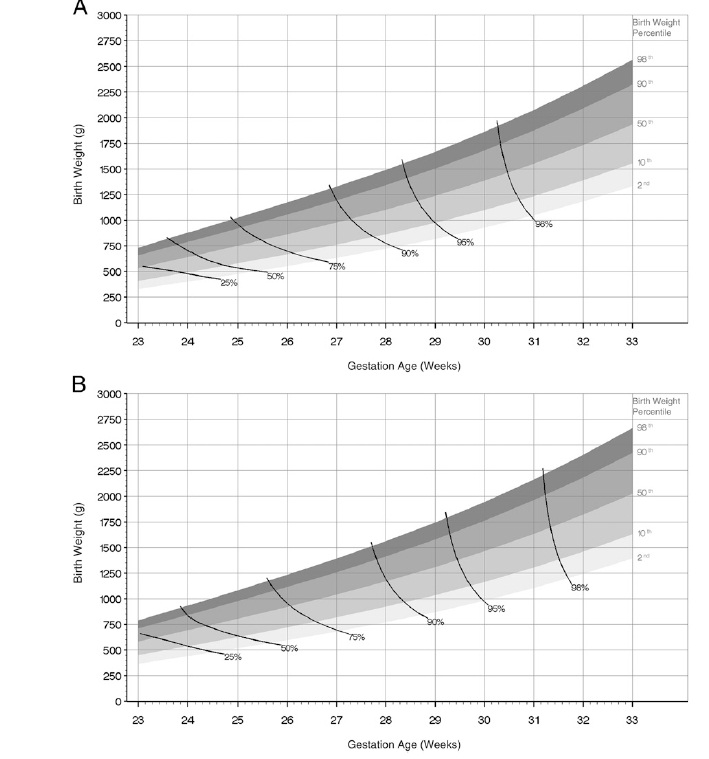
The top panel is for girls, the bottom one for boys. The graphs show the different weight percentiles at increasing gestational ages, and the solid lines join combinations of weight and gestational age which have the same mortality. If a GA based guideline made sense then these lines would have to be close to vertical, and be the same for boys and girls. In fact they are closer to horizontal, the graphs would have to be multi- dimensional to also include the effects of having had steroids and being multiple or a singleton, but those factors also affect survival. In fact the near horizontal line at very low gestations means that birth weight has a closer relationship with mortality than does gestational age. Of course we don’t know the birth weight before delivery and estimated fetal weights can be helpful, as a sort of general guide, but estimated weights are much more variable even than gestational age, being plus or minus 10%, 75% of the time (depending on the study you use to do the calculations). 

These are complex and difficult decisions in moments of stress. Reducing them to a simplistic mantra based on completed weeks of gestational age is unethical.

4. Finally the recommendations must mention the values and desires of the parents, which, although discussed in the text, are not in the recommendations, surely they are pivotal. Surely they must be mentioned in the recommendations.

I think that externally imposed arbitrary limits for resuscitation are unethical. In any field of medicine. In this particular case, threatened preterm delivery, the uncertainties of gestational age assessment and the poor correlation of gestational age with outcomes makes this triply unethical.
Posted in The CPS antenatal counselling statement | Tagged , , | 2 Comments

Preterm Babies are Human Beings Too

The Canadian Medical Association Journal has just published a Commentary by 2 neonatologists from the USA. Batton D, Batton B: Advocating for equality for preterm infants. Canadian Medical Association Journal 2013.

The commentary is in response to the CPS recent statement, produced by the fetus and newborn committee ‘Counselling and management for anticipated extremely preterm birth, Pediatr Child Health 2012:17; 443-6’. (The new document is behind a paywall, if you can’t find another way of getting a copy, let me know, I might be able to help.)

The new commentary is a brief critique of the statement, which, to me, hits all the right buttons; the uncertainty of gestational age assessment, the unreliability of data from centers that practice selective treatment, the impossibility of predicting outcomes before birth, and the fact that the decisions that are being made would be completely unacceptable for any other patient with similar predicted outcomes.

One thing that continues to disturb me is that way that neonatologists have often advocated against our patients. We have promoted standards that no other group would accept, and accepted enormous variations in practice that would be heavily criticized in other fields.

It is about time that we started to advocate for our patients, for standards of care that recognize that these babies deserve appropriate medical care, and have rights as human beings once they are born.  I don’t think that life sustaining interventions should always be provided to all preterm babies, but I don’t think that for older children or adults either. We should be pushing for all preterm babies to be given the same benefits, the same opportunities, and the same considerations of their best interest as other patients. We have instead accepted, and even ourselves promoted, arbitrary and non-evidence based limits to be placed on life-sustaining interventions.

The Key Points of the Battons’ commentary are :

• The decision to provide active intervention to extremely preterm infants at the border of viability is difficult but should not be discriminatory.

• Current methods of estimating gestational age are not sufficiently precise for this to be the sole basis for decision-making.

• The error of a self-fulfilling prophecy inherent in withholding active intervention in the delivery room because it is assumed to be futile should be avoided.

• Reported neurodevelopmental disability rates in populations of surviving infants are not sufficient criteria for withholding active intervention in the delivery room.

• Providing antenatal steroids and active intervention initially and then re-evaluating the appropriateness of such intervention with the parents thereafter should be the default approach to care when the infant’s best interests are unclear.

Posted in Neonatal Research | Tagged , , | 35 Comments

100,000 page Views!

I guess I am now an established blogger… just over 300 posts in about 18 months, 100,000 page views from 151 different countries. For a while I thought I must be blocked in China, but I now have had 2 visitors from their population.

To mark this event I thought I would give links to ‘Neonatal Research: greatest hits edition’, and I have updated some of the pages that I often neglect such as ‘Important Neonatal Publications’ and ‘My Publications’

The Posts that I chose as greatest hits are either those that had the most hits, or generated the most traffic, and those that I think were the most ‘important’ not that I think my posts are very important, this is my hobby!

https://neonatalresearch.org/2012/07/23/our-children-are-not-a-diagnosis-the-family-experience-of-trisomy-13-and-18/

https://neonatalresearch.org/2012/05/23/weaning-from-cpap-in-preterm-babies/

https://neonatalresearch.org/2012/06/02/what-does-a-low-bayley-score-mean-predicting-long-term-outcomes-part-1/

https://neonatalresearch.org/2013/06/07/why-were-they-in-such-a-hurry-to-see-her-die/

https://neonatalresearch.org/2013/08/19/end-of-life-at-birth/

https://neonatalresearch.org/2012/10/09/probiotics-enough-is-enough/

https://neonatalresearch.org/2012/10/06/assessing-perfusion-in-the-sick-preterm-baby/

Posted in Neonatal Research | 1 Comment

Palivizumab for late preterm infants, can we afford it?

It is quite clear that palivizumab reduces the incidence of RSV disease, and probably also the severity, among those who still get it nevertheless. It is just as clear that it is extremely expensive.

If RSV is likely to make you very sick and end up in hospital then there is a definite cost saving from administration, other benefits are much harder to cost.  This is probably the first time I have written about health care costs in this blog, but it was stimulated by a new publication  ‘Yoshihara S, Kusuda S, Mochizuki H, Okada K, Nishima S, Simões EAF: Effect of palivizumab prophylaxis on subsequent recurrent wheezing in preterm infants. Pediatrics 2013, 132(5):811-818′ This was a prospective observational study funded by Abbott, which followed 349 late preterm infants who received three doses of palivizumab and 95 who received none. Recurrent wheezing occurred much more frequently in the untreated than in those who received the prophylaxis. Although this appears effective, and the study design is a reasonable second best compared to an RCT, the cost implications are enormous.

Earlier this year a proper masked RCT was published in the PNEJM (Blanken MO, Rovers MM, Molenaar JM, Winkler-Seinstra PL, Meijer A, Kimpen JL, Bont L, Dutch RSVNN: Respiratory syncytial virus and recurrent wheeze in healthy preterm infants. The Prestigious New England journal of medicine 2013, 368(19):1791-1799). That study (also funded by Abbott) also showed a significant reduction in the onset of recurrent wheezing, of a slightly smaller magnitude (11% vs 21%). The diagnosis of recurrent wheezing is not necessarily the best way to determine the benefit of the RSV prophylaxis: in the first year of life the controls wheezed for 4.5% of the days of the year, the treated babies for 1.8%. That is a 61% relative reduction, but a modest actual benefit.

An editorial in Pediatrics accompanying the new article is worth a read (Meissner HC, Kimberlin DW: RSV immunoprophylaxis: Does the benefit justify the cost? Pediatrics 2013, 132(5):915-918). For anyone who does not have full text access, I summarize: palivizumab is horrendously expensive, it is not at all clear that the benefits are worth it.

A number of cost-effectiveness analyses have been published regarding palivizumab prophylaxis with dramatically different conclusions. Cost-analyses sponsored by the manufacturer generally show cost neutrality or even cost saving. Among independently conducted cost analyses, the cost of prophylaxis with palivizumab is generally found to far exceed the economic benefit of hospital avoidance, even among infants at highest risk.

The authors of this commentary note the following among high risk groups, in whom for every 19 affected children there is one fewer hospital admission:

The acquisition cost of palivizumab is $202 635 to save $8530 in hospitalization cost.

In many jurisdictions there are ‘rebates’ which can be given in many different ways. I personally am very concerned about the way this works in Quebec. We pay an enormous amount for this medication, making huge profits for the manufacturer, in order to ensure that all the eligible infants receive their palivizumab the company then gives a subsidy to the hospital to support the salary of an ‘RSV nurse’ whose job is to ensure that no-one is missed. This is touted as being a public benefit, a ‘good deed’ on behalf of the manufacturer (I wouldn’t be surprised if it is tax-deductible). So, even in our public health care system, the manufacturers are themselves ensuring that they have the maximum uptake.

Currently in Québec there are guidelines in place, which assign risk scores to late preterm infants to decide which ones are eligible for palivizumab. The risk scores are a way of determining which infants are at highest risk of developing RSV and being hospitalized for it, but I am not at all sure that they discriminate according to whether there is a cost-benefit or not. In these days of cuts in our health care budget, this should be re-scrutinized.

On the other hand these new studies support the long held idea that RSV causes long lasting pulmonary dysfunction, and finding better, cheaper, ways to prevent it would be a good thing.

Posted in Neonatal Research | Tagged , , | 6 Comments

Neonatal Mortality: good news… could do better.

The new report of the WHO Global Health Observatory notes that child mortality, infant mortality and neonatal mortality have all fallen substantially in the last 23 years. The efforts toward obtaining the millennium goals are bearing fruit. http://www.who.int/gho/child_health/mortality/neonatal_infant_text/en/index.html

The detailed report is available here:  http://www.who.int/maternal_child_adolescent/documents/levels_trends_child_mortality_2013.pdf

Annual neonatal deaths have fallen from 4 and a half million to just under 3 million. At the same time deaths of children under five have fallen from 12.4 million to 6.4 million, in 2000 they were at 9.6 million, so a substantial part of that fall is due to the efforts towards the millennium development goals. Nearly half of the remaining deaths were in Sub-Saharan Africa, where the under five mortality rate is still an appalling 97 per 1,000 births, including 32 per 1000 neonatal deaths (compared to 4 in the developed world).

So despite the fall in neonatal mortality, the proportion of pediatric deaths that are neonatal has increased, from 37 to 44%. Even though this is indeed encouraging, it shows that the improvement in neonatal mortality has not been as great as the overall child mortality improvements. Prevention of prematurity, ‘Helping Babies Breathe’, clean cord care, recognition of infections in the neonatal period, cooling for asphyxiated babies, and education of mothers. If we can do all these things we can make a huge difference for millions of babies.

Posted in Neonatal Research | Tagged | Leave a comment

Neonatal Updates #40

Oops, the last one was #40, except it wasn’t, this is the real #40, as we are heading to a big blog threshold soon, I will probably stop numbering these!

Field D: Neonatal ECMO Study of Temperature (NEST): A Randomized Controlled Trial. Pediatrics 2013. This was a UK multi-centre randomized trial of controlled hypothermia during ECMO, with just over 100 babies randomized, the 2 year outcomes showed that somewhat more babies died in the cooling arm, and the developmental scores were slightly lower with cooling than normothermia. Although none of the differences were significant, there is no evidence of benefit. I certainly thought this was worth studying, and that it might well be beneficial, it just shows again how important it is to do good trials like this one.

Wadhawan R, Oh W, Hintz SR, Blakely ML, Das A, Bell EF, Saha S, Laptook AR, Shankaran S, Stoll BJ et al: Neurodevelopmental outcomes of extremely low birth weight infants with spontaneous intestinal perforation or surgical necrotizing enterocolitis. J Perinatol 2013. We have known for a while that NEC is bad for your long term outcome, and that surgical NEC is worse; the data regarding spontaneous intestinal perforations  (SIP) has been less consistent, but worrying. This is probably the largest follow up study of SIP with nearly 300 cases, and nearly 500 surgical NEC. Both were bad, the SIP babies were a little less mature than the surgical NEC, but their long term outcomes were similarly worse than controls without SIP or NEC. The plot of the Odds ratios for neurological impairment or developmental delay on multiple logistic regression are revealing, SIP and surgical NEC are both serious risk factors for poor outcomes, with Odds similar to postnatal steroids, BPD, severe IVH and PVL.

Infantino BJ, Mercer DF, Hobson BD, Fischer RT, Gerhardt BK, Grant WJ, Langnas AN, Quiros-Tejeira RE: Successful Rehabilitation in Pediatric Ultrashort Small Bowel Syndrome. The Journal of pediatrics 2013, 163(5):1361-1366. If after a case of NEC (or for any other reason) you end up losing your bowel, make sure you are looked after by a multi-disciplinary intestinal rehabilitation team like this one. These authors report that after very prolonged intensive therapy they were able to get half of their babies, who had less than 20 cm of small bowel left, off TPN. It took up to 4 years, and many of the babies had surgery, sometimes more than once, but succesful TPN weaning, when the remaining bowel is this short, is a real success.

Konduri GG, Sokol GM, Van Meurs KP, Singer J, Ambalavanan N, Lee T, Solimano A: Impact of early surfactant and inhaled nitric oxide therapies on outcomes in term/late preterm neonates with moderate hypoxic respiratory failure. J Perinatol 2013. This is a secondary analysis of the early versus late iNO therapy. The original analysis showed no major difference between the groups. This analysis suggests that starting treatment earlier leads to improved outcomes.

Posted in Neonatal Research | Leave a comment

Registry Trials

The latest PNEJM reports a large trial in adults (over 7000 patients randomized) in a very tasty trial, known as TASTE (Thrombus Aspiration in ST-Elevation Myocardial Infarction in Scandinavia).

The trial was among patients who were undergoing coronary angiography and intervention for an acute ST elevation Myocardial Infarction, whose data were already being entered into the SWEDEHEART database (I love that acronym, which stands for Swedish Web System for Enhancement and Development of Evidence-based Care in Heart Disease Evaluated According to Recommended Therapies, not bad for an acronym in a foreign language, but I guess most Swedes speak English as well as many native speakers) In one group they sucked out the clot before proceeding to stent, in the other group they did not.

Basically the study found no difference between the groups. The reason I though I would write about it is that this is an amazing study. Of the 7200-odd patients randomized the losses to follow up were zero! They managed to enroll about 2/3 of eligible patients, and because the patients were part of the registry they were able to really find out what happened to the non-enrolled patients as well. So they present results of the 4,700 non-enrolled patients as well as the randomized patients.

As this is an emergency procedure and you can’t spend a lot of time faffing about getting consent, they initially got oral consent, then randomized the patients, performed the procedure and then came back to get full signed consent later.

All of the data being collected was already being collected by the SWEDEHEARTs, so they were able to finish the study in record time for very low cost.

I think this is the way to go, we already have some well established comprehensive databases in Canada, Australia/NZ, VON, who could perform studies like this, as the accompanying editorial in the PNEJM puts it this the next disruptive technology in medical research. We could use our neonatal databases to do research which will be done faster, at lower cost, include a greater proportion of eligible babies and therefore be more generalizable. I think this would work best for comparative effectiveness research, if you are comparing things that are already being done in different centers then there is much less need for serious adverse event forms, over-detailed case report forms, and all of the structure that is imposed on clinical trials nowadays.

One other point, for those who think that being treated according to your doctor’s best guess is preferable to being in an RCT, the randomized patients had an overall mortality of 3%, the patients who were not enrolled and treated according to their doctors best guess (about sucking the clot out or not) had a mortality of over 10%. 6% of the patients who were randomized and treated according to the protocol developed heart failure, and over 10% of those treated outside the protocol. You are much better off being randomized and treated according to protocol.

Posted in Neonatal Research | Tagged , | 2 Comments

Reducing BPD by Avoiding Intubation

Sometimes more than one article gets published almost simultaneously on the same topic, sometimes with similar methodology. Two systematic reviews of the effects of trying to avoid or curtail endotracheal intubation in order to protect the lungs have just been published.

One of the reviews (Schmolzer GM, Kumar M, Pichler G, Aziz K, O’Reilly M, Cheung PY: Non-invasive versus invasive respiratory support in preterm infants at birth: systematic review and meta-analysis. BMJ 2013, 347:f5980) only included studies that intervened in the delivery room. They found 4 studies (COIN, SUPPORT, CURPAP, VONDR). All of the studies compared immediate intubation for surfactant to CPAP, one gave the surfactant using a brief intubation (the INSURE technique), one had 3 groups, CPAP vs intubation and conventional weaning vs INSURE. The other 2 studies compared CPAP to intubation with either selective or routine surfactant. They found a 9% reduction in the combined outcome of death or BPD in the groups that had an attempt to maintain on CPAP, rather than being intubated, the NNT was 25.

The other publication (Fischer HS, Bührer C: Avoiding Endotracheal Ventilation to Prevent Bronchopulmonary Dysplasia: A Meta-analysis. Pediatrics 2013) included 3 other trials, which are somewhat different, the Columbian Neonatal Research Network trial, which excluded infants under 27 weeks, and randomized babies to either CPAP or INSURE within 60 minutes of birth, and 2 trials which are somewhat different. Gopel et al compared CPAP to CPAP with minimally invasive surfactant treatment (I will call it MIST after Peter Dargaville) but in fact they also included infants who were already intubated, so it is not so comparable to the other trials. Kanmaz et al compared CPAP with MIST to INSURE. The systematic review concluded that there was a 17% reduction in the combined outcome of death or BPD, with an NNT of 35.

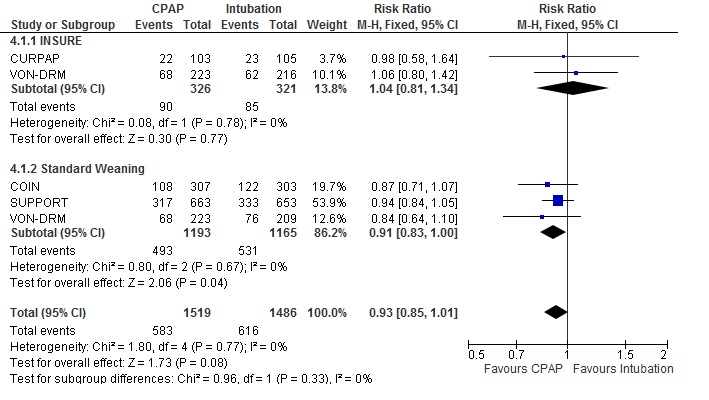
There will very shortly appear in ‘Seminars in Perinatology’ a review article that I was asked to write for an NIH conference in January. I was asked to perform an evidence based review of interventions that improve outcomes in the extremely preterm infant. (It was supposed to appear in October so there are 2 days left!). One of the things I did in that review was to look at the same issue; unfortunately there are very few extremely immature babies in the studies, I included the 4 trials in Schmolzer et al’s review mentioned above, but I separated the analyses into those that compared CPAP to INSURE, and those that compared CPAP to intubation with conventional weaning.

Figure 3 CPAP

As you can see from this Forest plot, that suggests that there is an advantage of CPAP started in the DR compared to intubation and standard weaning, but if you have to intubate, you should strongly consider the INSURE technique, which may have similar benefits.

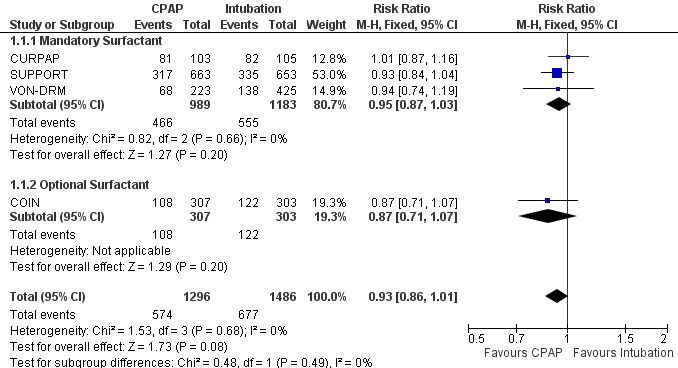
As you can also see if you are very perceptive, I included the VON-DRM CPAP babies twice, for the subgroup analyses that makes no difference, for the overall analysis, it is such a small number of babies that it makes no real difference to the final result. As you can see the confidence intervals include 1.0, just.

When I divide the analyses into those studies that mandated surfactant for all the infants, to those that had optional surfactant therapy (that is the COIN study, where the large majority did get surfactant) the overall result is the same, a very nearly significant reduction, even when including the VON-DRM CPAP babies only once.

Forest plot

UPDATE** review article has now been published. Barrington KJ. Management during the first 72h of age of the periviable infant: An evidence-based review. Seminars in Perinatology. 2014;38(1):17-24. If you want a copy and don’t have access, I can probably find you a source!

Posted in Neonatal Research | Tagged , , , , | 1 Comment

Brain Death: a fiction that has outlived its usefuleness

It may come as a surprise to some readers that I regard ‘Brain Death’ as a fiction. But brain death was invented by a US president’s commission as a way of deciding that patients were dead when they manifestly were not dead. That is they still had a heart beat. The sole reason for creating this new category of death was to provide an avenue for organ donation. If the patients were defined as being dead then we could apply the ‘dead donor rule’. The idea being that we cannot take organs from someone who is still alive, that would cause their death, and to cause the death of one person to save the life of another was not ethically acceptable.

So we are now in the situation where, as one example, a baby who is profoundly asphyxiated, who has no chance for recovery, and for whom intensive care will be discontinued and they will be allowed to die; if such a baby, on brain death testing, takes a few gasps when the CO2 hits 70, we are not allowed to use their organs, even when the parents want us to, and even when all the cortex of the baby, everything that makes us human, is irrevocably destroyed. Instead we have to shut off the ventilator, let the baby die, and then burn the organs that could have saved another baby’s life.

Is that, overall, a better outcome for humanity than using their organs to save the life of another infant? Is it a better outcome for that individual baby, or their family?

How was the concept of brain death developed? Human beings who have extremely severe brain injury may die without ever having regained consciousness. So the presidential commission decided that they were, therefore already dead. Such a decision is a 20th, 21st century consideration; before intensive care, such individuals would be truly dead already, that is their hearts would have stopped. But simply by breathing for them, we can keep alive those would previously have been dead, and create a new category of patients with profound, unrecoverable, brain injuries who continue to have cardiac activity. Tests were invented to show that the brain stem was not working, and, without a brain stem that works, consciousness does not return and the patient will soon die.

In the newborn, the brain stem is particularly resistant, so despite devastating lethal brain injury, many infants will continue to breathe a little, even when all other function has gone.

The ‘dead donor rule’ has become a mantra of organ donation. Even when we stretch the rule to breaking point.

A recent couple of articles in the PNEJM argue the issues. In one the author promotes keeping the DDR, but at the same time speaks positively about a new innovation, that, because taking out both kidneys does not immediately cause death, that could be done in patients who are not ‘Brain Dead’. But taking out the heart would not be acceptable, because that would destroy patients trust in doctors.

On the other side of the argument are those who consider ‘brain death’ to be a convenient fiction, and promote the idea that once (and only once) we have decided to stop ongoing intensive care, that consideration of organ donation could then follow without these restraints. This might sound like a sort of utilitarism, making use of patients and their organs in the most convenient way possible, but honestly I can’t see it. I can’t see any doctor deciding to interrupt intensive care for a patient just in order to take out their viable bits to give to someone else… that happens in movies, but in real life, not so much. Would such a change really affect the public’s trust in intensive care doctors? I am not so sure.

The somewhat less controversial new approach of stopping intensive care in the operating room for a potential donor who is ‘not quite Brain Dead’ and then waiting for their heart to stop with scalpels at the ready, and quickly whipping out their organs before their organs deteriorate is, to me, just as problematic. It is also less efficient, and also without a crystal clear definition of how long you have to wait after the last slow heart beat has passed to be sure there will not be another one; or even whether you should wait until after mechanical activity of the heart has stopped, or must you wait until all electrical activity has stopped.

I hope these articles in the PNEJM are the start of a new debate, that can start where the realities of intensive care have now brought us, where lethal brain injuries do not cause instant death, nor necessarily lead to ‘Brain Death’, but frequently lead to interruption of intensive care and the death of the patient, whose family occasionally might be given the option of helping another person with the organs which still function.

Posted in Neonatal Research | Tagged , | 3 Comments

How to deliver CPAP

Two almost simultaneous articles, one from the Melbourne group. One from Colm O’Donnell in Dublin who has worked with the Melbourne group in the past

Kamlin COF, Schilleman K, Dawson JA, Lopriore E, Donath SM, Schmölzer GM, Walther FJ, Davis PG, te Pas AB: Mask Versus Nasal Tube for Stabilization of Preterm Infants at Birth: A Randomized Controlled Trial. Pediatrics 2013, 132(2):e381-e388. If you are able to stabilize a small preterm infant with CPAP, how should you maintain it while you are transferring the baby to the NICU? This study was stopped early as there was no difference between groups, i think that makes sense as long as you are careful  to maintain distending pressure, it doesn’t matter very much how you do it during the transition period.

McCarthy LK, Twomey AR, Molloy EJ, Murphy JFA, O’Donnell CPF: A Randomized Trial of Nasal Prong or Face Mask for Respiratory Support for Preterm Newborns. Pediatrics 2013, 132(2):e389-e395. This is a similar trial looking at how to give distending pressure in the delivery room, again showing that it doesn’t matter much, as long as you are careful to ensure that there is real positive pressure being delivered.

So if your very premature baby can avoid intubation, giving CPAP by either a face mask or a single nasal tube are equally effective, you just need to ensure that you have procedures in place to provide uninterrupted distending pressure during the transfer to the NICU, and starting CPAP once you are there.

Posted in Neonatal Research | Tagged , , | Leave a comment