Do Moderately Preterm Infants need RSV Immunization? What use are numbers without a denominator?

Palivizumab is an enormously expensive medication, an antibody which is given intramuscularly about once per month to at-risk infants to prevent infection with the respiratory syncytial virus (RSV). Recently the AAP and the CPS have changed their recommendations to reduce the number of preterm babies who are eligible for it. Most babies who are slightly or moderately preterm will no longer be eligible for prophylaxis, the decision being largely because the benefits of RSV prophylaxis are not matched by the huge costs.

It is clear that palivizumab decreases both the incidence and severity of RSV infections. So its use is really only a question of cost-benefit. Costs being the monetary cost of the medication, and in addition the “cost” of a monthly intramuscular injection and its administration. If it were not for these costs then you could give palivizumab to everyone. It is to the financial benefit of the medication’s producers to emphasize the benefits of prophylaxis, while not talking about the costs, and not even trying to figure out the incidence of the problems that they are aiming to prevent.

The last sentence of this new paper you could write about absolutely any group of newborns:

Preventing severe RSV disease in this population would provide substantial health benefits, particularly during the first months of life when RSV disease incidence and severity are highest.

It may be no surprise to discover that this paper (paid for open access (by AstraZeneca), unlike most publications in this journal) was funded by AstraZeneca, who are the current producers of palivizumab; it was written by a medical writing company paid by AstraZeneca, has a corresponding author who works for AstraZeneca, and has multiple authors who have other links with AstraZeneca.

What this paper tells us is that some infants who did not get prophylaxis will catch RSV (we don’t know from this paper if that is more than babies who did get prophylaxis) some of them get very sick (we don’t know from this paper if that is more than babies who did get prophylaxis) and it costs a lot of money (we don’t know from this paper if that is more than babies who did get prophylaxis).

The paper gives no indication of how many potentially affected babies were involved, there is no denominator.

There were 702 babies with confirmed RSV disease which was community acquired. For some reason, which is not clear to me from this publication, they only give good information for 219 babies who were “enrolled”. I have read this paper a couple of times (only for the purposes of this blog; otherwise it would have quickly ended up in the metaphorical garbage can: the things I do for my gentle readers…) and I can’t figure out who was enrolled and why, compared to the non-enrolled babies, so we don’t know if the third who were enrolled were representative of the entire cohort.

The information we really need in order to decide who should get palivizumab is the following: how much does it cost if we give 10,000 34 (or 33 or 35) week gestation babies palivizumab prophylaxis, and how much does it cost if we don’t.

Studies designed, paid for, performed, written, and published, by the people who manufacture palivizumab are not likely to help us very much.

But even better would be studies that show how, now that all the R&D costs of the development of palivizumab have been recouped many times over, we can ensure that the price of palivizumab is reduced to reflect “production costs with a reasonable profit margin”; rather than “as much as we can possibly get away with”.

Posted in Neonatal Research | 2 Comments

Making Good Decisions: part 3. Living with the aftermath

When there are decisions made about withholding or withdrawing life-sustaining interventions for a baby. There are 2 possible long term outcomes, either the baby will be there a few weeks hence, or not.

What do we know about how parents adjust to losing a baby after a decision to withhold or withdraw life-sustaining interventions, or how they adjust to having a baby who survives, but with impairments, or adjust to having had a critically ill baby who is now doing well?

I mentioned this publication a while ago in a Neonatal Updates post, but it fits in with this series of posts, so I will revisit it, and try to give some more context. The question that was asked by the study was how parents whose babies had died in the NICU perceived their role in decision-making. The study was performed at least 2 years after the death of the baby, and eventually included 78 families. There were 23 parents whose baby died without and end-of-life decision, the remaining parents reported that there was a decision to withdraw or withhold active intensive care.

The parents reported 3 types of decision-making around the death, either it was mostly the doctors who decided, mostly they who decided themselves after receiving information from the doctors, or they felt it was a shred decision. Using a validated grief scoring system (the TRIG-F) these authors examined associations between patterns of death and  decision-making and parents grief scores. Grief scores were somewhat lower (less grief with lower scores) with shared decision making compared to the other 2 types of decision-making patterns and compared to when there was no decision taken. It must be said that the differences don’t seem huge, the score can range between 13 and 65, and the average scores were 39 for shared decision-making and 42 to 44 for the other situations. Apparently other studies have found long-term grief scores averaging 35 for perinatal losses, which were characterized as being intense and prolonged grief, so although the “shared-decision making” group had scores which were statistically significantly lower, all the groups were still experiencing intense grief.

Does everyone want to share in the decision? I am not sure if this has been studied in quite the same way in a neonatal ICU setting, but 87 parents of kids in the PICU were asked about the pattern of decision-making they preferred, it was not overtly a decision about withdrawal of life-sustaining interventions, but “They were asked to think of the most difficult decision they had made thus far, or could imagine having to make in the future”. About 40% of parents wanted a shared decision, about 40% wanted to make the decisions themselves, and about 20% of parents wanted either the doctor to make the decisions alone, or to make the decisions after considering the parental opinion.

I think that this means that, even though there may be somewhat less grief after a shared-decision making end-of-life decision, we should try and explore with parents how they want to proceed, and not impose a standard shared decision making style on them. That might be difficult to put into practice, but parents will sometimes ask “what would you do if it was you, doctor?” or “what do you think is best?” Even if they don’t, we can simply ask “would you like me to make a recommendation?”

There is a new policy statement from the American College of Critical Care Medicine and the ATS about this. Which says some of this, although entitled “shared decision making in the ICU” actually discusses whether patients or their surrogates actually want to share the decisions

Patient and surrogate preferences for decision making vary
significantly; therefore, clinicians should tailor the decision making process to each individual case. Although data suggest that the majority of surrogate decision makers for critically ill ICU patients prefer a “middle ground” approach, a nontrivial minority prefer either significantly greater control in decision making or cede control to clinicians (Table 2). When the surrogate clearly understands the patient’s preferences and wants greater independence in decision making, such independence in choosing from among the medically acceptable options may be appropriate. Alternatively, when the surrogate has a strong emotional or psychologic aversion to assuming decisional responsibility, a greater degree of clinician responsibility may be appropriate. Further, the decision-making process often needs to change over the course of the patient’s ICU stay…

I know Annie doesn’t like this to be called “shared decision making” (as she mentioned in a comment to a previous post in this series) but rather “personalized decision making”, and I guess she has a point; but investigating the parents preferences for how they want the decision-making to go (in the neonatal field the parents are almost always the surrogates) is an important step in making good decisions.

To get back to the part about long-term impact of the decisions that are made, what about when families live with an impaired child? What impacts does that have on the parents and on the family? I don’t know of one individual study that has addressed the impact on families, who were previously involved in end-of-life decisions, that made a decision to continue active intensive care, that had a child who was impaired. But there are other data about impacts of living with an impaired child.

In a mixed methods study, where themes were developed in a qualitative study of 15 parents, and a questionnaire was built around those results and administered to 80 parents of children with various severity of impairments, the authors found results which contrasted with :

Professional myths of family devastation, unending stress, near-universal divorce, and endless drudgery

In many domains the parents viewed the impacts of living with and raising a child with impairments to be positive. Here are some of the results: on a Likert scale the responses 4 or 5 were for agree or strongly agree, these figures are percentages of respondents.

Image3

I think it is fairly obvious that if different questions were asked you would find some negative impacts, nevertheless, parents often felt that there were many positive changes that happened to them as a result of raising a child with impairments.

Here in a parent report is great example of how NOT to do antenatal counseling. The mother had a threatened preterm delivery at 28 weeks, and, according to her account she was told, just before delivering, “the worst case scenario: brain damage, cerebral palsy, vision and hearing impairment, behavioural issues and a whole host of chronic health problems” by the neonatologist. Now, why on earth would you do that? Surely at a point where there are few decisions to be made, and in a situation of very high survival and very high chance of not having severe impairments, the focus should be on supporting the mother, informing her and her partner of what was likely to happen over the next few hours and days, and maintaining a hopeful attitude. It would be OK, I think, (but I don’t usually), if you added that sometimes there are more serious complications, and if they happen we will come back to see you again and have some more serious discussions. But any parent will know that having a seriously premature baby being admitted to an intensive care unit is not 100% of the time a walk in the park. Being hit on the head with a list of all the horrible things that probably won’t happen is not, in my view an appropriate approach, and, at least, in this mother’s case, had long term adverse effects on her expectations for her child.

This mother also notes the following:

The latest study, from McMaster University in Ontario, Canada, suggests that babies born prematurely are more likely to be unemployed and unmarried as adults, while previous reports have suggested they grow up neurotic and are likely to be less intelligent and wealthy in later life.

These studies are unhelpful, not least because they potentially stigmatise children and young adults from the moment they are born – but also because the findings are not followed up with practical support.

My daughter is 10 now, but not one of her teachers has had any knowledge on how her prematurity might have impacted on her learning.

She’s top of the class for English, but struggles with some aspects of maths. While there is a body of research to suggest this is common trait in children who were born prematurely, when I’ve mentioned it to her teachers, they’ve been very dismissive.

I tend to disagree with what some of this mother suggests, that teachers should be know about the child’s prematurity in order to tailor their educational approach. I don’t know of anything different about the educational needs of a premature baby with learning difficulties to anyone else’s needs. Teachers should indeed have the support services available to optimize the outcomes of children with learning difficulties, but this applies to all of their students.

While I can’t prove it, I’m pretty sure growing up in a stable environment, with food, shelter and plenty of love has helped my premature baby grow into a bright, happy 10-year-old (even if she sometimes needs a bit of extra help with her sums).

Actually we can prove it! The home environment is immensely important in assuring good outcomes for children, whether born very prematurely or even at term.

It’s helpful, of course, to know more about how children are affected by prematurity. But unless it’s followed up by practical support, this kind of research simply stigmatises children. I’d love to see it being used instead to give all premature children the chance to catch up with their peers.

Absolutely! As Annie and I have written frequently, there is a huge amount of research about how “messed-up” very preterm babies are, and a comparatively tiny amount of research about what to do about it.

To return again to the impacts of prematurity on the family there is a very nice review article in a recent Seminars in Fetal and Neonatal Medicine, which includes the following list of “practice points”:

Parents of VPT/VLBW children report higher levels of mental health problems, increased parenting stress and an increased negative impact on family systems compared with parents of term-born/NBW children in the early years.
These initially high levels of distress, stress and negative family impact appear to diminish over time.
Parents and families with VPT/VLBW children need early, specific  and targeted support for themselves, and to support their child’s development.
Evidence-based home and hospital early intervention programs for parents of VPT/VLBW children exist.

Posted in Neonatal Research | Tagged , | Leave a comment

Culture negative sepsis: what is it?

One of the things that I have wondered about over the years is whether infants who appear to be infected, but who have negative cultures, might have viral infections.

A new study suggests that this is not rare. Kidszun A, et al. Viral Infections in Neonates with Suspected Late-Onset Bacterial Sepsis-A Prospective Cohort Study. American journal of perinatology. 2016. In this study all the infants who were having a sepsis work-up also had evaluation for respiratory viruses (using a nasopharyngeal aspirate for a PCR multiplex) and enteral viruses using a stool sample for PCR of various viruses including an enterovirus screen. There were 88 babies with 137 sepsis screens. None of the babies who had positive blood cultures for bacteria had positive screens for viruses. 9 of the 113 sepsis evaluations which had negative blood cultures were positive for respiratory viruses, none for enteric viruses. So in this NICU at that period about 8% of sepsis-like episodes were associated with positive viral screens, some of those episodes had an increase in CRP, some had more than 5 days of antibiotic treatment. Basically all the indicators that are used to define culture-negative sepsis were present at times.

Similar data were published from 2 US NICUs a couple of years ago Ronchi A, et al. Viral respiratory tract infections in the neonatal intensive care unit: the VIRIoN-I study. The Journal of pediatrics. 2014;165(4):690-6. A similar incidence of positive tests for respiratory viruses were found with routine PCR multiplex screening added to traditional sepsis screens, of 6% among over 130 sepsis screens. They also had no patients with a positive viral screen who also had a positive blood culture.

I think there is value in doing this, the results can be obtained rapidly, could be used to stop antibiotics faster (although that doesn’t seem to have happened in either of these studies). Spread of viruses in the NICU can be reduced by good hand hygiene measures, knowing a baby is infected might make people do a better job of washing, but I’m not too hopeful about that.

Posted in Neonatal Research | Tagged , , | 3 Comments

New Publication

Just arrived on-line: a systematic review and meta-analysis (I can imagine Annie’s eyes glazing over right now as she reads those words) of neonatal resuscitation programs. Pammi M, et al. Newborn Resuscitation Training Programmes Reduce Early Neonatal Mortality. Neonatology. 2016;110(3):210-24. Available free on-line.

I have been a PALS instructor, an NRP instructor and regional trainer, and a real believer in evidence-based resuscitation programs, paediatric and neonatal, since they were introduced (not very evidence-based at first, but that has been improving). But being a “believer” is not my style, I would rather be an advocate based on good evidence that such programs actually reduce adverse outcomes. At first there was little good evidence that neonatal resuscitation training programs did that, the evidence was mostly that people improved their skills (according to standards established by the same programs) and were more able to comply with the resuscitation algorithms that those same programs had developed.

We decided to do a systematic review of the available evidence, and found that there was adequate evidence of benefit of NRP type programs.

At the same time, another demonstration of the effectiveness of such programs (not a randomized trial this time, but a valuable publication anyways) Kc A, et al. Reducing Perinatal Mortality in Nepal Using Helping Babies Breathe. Pediatrics. 2016.

I wish I knew how to pronounce “Kc” but, nonetheless, the HBB paradigm led to dramatic improvements in intra-partum stillbirth and early neonatal death in the centers in Nepal where it was initiated.

The intrapartum stillbirth rate decreased from 9.0 to 3.2 per thousand deliveries, and first-day mortality from 5.2 to 1.9 per thousand live births.

That is an effect that ‘risks’ saving hundreds of thousands of babies each year.

Posted in Neonatal Research | Tagged , | 1 Comment

I want a Guarantee.

Enomoto M, et al. Effect of Volume Guarantee in Preterm Infants on High-Frequency Oscillatory Ventilation: A Pilot Study. American journal of perinatology. 2016(EFirst).

One of the things that really bugs me (and there are many, as my gentle readers will know by now) is that new ventilator technology can be introduced with no actual evidence that it is safe, effective or improves outcomes. The same can be said of most medical devices (I am talking about Canada, but I think this applies in Europe also, and probably in most parts of the world), but assisted ventilation is the most invasive and potentially life-threatening intervention we perform on a daily basis; so a new trick on a ventilator holds a huge risk of creating more lung injury, and more mortality; but also potentially improving outcomes.

Shouldn’t we require phase 1 (proof of concept) trials, followed by small phase 2 trials (for efficacy), and then by large phase 3 trials, for safety and comparison with current best practice, when a ventilator manufacturer adds a new way of ventilating a critically ill baby to their machine?

When we took delivery of our Drager VN500 ventilators we found that they had a new mode of ventilation, High-frequency volume guarantee ventilation. The ventilator can be set to deliver a particular volume on high-frequency, and then will adjust the amplitude of the pressure excursions to maintain the same volume.

What a great idea!

(I am not being sarcastic, I actually do think its a great idea)

But. Shouldn’t there be some evaluation of whether it actually works in the real world, and not just in the engineers hangar? Some evidence that it actually improves stability of blood gases, without a major increase in potential markers of lung injury? And then some evidence that babies are actually better off (or at least not worse off) when using this technology compared to standard high frequency ventilation?

If someone introduced a new drug: “Lungprotecticon”: to improve pulmonary outcomes in premies we would ask for nothing less. But when we hook their lungs up directly to a machine capable of delivering enormously damaging pressures/volumes we accept that it is just a new tweak to an already evidence-poor part of neonatology.

This has to change.

Lets get back to the article at the top of this post.

In a tiny sample of 6 very small babies, (under 24 weeks gestation), these authors found that periods of time spent on volume guarantee high frequency had less fluctuation of measured minute volume, and less fluctuation of DCO2, and less desaturation. However, the minute ventilation is measured by the ventilator itself, and without independent validation I am not 100% sure that the numbers are reliable. The DCO2 is calculated by the ventilator based on Alison Froese’s equation that estimated that CO2 elimination is proportional to the tidal volume squared multiplied by the frequency; as the tidal volume is being measured by the ventilator, it really is the same result as the minute ventilation result.

Although the authors state that trans-cutaneous PCO2 was used in all the babies, I don’t see any result of those data. Was PCO2 more stable? I would guess that with only 6 babies the answer is likely no. So this is very limited phase 1 type data, which I think needs more phase 1 data before going on to phase 2 trials, but at least it is a start.


Posted in Neonatal Research | Tagged , | Leave a comment

Making Good Decisions; part 2

Green J, et al. Quality versus quantity: The complexities of quality of life determinations for neonatal nurses. Nurs Ethics. 2016. This study used a mixture of quantitative (survey of over 400 nurses) and qualitative (interviews with 24 nurses) methods. The authors showed that over 90% of their respondents believed that quality of life (QoL) should be taken into account when making decisions or very premature babies. Where it gets more interesting is when the authors asked what that actually meant. When they did a content analysis, the answers could be classified as follows :

  • Ability to use one’s brain 39.7%
  • To be independent 37.1%
  • Life which is fulfilling to the individual 34.6%
  • Able to interact with others 27.4%
  • To be happy 20.3%
  • To live life without pain 15.4%
  • Able to contribute to society 15.1%
  • “difficult to define” 8.6%
  • To love and be loved 8.0%
  • To be healthy 8.0%
  • Not to be a burden on family or society 7.7%
  • Other answers were less than 7%.

There are many illuminating quotes in the qualitative part of the study, which basically demonstrate the difficulty that the nurses had in defining what was a life of quality. Most were sure it is important, but couldn’t really say what it was.

There is such a huge difference between “ability to use the brain” and “ability to be independent”…

Einarsdottir J. Emotional experts: parents’ views on end-of-life decisions for preterm infants in Iceland. Medical anthropology quarterly. 2009;23(1):34-50. In this study the author interviewed almost all of the parents of babies under 1000 g born in Iceland over a 4 year period. As the population of Iceland is about 1/10 the population of Montreal that was possible, but still a great achievement. Those parents also believed that QoL was important, when asked what they meant by that, the responses were often characterized by saying that if the child would have ‘no life’ then limiting active treatment would be acceptable. “No life” could signify postponement of inevitable death for a short period by painful treatment, or what parents labeled as “no life” meaning living without crucial human qualities, such as an ability to take part in human communication and interaction.

If we are going to make decisions based on quality of life, then it is important to investigate with parents what they mean by that, what to them is a ‘life of quality’.

I have had parents tell me at times, that they “don’t want a handicapped baby”. Usually with a little discussion, I discover that they are thinking about the most extreme cases, of children who cannot meaningfully communicate. That is very different to most neonatal survivors who are categorized as having impairments; and it is also something we are very very poor at predicting, in the neonatal period.

We can’t even predict survival very well.

Mehler K, et al. Survival Among Infants Born at 22 or 23 Weeks’ Gestation Following Active Prenatal and Postnatal Care. JAMA Pediatrics. 2016. In Cologne, active care is frequently offered at 22 and 23 weeks gestation, and they are really good at it. 65% of the 22 weekers offered active care survived and 72% of the 23 week infants. But the babes had many complications; 20% for example had surgical NEC, 30% had serious intraventricular hemorrhages, retinopathy and BPD were common. The average length of hospitalisation of the non-survivors was around a week. Which suggests to me that one option that could, should, usually be offered is a “trial of therapy”, with clear plans to re-evaluate, with criteria for redirection of care if it is not going well. I certainly don’t think you can call a 65% survival “futile”!

But what becomes of them? Obviously we don’t know for those 22, 23 week infants, but we do know quite a lot about Saroj Saigal’s cohort of babies under 1000g birth weight, who are now in their 30’s. Saigal S, et al. Health, Wealth, Social Integration, and Sexuality of Extremely Low-Birth-Weight Prematurely Born Adults in the Fourth Decade of Life. JAMA Pediatrics. 2016. As usual, a remarkable piece of work from Saroj, which is available free access, so anyone with the interwebs can access it. I will just quote the last paragraph of the abstract

In the fourth decade of life, extremely low-birth-weight survivors achieved similar educational levels and family and partner relationships, and reported fewer risky behaviors compared with controls. However, they had lower levels of employment, income, and self-esteem, and fewer were married and had children. It is therefore essential that these individuals receive necessary support and continued monitoring throughout life.

Posted in Neonatal Research | Tagged , | 1 Comment

Making Good Decisions; part 1

White DB, et al. Prevalence of and Factors Related to Discordance About Prognosis Between Physicians and Surrogate Decision Makers of Critically Ill Patients. JAMA. 2016;315(19):2086. This is a really cool study among families who had a family member in the adult ICU. The investigators asked surrogate decision makers (family members of incompetent adult ICU patients) and the ICU docs what they thought the prognosis was. more than half the time there was a major discrepancy between the doc and the families (almost always the families were more optimistic than the doctors). Why? The main reasons they discovered were that families felt that if they remained positive, and hopeful, that would improve the chances of their loved one. The second most common was the belief that their family member was “a fighter” was “stronger than most people” and so on, that they had unique strengths that the doctor wasn’t aware of. Finally there were religious motivations, as demonstrated by comments like this “I really believe whether someone can live or not is up to God. If God wants someone to heal, even though the doctor thinks it’s impossible, I think someone can recover.” The surrogates were fairly good at predicting outcomes, but the doctors were in fact much more accurate in their predictions than the families.

I am sure this sort of discrepancy must really have an impact on decision-making, and it needs to be understood much better. If families have a different view of the likely outcomes of their loved ones, even after they have been given the best-guess of the doctor, which is usually closer to the true outcomes than the guesses of the family, then conflict, or at least disagreement, will sometimes follow.

One of the pillars of shared decision making is to investigate the families’ (or patient’s) views and values. But so rarely done. Did the doctors of those families ask them “do you think he’s going to pull through? and why do you think so”

One of the really important investigators in this field is Peter Ubel. He was recently giving a talk in which he said the following:

“I think many physicians today think of informed consent or shared decision-making or respecting patient autonomy as meaning an [obligation to] impart a tremendous amount of information to patients so they can be fully empowered to make a choice.” But Ubel says that strategy doesn’t always work.

In one survey, urologists said they only dispensed advice after gauging which way the patient was leaning. The urologists usually asked whether the patient had normal sexual function, but only 12 percent asked whether sexual function was important to the patient. And, astoundingly, only 13 percent said this preference should factor into deciding the right treatment. Look beyond age and test results, said Ubel; consider what patients care about.

Those quotes are from an on-line summary of one of his recent talks.

What if we transpose this to the neonatal/perinatal decision-making arena. Do doctors actually ask parents what is important to them, before trying to get a decision about “resuscitation or not”? Which is the decision often seen as being the reason for the antenatal consultation, by the neonatologists at least. I think that an exploration of the wishes and values of the parents, which should often be explicit, but doesn’t necessarily need to be, is an essential part of this process, but has not been well addressed by our professional societies, who seem to be more concerned about ensuring that parents receive a “tremendous amount of information” which is in reality mostly a list of all the possible complications.

I recently counseled a couple who were likely to deliver extremely prematurely a baby with a serious congenital anomaly. As we discussed the situation, it became clear that they wanted to give the baby a chance, just in case the situation was better than we all feared, but they also wanted to be reassured that, if things went badly, we could limit the duration and intensity of the medical care that the baby received. I was able to reassure them on both counts, and also talk about our pain control approach, our concern for the distress and discomfort of the babies and their parents, the family support network in our NICU, the fact that if their baby made it, then the chances of them having a good life were very high, that they could participate in all the decisions and in much of the day-to-day care of their baby, and that their presence in the NICU next to their baby would help the baby in many ways. (I know most of my colleagues would have handled it the same way). I came out of the consultation knowing their baby’s name, knowing their wishes for the baby’s life, that they wanted their baby to survive, but not at all costs…

I think that their values were respected, and the final approach that we agreed upon was a shared decision which was totally reasonable for their baby, and for their family.  I am certainly not a paragon of virtue in these situations, my approach has developed and changed over the years, and I have been able to learn a great deal from my colleagues, especially Annie Janvier.

Only about 5% of our discussion was covered by the position statements of the professional bodies, most of the things that I outline in the paragraph above are absent from those statements, but from research done, and being done in our center, such things are just as important to parents. I never mentioned the risk of retinopathy, for example, even though the baby will likely be immature enough to be at risk, it just wasn’t where we were at, at the time. Most of the vitally important discussion we had was not covered by those statements at all.

In contrast this publication is, I think, almost entirely, a description of a very good approach:

Lemyre B, et al. Shared decision making for infants born at the threshold of viability: a prognosis-based guideline. J Perinatol. 2016. The authors started with an extensive systematic literature review, went through multiple AGREE II based steps to develop some recommendations. They base their recommendations on the expected prognosis, rather than on complete weeks of gestational age, they avoid lumping together death with impairment or delay, and they give some guidelines that are appropriate for how to perform the consultation; some of which almost sound like they are based on the POST article that we published (Janvier A, et al. Ethics and etiquette in neonatal intensive care. JAMA Pediatr. 2014;168(9):857-8.). Here are some other recommendations about the process,

Share ‘balanced’ information including both positive and negative aspects, pros and cons, treatable and not treatable conditions and so on
Use different strategies to disclose the outcomes according to parents’ preferences:
Use grade such as majority, most, significant or some, a minority and so on.
Use numbers (for example, 6 out of 10 as opposed to 60%)
Use a consistent denominator to present the various options, or outcomes or event rates to make the information easier to understand, compare and be less open to misinterpretation (for example, XX out of 10, 100, 1000, depending on what we’re talking about)
 ….
Disclose uncertainty (that is, the limits of the meaning of the statistics for a particular baby)

….

Offer time to think
Avoid interrupting the parents; keep silent when they are describing their perspective or preferences.
Let the parents lead the conversation by:
Asking them how you can help them
Inviting them to talk about how they see the situation
Asking open-ended questions with how, could you tell me more, can you describe
Asking as often as possible if the parents have questions or need clarifications
Answering their questions

With the proviso that sometimes parents won’t want to lead the conversation.  As you can see this is very parent-oriented, encouraging a transparent shared decision-making.

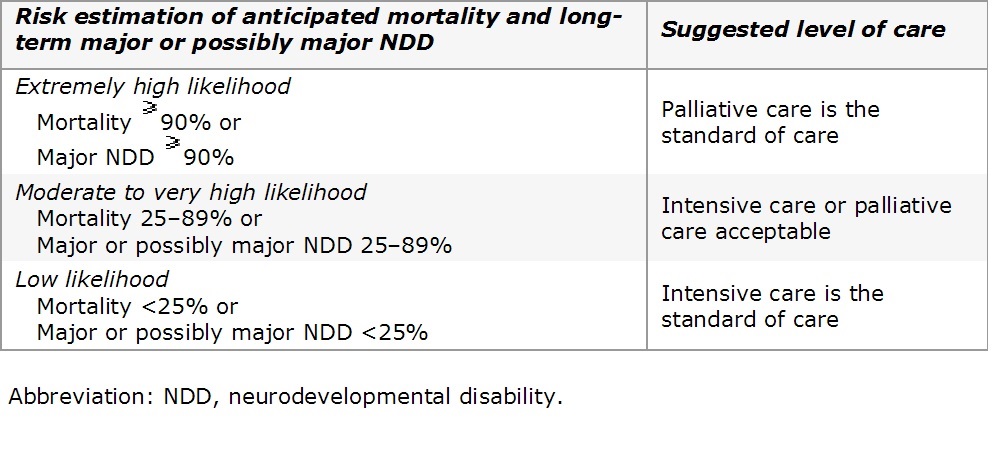
The big problem I have with this otherwise excellent paper is the table 3.
table

Surely preterm babies should be treated the same as babies born at full term, or older children with critical illness? But this table would suggest that, for any baby with a very high risk of major neurodevelopmental disability (NDD), that palliative care is the ‘standard of care’. The authors do not specifically describe the criteria for major NDD in this article, but refer instead to the Epicure cohort, who use this definition “A disability was defined as severe if it was considered likely to make the child highly dependent on caregivers and if it included nonambulant cerebral palsy, an IQ score more than 3 SD below the mean, profound sensorineural hearing loss, or blindness”.

This would imply that “palliative care” (which is a term which has become harder and harder to define over the last few years) is standard of care for children with trisomy 21, or blind babies, or deaf children, or with many other congenital disorders. I object to that. I think for some disorders with extremely high risk of major NDD, that comfort care may be an acceptable option, but to suggest it is “standard of care” is I think dangerous and unwarranted.

If we further examine that table, a 25% mortality risk is given as an acceptable risk for palliative care. I totally disagree. In what other area of medicine would a 25% risk of mortality be acceptable to let a patient die? “Hello Mrs A, your son has a 3 out of 4 chance of survival, so we think it is OK if we let him die.” I find that totally unacceptable. If the child was 4 years old, and parents brought him to the hospital with a severe pneumococcal pneumonia, and respiratory failure, and a PRISM score which predicts a 25% mortality (or even a 50% mortality), would anyone be prepared to let the child die?

I think this article would have been one of the better articles to appear in the perinatal high-risk counseling literature in the past few years, if it wasn’t for that damn table. The thresholds seem to come out of nowhere, to be neither evidence-based nor ethically acceptable. When all the rest of it is as evidence-based as you can get (for an area where evidence is less important than values), and ethically solid.

I do agree with the authors that we should be basing our counseling on predicted outcomes, and not on completed weeks of gestation; but the thresholds used for what are acceptable outcomes, and what are acceptable predicted proportions of babies with those outcomes should also be individualized. I am not sure that any general recommendation for thresholds of intervention, will work. Certainly not a threshold which states that a 25% risk of blindness is an acceptable criterion for forgoing intensive care. Which would mean that if the 2 parents each carried a recessive gene for a condition that causes blindness, then not resuscitating their child at birth would be within acceptable practice.

I am fairly sure (as I know these authors) that that was not their intention, but that is what the table actually says.

As I said there is much good stuff in the article, I strongly recommend it.


Posted in Neonatal Research | Tagged | 4 Comments

Neonatal Updates

Härkin P, et al. Paracetamol Accelerates Closure of the Ductus Arteriosus after Premature Birth: A Randomized Trial. The Journal of pediatrics. 2016. Despite all the interest in paracetamol (acetaminophen in N America) for ductal closure, most of the published data so far has been observational (“we gave it to 30 babies and some of them didn’t get a ligation” for example). This is a small RCT in preterm babies of less than 32 weeks gestation who received paracetamol or placebo within 24 hours of birth. The medication caused the PDA to constrict, and the average age of closure was much earlier in the babies who got the active drug. Not powered for clinically important outcomes, nevertheless, this trial at least shows that it does really work. It also was without any detected side effects.

Martillotti G, et al. Predicting Perinatal Outcome from Prenatal Ultrasound Characteristics in Pregnancies Complicated by Gastroschisis. Fetal diagnosis and therapy. 2016;39(4):279-86. Gastroschisis seems to have become much more frequent, and sometimes there are serious complications, the fetuses are now followed very closely, and when ultrasound findings change we often have discussions about what the significance of a finding is, and whether the baby should de delivered. This study, from our hospital, shows that the best predictor of a serious post-natal complication was dilatation of the intra-abdominal bowel. Some of these babies died or had major complications, the only thing that predicted that in the antenatal period was dilatation of the bowel that was still in the abdomen. Whether immediately delivering the babies or not would make a difference is, of course, uncertain.

Basta AM, et al. Fetal Stomach Position Predicts Neonatal Outcomes in Isolated Left-Sided Congenital Diaphragmatic Hernia. Fetal diagnosis and therapy. 2016;39(4):248-55. This is easier than calculating lung volume from an MRI and comparing to expected lung volumes. Where is the stomach?

Stomach position was intra-abdominal in 14% (n = 13), anterior left chest in 19% (n = 17), mid-to-posterior left chest in 41% (n = 37), and retrocardiac in 26% (n = 23). Increasingly abnormal stomach position was linearly associated with an increased odds of death (OR 4.8, 95% CI 2.1-10.9), extracorporeal membrane oxygenation (ECMO; OR 5.6, 95% CI 1.9-16.7), nonprimary diaphragmatic repair (OR 2.7, 95% CI 1.4-5.5), prolonged mechanical ventilation (OR 5.9, 95% CI 2.3-15.6), and prolonged respiratory support (OR 4.0, 95% CI 1.6-9.9). All fetuses with intra-abdominal stomach position survived without substantial respiratory morbidity or need for ECMO.

Manley BJ, et al. Extubating Extremely Preterm Infants: Predictors of Success and Outcomes following Failure. The Journal of pediatrics. 2016. Should we try and take the tube out? One third of this group of very preterm babies (under 28 weeks) failed extubation. “Higher GA and lower pre-extubation PCO2 predicted extubation success. Infants in whom extubation failed were more likely to die and have prolonged respiratory support and hospitalization”. All of the other potential predictors of extubation success were not much use.

And I am still not sure how you would do a trial to find out when you should take the tube out. If you do it too soon and the baby fails, they are more likely to do badly, but that doesn’t mean it was the failed attempt that was causative. If you don’t try when the baby could have a chance of success, and they stay intubated, then have you wrecked their lungs? There must be a good way to figure this out, but its late, and I can’t come up with any clever trial designs. Suggestions welcome.

Posted in Neonatal Research | Leave a comment

Why didn’t erythropoietin improve the outcome of preterm babies?

Because that is the result of a newly published RCT of erythropoietin (EPO) for neuroprotection of small preterm babies, no effect.

Natalucci G, et al. Effect of Early Prophylactic High-Dose Recombinant Human Erythropoietin in Very Preterm Infants on Neurodevelopmental Outcome at 2 Years. Jama. 2016;315(19):2079.

The dose regime was different to the doses used in the trials by Robin Ohls, which I discussed previously. In this new trial the EPO was started early, and at high dose, and for a short time; EPO (3000 IU/kg) was given  intravenously within 3 hours, at 12 to 18 hours, and at 36 to 42 hours after birth. About 450 babies of less than 32 weeks were randomized to get this dose or placebo. Babies under 26 weeks were not included. The primary outcome of the trial was the 2 year developmental screening tests, the Bayley version 2. There wasn’t a hint of a difference between the groups, with an MDI very close to 95 for each group. About 15% of each group didn’t get followed up at 2 years corrected, unlikely I think to have a substantial impact on the outcomes. There were a few protocol deviations, so they performed an Intention to treat analysis, and then also a “per-protocol” analysis, which also showed no impact of EPO on outcomes.

Why did the other studies show an effect, and not this trial? The authors suggest the following:

In the 2 smaller randomized trials, rhEPO was started later (between day 2 and 4 of life), given in lower doses (400 IU/kg), more often (3×/wk), and over a longer period (up to 35 weeks’ postmenstrual age) than in the present study. Therefore, one of the reasons for the lack of improved outcome with rhEPO in this study could be the timing of the first dose and shorter duration of rhEPO treatment.

Which is true of course, but not the only possible explanation. I think we should be very careful about the results of the 2 other trials they mention, As I noted before there were only 24 control babies reported for the 18 month follow-up, and only 14 for the pre-school follow-up. And the control babies had extremely, and unusually, poor scores on their pre-school follow-up. So I think another potential explanation would be that the results of the other trials are skewed by an unusually poor performance among the controls.

Of course it could be that the dose in this new study is too high. Maybe too much EPO is not a good idea. This observational study (Korzeniewski SJ, et al. Elevated endogenous erythropoietin concentrations are associated with increased risk of brain damage in extremely preterm neonates. PLoS One. 2015;10(3):e0115083.) showed that endogenous erythropoietin levels were higher in very preterm babies with poor developmental tests at 2 years (honestly, why do you need to call this “BRAIN DAMAGE”? Are you looking for more clicks?)

Or it could be that the duration was too short, and so on. But I think this study clearly shows that there is no high quality evidence that erythropoietin or its analogues are neuroprotective in the very preterm baby. The best evidence to date (this trial) shows no benefit.

Posted in Neonatal Research | Tagged , | Leave a comment

The microbiome of plastic tubes in children

Petersen SM, et al. Nasogastric feeding tubes from a neonatal department yield high concentrations of potentially pathogenic bacteria – even one day after insertion. Pediatr Res. 2016.  These authors cultured 94 nasogastric feeding tubes from 34 preterm infants. 1 ml of saline was washed down the tubes after removing them from the babies, and only organisms with more than 1000 CFU/mL were counted. They found 178 that passed this threshold. 89% of the tubes grew things other than probiotics, and this was not related to how long the tubes were in place, they became contaminated very quickly after insertion. Almost all of the organisms were potential pathogens, Coagulase negative staph, enterococci, Gram-negative rods, S aureus.

They also did scanning EM to look at the bioflims, I think they did this on just one NG tube (singular and plural terms are used), and found it to be coated with a “nice” thick biofilm. Although the authors did not show that contamination of the NG tubes led to clinical illness, reducing it would have to be a good thing, I think, as many of these organisms were pathogens, or at least potential pathogens. The authors put it this way:

Our findings and the existing literature suggest that resident NG-tubes should be handled with the same hygiene standards as materials containing fecal matter.

Gilbert RE, et al. Impregnated central venous catheters for prevention of bloodstream infection in children (the CATCH trial): a randomised controlled trial. Lancet. 2016;387(10029):1732-42.

Intravenous catheters are even more of a problem, there are apparently 56 RCTs of various impregnated catheters in adults, and several systematic reviews which show that they are effective at reducing invasive infections. Heparin-bonded catheters seem to be effective, maybe because they prevent the development of biofilms, or maybe there is a direct effect of heparin, or of the agent used to bond the heparin, benzalkonium chloride. Antibiotic-bonded catheters also seem effective, the usual agents are minocycline-rifampicin, which has the advantage that they are not much used as systemic treatments, so there is less worry about selecting resistant organisms.

In this new trial, about 1500 children in PICUs around England were recruited and randomized to get either standard catheters, a catheter with heparin bonding, or a catheter with minocycline-rifampin bonding. All clinical care was unchanged, except that they took an extra 0.5 mL of blood whenever the child needed to have a blood culture.

Heparin didn’t work.

The antibiotic-bonded catheters led to a reduction in invasive sepsis from 3.6% in the other two groups to 1% with the antibiotic-bonded catheters. To present the data another way the blood stream infections per 1000 catheter days were over 8 in the control and heparin groups, and 3.3 in the antibiotic group.

As far as I can tell the only down-side of these catheters is the additional cost. But that should be cancelled out, I would think, by an NNT of about 50, i.e. for every 50 antibiotic bonded catheters there is one less invasive bloodstream infection.

Now we need a neonatal study. Why? Well, our rates of infection in the very preterm baby are much higher than this, the bacteriology is different (they had a total of 42 infections, with only 6 being due to CoNS), toxicity might be different if there is any antibiotic which leaches into the circulation, but the cost implications might be much more positive, if the same relative reduction in sepsis is seen, the benefits could be enormous.

The relevant Cochrane review is quite recent (last September) and found only one small trial in newborns, (n=98). A trial with enough power to address safety would be a boon to neonatology.


Posted in Neonatal Research | Tagged , , | 2 Comments