Saving Babies’ Lives, for Pennies a day.

I am talking about Canada, not the third world!

Probiotics are cheap and reduce mortality.

Florababy(TM) costs about $25 per 60 gram tub.

One tub is enough for 120 days of prophylaxis, that is enough for the entire hospitalization of an extremely preterm infant.

Among babes who survive the first few days of life, the common causes of delayed death are sepsis, severe respiratory failure, and Necrotizing Enterocolitis. Probiotics decrease NEC frequency by about 60%. Probiotics decrease  delayed deaths by nearly half. For about 20 cents per day per baby.

(I have no conflicts of Interest: I have received no money or rewards of any kind from pharmaceutical or probiotic companies).

Posted in Neonatal Research | Tagged , , | Leave a comment

Not neonatology: Brian Cox

This week an American congressman, member of their science committee, stated that the earth was about 9000 years old, and that the big bang was a lie from the pits of hell. That might not touch me directly, but clearly he should not be in a position of authority over scientific matters.

One perfect response to him would be to make him watch, over and over again the acceptance speech of Brian Cox for the medal of the Institute of Physics in the UK. His speech is a wonderful brief description of the nature of science and his closing quote from Humphrey Davy is great. “Nothing is so fatal to the progress of the human mind as to suppose that our views of science are ultimate; that there are no mysteries in nature; that our triumphs are complete, and that there are no new worlds to conquer.” Brian Cox and the nature of science

I an a great fan of Brian Cox, a physicist from the University of Manchester. He is a wonderful communicator, he gives lectures with a clarity and a fluency that I can only envy, and in addition he has a strong Manchester accent, which is an added benefit (I still have a weak Manchester accent, more than 48 years after leaving the area). For a wonderful brief introduction to the recent history of physics and why it is important, you could do much worse than watching Brian Cox and the history of the universe.

Posted in Neonatal Research | 1 Comment

Who benefits from whole genome sequencing in the NICU? Who suffers?

Annie and I recently published a letter to the editor of Pediatrics and Child Health about the ethical implications of using Complete Genome Hybridization (CGH) as the default test for possibly genetically determined disorders in pediatrics. CGH is a very high resolution way of examining the DNA of an individual, and finding abnormalities that do not hybridize to the standard DNA of the chip. Although much higher resolution than a standard high resolution karyotype there are several risks that come along with that increased resolution. Those risks are (as enumerated in our published letter):

  • CGH often reveals minor DNA anomalies that are of uncertain significance, leaving a child labelled with a DNA anomaly, but with no idea whether it is of medical importance.
  • CGH may reveal significant DNA anomalies that are not related to the condition being investigated; these unrelated DNA anomalies may have implications for the future health of the child.
  • Finding DNA anomalies in the infant will often lead to the parents being tested. This testing may reveal that they also carry the DNA anomaly, which may have implications for the parents’ future health or may impact their insurability.
  • Because CGH is often performed when the diagnosis is uncertain, it is impossible to counsel parents regarding potential implications of the hundreds of possible diagnoses that might follow, or the potential future health impacts.
  • CGH may reveal DNA anomalies that could affect (or will, in the future, be shown to affect) the health status of the infant including risks of cardiovascular disease or cancer risks.
  • CGH may reveal DNA anomalies that are associated with an increased risk of future mental health or behaviour problems, but with what is referred to as ‘reduced penetrance’, ie, they are not very specific. How can we (and do we currently) counsel parents that the CGH test we are performing might reveal that their child has an increased risk of future antisocial behaviour, bipolar disorder and schizophrenia,  (This is not theoretical, this has actually been demonstrated!) but that even if their child has the relevant microdeletion, the occurrence of these problems is not certain, and we cannot do anything to prevent them anyway?
  • CGH results provide a permanent record of DNA anomalies, and the test is performed on an infant who is unable to understand or consent.

Now that is for CGH, imagine the next step up in resolution, sequencing the entire genome.  Some of you may have seen press releases from Children’s Mercy Hospital in Kansas City about whole genome sequencing, available for newborn babies within 3 days. The hype from that center states things like ‘one third of babies in the NICU have genetic disorders’ and ‘physicians can make practical use of diagnostic results to tailor treatments to individual infants and children’

Well I must live on another planet. The large majority of babies in my unit are there for prematurity. Now unless you really want to hype your own research and stretch the meaning of the phrase ‘genetic disorders’ to include possible potential SNP’s in the mother that might in the future be shown to maybe increase the risk that she will deliver prematurely, then that is a downright lie. A lie that will disturb parents and helps no-one. The only people who will be helped by that are those making profits from the test, which costs “only” 13,500$. The entirely spurious comparison of the cost of the test to the cost of neonatal intensive care made during interviews by the authors is equally inane and self-serving.

It is very likely that there are genetic variants that increase the chances that you will develop BPD if you are born prematurely,  or variants that make you more susceptible to RoP or Group B Strep sepsis etc. etc. But that is entirely different to calling them genetic disorders. It is also entirely different from being able to tailor our treatment to the condition. Even in the case of what have previously considered genetic disorders, there are a minority that can be directly treated. The main advantage of a diagnostic label for many children is to be able to give a prognosis.

Lets imagine a case, a very realistic case that will happen one day soon. A baby in the NICU has a club foot. The genetics consultant isn’t sure if there is an underlying genetic cause (even though there was oligohydramnios and the neonatologist was quite happy that the cause was in utero constraint, but nevertheless the resident had filled out a consultation form for the geneticist before I could stop them) so they decide to sequence the genome of the baby. The lab reports 300 different unknown SNP’s none of which have previously been noted to be associated with club foot. They also find that the baby is heterozygous for a beta glucosidase mutation that increases risk of Parkinson’s disease to 16%.

Now what the hell do you do?

As far as we know there is nothing you can do about this. There is no prospect in the near future of being able to do anything about this. So do you keep quiet about it? Do you lie to the parents and say we didn’t find anything? Or do you leave the knowledge hanging over his head for the next 50 years?

If you actually read the article that this hype is based on you will probably be profoundly unimpressed. They actually report 4 babies in the NICU with possible genetic disorders. Three of the babies were critically ill and had active care discontinued, the 4th is having cardiac surgery. For the 3 babies that died 1 had a condition that could have been diagnosed from his clinical presentation, 1 they didn’t figure out, even with whole genome sequencing, one turned out to have an abnormality in a gene only reported once before as a cause of their problems. The baby with heart disease clearly had an autosomal recessive condition, and the authors may have discovered a new gene causing visceral heterotaxy.

So who benefitted from the whole genome sequencing?

None of those babies benefited.  3 of them had care withdrawn because of the severity of their clinical condition, the 4th still needed to have heart surgery.

We read in a tiny footnote to the article the following “J.F., S.H., P.S., Z.K., J.C.W., J.B., R.J.G., E.H.M., and K.P.H. are employees of Illumina Inc., which manufactures the HiSeq 2500 instrument.” The initials refer to 9 of the 23 authors of the article. (That’s right an article about 4 babies with 23 authors!) So Illumina Inc will benefit if they sell their machines.

Children’s Mercy Hospital will benefit if they get more referrals. (in the US medical “system” the more sick babies you get referred the more money you make, even at a wonderful non-profit organisation like the Mercy Hospital a lot is driven by money, because they have to stay open, so they have to keep working on their “market share”).

The authors benefit from having a publication in a high profile journal

Clinical scientific knowledge benefits from knowing a bit more about genes that can cause epilepsy and visceral heterotaxy.

But the babies? The families? There certainly is at least a risk that the babies and families might suffer, they might have findings that are of unknown significance, that cause only concern. They might have findings that are of known significance, but have nothing to do with the reason for doing the test. They might have findings that have profound implications for the future health or future life expectancy of the baby, and they will very often be untreatable.

I certainly wouldn’t have whole genome sequencing, nor accept it for my children. If there was a good research project, I would let them take my blood (or my mouth swab or whatever) but I don’t want to know the results thanks very much! A press release suggesting that this technique makes a difference in clinical management, that it is cost effective, and that it could be applied to 1 in 3 NICU patients serves no-one… except Illumina Inc.

Posted in Neonatal Research | Tagged , | 1 Comment

Not neonatology: the Ness of Brodgar

I just heard about this from an article in the Guardian. A huge neolithic temple complex on the isle of Orkney has been discovered. A site, entirely man-made, covering more than 6 acres, which predates Stonehenge and the Pyramids. The site is just now being excavated, but  includes more than 12 buildings which have been called “temples” and bones of hundreds of cattle with signs of being butchered, perhaps sacrificed. Huge standing stones have been recognized here for a very long time, but the newer excavations have revealed something spectacular, and entirely unsuspected. The site dates from over 5000 years ago and was abandoned about 4,300 years ago.

Interesting to think that we know so little about the distant past of Europe, and that it was probably warmer back then for so much activity to have taken place in Orkney!

Another item to add to my list of places I want to go, sometime soon.

Posted in Neonatal Research | Leave a comment

Assessing perfusion in the sick preterm baby

I often give talks where I present my ‘data’, (notice the quotation marks, what I actually present are my prejudices, and uncontrolled observational information, along with systematic reviews of other people’s data) which suggest strongly that there is no need to treat preterm infants with numerically low blood pressure whose perfusion is adequate.

The most common question I get asked after these talks is: how do you define and evaluate perfusion? I am currently on my way to the EAPS meeting in Istanbul (don’t cry for me!!!) where the talk I have to give is about exactly this issue. So, as I haven’t finished preparing the talk yet, I will write this post as I think about what I am going to say. ***Update, I just finished giving the talk and told the audience that I would post about this issue and put the pptx file on this blog, it is on the “presentations by our group” page, References are listed below this post.***

Definition: this is the easy bit. Adequate perfusion means that there is enough oxygen delivery to the tissues to maintain all of their vital functions and to avoid any long term adverse consequences. Actually, writing that definition is easy, but putting it into real-life practice is hellishly difficult.

Evaluation: this is still a work in progress. There are 3 potential categories of methods of evaluating perfusion. 1, clinical exam and history. 2 non-invasive monitoring. 3. invasive tests. Before I discuss each category, we should ask the question, how do we determine if a method of evaluating perfusion is accurate?

Now there’s the rub (as someone who could write fairly well once said). How do we determine if evaluation, for example, of capillary filling is an accurate representation of perfusion? Is there a gold standard to compare cap filling to?

I would say no, we have no gold standard that really tells me if the mitochondria are receiving enough oxygen. But I do think we have something that comes fairly close, and which for the moment is as good as we can get. The measure which I believe comes closest to a gold standard for perfusion is a shunt independent measure of systemic blood flow. Now we do have to remember that oxygen delivery depends on perfusion, but also on saturation and hemoglobin concentration. And adequacy of oxygen delivery depends on supply as well as on demand, but if we assume that we are only measuring these things in babies with a reasonably normal hemoglobin, and a reasonably normal saturation, and a reasonably normal oxygen consumption, then systemic blood flow will reflect whether supply is normal, and hopefully whether it is adequate.

What shunt independent measures of systemic blood flow exist? The best, in terms of being completely unaffected by the usual intra-and extra-cardiac shunts which are present in the preterm newborn, is flow in the superior vena cava. However, in terms of precision and reproducibility of measurement there are problems. Accurate measurement of the diameter of the SVC, and accurate doppler measurements of blood flow velocity in the vessel are both difficult, and there are some concerns about how reproducible the measures might be, especially in less experienced hands. The PA is easier to measure the diameter reproducibly, but if there is a significant inter-atrial shunt this measure is less helpful; however, for most purposes PA flow seems to be adequate.

A number of collaborators from Sydney, Australia (Martin Kluckow, Nick Evans, David Osborn and others) have shown that there appears to be a cutpoint of 40 mL/kg/min in the SVC below which there are adverse consequences, in particular an increase in the frequency of late onset intraventricular hemorrhage, they have also shown an association with poorer neurodevelopmental outcome. Other groups have confirmed this.

So do the measures of clinical perfusion correlate well with our imperfect gold standard?

1. Clinical evaluation of perfusion relies on what can be directly observed, and observations of the consequences of good or poor perfusion. Direct observations of perfusion are capillary filling time and warmth of the extremities. observations of consequences include urine output (renal perfusion), and level of activity/alertness. (CNS perfusion).

Capillary filling does have some correlation with SVC flow, but it is quite imperfect by itself. Even in order to achieve that degree of imperfection it needs to be done as objectively as possible, over the sternum with a standard methodology, and a stop watch to time the refill.

Toe temperature and central peripheral temperature difference are probably of limited value for babies who are in warm incubators. There is no good way of quantifying level of activity, so it is not clear whether this is useful. Urine output is low because of low renal blood flow and GFR immediately after birth, but seems to be more reliable after the first day or so (as renal vascular resistance falls by more than half), again little published data to confirm this.

2. Non-invasive measures. NIRS has great promise I think, but despite many years of investigation there remain a number of limitations to its use. It isn’t clear to me which parameter is most appropriate. Fractional oxygen extraction for example will be decreased if there is better oxygen supply, or if there is reduced consumption. It may be that simple is best and tissue oxygen saturation the preferred measure. Direct measures of tissue oxygenation correlate well with cranial NIRS, but there is a +/- 17% error, which is clearly substantial. In any case there is a correlation between tissue oxygenation and SVC flow. There is also a correlation between fractional oxygen extraction and the occurrence of cerebral injury.

You could be forgiven for thinking that NIRS should be the gold standard. Surely oxygenation of cerebral tissues is the most important function of the cardiovascular system from minute to minute? However there are numerous limitations, and its use has not become widespread clinically, at least not in North America, despite many publications (Gorm Griesen recently discussed why this should be, and how we should go about determining whether we should be using it routinely). I guess we need more evidence that low NIRS cerebral oxygenation correlates with poor outcomes, and then some evidence that therapy directed to improving NIRS improves outcomes. This may be asking a lot, as we don’t have such evidence for most of the things that we already treat (such as low blood pressure!) Newer devices which are simpler to use, and have probes designed for preterm infants might allow us to collect such evidence. We need to define a trigger level for intervention, or a set of circumstances which include a NIRS number.

How about perfusion index? The Masimo pulse oximeter displays a number called the perfusion index. This is of uncertain derivation (seems to be a trade secret) but has something to do with how much pulsation is going on in the signal that the pulse oximeter interprets. (Other pulse oximeters have numbers as well, but the further evaluation of PI has only been done with the Masimo). PI seems to correlate broadly with SVC flow, may correlate with poor outcomes, and may turn out to be an easily monitored indicator of peripheral perfusion. A number that the nurses can write down from a clinical monitor could perhaps be quite helpful to flag babies for further evaluation.

3. Invasive testing. Blood tests: serum lactates are the most studied for evaluating overall adequacy of oxygen delivery. Single measurements of lactate are correlated with mortality, but a single lactate taken shortly after birth is of more limited use, as lactates may be very high after a complicated delivery, and then fall if perfusion is adequate, so the trend in lactate values may be more useful. A lactate of 5 for example might mean something very different if the previous was 10 or if the previous one was 1!

Other lab tests such as pH or base excess seem to be of little value.

Combining indicators

Perhaps the best thing to do would be to combine indicators, to construct a perfusion scale with capillary filling, serum lactate and how much it has changed, urine output, etc. Some preliminary work in this has been published by my good friend and colleague Gene Dempsey, he showed that a combination of a capillary filling time of >4 secs and a lactate of more than 4 correlated well with an SVC flow of less than 40. As well as being significant it is easy to remember!

In Summary

An SVC flow below 40 mL/kg/min is associated with poorer outcomes, but –Using the same limit for everyone is a bit simplistic, it ignores variations in HgB, Saturation and O2 demand: but it is by far the best evaluated and supported measure we have

SVC flow <40 mL/kg/min has become relatively uncommon in the small preterms (<20%) probably in association with less aggressive intervention.

Other measures have often been evaluated for their correlation with SVC flow: They should also be evaluated independently for their association with clinical outcomes

Capillary filling has some correlation with SVC flow

An overall clinical estimation of poor perfusion is associated with poor outcomes

Cap filling <4 AND lactate >4 is associated with low SVC flow

NIRS of brain and other regions? The method of analysis, and best parameter to use are uncertain. The Big Question of NIRS that needs to be asked is: Is there a single cutoff that predicts poorer outcome, therefore could be used to instigate (or investigate) therapy?

Perfusion Index from the pulse oximeter? Much more work needed.

What we need are prospective cohort studies analyzing all of these factors in a group of preterm infants. They should be compared with echo indices of flow.and more importantly with short and long term complications.

The research questions to be asked are: •Does this measure correspond with outcomes? Does it correlate with flow •Is it an appropriate measure to guide treatment?

References

1. Greisen G, Leung T, Wolf M: Has the time come to use near-infrared spectroscopy as a routine clinical tool in preterm infants undergoing intensive care? Philosophical Transactions of the Royal Society A: Mathematical, Physical and Engineering Sciences 2011, 369(1955):4440-4451.
2. Wardle SP, Yoxall CW, Weindling AM: Determinants of Cerebral Fractional Oxygen Extraction Using Near Infrared Spectroscopy in Preterm Neonates. J Cereb Blood Flow Metab 2000, 20(2):272-279.
3. Victor S, Marson AG, Appleton RE, Beirne M, Weindling AM: Relationship Between Blood Pressure, Cerebral Electrical Activity, Cerebral Fractional Oxygen Extraction, and Peripheral Blood Flow in Very Low Birth Weight Newborn Infants. Pediatric Research 2006, 59(2):314-319.
4. Shah DM, Condò M, Bowen J, Kluckow M: Blood pressure or blood flow: Which is important in the preterm infant? A case report of twins. Journal of Paediatrics and Child Health 2011:no-no.
5. Kluckow M: Functional Echocardiography in Assessment of the Cardiovascular System in Asphyxiated Neonates. The Journal of Pediatrics 2011, 158(2, Supplement 1):e13-e18.
6. Groenendaal F, Lindemans C, Uiterwaal CSPM, de Vries LS: Early Arterial Lactate and Prediction of Outcome in Preterm Neonates Admitted to a Neonatal Intensive Care Unit. Neonatology 2003, 83(3):171-176.
7. Takahashi S, Kakiuchi S, Nanba Y, Tsukamoto K, Nakamura T, Ito Y: The perfusion index derived from a pulse oximeter for predicting low superior vena cava flow in very low birth weight infants. J Perinatol 2010, 30(4):265-269.
8. Moran M, Miletin J, Pichova K, Dempsey EM: Cerebral tissue oxygenation index and superior vena cava blood flow in the very low birth weight infant. Acta Pædiatrica 2009, 98(1):43-46.
9. Miletin J, Pichova K, Dempsey E: Bedside detection of low systemic flow in the very low birth weight infant on day 1 of life. European Journal of Pediatrics 2009, 168(7):809-813.
10. Miletin J, Dempsey EM: Low superior vena cava flow on day 1 and adverse outcome in the very low birthweight infant. Archives of Disease in Childhood – Fetal and Neonatal Edition 2008, 93(5):F368-F371.
11. Cresi F, Pelle E, Calabrese R, Costa L, Farinasso D, Silvestro L: Perfusion index variations in clinically and hemodynamically stable preterm newborns in the first week of life. Italian Journal of Pediatrics 2010, 36(1):6.
12. Weindling M, Paize F: Peripheral haemodynamics in newborns: Best practice guidelines. Early Human Development 2010, 86(3):159-165.
13. Miletin J, Pichova K, Doyle S, Dempsey EM: Serum cortisol values, superior vena cava flow and illness severity scores in very low birth weight infants. J Perinatol 2010.
14. Dempsey EM, Al Hazzani F, Barrington KJ: Permissive hypotension in the extremely low birthweight infant with signs of good perfusion. Arch Dis Child Fetal Neonatal Ed 2009, 94(4):F241-244.
15. Paradisis M, Evans N, Kluckow M, Osborn D: Randomized Trial of Milrinone Versus Placebo for Prevention of Low Systemic Blood Flow in Very Preterm Infants. The Journal of Pediatrics 2009, 154(2):189-195.
16. Dempsey EM, Barrington KJ: Evaluation and treatment of hypotension in the preterm infant. Clin Perinatol 2009, 36(1):75-85.
17. Dempsey EM, Barrington KJ: Treating hypotension in the preterm infant: when and with what: a critical and systematic review. J Perinatol 2007, 27(8):469-478.
18. Dempsey EM, Barrington KJ: Diagnostic criteria and therapeutic interventions for the hypotensive very low birth weight infant. J Perinatol 2006, 26(11):677-681.
19. Barrington KJ, Dempsey EM: Cardiovascular support in the preterm: treatments in search of indications. J Pediatr 2006, 148(3):289-291.
20. Osborn DA, Evans N, Kluckow M, Bowen JR, Rieger I: Low Superior Vena Cava Flow and Effect of Inotropes on Neurodevelopment to 3 Years in Preterm Infants. Pediatrics 2007, 120(2):372-380.
21. Hunt RW, Evans N, Rieger I, Kluckow M: Low superior vena cava flow and neurodevelopment at 3 years in very preterm infants. The Journal of Pediatrics 2004, 145(5):588-592.
22. Weindling AM, Kissack CM: Blood pressure and tissue oxygenation in the newborn baby at risk of brain damage. Biol Neonate 2001, 79:341-245.
23. Kluckow M, Evans N: Low superior vena cava flow and intraventricular haemorrhage in preterm infants. Arch Dis Child Fetal Neonatal Ed 2000, 82(3):F188-194.
24. Kluckow M, N. E: Superior vena cava flow in newborn infants:a novel marker of systemic blood flow. Arch Dis Child Fetal Neonatal Ed 2000, 82:F182-F187.
25. Deshpande SA, Platt MP: Association between blood lactate and acid-base status and mortality in ventilated babies. Arch Dis Child Fetal Neonatal Ed 1997, 76(1):F15-20.            26. de Boode W-P: Clinical monitoring of systemic hemodynamics in critically ill newborns. Early Human Development 2010, 86(3):137-141.

Posted in Neonatal Research | Tagged | 1 Comment

Domperidone for GE reflux; toxic and worse than placebo!

As mentioned in a previous post, to get cisapride for a patient in Canada, you have to contact Health Canada for special permission through the Special Access Program. The last time that I am aware of someone asking Health Canada for special access for cisapride for treatment of reflux in a preterm infant they were refused; this might sound like a good thing, but unfortunately the reason for refusal was that they hadn’t tried domperidone! I almost collapsed when I heard that one!

So is domperidone effective for GER in newborn infants? Is it safe?

You can probably guess the answers by now. No and No.

Domperidone is a drug closely related to metoclopramide, in the sense that it is a dopamine D2 antagonist, however it also has some cisapride like effects, in that it prolongs ventricular repolarization by interfering with a potassium channel. Are there any controlled studies examining domperidone effects on GER in the preterm? I found just one (Cresi F, Marinaccio C, Russo MC, Miniero R, Silvestro L: Short-term effect of domperidone on gastroesophageal reflux in newborns assessed by combined intraluminal impedance and ph monitoring. J Perinatol 2008, 28(11):766-770). A small trial that actually had controls! and randomization! And just like one of the metoclopramide studies, there was an increase in reflux in the domperidone group. This study has nice methodology with multiple intraluminal impedance combined with pH for quantifying the reflux. Domperidone does seem to be an effective prokinetic in the preterm, which may be why it increases GER.

So domperidone is ineffective for GER, indeed it is the opposite of effective, it is anti-effective! It also can prolong the QT interval, so it may be unsafe from a cardiac standpoint, and it can cause extrapyramidal side effects so probably not safe for the brain either.

Domperidone should never be used for reflux in the newborn, and probably not for other indications either. Studies of domperidone use in mothers should evaluate possible neonatal absorption and neonatal effects.

Posted in Neonatal Research | Tagged , | 2 Comments

Cisapride for GE reflux; more toxic placebos!

I am currently writing a chapter for a textbook, the chapter will deal with GE reflux. So I have been reviewing the data around various treatment options. I have already written on this blog about the lack of physiologic rationale for using prokinetics, and the lack of efficacy and toxic complications of metoclopramide. Although cisapride is no longer readily available it is still possible to obtain it in Canada through the Special Access Program, which allows you to obtain critically important medications even if they are not currently licensed. I believe that similar programs exist in other jurisdictions also. Requests for special access to cisapride are sometimes made by doctors as it is believed that it will improve GERD in babies not “responding” to other treatments, and that the risks were overstated anyway.

So what about cisapride, does it really work? Is it safe? Should it continue to be available under Special Access Programs?

The simple answers to these questions are no, no and no.

Does it work: There are no good RCTs in preterm infants. This is despite the fact that at one point about 20 percent of all the preterm infants in NICUs in the USA were receiving cisapride. You would think that after all the disasters in neonatology since the 1950s (subject of an upcoming post I guess) we would be reticent about prescribing a new drug for which there are no neonatal data… Maybe we did so because there were such compelling data from older children? Is that the case? Does cisapride work in older infants? Here again the response has to be no, there is no reliable evidence of efficacy. The Cochrane review updated in 2010, could only find 8 tiny placebo controlled studies, with a total of 262 infants, that looked at symptoms of GER. There was some evidence of publication bias, so negative studies may well be missing from the published literature. Only 2 of those 8 studies were of good quality and were slightly larger (n=36, and 68).  There was no overall evidence of improvement, and the 2 less small, better quality, studies showed a tendency to worse symptoms in the cisapride group.

The few controlled studies that exist in the preterm show that gastric emptying is prolonged by cisapride, that feeding tolerance is not improved, and that transit time might be prolonged. So as well as being useless for GER it isn’t even prokinetic in the preterm! This might because of immaturity of certain 5-HT4 receptors, and stimulation of different receptors which slow intestinal function. There is some evidence that the toxicities of cisapride, that is the effects on QT interval, and more marked in the newborn, and occur at lower serum concentrations than older individuals.

So cisapride is ineffective for GER in the newborn, may actually slow intestinal transit and gastric emptying, and may well be more toxic than in older patients. So having it available on special access programs is senseless.

Posted in Neonatal Research | Tagged | Leave a comment

Weekly updates #9

Avettand-Fenoel V, Marlin S, Vauloup-Fellous C, Loundon N, Francois M, Couloigner V, Rouillon I, Drouin-Garraud V, Laccourreye L, Denoyelle F et al: Congenital Cytomegalovirus Is the Second Most Frequent Cause of Bilateral Hearing Loss in Young French Children. J Pediatr 2012(0). When a baby fails a hearing screen, they should routinely be tested for CMV.

The following aren’t really neonatal, but each has a message for us I think.

Van den Bruel A, Thompson M, Buntinx F, Mant D: Clinicians’ gut feeling about serious infections in children: Observational study. Bmj 2012, 345(sep25 2):e6144-e6144. This is interesting, when clinicians were evaluating children for whether they had a serious infection or not, the clinical evaluation sometimes suggested a low risk, but the clinician had a “gut feeling” that something was not right (it seems that this was often when the parents were very anxious, or the child was lethargic and not laughing or was breathing funny). The gut feeling added significantly to the more objective clinical evaluation and picked up a few kids with serious infections. I don’t know quite what this means, or if it applies in the NICU, but its not unusual to have an experienced nurse tell me that the baby isn’t the way they usually are, without much that is really objective, and they are often right. It is very difficult or impossible to teach this, maybe someone will devise gut training sessions soon, probably we need a gut feeling simulator.

Mehta NM, Bechard LJ, Cahill N, Wang M, Day A, Duggan CP, Heyland DK: Nutritional practices and their relationship to clinical outcomes in critically ill children–an international multicenter cohort study*. Crit Care Med 2012, 40(7):2204-2211. This study looked at how well pediatric intensivists met the nutritional needs of their patients. They are lousy.  Worse than we (neonatologists) are. And the children who were most nutritionally compromised had higher mortality. Having a feeding protocol was the best way to improve the situation.

Yavchitz A, Boutron I, Bafeta A, Marroun I, Charles P, Mantz J, Ravaud P: Misrepresentation of randomized controlled trials in press releases and news coverage: A cohort study. PLoS Med 2012, 9(9):e1001308. People often complain about how skewed and over the top press coverage of medical research can be. In England the Daily Mail is often mocked as being a source of long lists of things which either cause or prevent cancer, with red wine and coffee being in both lists. Very often those stories are based on studies in  experimental rodents, or on cellular or molecular studies. Yaychitz and his co-workers looked into this and showed that “spin”  as they call it, in press reports, was indeed common, but the most common reason for the overblown press reports was overblown conclusions in the published abstract. You know the sort of thing, Resfertabarol was shown to block enzyme pgpgp3 in a mouse cancer cell line. last line of the abstract, “Resfertabarol holds promise to reduce mortality from cancer.” !

Posted in Neonatal Research | Leave a comment

Do blood transfusions improve feeding in anemic preterm Infants?

The possible benefits of blood transfusions in anemic preterm infants have never been well investigated. There is some reliable data about the outcomes of babies randomized to different goals of hemoglobin concentration (for example the PINT study Kirpalani H, Whyte RK, Andersen C, Asztalos EV, Heddle N, Blajchman MA, Peliowski A, Rios A, LaCorte M, Connelly R, Barrington K, Roberts RS. The premature infants in need of transfusion (pint) study: A randomized, controlled trial of a restrictive (low) versus liberal (high) transfusion threshold for extremely low birth weight infants. J Pediatr 2006, 149(3):301-307.) but little data about what clinical benefits may truly be expected in an anemic preterm infant if you are unsure whether to transfuse them or not.

A new observational study attempted to determine whether anemic preterm babies would suckle better after a transfusion. (Bromiker R, Kasinetz Y, Kaplan M, Hammerman C, Schimmel M, Medoff-Cooper B: Sucking improvement following blood transfusion for anemia of prematurity. Arch Pediatr Adolesc Med 2012, 166(10):1-5.) Unfortunately the analysis of their data is an object lesson in how not to analyze observational data. I will explain…

After measuring the outcome of interest, in this case it was suckling before and after a transfusion, measured with a special bottle as the number of sucks in a 5 minute period, the authors divided the data into those with lower than average suckling, and those with higher than average.What is entirely unsurprising is that the babies with lower than average suckling had an increase on the second measurement. This is a phenomenon known as the regression to the mean. It is something that happens with any data set. you can construct completely random data sets and find that the cases below average on the first measure will increase overall on the second measure. And vice versa, those above the average on the first measure will be lower overall on the second measure.

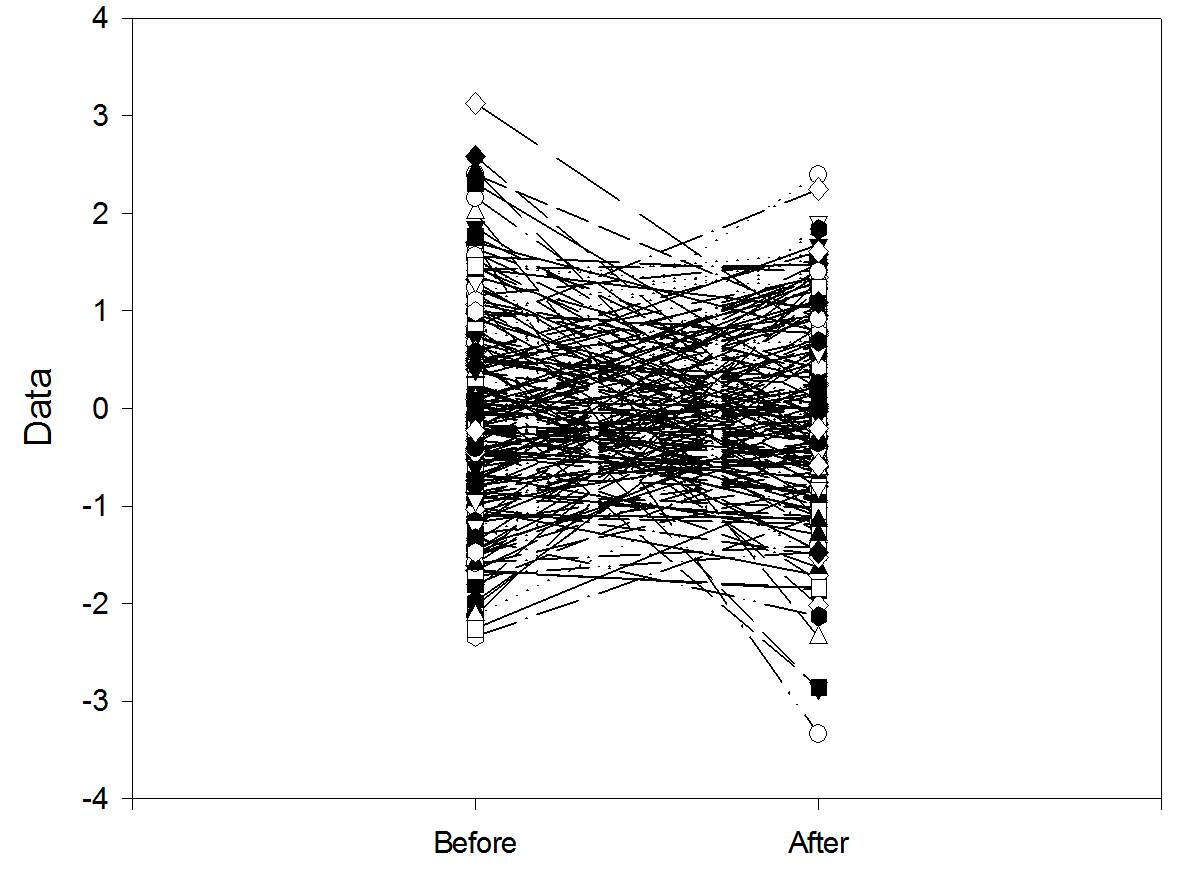
I did this below, I randomly generated 200 normally distributed numbers in column A, the mean is 0 and the SD is 1. In column B I put another randomly generated series of 200 numbers, same mean and SD. Then I joined the first number in column A to the first number in column B, and so on.

The next thing I did was to take out all those that had a value below the mean in column A, and their partner in column B.

Then if you do a paired t-test the p value is <0.001 !

Remember these are entirely random numbers! This is regression to the mean, and analyzing data in this way is a common error.

This phenomenon is also responsible for most of the placebo effect. Most demonstrations of the placebo effect are nothing to do with the healing capacity of the body, or the power of our brains to mislead us, they are just due to the simple arithmetic phenomenon I just showed. If you have more movement restriction than usual in your knee on the day you get the placebo, then the next day you will tend to be better!

Another feature of this phenomenon is that the more abnormal the initial value, the greater on average will be the change. So if I plot the data in the last graph in a different way, comparing column A to the change between A and B, you find that there is a significant correlation (r=0.56, p<0.0001).

To return to the paper about sucking after transfusion, there was NO overall difference before and after transfusion. Only when the babies with lower than average sucking before transfusion are analyzed separately was there an increase after transfusion. As you can also see in the results, those with a higher than average sucking before transfusion actually had a decrease! Which is exactly what you would expect if transfusion had no effect.

This is not the first time similar interpretations have been made regarding transfusion. A paper published in 1984 showed that babies who had poorer weight gain prior to transfusion had more weight gain after transfusion, again entirely compatible with regression to the mean. Now it is touchy to perform randomized trials of blood transfusion, which is why there are so few, I guess. But the only way to answer questions about the clinical efficacy of transfusion is to have controlled trials.

And it is obviously not just in this situation, a paper published in the New England Journal in 1983 on the effects of digoxin in infants with a VSD and circulatory congestion showed that the 6 babies with the lowest shortening fraction before digoxin had an increase in this measure, and the 15 with better pre-digoxin shortening fraction had a decrease. The appropriate interpretation should have been that digoxin had no measurable effect, but the paper was published as if there were 6 ‘responders’ to digoxin, and 15 non-responders. I don’t think there has ever been a substantial RCT of digoxin in infants with circulatory congestion, which is worrying as it is potentially toxic, and this type of paper, incorrectly interpreting the results, has the potential to mislead physicians for years to treat with an agent which may be ineffective.

The importance of Controlled trials to answer clinically important question such as these cannot be overstated.

Posted in Neonatal Research | Tagged | 2 Comments

Improving Nutrition in the very Preterm; more protein?

A new study published in Pediatrics looked at the question in the title of this post. Moya F, Sisk PM, Walsh KR, Berseth CL: A new liquid human milk fortifier and linear growth in preterm infants. Pediatrics 2012.  This was a modestly sized trial (n=140) comparing 2 human milk fortifiers from Mead-Johnson, one which may be their standard commercially available powdered one (it isn’t clearly stated), the other a new highly concentrated liquid fortifier. There are a number of problems with this study. 1. It was funded by Mead Johnson, and there is no statement as to who controls the data, nor whether the 2 authors who were not Mead-Johnson employees saw or analysed the raw data. 2. It is said to be a multicenter trial, but the number of centers and their identity are not revealed. 3. The concentration of the new liquid fortifier is not described, we are only told that 5 vials of fortifier were added to 100 mL of breast milk, but does that make 50 mL or 0.5 mL? Diluting the good stuff in breast milk as little as possible is why we mostly switched to powdered fortifiers, so we need to know! 4. A table in the publication is stated in the text to show the composition of the fortifiers, but actually shows estimated composition of preterm human milk plus fortifier, and they do not give a reference to where they chose the data about preterm human milk composition. 5. The power calculation is for 50 patients per group, but they enrolled 150 infants. 6. Neither of the 2 analyses performed were truly intention to treat, the first analysis excluded the 4 randomized infants who never got the fortifier (they call this “similar to intention to treat”), the second excluded more than half of the babies in each group according to how much fortifier they received. Even for the first of these analyses they excluded 17 controls and 23 liquid fortifier patients before the end of the study when they discontinued the fortifier, so the final weight gain and growth variables presented only refer to a selected sub-group of 58 and 51 infants for the first analysis and 32 and 24 infants for the second analysis. 7. Finally there was no difference in the primary outcome. The primary outcome was weight gain in g/kg/d over the 28 days of the study, and none of the analyses of this were different. This is therefore a negative trial. However the last sentence of the abstract, which is all many people will read, states “Benefits of LHMF include improvements in growth”. Not as shown here they don’t. The only thing that was significantly different according to the slightly less unreasonable analysis #1 was that, after 28 days, the 2/3 of the enrolled infants remaining in the analysis who got the liquid fortifier weighed 100 g more, and were 0.9 cm longer. One big problem with this data is that we don’t know whether this sub-sub-group had the same weights and head circumference in the 2 groups at the start of the study. The only baseline data are given for the groups as a whole, not for those who had an analysis of the primary outcomes. As there were so many babies who dropped out of the study before the primary outcome was measured we should at least be told what were the baseline measurements of the 2/3 who remained.

Now I actually think this was probably a good idea, to make a fortifier which ends up supplying more protein, which, I didn’t mention above, was the main difference in the final composition of the milk plus fortifier (3.2g/100mL compared to 2.6g/100mL) there were a few other minor differences (including 3 kcal/100ml more energy with the new stuff). I am not sure if a liquid is better than a powder or not. But I think Pediatrics has really made some poor decisions about publishing this in this form, we need to know the final weight, length, and head circumference of all the randomized babies, or at the very least all of those who started on the study intervention, and it should be clear in teh abstract that this was a negative study.

A much more important issue for future studies is data on body composition. We know that very preterm babies, if you use ‘optimal’ nutrition to avoid postnatal growth restriction, still end up short and fat; so we need to improve what we consider optimal nutrition, with the initial goal that preterm babies when they reach term should have the same body composition as a full term baby that is a few days old, and the eventual goal that long term metabolic and other outcomes should be equivalent. Now my reading of the recent literature is that to do this we need to give more protein, at least during the enteral nutrition stage of the babies’ stay, and particularly among breast fed babies. The evidence to support that reading is here and here and here.

One recent study that may have worried a few people is by Cynthia Blanco and colleagues. This very small study which was designed to look at short term effects of earlier, higher protein administration during TPN. Babies were randomized to 2 amino acid advancement regimes that were only different during the first 7 days of life, the 1st group got 0.5 g/kg/d on day 1 increasing to a max of 3, and the 2nd group received 2 g/kg/day increasing to 4. After day 7 everyone received 3.5 g/kg/d. The authors added follow up to the study, but were only able to examine 32 of the 51 surviving infants at 18 to 24 months.

Now some problems with this study are that their babies are normally seen at 0,3,6,12,18 months corrected age, and 24 months chronologic age. Results are reported at 18 to 24 months and it is not at all clear how many babies were seen at each of those 2 ages. In addition the statistics do not seem to have been adjusted for multiple comparisons, so the finding that prompted an editorial in the journal, that the Bayley MDI was a little lower (11 points different, p<0.03) in the high AA group at 18 months, is almost certainly not significant if the large number of comparisons is taken into account. In addition, the difference disappeared at 24 months! So although the interesting initial metabolic and balance studies in this RCT are of interest, I don’t think there is any evidence here of a harmful effect of the higher intravenous protein load in the first week of these very preterm babies.

What is the optimal and the maximal protein intake remains uncertain.

Posted in Neonatal Research | Tagged , | Leave a comment