HIP Protocol published

The Hypotension in Preterms trial is about to get underway, with all the final hurdles just about cleared. Just at the right time our protocol has been published in ‘Neonatology’.

Dempsey EM, Barrington KJ, Marlow N, O’Donnell CP, Miletin J, Naulaers G, Cheung PY, Corcoran D, Pons G, Stranak Z, Van Laere D, on behalf of the HIP consortium: Management of hypotension in preterm infants (the hip trial): A randomised controlled trial of hypotension management in extremely low gestational age newborns. Neonatology 2014, 105(4):275-281.

Starting to get excited! I’ll be even more so when we randomize the first patient.

Posted in Neonatal Research | Tagged , , | Leave a comment

Insulin, nutrition, insulin-like growth factors and the retina

I’d really like to see a good quality review article with that title, there are several that touch on these issues (for example, here and here), but I find the data hard to digest, probably because it is relatively novel for me.

So here is my attempt to summarize things for myself:

Recent data show that infants with poor postnatal growth have an increased risk of retinopathy (RoP), and that this seems to be  statistically be related to lower IGF levels.

Prediction models have been produced, based on neonatal growth, the main aim of which seems to be reducing and/or targeting retinal screening exams. They appear to be fairly good predictors of who will not develop RoP. If you grow well you are relatively protected from developing severe RoP.

Insulin-like Growth Factor 1 plays a rôle in retinal vascular development, it seems to be required for VEGF to have an effect. IGF1 decreases after preterm birth,  and then slowly increases. The low initial IGF1 concentration is thought to participate in poorer retinal development initially, but then, later on when the IGF1 levels increase, it permits VEGF to act, promoting neo-vascular proliferation.

IGF1 levels are also affected by/correlated with  postnatal growth, and by nutritional intakes.

IGF1 levels seem to be lower in infants who are hyperglycemic, treatment with insulin may lead to a later increase in IGF1. Optimizing nutritional intakes, improves growth, probably increases IGF1 levels and might decrease RoP. However, many of the observational and interventional studies of differing nutritional intakes have not mentioned RoP as an outcome, probably, like me, few people thought there would be a change in RoP by changing early calorie administration. Even fairly recent review articles of nutritional intakes of the preterm infant do not address retinopathy reduction as a potential benefit of improved nutrition.

I recently heard that there is a planned RCT of recombinant IGF to try and prevent retinopathy, which seems to me to be far too early given the current state of knowledge. Surely the first step should be to find ways to optimize postnatal nutrition, to have uniform optimal nutritional protocols with good quality protein and appropriate lipids. An RCT of IGF against such a background might then be worthwhile. But while postnatal growth is so poor in many very preterm babies, because their nutritional intakes do not follow guidelines, and the other benefits of optimal nutrition are numerous, I think we should have better studies showing the effects of optimal nutritional management before leaping into supplying IGF1, which might just be a way to counter our deficiencies of nutritional management!

These issues will become more important in the near future, as we increase oxygen saturation targets we need to find the best ways we can to protect the retinae of our extreme preterm babies.

Posted in Neonatal Research | Tagged , | Leave a comment

Weaning CPAP

One of the things that we should always remember in neonatology is that the main goal of any supportive therapy is to stop it. The main goal of blood pressure support should be to achieve hemodynamic stability in order to be able to stop the blood pressure support. The main goal of intubation is extubation. The main goal of CPAP is to stop CPAP, and so on.

Which makes it remarkable that there are so few studies about how best to wean from support, including respiratory support.

We are slowly accumulating some information about how to wean from respiratory support, and this new trial supports previous studies showing that cycling time-off CPAP is not helpful.  The comparisons studied were just stopping the CPAP from 5 cm H2O compared to cycling the baby on and off CPAP while gradually increasing the time off (3 on 3 off for 48 hours, then 3 on 6 off for 48h).  Which is quite similar to the study by Todd et al that I previously mentioned on this blog. This new trial enrolled only 56 babies, the sample size was determined by hypothesizing an enormous difference in success rate, 33% with sudden weaning to 66% with cycling.  Success of weaning was defined as the absence of persistent tachypnea, marked retractions or apneic episodes on room air with no ventilator support, and need for supplemental oxygen for 7 days.

This study was negative (by which I mean there was no difference in outcomes that could not have easily been ascribed to chance). Clearly, the trial is underpowered, it is presented as a pilot trial, which I think is OK as long as the authors recognize the limitations of the small sample and report the confidence intervals. I don’t see in this report the confidence intervals for the primary outcome variable, I think that should be routine, small negative trials (in fact all trials positive and negative of any size) should report the confidence intervals. That way a reader can tell how large an effect could have been missed.

For this study there were 13 successes in the immediate weaning, and 12 in the cycling group. The difference between those proportions is 0.036, with confidence interval of -0.23 to +0.29. Meaning that the real difference in success of weaning, consistent with these results with 95% confidence, lies somewhere between a 29% better success of weaning with the sudden approach and a 23% better success with cycling.

This is not difficult to calculate; I used an on-line calculator, and it took me less than 2 minutes. Reviewers should require that such information be presented, as it is the only way to interpret the meaning of a result like the one from this study.

Posted in Neonatal Research | Tagged , | Leave a comment

Leave my renal nerves alone, please.

Not having looked after an adult for many years (although I did do a year of postgraduate training in adult internal medicine before switching to paediatrics; I thought I should practice on the old ones before subjecting children to my ministrations) I had never heard about renal denervation therapy for hypertension. The idea being that sympathetic renal stimulation is important in maintaining high blood pressure; so someone invented a catheter that you insert into the femoral artery, pass up into the renal artery and denervate the kidneys using radio-frequency pulses.

As a neonatologist, who tries to use physiology rather than fighting against it, this seems  to me inherently unlikely to be effective, but smarter people than me thought it might work, and performed a couple of randomized trials with impressive, almost unbelievable results (30 mmHg reduction in systolic blood pressure), and even managed to  get a case report in the PNEJM. The company making the catheter became very profitable and were sold for millions.

Unfortunately it probably doesn’t work.

An excellent editorial in the BMJ includes this figure
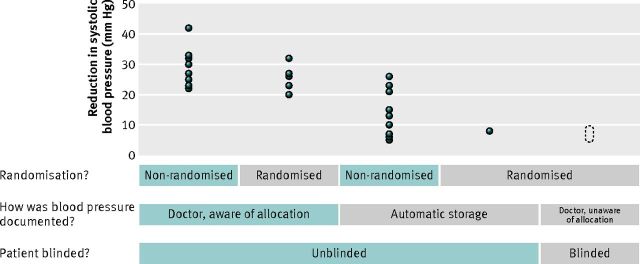
BMJ renal denervation

I like the subheading that precedes this figure ‘does my bias look big in this study?’ The figure shows the size of the apparent effectiveness of the intervention depending on the potential bias in the study design, each circle represents the systolic BP reduction from an individual trial. As you move from the unblinded studies where an unblinded investigator, who may have recently performed a highly invasive procedure on his patient, was responsible for recording the result, to masked randomized trials (with either automated BP measurement or a masked investigator taking the blood pressure), the effectiveness of the intervention disappears. The most recent, rigorous trial may show some residual minor benefit, but that is not clear. The trial has not even yet been published, but a press release from the company that bought the rights tot make the device states that they showed no benefit. A move they would only make if they didn’t find anything.

They did not show a substantial reduction in systolic blood pressure, even though the trial was designed to be able to find a 10 mmHg reduction.

The lessons are several.

1. Medical devices should be tested, with the same level of rigour as medications, before being licensed.

2. We should start with the most rigorous, least biased research designs, before huge financial resources are wasted, and patients potentially harmed. Which means that the first patient treated with a new intervention, be it a device, a procedure, or a drug, should be randomized and compared to best current practice.

3. In the long run it is cheaper to do the hard trials first, with randomization, blinding, objectively defined clinically important outcomes.

More from the BMJ editorial:

..ethics committees are responsible for protecting research participants’ “rights, safety, dignity, and wellbeing,” while balancing risks to participants against benefits to future patients. If the study is doomed to give the wrong answer, then no matter how small the risk, it is too large.

…interventional trials aimed at measuring efficacy without randomisation or blinding might be worse than useless. If so, they could be unethical by default.

Blinding isn’t always feasible, some trials are extremely difficult to blind: I remember one of my small studies which was comparing intubation using a muscle relaxant to without a muscle relaxant. It is easy to tell which babies are ‘paralyzed’, in fact you had to wait for the baby to be paralyzed before proceeding with the intubation. In such a case you must ensure that the data collected is completely objective, and that the enrollment is completed before the group assignment is revealed, that is, masking of the allocation.

We have to learn the lessons of trials like these, to avoid continually making the same mistakes. Unfortunately it seems the device is already licensed in Canada, clearly a huge mistake, we have to hope that doctors will just stop using it.

Posted in Neonatal Research | Tagged , , | Leave a comment

Neonatal Updates : pain and stress

Cabral DM, Antonini SRR, Custódio RJ, Martinelli Jr CE, da Silva CAB. Measurement of Salivary Cortisol as a Marker of Stress in Newborns in a Neonatal Intensive Care Unit. Hormone Research in Paediatrics. 2013;79(6):373-8. As I noted previously, we have just published about salivary cortisol concentrations in a study of co-bedding of twins. This study shows that stressed newborns generally have higher (much higher) salivary cortisol than healthy control newborns. I am sure the readers of this blog could point out many potential biases in this study, but nonetheless it is suggestive that this non-invasive test does reflect stress.

Harlos MS, Stenekes S, Lambert D, Hohl C, Chochinov HM. Intranasal Fentanyl in the Palliative Care of Newborns and Infants. Journal of Pain and Symptom Management. 2013;46(2):265-74. If you don’t have an IV, how to manage pain and distress in a dying baby can be problematic. This study notes that intranasal fentanyl was well tolerated, and appeared to be effective.

Cohen AM, Cook N, Harris MC, Ying GS, Binenbaum G. The pain response to mydriatic eyedrops in preterm infants. J Perinatol. 2013;33(6):462-5. No wonder that pain control for retinal exams is difficult, it even hurts when you put the eye-drops in ! Preterm babies have somewhat stereotyped responses to being disturbed. So when we, as adults, get something unpleasant but not actually painful done (such as the prostate exam!) we can say ‘ew’, and when a truly painful event occurs we say ‘ow’. Preterm babies say ‘ow’ for both. They may experience similar sensations and have similar adverse endocrine responses for both, or not; we don’t really know. Putting eye-drops, in we wouldn’t ordinarily suppose to be painful, but preterm babies have increases in pain scores, and about a third have significant increases, when they are prepared for their eye exams. 

Vinall J, Miller SP, Bjornson BH, Fitzpatrick KPV, Poskitt KJ, Brant R, et al. Invasive Procedures in Preterm Children: Brain and Cognitive Development at School Age. Pediatrics. 2014 February 17, 2014. With all respect to this great group of authors, I think it is impossible to separate the results of invasive procedures from the reasons that the procedures were done. The more procedures you had, the sicker you were, and this study shows that even at 7 years of age the lower is the fractional anisotropy of your white matter. These two factors (invasive procedures and FA) were correlated with poorer development. I think it is very likely that the pain associated with many procedures is important, but the reason you needed them is probably also important.

Posted in Neonatal Research | Leave a comment

More about mother’s voices

When I first read this article I thought that the authors had rigged up a system to play music actually in the babies mouth, but I think I was wrong about that.

Chorna OD, Slaughter JC, Wang L, Stark AR, Maitre NL: A pacifier-activated music player with mother’s voice improves oral feeding in preterm infants. Pediatrics 2014.

This was a randomized trial in preterm babies who were learning to orally feed. What they did was record mothers of preterm babies singing or talking. Then in the intervention group they used, for 15 minutes per day during 5 consecutive days, a pacifier that had been rigged up with a trigger, so that during a period of quiet wakefulness, if they sucked hard enough on the pacifier a recording of the mothers voice was played. It looks like they didn’t get a pacifier at any other time during those 5 days. The controls got a pacifier without any electronics. And the voice came out of loudspeakers a few inches away from the baby (not from the pacifier).

The primary outcome was how much milk the baby sucked from a bottle comparing before and after the intervention. As this is a period of time when feeding competence improves rapidly a control group is essential, if we can get babies to feed better faster then they should be able to get home faster as well.

The results showed that babies with the mother’s voice intervention sucked more strongly over the 5 days, had a greater increase in the volume of milk that they took, had a better increase in the number of oral feeds per day, and seem to have gone home earlier (not statistically significant. Mothers are important after all, or at least their voices!

Posted in Neonatal Research | Tagged | Leave a comment

Ventilator Graphics: Are Pressure Volume Loops interesting?

If you buy a new ventilator today for your preterm infants, you cannot avoid having ‘sophisticated graphics’. These ‘sophisticated graphics’ are supposed to help you ventilate the babies appropriately. I have always been very skeptical about ‘sophisticated graphics’ as they never look like the pretty curves in the books and review articles with clear inflection points, that, supposedly, allow you to tell whether a patient is over-distended or under-inflated.

So I thought I would get the readers of this blog to help me with a little project. I took some photos of real-life pressure volume loops on ventilators in my NICU, either EvitaXL or VN500. I have created a survey monkey survey that will take you about 3 minutes to complete. I will give you some info about each baby, and I would like you to look at each loop, and tell me whether you think the lung is overdistended, or underinflated, and what change in ventilation you think should be made as a result of seeing the loops. The first thing that I have to admit is that to get clean loops like these is not very easy, often you have to freeze the screen multiple times to choose a loop that looks like something, and is not, for example, a double figure of 8 loop that crosses over itself multiple times. Which immediately introduces an element of subjectivity.

So the idea of this little survey is to see if people can agree to what the loops actually show.

The survey is at the following link  https://fr.surveymonkey.com/s/BJF2JJF

Posted in Neonatal Research | Tagged , | 2 Comments

Pain, still bad for you

Roofthooft DWE, Simons SHP, Anand KJS, Tibboel D, van Dijk M: Eight years later, are we still hurting newborn infants. Neonatology 2014, 105(3):218-226. The answer is yes, but much less! In this study from a single hospital in Rotterdam with a focus on pain research, there were many fewer painful procedures performed than in the previous study, using a similar methodology, and more sucrose and kangaroo care and other interventions were used for the procedures that were still required. But we can still do better!

One thing the authors noted was that as the number of procedures has decreased, the percentage of unsuccessful procedures has increased. So peripheral arterial lines (which have a high failure rate as the catheters are often around the same size as the artery being cannulated) were unsuccessful 38% of the time in 2001 and 63% of the time in the new cohort. There were a lot fewer of them, so I think this shows that, as we are doing better at being less-invasive, then, when we really need to be invasive, we don’t have the same skills anymore. In our group one or two of us are recognized as having a higher success rate at peripheral lines, so they tend to get asked to do them, and maintain a reasonable success rate, which I think is best for the babies, but when they are not available, what then?

For a much more frequent procedure, peripheral intravenous catheter insertion, success rate dropped from 69% to 62%. So a large number of potentially painful procedures are performed for no benefit. A failed procedure also affects the use of analgesia for the subsequent procedure. If I have put EMLA for a procedure and then fail, re-application may not be possible as time is passing, and I may start to be concerned about toxicity, even sucrose may be less effective if you have to give it multiple times to get a single i.v.

We must find ways of improving success, with new technologies, simulation training etc. I think the next big step forward in neonatal pain control could well be finding ways to reduce unsuccessful procedures.

Posted in Neonatal Research | Tagged , | Leave a comment

Stop the Antibiotics!

We know that prolonged antibiotic use in preterm babies increase their chance of later developing NEC. The assumption being that the disturbance of the intestinal flora leads to the increase in susceptibility. Here is some more direct evidence to support that assumption.

Greenwood C, Morrow AL, Lagomarcino AJ, Altaye M, Taft DH, Yu Z, Newburg DS, Ward DV, Schibler KR: Early empiric antibiotic use in preterm infants is associated with lower bacterial diversity and higher relative abundance of enterobacter. The Journal of pediatrics 2014(0).

There were 74 babies under 33 weeks studied, who had their microbiomic analysis performed weekly, 3 times. They divided the babies into those who had antibiotics for 0 days, 1-4 days, or 5-7 days.

All of the antibiotic use was empiric, defined as treatment based solely on clinical suspicion of infection without a positive culture result.

RESULTS: Infants who received 5-7 days of empiric antimicrobial agents in the first week had increased relative abundance of Enterobacter (P = .016) and lower bacterial diversity in the second and third weeks of life. Infants receiving early antibiotics also experienced more cases of necrotizing enterocolitis, sepsis, or death than those not exposed to antibiotics.

The table 2 in that article requires a bit of explanation, it took me  a while to realize that the row labelled ‘cases’ means those babies who had the combined outcome of death, NEC or sepsis.

The message to me is clear, prematurity is not in itself a septic event. You don’t have to have antibiotics just because you are admitted to an NICU! If you do have an indication for expectant antibiotic therapy, they should be stopped if the cultures are negative unless you have a very good reason.

Of course the other method is that all babies develop a microbiome, we can wreck it by giving antibiotics, and we can nudge it in the right direction by administering probiotics.

Posted in Neonatal Research | Tagged , , | 4 Comments

Does being ventilated hurt? It depends who you ask

Ruth Guinsburg is a neonatologist in Sao Paulo who has been super-productive, especially in the area of pain control in the newborn. Her latest is an interesting comparison of how caregivers and parents rate pain in infants on ventilators.

Elias L, dos Santos A, Guinsburg R: Perception of pain and distress in intubated and mechanically ventilated newborn infants by parents and health professionals. BMC Pediatrics 2014, 14(1):44. (Open Access).

The group asked the participants to observe different babies who were 24 to 96 hours old, in an incubator on a conventional ventilator, who had a gastric tube and and IV, During the one minute of observation they were not handled and had no procedures.

The participants were in 3 groups, pediatricians, nurse technicians (who seem to be nursing auxiliary types who work under the supervision of RNs) and parents. There were enormous discrepancies between the observers regarding whether they thought the babies were in pain, or distressed. Which makes it really difficult to treat or prevent such pain and distress. I think that many preterm babies who are intubated and ventilated seem very calm in between interventions, and have little evidence of pain or distress, which is probably why there is little evident benefit of routine analgesic (or sedative) infusions during assisted ventilation. Some babies, especially I think, the more mature infants do seem somewhat distressed and may benefit from maneuvers to decreases this.

It is of interest then that the very long term follow up of one of the trials of continuous morphine infusion during assisted ventilation has now been published. (de Graaf J, van Lingen RA, Valkenburg AJ, Weisglas-Kuperus N, Groot Jebbink L, Wijnberg-Williams B, Anand KJS, Tibboel D, van Dijk M: Does neonatal morphine use affect neuropsychological outcomes at 8 to 9 years of age? Pain 2013, 154(3):449-458).  There were 132 survivors of the original trial, of whom 89 were seen at 8 to 9 years. Reassuringly there were no adverse effects of the morphine detected, and there was even a tendency for executive functions to be better in the morphine group. With all the concerns about such agents potential effects on brain development and increase in apoptosis, it is comforting that very little was found.


Posted in Neonatal Research | Tagged , , , | Leave a comment