Screening for Hyperbilirubinemia

When I was chair of the CPS Fetus and Newborn committee, we produced several position statements, one of which I was quite proud was written by myself and by Dr Sankaran from Saskatoon, it was a guideline for the screening and treatment of hyperbilirubinemia in full term babies. The guideline recommended among other things, universal pre-discharge bilirubin screening.

When you write these things you are never sure what sort of effect it will have, we hoped that it would reduce the numbers of babies receiving phototherapy, and reduce the frequency of kernicterus, while having little effect on hospital costs or the total number of bilirubin tests prescribed. Of course, there will only be an effect if people actually follow the guidelines.

So I was pleased to see that in Ontario at least most hospitals that deliver babies do now screen routinely for high bilirubin at discharge, and most of them started doing so after the guidelines were published.

That is not to say there aren’t problems, the new study shows that the biggest problem is how to organize follow up testing. To clarify, infants at significant risk who have levels at discharge that are high, but not high enough to need immediate phototherapy, have to get follow up testing. In some communities this can be a problem, especially at weekends. In many places the mothers (or fathers) bring the baby back to the hospital, either to the lab or to the newborn nursery in order to be re-tested. This is certainly not optimal, requiring often longer journeys, and disrupting the post-partum period. Community based testing available 7 days a week is needed. Testing at home with optical bilirubinometers during a home visit from a health professional who can also check on breast feeding and progress of weight would be optimal.

Finally did it work? Is there a reduction in kernicterus? well, we don’t yet know, is I think the right answer, the guidelines were published in 2007, this new article from Ontario shows that it took until 2011 for 75% of the hospitals to be screening. In 2007, 2008 kernicterus was still a problem (albeit rare) in Canada; and not as rare as we might think, with a calculated incidence of at least 1 in 44,000 live births. It would be great to repeat the Canadian Paediatric Surveillance Program study on kernicterus to see if the guideline had an effect. I think I will drop them a line and see if that is possible…

Posted in Neonatal Research | Tagged , | Leave a comment

On the radio

I was interviewed for the excellent Radio-Canada program on science, known as ‘les années lumières’ recently. The subject was about whether breast feeding is really best for babies. The reason for them doing the story was a recent publication by a sociologist who analyzed a database which included some siblings. Among the siblings, by parental report there were some pairs where one had been breastfed and the other had not. The authors of that study did some analyses to ‘correct’ for other influences on outcome and concluded that breast feeding had no effect. The outcomes they tested included asthma, obesity, child behaviour and some indices of intelligence.

Apart from serious deficiencies in data quality, research design and analysis, the study is only one of a very large number examining the benefits of breast feeding, some others have also examined discordant sibling pairs. There is an excellent systematic review by the US Agency for health care research and quality with the first author being Stanley Ip. A summary of which you can find here. There is also a nice take down of the article in The Huffington Post.

Anyway the interview went fairly well I think, if you want to listen it is here (it is in French) my part starts at about 18 minutes, the link should take you to the start of that specific segment, which is about 15 minutes into the show.

Posted in Neonatal Research | Tagged , | Leave a comment

Public citizen are becoming a public danger

Public citizen are at it again, they have written another letter to the director of the DHHSS to try and follow up on their previous nonsense. I didn’t write about this when I first heard about it, as 1. it is dumb and 2. I didn’t think anyone will take any notice of more misguided criticism of SUPPORT. But with a very interesting and thoughtful viewpoint article in JAMA just published, about comparative effectiveness research, I thought I would come back to the issues briefly. 

In this new missive to Kathleen Sebelius they introduce more ridiculous arguments, criticizing the SUPPORT trial for study design lapses, inadequate oversight and failure to stop the study early.

In this new letter they state for example that oxygen saturation targets should normally be adjusted according to capillary filling time, hepatic function, intravascular volume and impending NEC (among other indications). As far as I can see they have just made these things up.

Let me make this clear in case anyone from Public Citizen is reading this blog.

THIS IS CRAP.

We do not do this. We do NOT adjust saturation targets according to capillary filling, hepatic function or intravascular volume it doesn’t make any sort of physiologic sense, and if anyone in my NICU did this we would have a very serious discussion. We do NOT adjust saturation targets in the case of non-existent diagnoses either, such as ‘impending NEC’ even if we knew when NEC was impending we have no evidence from any sort of trial (and certainly not from high quality large RCTs such as SUPPORT) that changing saturation limits is appropriate.

So here is my advice for people who want to criticize clinical research in a particular field, if you have no idea what you are talking about, either shut up, or go and ask someone who does know. Otherwise you just make yourself look stupid.

The authors of the letter then make certain points about early termination of the study which show still more clearly that they don’t understand clinical research, or how this sort of study is run.

Most trials, and all large multicenter trials, now have an independent data safety monitoring committee (DSMC). They are set up by the study steering group, but are completely independent of them, they have access to study data as the study is being run. At pre-specified points in the study the are supplied with data from currently enrolled subjects, which is usually supplied as 2 groups of data, 1 from each arm of the study, but without necessarily revealing which arm is which. They then look at the data to see if there are safety concerns, the idea being that if one group is clearly having worse outcomes on an important outcome variable than the other group, then the study can be stopped. This is an important principle to avoid exposing further patients to risks when the answer is already crystal clear.

There are risks to doing this, every time you look at the data there is a chance that you will find a difference just because of random variation, and the more times you look at the data these risks accumulate. You protect against such risks by having a limited number of looks at the data, and by requiring highly significant differences in clinically important outcomes in order to stop a trial.

What the Public Citizen authors claim is that there was no plan to examine retinopathy and death separately, and that if that had been done then the study could have been stopped after 25% enrollment. Which would have spared the remaining infants from the risks of death or severe retinopathy.

Firstly it is highly likely that the DSMC (data safety monitoring committee) did look at components of the primary outcome separately. The DSMC is independent, and is tasked with protecting future enrollees, they are not in any way restricted in what they can examine, and often ask for extra details and clarifications. I can give the example of the CAP trial, where the DSMC noted a difference in PDA ligation rates between the groups, even though that was not at all in their list of outcomes to examine according to the approved protocol.

Secondly the letter writers guess what the retinopathy rates were after 25% of the enrollment, assuming that retinopathy was uniformly distributed amongst patients. In fact that is highly unlikely. If 10% of the patients have an adverse even, it is highly unlikely that every tenth patient will be the one affected, it is equally (un)likely that the first 10 all have the adverse event and the next 90 are fine. That is one reason why much higher levels of statistical significance are required for early stopping of a trial. So according to their calculations there would have been a statistically significant difference in retinopathy between the groups after 25% enrollment. All that statement does is to show their profound ignorance. A p<0.05 level of significance is not used for early stopping of trials; more commonly a 3SD difference is required in an important outcome, equivalent to about p<0.001, for the reasons outlined above.

If that had indeed happened, however, and the study had been stopped as they suggest it should have been, this would, of course, have prevented the investigators from noting the increased mortality in the low saturation group, and the result of the trial would have encouraged everyone to start using lower saturations and causing the death of many preterm babies.

According to the Public Danger (my new pet name for the group) authors, this would not have happened because there was no ‘usual care’ group, and therefore everyone would have ignored the results and carried on as before!!!

Public Danger’s lack of understanding of what constitutes ‘usual care’ in a modern NICU is not just profound, it is persistent. It resembles schizophrenic delusions that persist despite all the evidence to the contrary.

Le me try and explain this again in case any of them are listening, which I doubt. Both arms of the SUPPORT trial were ‘usual care’. It is ‘usual care’ for an NICU to have pre-specified limits of saturations for all the preterm babies in the unit, which are not changed based on clinical factors, but stay unchanged in the face of, for example liver disease or ‘impending NEC’.

Since SUPPORT and the other oxygen trials have been published we, and many other centers, have changed our oxygen saturation limits, we now aim for over 90% for all of our preterm babies (and try to stay below 95%). We may have more retinopathy as a result, but will try to compensate by optimizing nutrition, and investigating other interventions such as perhaps omega3 fatty acids.

It would have been an enormous disaster for preterm babies, in the USA, Canada, and around the world, if the viewpoint of Public Danger had prevailed and we had all set our saturations to less than 90% because the study had terminated early. Thousands of dead babies would not have thanked us for that.

Posted in Neonatal Research | Tagged , , , , | Leave a comment

HIP Protocol published

The Hypotension in Preterms trial is about to get underway, with all the final hurdles just about cleared. Just at the right time our protocol has been published in ‘Neonatology’.

Dempsey EM, Barrington KJ, Marlow N, O’Donnell CP, Miletin J, Naulaers G, Cheung PY, Corcoran D, Pons G, Stranak Z, Van Laere D, on behalf of the HIP consortium: Management of hypotension in preterm infants (the hip trial): A randomised controlled trial of hypotension management in extremely low gestational age newborns. Neonatology 2014, 105(4):275-281.

Starting to get excited! I’ll be even more so when we randomize the first patient.

Posted in Neonatal Research | Tagged , , | Leave a comment

Insulin, nutrition, insulin-like growth factors and the retina

I’d really like to see a good quality review article with that title, there are several that touch on these issues (for example, here and here), but I find the data hard to digest, probably because it is relatively novel for me.

So here is my attempt to summarize things for myself:

Recent data show that infants with poor postnatal growth have an increased risk of retinopathy (RoP), and that this seems to be  statistically be related to lower IGF levels.

Prediction models have been produced, based on neonatal growth, the main aim of which seems to be reducing and/or targeting retinal screening exams. They appear to be fairly good predictors of who will not develop RoP. If you grow well you are relatively protected from developing severe RoP.

Insulin-like Growth Factor 1 plays a rôle in retinal vascular development, it seems to be required for VEGF to have an effect. IGF1 decreases after preterm birth,  and then slowly increases. The low initial IGF1 concentration is thought to participate in poorer retinal development initially, but then, later on when the IGF1 levels increase, it permits VEGF to act, promoting neo-vascular proliferation.

IGF1 levels are also affected by/correlated with  postnatal growth, and by nutritional intakes.

IGF1 levels seem to be lower in infants who are hyperglycemic, treatment with insulin may lead to a later increase in IGF1. Optimizing nutritional intakes, improves growth, probably increases IGF1 levels and might decrease RoP. However, many of the observational and interventional studies of differing nutritional intakes have not mentioned RoP as an outcome, probably, like me, few people thought there would be a change in RoP by changing early calorie administration. Even fairly recent review articles of nutritional intakes of the preterm infant do not address retinopathy reduction as a potential benefit of improved nutrition.

I recently heard that there is a planned RCT of recombinant IGF to try and prevent retinopathy, which seems to me to be far too early given the current state of knowledge. Surely the first step should be to find ways to optimize postnatal nutrition, to have uniform optimal nutritional protocols with good quality protein and appropriate lipids. An RCT of IGF against such a background might then be worthwhile. But while postnatal growth is so poor in many very preterm babies, because their nutritional intakes do not follow guidelines, and the other benefits of optimal nutrition are numerous, I think we should have better studies showing the effects of optimal nutritional management before leaping into supplying IGF1, which might just be a way to counter our deficiencies of nutritional management!

These issues will become more important in the near future, as we increase oxygen saturation targets we need to find the best ways we can to protect the retinae of our extreme preterm babies.

Posted in Neonatal Research | Tagged , | Leave a comment

Weaning CPAP

One of the things that we should always remember in neonatology is that the main goal of any supportive therapy is to stop it. The main goal of blood pressure support should be to achieve hemodynamic stability in order to be able to stop the blood pressure support. The main goal of intubation is extubation. The main goal of CPAP is to stop CPAP, and so on.

Which makes it remarkable that there are so few studies about how best to wean from support, including respiratory support.

We are slowly accumulating some information about how to wean from respiratory support, and this new trial supports previous studies showing that cycling time-off CPAP is not helpful.  The comparisons studied were just stopping the CPAP from 5 cm H2O compared to cycling the baby on and off CPAP while gradually increasing the time off (3 on 3 off for 48 hours, then 3 on 6 off for 48h).  Which is quite similar to the study by Todd et al that I previously mentioned on this blog. This new trial enrolled only 56 babies, the sample size was determined by hypothesizing an enormous difference in success rate, 33% with sudden weaning to 66% with cycling.  Success of weaning was defined as the absence of persistent tachypnea, marked retractions or apneic episodes on room air with no ventilator support, and need for supplemental oxygen for 7 days.

This study was negative (by which I mean there was no difference in outcomes that could not have easily been ascribed to chance). Clearly, the trial is underpowered, it is presented as a pilot trial, which I think is OK as long as the authors recognize the limitations of the small sample and report the confidence intervals. I don’t see in this report the confidence intervals for the primary outcome variable, I think that should be routine, small negative trials (in fact all trials positive and negative of any size) should report the confidence intervals. That way a reader can tell how large an effect could have been missed.

For this study there were 13 successes in the immediate weaning, and 12 in the cycling group. The difference between those proportions is 0.036, with confidence interval of -0.23 to +0.29. Meaning that the real difference in success of weaning, consistent with these results with 95% confidence, lies somewhere between a 29% better success of weaning with the sudden approach and a 23% better success with cycling.

This is not difficult to calculate; I used an on-line calculator, and it took me less than 2 minutes. Reviewers should require that such information be presented, as it is the only way to interpret the meaning of a result like the one from this study.

Posted in Neonatal Research | Tagged , | Leave a comment

Leave my renal nerves alone, please.

Not having looked after an adult for many years (although I did do a year of postgraduate training in adult internal medicine before switching to paediatrics; I thought I should practice on the old ones before subjecting children to my ministrations) I had never heard about renal denervation therapy for hypertension. The idea being that sympathetic renal stimulation is important in maintaining high blood pressure; so someone invented a catheter that you insert into the femoral artery, pass up into the renal artery and denervate the kidneys using radio-frequency pulses.

As a neonatologist, who tries to use physiology rather than fighting against it, this seems  to me inherently unlikely to be effective, but smarter people than me thought it might work, and performed a couple of randomized trials with impressive, almost unbelievable results (30 mmHg reduction in systolic blood pressure), and even managed to  get a case report in the PNEJM. The company making the catheter became very profitable and were sold for millions.

Unfortunately it probably doesn’t work.

An excellent editorial in the BMJ includes this figure

BMJ renal denervation

I like the subheading that precedes this figure ‘does my bias look big in this study?’ The figure shows the size of the apparent effectiveness of the intervention depending on the potential bias in the study design, each circle represents the systolic BP reduction from an individual trial. As you move from the unblinded studies where an unblinded investigator, who may have recently performed a highly invasive procedure on his patient, was responsible for recording the result, to masked randomized trials (with either automated BP measurement or a masked investigator taking the blood pressure), the effectiveness of the intervention disappears. The most recent, rigorous trial may show some residual minor benefit, but that is not clear. The trial has not even yet been published, but a press release from the company that bought the rights tot make the device states that they showed no benefit. A move they would only make if they didn’t find anything.

They did not show a substantial reduction in systolic blood pressure, even though the trial was designed to be able to find a 10 mmHg reduction.

The lessons are several.

1. Medical devices should be tested, with the same level of rigour as medications, before being licensed.

2. We should start with the most rigorous, least biased research designs, before huge financial resources are wasted, and patients potentially harmed. Which means that the first patient treated with a new intervention, be it a device, a procedure, or a drug, should be randomized and compared to best current practice.

3. In the long run it is cheaper to do the hard trials first, with randomization, blinding, objectively defined clinically important outcomes.

More from the BMJ editorial:

..ethics committees are responsible for protecting research participants’ “rights, safety, dignity, and wellbeing,” while balancing risks to participants against benefits to future patients. If the study is doomed to give the wrong answer, then no matter how small the risk, it is too large.

…interventional trials aimed at measuring efficacy without randomisation or blinding might be worse than useless. If so, they could be unethical by default.

Blinding isn’t always feasible, some trials are extremely difficult to blind: I remember one of my small studies which was comparing intubation using a muscle relaxant to without a muscle relaxant. It is easy to tell which babies are ‘paralyzed’, in fact you had to wait for the baby to be paralyzed before proceeding with the intubation. In such a case you must ensure that the data collected is completely objective, and that the enrollment is completed before the group assignment is revealed, that is, masking of the allocation.

We have to learn the lessons of trials like these, to avoid continually making the same mistakes. Unfortunately it seems the device is already licensed in Canada, clearly a huge mistake, we have to hope that doctors will just stop using it.

Posted in Neonatal Research | Tagged , , | Leave a comment

Neonatal Updates : pain and stress

Cabral DM, Antonini SRR, Custódio RJ, Martinelli Jr CE, da Silva CAB. Measurement of Salivary Cortisol as a Marker of Stress in Newborns in a Neonatal Intensive Care Unit. Hormone Research in Paediatrics. 2013;79(6):373-8. As I noted previously, we have just published about salivary cortisol concentrations in a study of co-bedding of twins. This study shows that stressed newborns generally have higher (much higher) salivary cortisol than healthy control newborns. I am sure the readers of this blog could point out many potential biases in this study, but nonetheless it is suggestive that this non-invasive test does reflect stress.

Harlos MS, Stenekes S, Lambert D, Hohl C, Chochinov HM. Intranasal Fentanyl in the Palliative Care of Newborns and Infants. Journal of Pain and Symptom Management. 2013;46(2):265-74. If you don’t have an IV, how to manage pain and distress in a dying baby can be problematic. This study notes that intranasal fentanyl was well tolerated, and appeared to be effective.

Cohen AM, Cook N, Harris MC, Ying GS, Binenbaum G. The pain response to mydriatic eyedrops in preterm infants. J Perinatol. 2013;33(6):462-5. No wonder that pain control for retinal exams is difficult, it even hurts when you put the eye-drops in ! Preterm babies have somewhat stereotyped responses to being disturbed. So when we, as adults, get something unpleasant but not actually painful done (such as the prostate exam!) we can say ‘ew’, and when a truly painful event occurs we say ‘ow’. Preterm babies say ‘ow’ for both. They may experience similar sensations and have similar adverse endocrine responses for both, or not; we don’t really know. Putting eye-drops, in we wouldn’t ordinarily suppose to be painful, but preterm babies have increases in pain scores, and about a third have significant increases, when they are prepared for their eye exams. 

Vinall J, Miller SP, Bjornson BH, Fitzpatrick KPV, Poskitt KJ, Brant R, et al. Invasive Procedures in Preterm Children: Brain and Cognitive Development at School Age. Pediatrics. 2014 February 17, 2014. With all respect to this great group of authors, I think it is impossible to separate the results of invasive procedures from the reasons that the procedures were done. The more procedures you had, the sicker you were, and this study shows that even at 7 years of age the lower is the fractional anisotropy of your white matter. These two factors (invasive procedures and FA) were correlated with poorer development. I think it is very likely that the pain associated with many procedures is important, but the reason you needed them is probably also important.

Posted in Neonatal Research | Leave a comment

More about mother’s voices

When I first read this article I thought that the authors had rigged up a system to play music actually in the babies mouth, but I think I was wrong about that.

Chorna OD, Slaughter JC, Wang L, Stark AR, Maitre NL: A pacifier-activated music player with mother’s voice improves oral feeding in preterm infants. Pediatrics 2014.

This was a randomized trial in preterm babies who were learning to orally feed. What they did was record mothers of preterm babies singing or talking. Then in the intervention group they used, for 15 minutes per day during 5 consecutive days, a pacifier that had been rigged up with a trigger, so that during a period of quiet wakefulness, if they sucked hard enough on the pacifier a recording of the mothers voice was played. It looks like they didn’t get a pacifier at any other time during those 5 days. The controls got a pacifier without any electronics. And the voice came out of loudspeakers a few inches away from the baby (not from the pacifier).

The primary outcome was how much milk the baby sucked from a bottle comparing before and after the intervention. As this is a period of time when feeding competence improves rapidly a control group is essential, if we can get babies to feed better faster then they should be able to get home faster as well.

The results showed that babies with the mother’s voice intervention sucked more strongly over the 5 days, had a greater increase in the volume of milk that they took, had a better increase in the number of oral feeds per day, and seem to have gone home earlier (not statistically significant. Mothers are important after all, or at least their voices!

Posted in Neonatal Research | Tagged | Leave a comment

Ventilator Graphics: Are Pressure Volume Loops interesting?

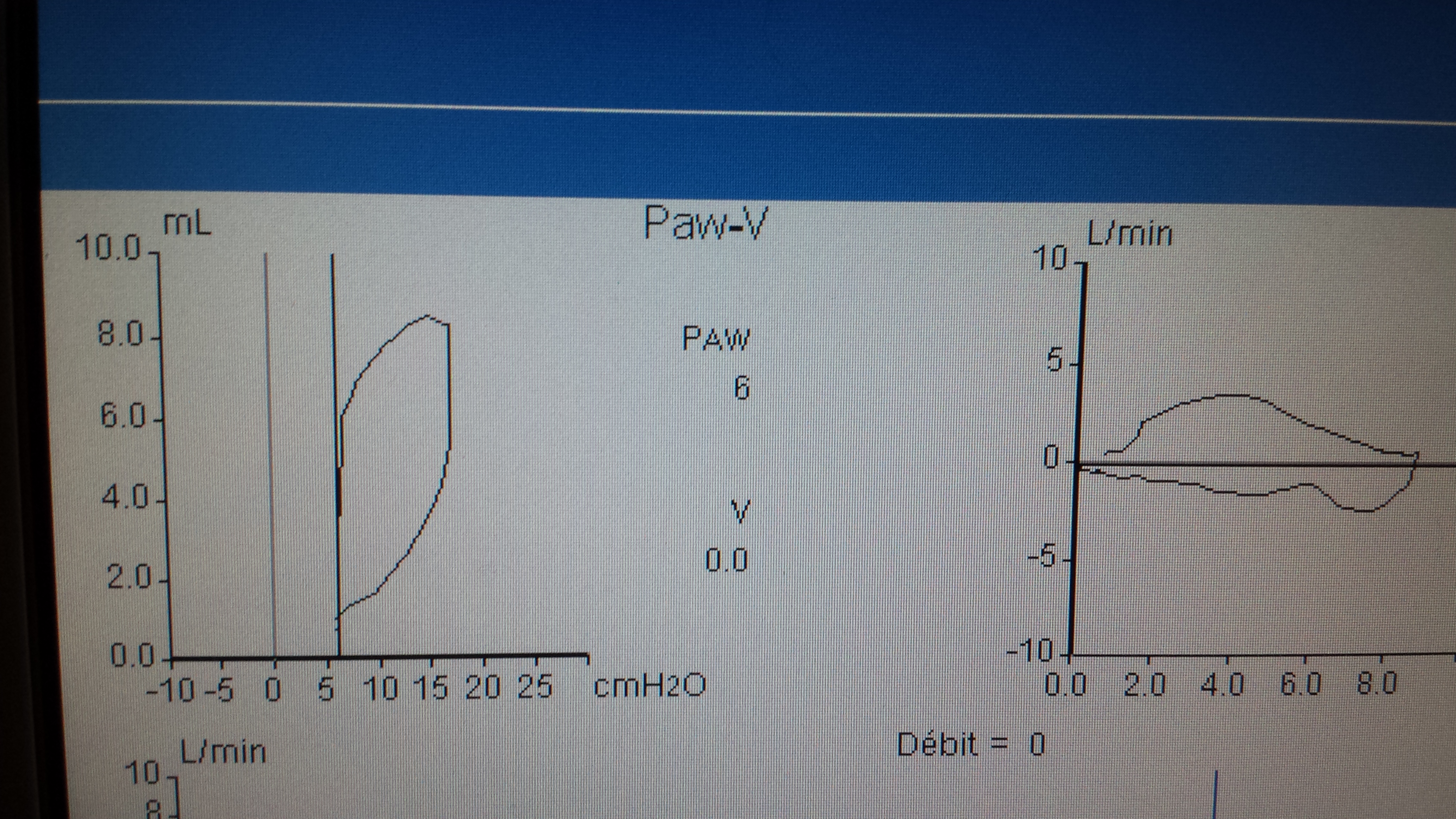
If you buy a new ventilator today for your preterm infants, you cannot avoid having ‘sophisticated graphics’. These ‘sophisticated graphics’ are supposed to help you ventilate the babies appropriately. I have always been very skeptical about ‘sophisticated graphics’ as they never look like the pretty curves in the books and review articles with clear inflection points, that, supposedly, allow you to tell whether a patient is over-distended or under-inflated.

So I thought I would get the readers of this blog to help me with a little project. I took some photos of real-life pressure volume loops on ventilators in my NICU, either EvitaXL or VN500. I have created a survey monkey survey that will take you about 3 minutes to complete. I will give you some info about each baby, and I would like you to look at each loop, and tell me whether you think the lung is overdistended, or underinflated, and what change in ventilation you think should be made as a result of seeing the loops. The first thing that I have to admit is that to get clean loops like these is not very easy, often you have to freeze the screen multiple times to choose a loop that looks like something, and is not, for example, a double figure of 8 loop that crosses over itself multiple times. Which immediately introduces an element of subjectivity.

So the idea of this little survey is to see if people can agree to what the loops actually show.

The survey is at the following link  https://fr.surveymonkey.com/s/BJF2JJF

Posted in Neonatal Research | Tagged , | 2 Comments