Re-re-re-visited (delayed cord clamping of course)

I received 2 comments about the last posting re: DCC. The way I set up this blog the comments aren’t necessarily very obvious, especially if you visit the home page rather than following a link to the individual posting. So I will sometimes copy parts of a comment into a new post. I will certainly never do that to criticize or embarrass anyone, just to try and further a discussion.

First a comment from Wally Carlo, who noted that Judith Mercer had an abstract at the PAS meeting reporting outcomes from a moderately large RCT of DCC. I didn’t put any data from that study in my analysis, because I don’t have the actual numbers, so I only put published articles in the Forest plots. But to clarify: Mercer’s study enrolled 208 babies under 32 weeks and basically showed no short term differences. The abstract doesn’t mention mortality, which makes me think that wasn’t significant either, but there were specifically no differences in IVH, or sepsis.

The other comment was from Michael Hewson, and I quote some of it here

It could be getting difficult to continue with the APTS trial enrollment after explaining to parents that in the data available so far delayed cord clamping reduced mortality and NEC by at least 50% (admittedly there is a 2.5% chance of obtaining such dramatic benefits by chance alone). It’s true that more data would be great, that we don’t have enough long term outcome data, and that APTS could theoretically swing the pendulum in the other direction (like INIS or BOOST) but still how to look past the existing delayed cord clamping data, including the physiological evidence?

There seems to be a tricky no mans land that is reached after the point of equipoise has been passed but before widespread acceptance of a new intervention… therapeutic hypothermia also springs to mind.

I think those are important points, both the specific point about this issue, and a general point about how much evidence is enough.

The summary statistics of the data that I selected for my Forest plots (I must emphasize that this is not an ‘updated systematic review and meta-analysis’ it is me trying to summarize what I think are the relevant data), show a difference in mortality which is actually between 6.8% in controls and 4.3 % with DCC. That makes the risk difference 0.025, with an NNT of 40, 95% CI of 20 to infinity. The p-value for the mortality difference is 0.11, which is not a 2.5% likelihood of being due to chance.

For trainees and others everywhere, what this p-value means is that random selection of 2 groups of patients from the population of very preterm infants would show differences as great, or more extreme, 11 times out of 100.

Now I don’t think that’s enough to be sure that this procedure is safe, let alone advantageous. I think it is probably safe, the likelihood of significant harm seems quite low from the data that have been collected so far.

The difference in NEC is 7.4% in the controls, and 3.8% with DCC, among the studies that reported the outcome, there were many studies that did not report NEC, so there are only 30 events in total, among over 500 babies in the trials with this result. But if we assume that those that didn’t report NEC did not have any (which is a dangerous assumption, but many of those trials were larger babies who were at lower risk), then the difference is between, 3.9% and 2.0%, or a risk difference of 0.019, and an NNT of 52, 95% CI also include infinity!

The p value for the difference, using the trials that reported NEC which I put in the meta-analysis,  is 0.09, far from what we usually consider to be significant, and again not a 2.5% likelihood of being due to chance, but much more than that.

If someone was to do a Jesper Brok style sequential analysis (Brok J, et al. Apparently conclusive meta-analyses may be inconclusive—Trial sequential analysis adjustment of random error risk due to repetitive testing of accumulating data in apparently conclusive neonatal meta-analyses. International Journal of Epidemiology. 2009;38(1):287-98.
which I have neither the time, the expertise, nor the software to do), I can bet you that it would be far, far away from a significant result.
We’ve been here before, as is mentioned in this comment, based on multiple small studies, IVIG seemed to reduce mortality in septic newborns. INIS showed absolutely zilch. Fortunately there was no prior evidence of harm in the IVIG studies before INIS, and that trial also confirmed that there was no harm.

I appreciate the comment about the importance of making sure parents are well informed of the current state of the literature when getting consent to enroll them, that is of course essential, and these things can be difficult to explain, but I would insist that it is by no means clear that the differences in mortality or NEC are really due to the DCC. Hopefully enough parents will agree that this is an important question to answer, and will consent to randomization. I think if a parent, presented with this information, requested DCC (or requested immediate clamping) there would be no good reason for denying it. If you are set up to do the study then presumably you have equipoise, so organising a DCC should be no problem.

As there is no “trend” towards harm in any of the outcomes presented, and babies who have DCC need less blood in most of the studies (but interestingly not in that study by Judith Mercer, the hematocrits, at least, were no different between groups) I think it is unlikely that we are harming babies with DCC, but there really isn’t yet any reliable evidence of any benefit other than a possible reduction in blood transfusion. Most of that data of course comes from more mature preterm babies; for us to ensure that this is really safe, and that there are real benefits for small preterm infants, requires us to finish large studies if we at all can.

I think the example of the hypothermia studies is not a clear parallel. It became difficult to randomize after the publication of two large high quality multicenter trials, after the 3rd was published I was of the opinion that the other studies should stop, and that it was no longer appropriate to continue to randomize patients. We are far from that situation with DCC in the very preterm baby.  Even one well done, large multicenter trial, if it showed no harm, and clarified what the real benefits might be, could be enough to appropriately change practice everywhere.
Posted in Neonatal Research | Tagged , , , | 2 Comments

Very Sad News

Maureen Hack has died.

Apparently she died earlier today. Although several years past a usual person’s retirement age, Maureen was still a towering, (metaphorically) and very active figure in neonatology, her follow up research, and her insights were very valuable for all of us.

I remember her as someone who was easy to talk too, interested and interesting, who made contributions to neonatology which will be quoted for a very long time, and who was humble enough to be open to new interpretations of her results as her subjects aged.

Maureen showed that extremely low birth weight babies mostly functioned very well as they entered adolescence and adulthood. She showed the importance of having a good control group from similar backgrounds to the preterm subjects. She showed more clearly than anyone else at the time how much test scores improve over time for the majority of preterm babies who have developmental evaluations in the first couple of years.

She will be sorely missed.

Posted in Neonatal Research | 2 Comments

Keep people like this away from the NICU

After my novel-length post earlier, a quick rant.

In the few weeks since the NICHD ‘before 24’ paper came out there have been a number of newspaper articles reporting the results, and responses to them. A report in the National Post included some comments made by an “ethicist” by the name of Arthur Schafer who for a long time apparently was an advisor to the Winnipeg neonatal group** UPDATE** see the comment from Molly Seshia after the post**. I can only say I feel sorry for them. His comments show a lack of understanding of the issues and a deep misunderstanding/mistrust of modern medicine, not a good combination for a bioethicist:

“Relying on gestational age to judge the viability of a preemie may be inexact and arbitrary – like setting a speed limit or legal drinking age – but it does provide some useful guidance”, argues Arthur Schafer, head of the University of Manitoba’s Centre for Professional Applied Ethics.

What a ridiculous analogy. Keeping to the speed limit won’t kill you, waiting until you reach legal drinking age won’t kill you either. And you can tell pretty accurately how fast you are going, most of us know how old we are.

“Some of the time I had to struggle to suppress the thought ‘How unlucky for these families that their child was born with access to an NICU,'” he says.

“Wouldn’t they have been more fortunate if they had been living in a remote area … where the baby would have died instead of being put through days and weeks of intensive, high-tech medicine, with virtually no chance of surviving, or surviving without overwhelming impairments.”

What a disgusting thing to say. Would he dare say that to parents of a child with leukemia? Or a child who has just been badly burned or hit by a bus? I wonder if he might be more fortunate to be living in a remote area when he gets his stroke.

How unlucky for the babies in Winnipeg that they were born with access to a bioethicist like this.

He clearly has no idea what the actual results of NICU care are. “virtually no chance of surviving, or surviving without overwhelming impairments”? What on earth is he talking about?

Even more unfortunate, we sometimes hear neonatologists say similar things, and they have said them again since that article was published. Seriously, if you think your patients would be better off being born without access to an NICU, you should get a new career. We need neonatologists who will advocate FOR their patients, and not against them.

Posted in The CPS antenatal counselling statement | Tagged , , | 5 Comments

Delayed Cord Clamping re-re-visited

I have been trying to develop some sort of protocol for babies in our center, so I have been reading in some detail the studies about very preterm births and cord clamping that are in the literature. It seems from the PAS meeting that everyone is jumping on the bandwagon, hence my detailed inspection of the trials (and the Cochrane and other systematic reviews), because we are thinking of jumping on too, to make sure that we are going to do the right thing.

I created a couple of tables with some of the details of the studies that have been done, both those in the Cochrane review, and some done since the review. These are the studies of delayed clamping (further down are the studies of cord milking):

Nom N GA Delay (s) Position
Hofmeyr 38 <35 60
Hofmeyr 1993 86 expected to be <2 kg 60-120 At level of uterus
Ibrahim 32 24 to 28 20 At level of introitus
Baenziger 39 24 to 32 60-90 As low as possible
Chu 36 24 to 32 30-45
Kinmond 36 >27 to <33 30 20cm below introitus
Kugelman 65 >24 to<35 60-90 20-30 below introitus
Mcdonnell 46 26 to 33 30 Between mother’s legs
Mercer 32 <32 30 to 45 10 to 15 inches lower than placenta
Mercer 72 24 to 32 30 to 45 10 to 15 inches lower than placenta
Nelle 19 <1.5 kg, c/s only 30 30 cms lower than placenta
Oh 33 24 à 28 30 à 45 10 cm below introitus
Rabe 40 <33 45 Below the placenta
Elimian 200 24 to 34 30 + cord milking, x 3 to 4 “not below the introitus or on thetable”
Gokmen 42 24 to 32 30 to 45

As I was analyzing the studies, I found a number of disturbing issues, for example the study by Aladangady states that they did not report any clinical outcomes, the study by Baenziger also reported none, they both appear to have been part of a large multicenter trial of delayed clamping in the preterm, which has never been published. Which is outrageous. How can anyone morally perform a randomized intervention trial in a high risk population (or any population), and then not report ANY clinical outcomes, not even whether the “subjects” survived or not? Where are those data? These studies were from before registration of RCTs, so I haven’t been able to find out who has the data of these high-risk babies, who were randomized in an international RCT, and never published. Please, if anyone knows, the trial publication amnesty would make it easy to publish these extremely important data.

There were 2 studies in the Cochrane review that I think we can disregard: the study by Strauss et al was a study for babies under 36 weeks, but those under 30 weeks were not randomized to DCC nor to cord milking; the intervention group <30 wk was an attempt to obtain placental blood by needle puncture of the placental vein, after immediate clamping and place in a transfusion bag for later infusion. They weren’t actually able to do this in any of the babies in that group except 1. So I think we can reasonably leave their data out of a very preterm baby review. Ultee et al only randomized late preterm babies 34 to 36 weeks, and the controls had a 30 s delay anyway, so it was really a comparison of DCC and very DCC. Heike Rabe’s study was also a comparison between 20 and 45 seconds of delayed clamping, although it included babies <33 weeks, with no stated lower limit, so it is a comparison of moderately DCC to DCC.

We are therefore left with the other studies and can add two other, newer, RCTs not in the Cochrane review, Elimian and Gokmen, which add a total of 242 babies.

In almost all the studies the average gestational age of the babies was between 29 and 32 weeks. So there are few very preterm babies in these trials.

One of the studies included in the Cochrane review was not clearly randomized (Nelle et al is only reported as an abstract from the ESPR, and does not mention randomization). Others had outcomes which I think the Cochrane has tabulated incorrectly. For example the NEC outcomes reported from the Oh trial are for stage 2 or 3; but the numbers from the 2 Mercer trials and included in the Cochrane review, were actually the numbers for “suspected NEC” meaning, basically, any baby who had an abdominal x-ray. The numbers for actual NEC are in the publications, but harder to find, and not so clearly defined, also the numbers of NEC cases in the second Mercer trial are not consistent, the number in the DCC group is 1 in their Table 3, but 2 in Table 5. I have put the numbers for stage 2 NEC or worse, and used the figure of 2 cases from Mercer’s 2nd study. Also I am not clear of the numbers from the McDonnell trial, the paper states that 43 “cases” were randomized, which might have been mothers or babies (it is one of the few trials that includes twins, and there were 4 sets of twins, but data are very scanty in the publication).

Other systematic reviews don’t come out of this scrutiny any better, The review by Backes includes data from the NICHD pilot trial twice, including the IVH rates from the abstract as well as from the final publication, they also use the same numbers from that abstract for total IVH and for severe IVH, and use an incorrect denominator for the late onset sepsis rates from that study. The meta-analysis by Ghavam et al, which is restricted to extremely low birth weight infants presents the “number of blood transfusion” (sic) which is reported as 79 vs 70 with a weighted mean difference of 2.22. What on earth does that mean? That review noted the paucity of data from the ELBW, and the consequent lack of power for any important outcome. They found extremely limited data regarding neurological/developmental outcomes, which showed no difference.

One final problem with the data, the Hofmeyr study was published in the “online journal of Current Clinical Trials” which was one of the first on-line journals, set up by the American Association for the Advancement of Science. It lasted about 2 years, and then disappeared, in about 1995, with no arrangements being made to have an archive available. Which is also outrageous. Published data from RCTs which included sick patients are no longer available. Surely the AAAS could deposit them in Pubmed Central? Surely they have a moral responsibility to do so.

For cord milking, the studies are outlined in the next table:

Nom N GA Méthode
March 75 24 – 28 Milking x 3 before clamping
Alan 44 <32 Milking x 3 before clamping
Hosono 40 24 – 28 Milking x 2-3 before clamping
Katheria 60 <32 Milking x 2 before clamping

As you can see, 2 of these studies were restricted to very preterm babies, with average gestational ages around 26 weeks, the others with average GA around 29-30.

For each of these studies the cord milking required some delay in clamping also, as the cord was milked 2 to 3 times, often with a description in the papers of how fast to milk, meaning that cord clamping was delayed for probably around 10 to 20 seconds in many of these studies. There is therefore some overlap, especially with the study of Elimian, 30 seconds of delay with 3 to 4 “milking’s”.

Finally to construct the figures that I am including here, I included the data from Ibrahim et al, that the Cochrane review excluded because the delay in clamping was only 20 seconds, and it therefore didn’t meet their criteria. The hematocrit and transfusion results do suggest that those babies got a significant transfusion, so I decided to put them in here. I couldn’t find any numbers for grade 2 NEC or severe IVH, only for mortality; it is also the only delayed clamping study restricted to very preterm babies, other than Oh et al, and their mean GA was 26.5 wks in the 2 groups.

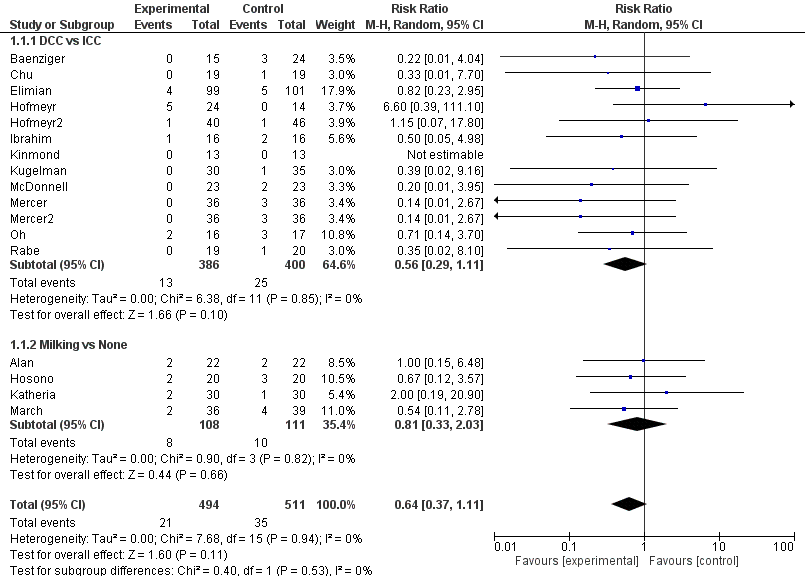
This is the Forest plot for mortality

Forest plot mortality

So 1000 babies randomized, all in very small studies, one which is slightly larger.  The babies were largely at low risk of mortality, so the number of actual events, is tiny, and the difference between the groups could easily be due to chance, especially when you add the potential for an inflation of type 1 error with multiple small studies.

Severe IVH:

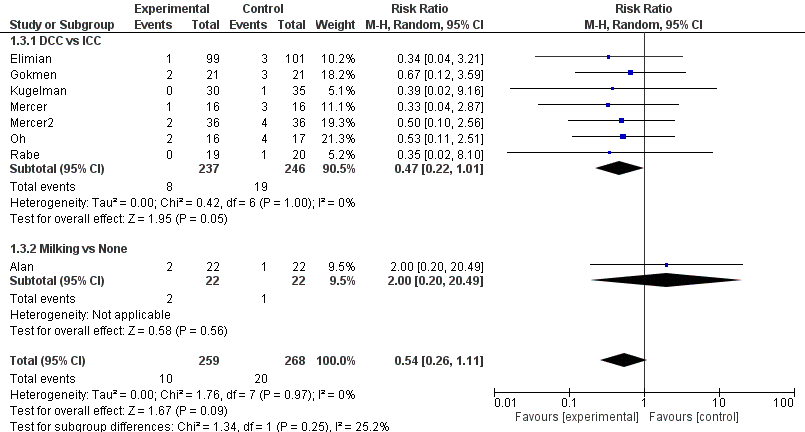
Forest plot severe IVH

The differences are in the direction of fewer hemorrhages with DCC, but a substantial chance that they are due to random effects.

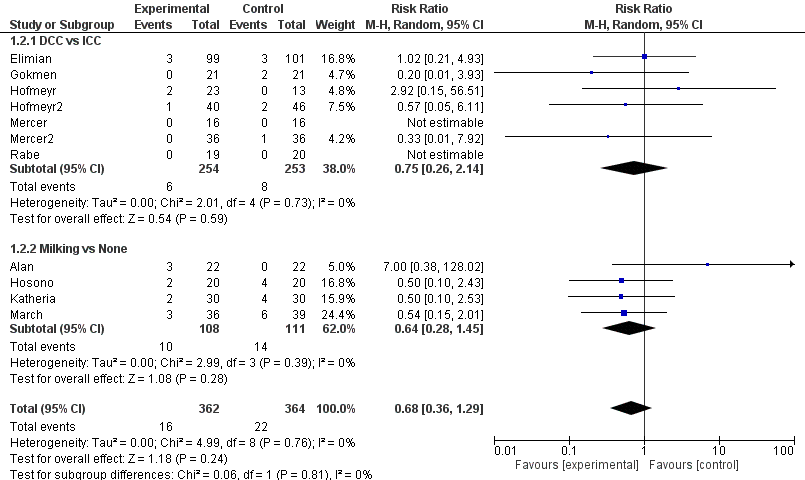
Stage 2 or 3 NEC :

Forest plot NEC

So again, tiny numbers of events, and differences which could be due to chance.

So why all this rush to delay cord clamping in the very preterm infant? I really don’t understand the ACOG opinion. They have it entirely the wrong way round. They state that the benefits in term infants are not clear,

insufficient evidence exists to support or to refute the benefits from delayed umbilical cord clamping for term infants that are born in settings with rich resources. Although a delay in umbilical cord clamping for up to 60 seconds may increase total body iron stores and blood volume, which may be particularly beneficial in populations in which iron deficiency is prevalent, these potential benefits must be weighed against the increased risk for neonatal phototherapy.

But Iron Deficiency is prevalent everywhere, the exact incidence depends on your definition and the population. But, in the US it is between 7 and 21% in toddlers according to a recent review. With our current more restrictive phototherapy use, I can’t see any downside really for doing this as a routine in term infants. One of the best term studies, by Ola Andersson and colleagues was performed in Sweden in the recent era, and had about a 1% rate of phototherapy, not different between groups. He has also just published 4 year follow up of the infants in the study, showing some developmental advantages in the DCC group.

In contrast, given the weakness of the evidence, their committee opinion for preterm babies is wrong in the other direction.

However, evidence supports delayed umbilical cord clamping in preterm infants. As with term infants, delaying umbilical cord clamping to 30–60 seconds after birth with the infant at a level below the placenta is associated with neonatal benefits, including improved transitional circulation, better establishment of red blood cell volume, and decreased need for blood transfusion. The single most important clinical benefit for preterm infants is the possibility for a nearly 50% reduction in intraventricular hemorrhage.

I think the evidence of benefits of cord clamping for any clinical outcomes is highly questionable in the very preterm, and given the fragility of these patients we really need good quality large studies, powered for clinical outcomes. Which are fortunately being performed, the APTS trial is planned to include 1600 babies under 30 weeks gestation.

In the meantime, what to do while waiting for the results of adequately powered trials? The one benefit of delayed clamping or milking, which I think is clear, is that the babies have a greater red cell mass after either procedure. Which leads to fewer transfusions. The transfusion outcome has not always been reported in the same way, so its not easy to do a meta-analysis, but I think it’s fairly consistent, almost all of the trials have shown a reduced need for transfusion, either the total volume required, or the proportion of babies transfused, and so on. That, in addition to the lack of harm shown in the studies, and the physiologic rationale suggests to me that it is reasonable to institute DCC (or milking) while waiting for the large RCT results. I think we need to continue surveillance of adverse outcomes after instituting DCC, including a watch on admission temperatures, especially for the most immature babies, but those have not been adversely affected to date.

Figuring out how to resuscitate babies during DCC is an interesting idea, but given that the  evidence of benefits of DCC could only be considered marginal as yet, I am not rushing to buy a special table.

Posted in Neonatal Research | Tagged , , , | 3 Comments

Should we resuscitate children?

I am going to be deliberately provocative today… for a change.

A very interesting study from Japan has reported the results of out-of-hospital cardiac arrest in children. Goto Y, et al. Decision tree model for predicting long-term outcomes in children with out-of-hospital cardiac arrest: a nationwide, population-based observational study. Critical Care. 2014;18(3):R133. (open access). They have a national database which records the phenomenon, and the outcomes. The authors report the survival and the survival with a good cerebral outcome at one month using the following scale

Cerebral Performance Category (CPC) scale: category 1, good cerebral performance; category 2, moderate cerebral disability; category 3, severe cerebral disability; category 4, coma or vegetative state; and category 5, death

I think it is a very well done study, with a large cohort of patients that they used to make a prediction model, and another large cohort used to validate the model, which showed that the model gave consistent results. The meat of the initial results are in this figure.

cc13951-1

1 month survival with reasonable cerebral outcome was between 3.5% and 4.5%.

You probably can guess what is going to come next: that is far worse than the survival with reasonable cerebral outcome of 22 week gestation babies. So if we were to apply the same logic to children that is invoked for extremely preterm infants by many perinatal societies, you should never offer resuscitation to children experiencing a cardiac arrest out of the hospital.

Which would mean of course that survival would go down to zero, which would prove that we were right.

Rather than say that, the authors examined predictive factors to see which were associated with a higher likelihood of a good outcome. cc13951-3

As you can see, if a child has an unwitnessed cardiac arrest, it extremely unlikely that they will have a good outcome, whereas,  after a witnessed arrest, a return of circulation before arriving in the ER has a relatively good outcome. The authors of the article discuss what they refer to as TOR (termination of resuscitation) and note how tricky the decision is in children. In the discussion they note the following:

If a child with unwitnessed OHCA is transported to the hospital before ROSC, even an adult-oriented physician can immediately understand that the child will have a very poor outcome and can counsel the family on whether to terminate the futile resuscitation. On the contrary, if a child has prehospital ROSC together with an initial shockable rhythm, the physician can immediately expect survival with a favorable neurological outcome and should perform resuscitation with advanced life support according to accepted guidelines.

Which sounds entirely reasonable to me, and I think is analogous to what we should do with extremely immature babies: we should gather all the useful prognostic features (not just the gestational age in completed weeks!) and use that to counsel parents about whether to institute or limit resuscitation. In cases where outcomes are more likely to be positive, the default should be to institute active care and re-evaluate. In situations where the expectation of a good outcome is very poor, there should be an evaluation of the parents values and desires and a shared decision.

I don’t know of any situation in neonatology which approaches the level of futility shown in this study for children with an unwitnessed arrest, it is possible that a best guess gestational age under 22 weeks in a boy who weighs under 400 grams might have a survival with good outcomes of less than 0.7%, but we don’t have enough numbers to know.

I don’t think we can actually calculate prognosis accurately enough to have precise thresholds for “futility”, nor do I think we should have externally imposed limits of predicted good outcomes that should be applied to all families. So I would be very wary of trying to define the terms I just used, “outcomes are more likely to be positive” and “expectation of a good outcome is very poor”. Trying to put a numerical limits to those phrases risks replacing one simplistic rule with another: less simplistic, more rational perhaps, but also with the risk imposing the values of one group on another family.

I’m sorry folks, but there are no simple rules. Or at least, there should be no simple rules. Life is hard, life and death decisions for others are even harder.

Posted in Neonatal Research | Tagged , , , | Leave a comment

Are we family centered? Families don’t think so!

Finlayson K, et al. Mothers’ perceptions of family centred care in neonatal intensive care units. Sex Reprod Healthc. 2014;5(3):119-24.

This qualitative study interviewed mothers who had babies in one of three NICUs in the UK which claim to practice family-centered care. As usual in qualitative research, the sample size was tiny (12 mothers) and you can’t be sure how generalizable the results are from this very limited data set.

Nevertheless, I think the results should make us all stop and consider, and I wouldn’t be at all surprised to find parallels among mothers in Canada, or anywhere else in the world.

The mothers felt dis-empowered, with an overall theme that the authors called “Finding my Place”. The various aspects of this lack of ability to feel like a mother were referred to under these descriptions: Mothering in Limbo; Deference to the Experts; Anxious Surveillance; Muted Relations, Power Struggles and Consistently Inconsistent. Its worth a read if you can get access:

All of the mothers highlighted staff inconsistencies as being one of the most upsetting aspects of the care they received. Criticism from nurses about the way they were mothering or being given conflicting pieces of advice or information made them feel incompetent, naive and disrespected.

As the authors state

Despite the rhetoric about the practice of family centered care as the principle model of care in these neonatal units, there was little in the mothers’ narratives to support this.

Some of what they show is probably an inevitable result of the power and experience imbalance between parents and neonatal staff. Parents (mothers in this study) are suddenly thrust into an environment which is foreign, where the staff have enormously more knowledge than they do. On the other hand, there are clearly huge areas for improvement: one mother reports being told by a nurse that “you don’t need to concern yourself with” tube feeding, “we need to concern ourselves with that”. I can imagine a nurse saying that in a kindly manner, trying to relieve stress for a mother, and it doesn’t sound so bad in my head, but its easy to see how it could be interpreted by a mother as being pushed aside.

Making sure that all the staff in the NICU know what parents are expected and allowed to do, and that they have a consistent approach, will really help parents. Helping parents develop the skills they need to participate in the care of their infants, ensuring that they can safely collaborate, will start to make us more truly “family centered”.


Posted in Neonatal Research | Tagged , | Leave a comment

Neonatal Updates

Aly H, et al. Melatonin use for neuroprotection in perinatal asphyxia: a randomized controlled pilot study. J Perinatol. 2015;35(3):186-91. Thirty asphyxiated infants undergoing hypothermia were randomized to melatonin or not, in a study from Egypt. The melatonin was given enterally, and serum concentrations rose in the treated group. There were some potential benefits in the melatonin infants, with less seizures and improved MRI appearance. But this was a very small unblinded study, so a high risk of bias, but very interesting, suggestive results.

Livingston MH, et al. Glycerin Enemas and Suppositories in Premature Infants: A Meta-analysis. Pediatrics. 2015;135(6):1093-106. I must say I have never ordered a glycerin enema for a baby (or for anyone else for that matter), but I have occasionally given a suppository for a baby who has not stooled for a couple of days and appears distended. The three trials included in this meta-analysis are all of routine use of glycerine suppos or enemas. The trials all have some significant limitations, but they show, in general, that there may be a minor effect on the stool pattern, but no other clinical benefits, and there may be an increase in Necrotizing Enterocolitis. The relative risk for NEC was very high at 2.72, but with wide 95% confidence intervals which include the possibility of no effect.

I don’t really understand the rationale behind doing further trials of this subject, even though the authors of this review note that there are 3 that have been or are being done. With the data already in the literature, including the potential for an increase in NEC, I think that routine glycerine suppositories should be avoided, and even occasional intermittent use should be reconsidered or abandoned.

van Pul C, et al. Safe patient monitoring is challenging but still feasible in a neonatal intensive care unit with single family rooms. Acta Paediatrica. 2015;104(6):e247-e54. As many of us are moving toward single patient rooms, a common concern is how to provide alarm surveillance. If a nurse has two patients, as is usual in most places around the world for the more stable NICU patient, and is in a room suctioning a baby, for example, what happens when the other babies ventilator circuit comes apart? The problem is obviously compounded at break times. Many centers have adopted technological solutions which lead to distributed alarms, so the caregivers are supplied with wireless devices that receive alarms, with the primary nurse receiving alarms immediately for her/his patients, and a second nurse receiving the alarm if the first is not able to respond. One thing that I don’t see in the publication is how long it takes on a daily basis to log each primary or secondary nurse or other caregiver to their patient(s). We are expecting a substantial time commitment for that process when we move to our new unit, in about 18 months. This study is reassuring that a workable system can be developed which does not increase the alarm fatigue of the nurses. A system which includes important equipment alarms including the ventilator would be an improvement.


Posted in Neonatal Research | 2 Comments

What is a perfect baby?

With the recent publication from the NICHD network concerning survival rates of the most immature infants, there has been a lot of discussion. Including a strange article in “the Daily Beast”, by Jeff Perlman. Why he would publish something there I don’t know, but his argument is weird. He basically doesn’t believe babies can be viable before 23 weeks (he says that at his hospital they have decided that viability is at 24 weeks), and notes that there are uncertainties in gestational age assessment. But he is extremely inconsistent and then argues that we should use that same uncertain assessed gestational age to decide whether a baby should be given a chance of survival, using completely arbitrary cutoffs that reflect the traditional gestational age mantra. If gestational age assessment is so problematic (which I agree with entirely) how can we use that as the over-riding consideration in whether an extremely immature baby is offered intensive care or not?

He goes on to suggest that the data are biased because they are observational; which is also a strange argument. They are supposed to be observational. The data show that, among babies who are born in centers where almost all “22 weekers” are resuscitated, 23% survive, in centers where they are more selective the average survival among infants getting intensive care is 28% but the overall survival is much less, depending on the proportion getting intensive care. In centers where 0% are resuscitated, then 0% survive. I don’t understand where the bias is there. The data are clear and irrefutable, there is huge variation in the approach between centers, and huge variation in survival as a result. Sure, some of the babies who survived who were called 22 weekers might have been 23 weekers, but some of the 22 week babies who were not offered intensive care, and therefore died, might also have been 23 weekers (or even 24 weekers).

Dr Perlman’s article ends by saying that, based on his decision that viability starts at 24 weeks, they will not offer intervention before 23 weeks at his hospital, nowhere does he suggest that parents have been involved in making that decision; I guess the doctors know best.

There have been a lot of comments on parent blogs, including for example “life with Jack” and “they don’t cry“, many of which point out the stupidity of relying on inaccurate information to make life and death decisions, and the fact that survival with impairment is also a success, for many families.

Annie was interviewed about some of this recently on the radio, which reminded me of a recent radio program, in which I made a brief appearance, Radiolab, an NPR radio show that is generally very interesting and well made. When I was on the show, which was triggered by the experiences of a journalist who had an extremely preterm baby, I was asked to be there for my opinions about the story. Towards the end, I was not expecting a certain question, which was how Violette was doing.

I probably should have been ready with a glib answer, but I just stammered a little not knowing how best to answer, then I said simply, that she is ‘perfect’. After the show there were numerous comments, on the website, which implied that the producers of the show had selected families whose infants had unusually good outcomes. I am not going to give a lot of personal details about Violette, and how she is doing, because that is something that is actually irrelevant to this debate. I do want to try and answer the question, also addressed on “Life with Jack

“Does anyone have a ‘perfect’ baby?”

I have several

Or maybe I have none

We are extremely fortunate that Violette does not have a major neurological deficit. But even if she did, can a blind baby not be perfect? Is it impossible that a child with cerebral palsy is perfect?

My daughter will, in all likelihood, struggle more in school than if she had exactly the same genome, but been born at term. Does that make her less perfect as a result?

Not to me.

She is my gorgeous little girl, whom I love without limits, and who has a wonderful life ahead of her. To me she is perfect, despite her imperfections. Just as are my other children.

I am glad that I stammered and said she was “perfect”, I can’t think of a better description of her.

Today is her tenth birthday!

Posted in Neonatal Research | Tagged , | 4 Comments

Genetic variants and NEC risk

This post is out of my usual comfort zone, but I thought I’d write about it as it is fascinating, and might lead to something clinical. I don’t understand any of the lab methodology of this study, except to say that they examined bits of DNA. Sampath V, et al. SIGIRR Genetic Variants in Premature Infants With Necrotizing Enterocolitis. Pediatrics. 2015.

What they did was to look at bits of DNA that code for something called SIGIRR in preterm infants with NEC. Toll-like receptors are cell-surface receptors that are involved  in pathogen recognition and regulation of intestinal inflammation. SIGIRR is apparently the nom-de-guerre of a gene that inhibits TLR signaling, so when it doesn’t work properly you get exaggerated inflammation, and maybe NEC. The TLR which is most implicated is TLR4, which senses endotoxin from Gram-negatives, and it is this TLR which promotes inflammation when not regulated by SIGIRR (I think; someone can let me know if I am out to lunch). They tested this in an epithelial cell line to confirm the effect.

Basically a lot of the preterm babies with NEC had SIGIRR genes that were messed up. In the general population there are fewer than 400 potentially deleterious alleles in a database of 12,000 individuals. In 18 NEC cases there were 11 who had abnormal alleles. In 17 preterms without NEC they did not find any. The incidence is therefore dramatically associated with NEC and there is a strong mechanistic rationale.

The next question might be “Now what do we do about it?”

Well, not too much surprise here for regular followers of the blog, the answer is (or may be): Probiotics!

Bifidobacterial conditioned media increased mRNA levels of SIGIRR and other inflammatory regulators in this study :Ganguli K, et al. Probiotics Prevent Necrotizing Enterocolitis by Modulating Enterocyte Genes that Regulate Innate Immune-Mediated Inflammation. American Journal of Physiology – Gastrointestinal and Liver Physiology. 2012. This study and a couple of others show an effect of bifidobacteria in regulating the expression of SIGIRR, and therefore decreasing intestinal inflammation. Cool. Maybe even true.

Posted in Neonatal Research | Tagged , | 1 Comment

Cord milking/delayed clamping at the 2015 PAS-meeting

I have tried to go through the abstracts from PAS to find those that had new information, from controlled trials, about the efficacy and safety of cord milking and/or delayed clamping.

Mercer and the group from Rhode Island presented the 18-22 month follow-up of about 200 very preterm (<32 wks) babies randomized to immediate compared to delayed (30 to 45 s, combined with one milking of the cord) clamping. There was no effect on IVH in the groups they compared here, but there were fewer babies with Bayley motor scores under 85.

Hosono was the first author of the paper about cord milking from a few years ago. This time he led a multi-center RCT which compared cord milking in a new way that they described in another of the articles I just briefly reviewed, that is cutting the cord very long, then a one time milking of the cord. There were 100 patients in each group when they stopped the study, but they only present data in the abstract from 77 per group. Don’t know why. They say that there were fewer severe IVH (no data but they write p<0.04) and less mortality in the one time cord milking group.

The APTS study echocardiographic sub-study (Popat et al) reported cardiac function findings after delayed cord clamping (at least 60 seconds) compared with immediate clamping in about 260 babies of less than 30 weeks gestation. They found very little difference in cardiac function, BP was unaffected, SVC flow was the same, and right ventricular output was a little lower.

Anup Katheria from San Diego led a 2 center trial looking at hemodynamics after cord milking in very preterm babies delivered by C-Section. They showed higher BP and higher RVO in the cord milking group.

Most of the other abstracts were either before/after reports, or concentrated on hemoglobin, as far as I can see.

Posted in Neonatal Research | Tagged , , , , | Leave a comment