Making Good Decisions; part 1

White DB, et al. Prevalence of and Factors Related to Discordance About Prognosis Between Physicians and Surrogate Decision Makers of Critically Ill Patients. JAMA. 2016;315(19):2086. This is a really cool study among families who had a family member in the adult ICU. The investigators asked surrogate decision makers (family members of incompetent adult ICU patients) and the ICU docs what they thought the prognosis was. more than half the time there was a major discrepancy between the doc and the families (almost always the families were more optimistic than the doctors). Why? The main reasons they discovered were that families felt that if they remained positive, and hopeful, that would improve the chances of their loved one. The second most common was the belief that their family member was “a fighter” was “stronger than most people” and so on, that they had unique strengths that the doctor wasn’t aware of. Finally there were religious motivations, as demonstrated by comments like this “I really believe whether someone can live or not is up to God. If God wants someone to heal, even though the doctor thinks it’s impossible, I think someone can recover.” The surrogates were fairly good at predicting outcomes, but the doctors were in fact much more accurate in their predictions than the families.

I am sure this sort of discrepancy must really have an impact on decision-making, and it needs to be understood much better. If families have a different view of the likely outcomes of their loved ones, even after they have been given the best-guess of the doctor, which is usually closer to the true outcomes than the guesses of the family, then conflict, or at least disagreement, will sometimes follow.

One of the pillars of shared decision making is to investigate the families’ (or patient’s) views and values. But so rarely done. Did the doctors of those families ask them “do you think he’s going to pull through? and why do you think so”

One of the really important investigators in this field is Peter Ubel. He was recently giving a talk in which he said the following:

“I think many physicians today think of informed consent or shared decision-making or respecting patient autonomy as meaning an [obligation to] impart a tremendous amount of information to patients so they can be fully empowered to make a choice.” But Ubel says that strategy doesn’t always work.

In one survey, urologists said they only dispensed advice after gauging which way the patient was leaning. The urologists usually asked whether the patient had normal sexual function, but only 12 percent asked whether sexual function was important to the patient. And, astoundingly, only 13 percent said this preference should factor into deciding the right treatment. Look beyond age and test results, said Ubel; consider what patients care about.

Those quotes are from an on-line summary of one of his recent talks.

What if we transpose this to the neonatal/perinatal decision-making arena. Do doctors actually ask parents what is important to them, before trying to get a decision about “resuscitation or not”? Which is the decision often seen as being the reason for the antenatal consultation, by the neonatologists at least. I think that an exploration of the wishes and values of the parents, which should often be explicit, but doesn’t necessarily need to be, is an essential part of this process, but has not been well addressed by our professional societies, who seem to be more concerned about ensuring that parents receive a “tremendous amount of information” which is in reality mostly a list of all the possible complications.

I recently counseled a couple who were likely to deliver extremely prematurely a baby with a serious congenital anomaly. As we discussed the situation, it became clear that they wanted to give the baby a chance, just in case the situation was better than we all feared, but they also wanted to be reassured that, if things went badly, we could limit the duration and intensity of the medical care that the baby received. I was able to reassure them on both counts, and also talk about our pain control approach, our concern for the distress and discomfort of the babies and their parents, the family support network in our NICU, the fact that if their baby made it, then the chances of them having a good life were very high, that they could participate in all the decisions and in much of the day-to-day care of their baby, and that their presence in the NICU next to their baby would help the baby in many ways. (I know most of my colleagues would have handled it the same way). I came out of the consultation knowing their baby’s name, knowing their wishes for the baby’s life, that they wanted their baby to survive, but not at all costs…

I think that their values were respected, and the final approach that we agreed upon was a shared decision which was totally reasonable for their baby, and for their family.  I am certainly not a paragon of virtue in these situations, my approach has developed and changed over the years, and I have been able to learn a great deal from my colleagues, especially Annie Janvier.

Only about 5% of our discussion was covered by the position statements of the professional bodies, most of the things that I outline in the paragraph above are absent from those statements, but from research done, and being done in our center, such things are just as important to parents. I never mentioned the risk of retinopathy, for example, even though the baby will likely be immature enough to be at risk, it just wasn’t where we were at, at the time. Most of the vitally important discussion we had was not covered by those statements at all.

In contrast this publication is, I think, almost entirely, a description of a very good approach:

Lemyre B, et al. Shared decision making for infants born at the threshold of viability: a prognosis-based guideline. J Perinatol. 2016. The authors started with an extensive systematic literature review, went through multiple AGREE II based steps to develop some recommendations. They base their recommendations on the expected prognosis, rather than on complete weeks of gestational age, they avoid lumping together death with impairment or delay, and they give some guidelines that are appropriate for how to perform the consultation; some of which almost sound like they are based on the POST article that we published (Janvier A, et al. Ethics and etiquette in neonatal intensive care. JAMA Pediatr. 2014;168(9):857-8.). Here are some other recommendations about the process,

Share ‘balanced’ information including both positive and negative aspects, pros and cons, treatable and not treatable conditions and so on
Use different strategies to disclose the outcomes according to parents’ preferences:
Use grade such as majority, most, significant or some, a minority and so on.
Use numbers (for example, 6 out of 10 as opposed to 60%)
Use a consistent denominator to present the various options, or outcomes or event rates to make the information easier to understand, compare and be less open to misinterpretation (for example, XX out of 10, 100, 1000, depending on what we’re talking about)
 ….
Disclose uncertainty (that is, the limits of the meaning of the statistics for a particular baby)

….

Offer time to think
Avoid interrupting the parents; keep silent when they are describing their perspective or preferences.
Let the parents lead the conversation by:
Asking them how you can help them
Inviting them to talk about how they see the situation
Asking open-ended questions with how, could you tell me more, can you describe
Asking as often as possible if the parents have questions or need clarifications
Answering their questions

With the proviso that sometimes parents won’t want to lead the conversation.  As you can see this is very parent-oriented, encouraging a transparent shared decision-making.

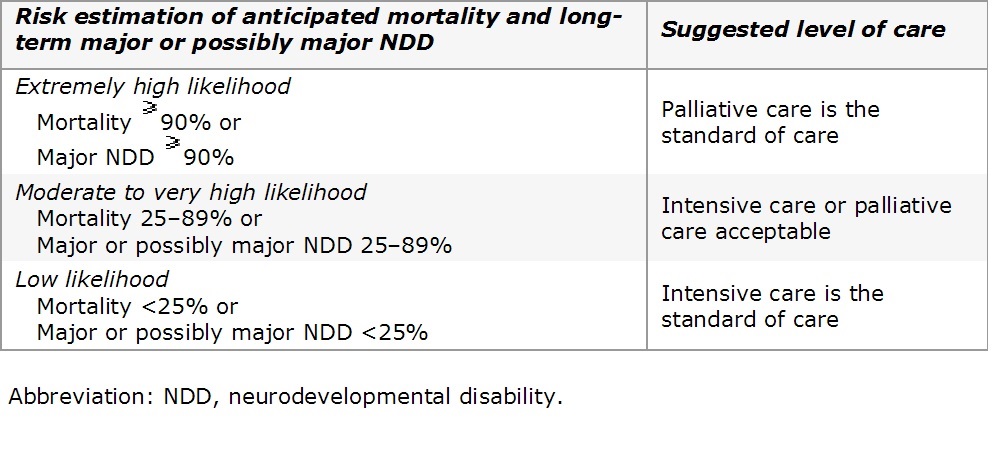
The big problem I have with this otherwise excellent paper is the table 3.
table

Surely preterm babies should be treated the same as babies born at full term, or older children with critical illness? But this table would suggest that, for any baby with a very high risk of major neurodevelopmental disability (NDD), that palliative care is the ‘standard of care’. The authors do not specifically describe the criteria for major NDD in this article, but refer instead to the Epicure cohort, who use this definition “A disability was defined as severe if it was considered likely to make the child highly dependent on caregivers and if it included nonambulant cerebral palsy, an IQ score more than 3 SD below the mean, profound sensorineural hearing loss, or blindness”.

This would imply that “palliative care” (which is a term which has become harder and harder to define over the last few years) is standard of care for children with trisomy 21, or blind babies, or deaf children, or with many other congenital disorders. I object to that. I think for some disorders with extremely high risk of major NDD, that comfort care may be an acceptable option, but to suggest it is “standard of care” is I think dangerous and unwarranted.

If we further examine that table, a 25% mortality risk is given as an acceptable risk for palliative care. I totally disagree. In what other area of medicine would a 25% risk of mortality be acceptable to let a patient die? “Hello Mrs A, your son has a 3 out of 4 chance of survival, so we think it is OK if we let him die.” I find that totally unacceptable. If the child was 4 years old, and parents brought him to the hospital with a severe pneumococcal pneumonia, and respiratory failure, and a PRISM score which predicts a 25% mortality (or even a 50% mortality), would anyone be prepared to let the child die?

I think this article would have been one of the better articles to appear in the perinatal high-risk counseling literature in the past few years, if it wasn’t for that damn table. The thresholds seem to come out of nowhere, to be neither evidence-based nor ethically acceptable. When all the rest of it is as evidence-based as you can get (for an area where evidence is less important than values), and ethically solid.

I do agree with the authors that we should be basing our counseling on predicted outcomes, and not on completed weeks of gestation; but the thresholds used for what are acceptable outcomes, and what are acceptable predicted proportions of babies with those outcomes should also be individualized. I am not sure that any general recommendation for thresholds of intervention, will work. Certainly not a threshold which states that a 25% risk of blindness is an acceptable criterion for forgoing intensive care. Which would mean that if the 2 parents each carried a recessive gene for a condition that causes blindness, then not resuscitating their child at birth would be within acceptable practice.

I am fairly sure (as I know these authors) that that was not their intention, but that is what the table actually says.

As I said there is much good stuff in the article, I strongly recommend it.


Posted in Neonatal Research | Tagged | 4 Comments

Neonatal Updates

Härkin P, et al. Paracetamol Accelerates Closure of the Ductus Arteriosus after Premature Birth: A Randomized Trial. The Journal of pediatrics. 2016. Despite all the interest in paracetamol (acetaminophen in N America) for ductal closure, most of the published data so far has been observational (“we gave it to 30 babies and some of them didn’t get a ligation” for example). This is a small RCT in preterm babies of less than 32 weeks gestation who received paracetamol or placebo within 24 hours of birth. The medication caused the PDA to constrict, and the average age of closure was much earlier in the babies who got the active drug. Not powered for clinically important outcomes, nevertheless, this trial at least shows that it does really work. It also was without any detected side effects.

Martillotti G, et al. Predicting Perinatal Outcome from Prenatal Ultrasound Characteristics in Pregnancies Complicated by Gastroschisis. Fetal diagnosis and therapy. 2016;39(4):279-86. Gastroschisis seems to have become much more frequent, and sometimes there are serious complications, the fetuses are now followed very closely, and when ultrasound findings change we often have discussions about what the significance of a finding is, and whether the baby should de delivered. This study, from our hospital, shows that the best predictor of a serious post-natal complication was dilatation of the intra-abdominal bowel. Some of these babies died or had major complications, the only thing that predicted that in the antenatal period was dilatation of the bowel that was still in the abdomen. Whether immediately delivering the babies or not would make a difference is, of course, uncertain.

Basta AM, et al. Fetal Stomach Position Predicts Neonatal Outcomes in Isolated Left-Sided Congenital Diaphragmatic Hernia. Fetal diagnosis and therapy. 2016;39(4):248-55. This is easier than calculating lung volume from an MRI and comparing to expected lung volumes. Where is the stomach?

Stomach position was intra-abdominal in 14% (n = 13), anterior left chest in 19% (n = 17), mid-to-posterior left chest in 41% (n = 37), and retrocardiac in 26% (n = 23). Increasingly abnormal stomach position was linearly associated with an increased odds of death (OR 4.8, 95% CI 2.1-10.9), extracorporeal membrane oxygenation (ECMO; OR 5.6, 95% CI 1.9-16.7), nonprimary diaphragmatic repair (OR 2.7, 95% CI 1.4-5.5), prolonged mechanical ventilation (OR 5.9, 95% CI 2.3-15.6), and prolonged respiratory support (OR 4.0, 95% CI 1.6-9.9). All fetuses with intra-abdominal stomach position survived without substantial respiratory morbidity or need for ECMO.

Manley BJ, et al. Extubating Extremely Preterm Infants: Predictors of Success and Outcomes following Failure. The Journal of pediatrics. 2016. Should we try and take the tube out? One third of this group of very preterm babies (under 28 weeks) failed extubation. “Higher GA and lower pre-extubation PCO2 predicted extubation success. Infants in whom extubation failed were more likely to die and have prolonged respiratory support and hospitalization”. All of the other potential predictors of extubation success were not much use.

And I am still not sure how you would do a trial to find out when you should take the tube out. If you do it too soon and the baby fails, they are more likely to do badly, but that doesn’t mean it was the failed attempt that was causative. If you don’t try when the baby could have a chance of success, and they stay intubated, then have you wrecked their lungs? There must be a good way to figure this out, but its late, and I can’t come up with any clever trial designs. Suggestions welcome.

Posted in Neonatal Research | Leave a comment

Why didn’t erythropoietin improve the outcome of preterm babies?

Because that is the result of a newly published RCT of erythropoietin (EPO) for neuroprotection of small preterm babies, no effect.

Natalucci G, et al. Effect of Early Prophylactic High-Dose Recombinant Human Erythropoietin in Very Preterm Infants on Neurodevelopmental Outcome at 2 Years. Jama. 2016;315(19):2079.

The dose regime was different to the doses used in the trials by Robin Ohls, which I discussed previously. In this new trial the EPO was started early, and at high dose, and for a short time; EPO (3000 IU/kg) was given  intravenously within 3 hours, at 12 to 18 hours, and at 36 to 42 hours after birth. About 450 babies of less than 32 weeks were randomized to get this dose or placebo. Babies under 26 weeks were not included. The primary outcome of the trial was the 2 year developmental screening tests, the Bayley version 2. There wasn’t a hint of a difference between the groups, with an MDI very close to 95 for each group. About 15% of each group didn’t get followed up at 2 years corrected, unlikely I think to have a substantial impact on the outcomes. There were a few protocol deviations, so they performed an Intention to treat analysis, and then also a “per-protocol” analysis, which also showed no impact of EPO on outcomes.

Why did the other studies show an effect, and not this trial? The authors suggest the following:

In the 2 smaller randomized trials, rhEPO was started later (between day 2 and 4 of life), given in lower doses (400 IU/kg), more often (3×/wk), and over a longer period (up to 35 weeks’ postmenstrual age) than in the present study. Therefore, one of the reasons for the lack of improved outcome with rhEPO in this study could be the timing of the first dose and shorter duration of rhEPO treatment.

Which is true of course, but not the only possible explanation. I think we should be very careful about the results of the 2 other trials they mention, As I noted before there were only 24 control babies reported for the 18 month follow-up, and only 14 for the pre-school follow-up. And the control babies had extremely, and unusually, poor scores on their pre-school follow-up. So I think another potential explanation would be that the results of the other trials are skewed by an unusually poor performance among the controls.

Of course it could be that the dose in this new study is too high. Maybe too much EPO is not a good idea. This observational study (Korzeniewski SJ, et al. Elevated endogenous erythropoietin concentrations are associated with increased risk of brain damage in extremely preterm neonates. PLoS One. 2015;10(3):e0115083.) showed that endogenous erythropoietin levels were higher in very preterm babies with poor developmental tests at 2 years (honestly, why do you need to call this “BRAIN DAMAGE”? Are you looking for more clicks?)

Or it could be that the duration was too short, and so on. But I think this study clearly shows that there is no high quality evidence that erythropoietin or its analogues are neuroprotective in the very preterm baby. The best evidence to date (this trial) shows no benefit.

Posted in Neonatal Research | Tagged , | Leave a comment

The microbiome of plastic tubes in children

Petersen SM, et al. Nasogastric feeding tubes from a neonatal department yield high concentrations of potentially pathogenic bacteria – even one day after insertion. Pediatr Res. 2016.  These authors cultured 94 nasogastric feeding tubes from 34 preterm infants. 1 ml of saline was washed down the tubes after removing them from the babies, and only organisms with more than 1000 CFU/mL were counted. They found 178 that passed this threshold. 89% of the tubes grew things other than probiotics, and this was not related to how long the tubes were in place, they became contaminated very quickly after insertion. Almost all of the organisms were potential pathogens, Coagulase negative staph, enterococci, Gram-negative rods, S aureus.

They also did scanning EM to look at the bioflims, I think they did this on just one NG tube (singular and plural terms are used), and found it to be coated with a “nice” thick biofilm. Although the authors did not show that contamination of the NG tubes led to clinical illness, reducing it would have to be a good thing, I think, as many of these organisms were pathogens, or at least potential pathogens. The authors put it this way:

Our findings and the existing literature suggest that resident NG-tubes should be handled with the same hygiene standards as materials containing fecal matter.

Gilbert RE, et al. Impregnated central venous catheters for prevention of bloodstream infection in children (the CATCH trial): a randomised controlled trial. Lancet. 2016;387(10029):1732-42.

Intravenous catheters are even more of a problem, there are apparently 56 RCTs of various impregnated catheters in adults, and several systematic reviews which show that they are effective at reducing invasive infections. Heparin-bonded catheters seem to be effective, maybe because they prevent the development of biofilms, or maybe there is a direct effect of heparin, or of the agent used to bond the heparin, benzalkonium chloride. Antibiotic-bonded catheters also seem effective, the usual agents are minocycline-rifampicin, which has the advantage that they are not much used as systemic treatments, so there is less worry about selecting resistant organisms.

In this new trial, about 1500 children in PICUs around England were recruited and randomized to get either standard catheters, a catheter with heparin bonding, or a catheter with minocycline-rifampin bonding. All clinical care was unchanged, except that they took an extra 0.5 mL of blood whenever the child needed to have a blood culture.

Heparin didn’t work.

The antibiotic-bonded catheters led to a reduction in invasive sepsis from 3.6% in the other two groups to 1% with the antibiotic-bonded catheters. To present the data another way the blood stream infections per 1000 catheter days were over 8 in the control and heparin groups, and 3.3 in the antibiotic group.

As far as I can tell the only down-side of these catheters is the additional cost. But that should be cancelled out, I would think, by an NNT of about 50, i.e. for every 50 antibiotic bonded catheters there is one less invasive bloodstream infection.

Now we need a neonatal study. Why? Well, our rates of infection in the very preterm baby are much higher than this, the bacteriology is different (they had a total of 42 infections, with only 6 being due to CoNS), toxicity might be different if there is any antibiotic which leaches into the circulation, but the cost implications might be much more positive, if the same relative reduction in sepsis is seen, the benefits could be enormous.

The relevant Cochrane review is quite recent (last September) and found only one small trial in newborns, (n=98). A trial with enough power to address safety would be a boon to neonatology.


Posted in Neonatal Research | Tagged , , | 2 Comments

Neonatal Updates

Raina A, et al. Treating perinatal asphyxia with theophylline at birth helps to reduce the severity of renal dysfunction in term neonates. Acta Paediatrica. 2016. This was an RCT in 160 full-term babies with perinatal asphyxia and encephalopathy. Babies, who were not cooled, received either a single dose of 5 mg/kg of theophylline or placebo, prior to 1 hour of life. Babies needing assisted ventilation were not eligible.

Despite the Acta Paediatrica website claiming that all RCT reports must follow the CONSORT guidelines, this report does not.

A few examples: the title does not mention that it is a randomized trial; it is not clear what the primary outcome was; there is no CONSORT flow chart; the sample size calculation is poorly explained; there is no trial registration noted, and I could go on. I don’t see how an RCT can be published in a journal claiming to require CONSORT standards when there are so few of those standards being respected.

The sample size was calculated based on a reduction of AKI (acute Kidney Injury) from 40% to 20% “using a power of 85 and confidence interval of 95%.” which doesn’t make sense, power is expressed as a percentage or as a decimal, in fact, if you do the calculations, the sample size of 164 patients is for a power of 80% and an alpha of 0.05. AKI is also not defined. There is a definition for “post asphyxia severe renal dysfunction”, but it is not clear if this was what they meant by AKI.

According to the results section there were 33 deaths, 12 in the theopylline group, and 18 in the placebos (!), In the discussion the deaths in the theophylline group are noted as being 15.

If we assume that AKI is the primary outcome variable, and that the definition of “post asphyxia severe renal dysfunction” is actually AKI, then this was reduced by theophylline, from 48% to 15%.

I think this is a real shame, the authors have performed an RCT of an important clinical issue, and peer review has really failed them. They could and should have been helped to make this a much clearer report, a peer reviewer, and the editor, really should have picked up on the things I describe above.

The relevance of the data to my practice are questionable, but, in the context of the other smaller trials already published, this suggests some improvement in creatinine, and higher urine output in the babies who received theophylline. Whether this would translate to some medium or longer term clinical benefit is unclear, but it may warrant investigation in infants undergoing hypothermia.

Watterberg KL. Hydrocortisone Dosing for Hypotension in Newborn Infants: Less Is More. The Journal of pediatrics. 2016. A great review from Kristi Watterberg about the dose that we might need to treat hypotension (and shock). She reviews the available data regarding the dose requirements to mimic stress steroid release, and the data about potential harms of excessive steroid levels during critical illness. She notes that 0.5 mg/kg should normally give a response if one is going to occur, but that, practically speaking, that might just lead to a delay and a desire to try a higher dose, so as a result:

, I suggest a “test dose” of 1 mg/kg. If no response is seen within 2-4 hours after 1 mg/kg is given, further dosing is not warranted. If the infant’s … cardiovascular status improves over this time frame, subsequent doses of 0.5 mg/kg can be given, with an initial planned dosing interval of 12 hours for extremely preterm infants, and 6-8 hours for late preterm and term infants.

In the absence of trials comparing different doses, I think this is the best we can do, and I plan to follow this guidance.

Tang J, et al. Randomised controlled trial of weaning strategies for preterm infants on nasal continuous positive airway pressure. BMC pediatrics. 2015;15(1):147. How to wean CPAP? This pilot trial of only 60 babies in a 2×2 factorial trial was performed to get some more information before progressing to a larger trial. Once babies needed 5 cmH2O or less they could have their CPAP stopped, or have alternating periods with and without CPAP. With either method they could either have high flow nasal cannulae or not. Babies who had “abrupt” weaning spent less time off CPAP. One important result was that babies in the abrupt weaning with no HFNC group were much more likely to be taken out of the trial by their parents, as they weren’t satisfied with the weaning method. It is interesting to me that a few years ago the parents would have all been satisfied with this method as it is what we always did! So how did the parents develop this attitude? There was no objective finding that the babies were worse off at all.  In some centers it has become almost universal that a period of time on HFNC follows discontinuation of CPAP, maybe that subtly influenced the parents to think their baby wasn’t getting the right care for them; or maybe the parents in this study were sensitive to the needs of their baby in one group that they felt were struggling more, even though the investigators couldn’t see much difference.

There is a tendency to think that HFNC is a benign intervention, but I think overuse of any intervention, including HFNC, is a problem. Effects on development of the lungs, on development of orality, and so on, are understudied.

Posted in Neonatal Research | Tagged , | Leave a comment

How to define BPD

An article published at the end of 2015, (I only just got the full-text) compared 3 diagnostic criteria for defining BPD. The original 36 week threshold by Andy Shennan, the NIH workshop definition, and the ‘physiologic’ definition requiring a room-air challenge as developed by Michele Walsh and colleagues. They also looked at a modification of the Shennan definition, to consider babies discharged before 36 weeks on room air as no BPD; and a modification of the NIH workshop definition to eliminate the requirement for oxygen therapy for at least 28 days, which eliminated the category ‘mild BPD’.

They looked at 765 babies under 29 weeks who arrived at 36 weeks post-menstrual age. There isn’t much difference between the modified Shennan and modified NIH definitions, and they both classified about 55% of the babies as not having BPD. The physiologic definition classified 52% as not having BPD but there were 16% of babies who were unclassified (compared to just 2% for the other definitions), mostly because they didn’t have the room air- challenge performed at the right time.

The article abstract ends with the following

Contemporary changes in management of infants, such as use of high-flow nasal cannula, limit application of existing definitions and may result in misclassification. A contemporary definition of bronchopulmonary dysplasia that correlates with respiratory morbidity in childhood is needed.

I certainly agree with that. It is of little importance to families whether a child comes out of oxygen just before or just after 36 weeks. even though there is a significant correlation of this with early childhood morbidity, there is much uncertainty, Violette, my daughter for example did not have BPD by the Shennan definition, did have mild BPD by the NIH workshop definition, and didn’t have BPD by the ‘physiologic’ definition. She did however have a cough, mild retractions, persistent tachypnea for many months after discharge; she was kept away from all child contact for months, apart from her older brother who was taken out of daycare because of her respiratory status, and had steroids a couple of times in the first year because of stridor.

I think trials that try and impact respiratory illness in the preterm infant should not be based on analyzing the duration of oxygen therapy, but on some indicator(s) of the impact of pulmonary damage on the well-being of the child and their  family. I think an outcome which took into account the need for oxygen at home, re-admission for respiratory disease during the first year of life, need for daily respiratory medications, impacts on activity levels, as examples, would be much more meaningful as a target for reducing lung injury.

There may well be a statistical correlation between 36 week oxygen requirement and important lung disease after discharge, but it won’t be a perfect relationship, and if you reduce “BPD” by current definitions, but have no effect on things that affect families, then you probably haven’t done much good.

Posted in Neonatal Research | Tagged | Leave a comment

CMV transmission by breast milk in the very preterm, how important is it?

Over the past couple of years there have been quite a few articles addressing this issue, so I guess it must be important.

The results of all these studies are not consistent, however,

Kelly MS, et al. Postnatal Cytomegalovirus Infection and the Risk for Bronchopulmonary Dysplasia. JAMA Pediatr. 2015;169(12):e153785. In this retrospective cohort of over 100,000 VLBW babies there were only 0.3% that acquired CMV postnatally. Which seems kind of low compared to many prospective studies. CMV acquisition was associated with an increased risk of BPD. I wonder if the diagnosis of CMV might be more likely to be sought out if a baby has BPD, hence biasing the results. Most of the 100,000 babies probably never had screening for CMV.

Brecht KF, et al. Postnatal human cytomegalovirus infection in preterm infants has long-term neuropsychological sequelae. The Journal of pediatrics. 2015;166(4):834-9 e1. This is a relatively small, but in contrast prospective cohort of very preterm babies (<32 weeks). Infants were drawn from a prospective surveillance of CMV re-activation during lactation and transmission to very preterm babies initially published in the Lancet in 2001. In that study, nearly half of the mothers had CMV re-activation and excreted CMV DNA in their breast milk, and over 1/3 of their babies acquired CMV as a result. About half of the babies had symptoms possibly related to CMV. This is why I made the comment about the extremely low numbers of babies with CMV in the first article. The babies from the initial study are now adolescents, and their outcomes were compared to CMV-negative very preterm babies and to term controls. The babies who acquired CMV had lower scores on IQ testing than the CMV-negative preterms, who were lower than the term controls.

Mehler K, et al. High Rate of Symptomatic Cytomegalovirus Infection in Extremely Low Gestational Age Preterm Infants of 22-24 Weeks’ Gestation after Transmission via Breast Milk. Neonatology. 2013;105(1):27-32. In this hospital mothers who deliver small preterm babies are all screened for CMV, and the babies are checked if they got untreated breast milk. In one year they had 22 mothers who delivered at 22 to 24 weeks, 16 of whom were CMV positive; there were 17 babies. 11 of those babies developed CMV infection, 5 of them just had a transient thrombocytopenia, the others had a clinical sepsis like syndrome with or without hepatitis, colitis and various other findings.

Stock K, et al. Pasteurization of breastmilk decreases the rate of postnatally acquired cytomegalovirus infections, but shows a nonsignificant trend to an increased rate of necrotizing enterocolitis in very preterm infants–a preliminary study. Breastfeeding medicine : the official journal of the Academy of Breastfeeding Medicine. 2015;10(2):113-7. This unit in Innsbruck went from pasteurizing its maternal milk, to giving unpasteurized milk in 2010. The results are in the title, and seem as reliable as any retrospective cohort study. You can inactivate CMV by pasteurization, but other impacts on the advantages of breast milk might be negative.

Gunkel J, et al. Predictors of severity for postnatal cytomegalovirus infection in preterm infants and implications for treatment. Expert Rev Anti Infect Ther. 2014;12(11):1345-55. This review article points out that symptomatic CMV is more common in the most immature babies, and it is those below 26 weeks, and especially below 25 weeks who are at very high risk of the short term and negative consequences of CMV.

Summary

CMV infections in very preterm infants are now usually acquired from breast milk.

Donor breast milk is pasteurized and does not carry this risk.

Maternal breast milk has significant advantages to donor milk, but carries an appreciable risk of CMV transmission if the mother has previously had a CMV infection, as the majority of mothers have re-activation of CMV after very preterm delivery.

Pasteurizing maternal breast milk inactivates CMV, but has adverse impacts on the benefits of breast milk.

The most immature infants have the highest rate of CMV acquisition, and the highest rate of significant clinical impacts. Including long-term impacts on intellectual function, and possibly BPD.

Unless you screen mothers and/or breast milk and/or babies for CMV you won’t know how many have acquired CMV, and you probably grossly under-estimate the incidence.

If you do screen, I don’t know what to do with a positive result. ?should we have targeted pasteurization for a subgroup of babies? ?can high-efficiency leukodepletion filters make breast milk CMV-safe without adversely affecting the benefits of maternal milk?

There are still many unanswered questions, but this issue really needs some definitive answers.

Posted in Neonatal Research | Tagged , , | 2 Comments

Is breast-milk really best?

Although many people (including myself) are convinced that human breast milk is the preferable nutrition for human babies, including the preterm, some of the evidence regarding benefits is shaky. For example the evidence that breast milk feeding reduces late-onset sepsis. The Cochrane systematic review by Bill McGuire and first author Maria Quigley Quigley M, McGuire W. Formula versus donor breast milk for feeding preterm or low birth weight infants. Cochrane database of systematic reviews (Online). 2014;4:CD002971. for example found 2 trials that reported the outcome, with no significant difference between donor breast milk and formula, RR 1.12 (95% CI 0.84 to 1.49). Of course, as my gentle readers will be well aware, absence of evidence is not the same as evidence of absence. Which means that breast milk might really reduce infections, we just haven’t proven it (or it might not).

There is so little “equipoise” that it is difficult to get good trials done, partly because the evidence regarding NEC pushes us to promote donor milk if you have it available. Again from a strict scientific viewpoint the evidence is not that strong, a few small trials, none of which are significant individually, according to the above Cochrane review, but together there is a possibility of a benefit, RR of NEC with formula 2.77.

NEC

The effect of an intervention when there are multiple small trials is often exaggerated, a trial sequential analysis might well show no significant difference, but I don’t have the energy to do that right now.

Other comparisons show other benefits of breast milk (mostly with mother’s own breast milk), but there also concerns about short term growth, with either maternal or donor breast milk.

Having said all that, I have to note that I am very happy that Quebec now has a government funded human milk bank, that gives us very high quality product, and I am ready to give it to all the babies at risk of NEC whose mothers can’t produce enough milk. If breast milk were an expensive drug, with possible side effects, to prevent NEC I’d say the data are not sufficient. But breast milk doesn’t have much of a down side, apart from potential growth effects and maybe CMV, and processing it according to the latest standards gets to be expensive. It also just makes a lot of sense.

I should, of course, note that Hema-Quebec do process the milk, but the “product” is the fruit of the dedication of milk donors around the province who selflessly, and freely, and anonymously, donate their milk to help our preterm babies. Thank you so much donors!

So why the title of this post? Partly because of this study:

Corpeleijn WE, et al. Effect of Donor Milk on Severe Infections and Mortality in Very Low-Birth-Weight Infants: The Early Nutrition Study Randomized Clinical Trial. JAMA Pediatr. 2016. Nearly 400 VLBW infants were randomized to receive either formula or banked donor breast milk if the mother didn’t provide enough milk. Only infants who had never had formula were eligible, and most babies were in the trial and randomized and receiving their first feed by 6 hours of age. The primary outcome of the study was the composite incidence of NEC, serious infection (blood culture positive sepsis or meningitis), or all-cause mortality between 72 hours and 60 days of life. The main problem with the study is that the intervention only lasted 10 days, after which babies who needed supplements to mother’s milk all received formula. The breast milk was not fortified during the first 10 days either group.

The authors explain why the study intervention period was only 10 days, the need to fortify breast milk to supply adequate nutrition, and that the only fortifiers available to them are cow’s milk based. They wanted to examine the effects of  a period with no cow’s milk exposure.

The primary endpoint was not different between groups, not even a little bit.

As the authors note, about half of the primary outcome determinations were before 10 days of age, but this design does still have major limitations.

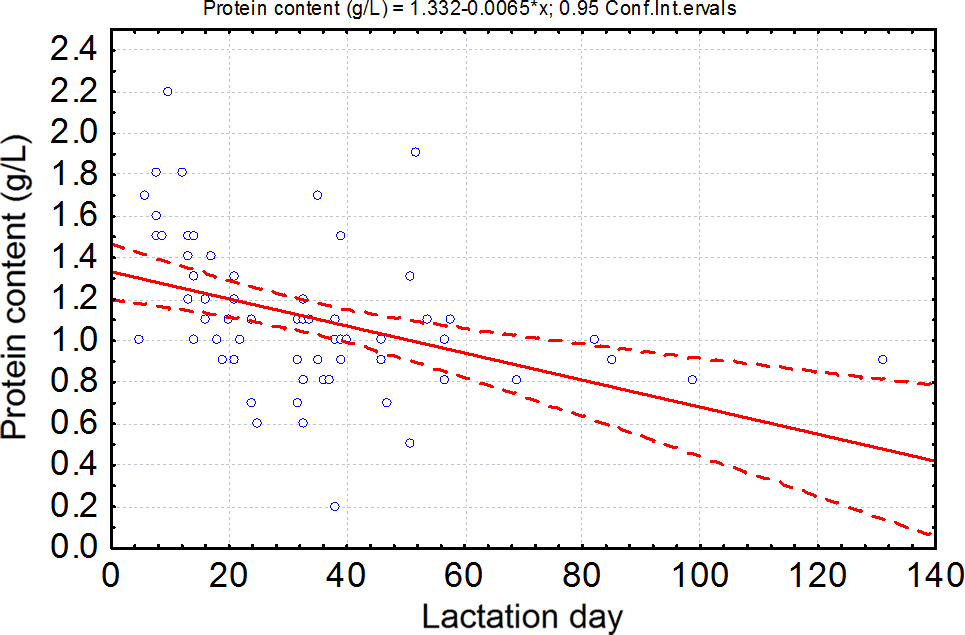
Kreissl A, et al. Human Milk Analyser shows that the lactation period affects protein levels in preterm breastmilk. Acta Paediatr. 2016;105(6):635-40. Preterm breast milk protein content soon after initiating lactation is higher than later on. This is new data confirming that, and graphically showing how enormously variable the protein concentrations are. One was only 0.2 g/L

breast milk protein

Protein concentration of milk expressed by mothers of preterm infants during the lactation period. We included 70 milk samples expressed by mothers of preterm infant between the 5th and the 131st day of lactation in the analysis.

This is one of the things making enteral nutrition with maternal breast milk difficult. Breast milk fed babies, as a group, grow more slowly than formula fed babies, often because some of them aren’t getting enough protein. As yet, breast milk fortification is standardized, but these types of variability really support the idea that individualized fortification might be preferable. Right now the difficulties with frequent breast milk analysis mean that a baby receiving breast milk and not growing adequately gets a blind increase in either feeding volume or fortifier; whereas they might benefit more from just a protein supplement for example.

Einloft PR, et al. Supplemented vs. unsupplemented human milk on bone mineralization in very low birth weight preterm infants: a randomized clinical trial. Osteoporosis International. 2015;26(9):2265-71. This trial in VLBW infants confirms that human milk fortifiers improve bone mineralization when they receive human milk. There is nowhere near enough phosphorus and not enough calcium in human milk for very preterm infants.

Omarsdottir S, et al. Cytomegalovirus infection and neonatal outcome in extremely preterm infants after freezing of maternal milk. Pediatr Infect Dis J. 2015;34(5):482-9. In a previous NICU we decided to routinely freeze all breast milk for preterm infants, because of lab evidence of CMV inactivation during freezing and thawing. In this RCT 140 infants were randomized to either have their mother’s milk frozen before it was fed to them, or to receive unfrozen milk. There was no overall difference in CMV transmission, many of the mothers produced CMV positive milk. When the analysis was restricted to those with CMV positive milk, the CMV transmission rate with CMV-DNA positive milk was 8% (3 of 37) in the intervention group and 6% (2 of 33) in controls. Freezing the breast milk reduced the rate of serious fungal infections however, which is possibly a true effect of the freezing, or perhaps a spurious result as they did make a large number of comparisons.

So let’s go back to the study from Corpeleijn,  A secondary analysis of their data, that is, in essence, an observational study using their data showed that the infants who received more than 50% of their feeds as mother’s milk (which was supplied non-pasteurized) had many fewer infants with the primary outcome. Breatmilk

The groups were diverging before 10 days of life.

It may be that unpasteurized maternal milk is the best source of milk for very preterm infants, with fewer infectious/NEC complications. But there will never be an RCT of maternal vs donor milk so we’ll just have to accept that, I think. The benefits of donor milk aren’t as clear, but there may be a reduction of NEC compared to the rates with formula, a reduction which isn’t evident if the comparison is just for 10 days. Human milk needs fortification to optimize bone mineralization, and composition is so variable that often extra fortification will be needed to get to optimal protein intakes. CMV transmission is very frequent and doesn’t seem to be prevented by freezing the milk; the importance of postnatal CMV transmission is something that has been studied recently in several investigations… there could well be a post about that!

Posted in Neonatal Research | Tagged , , , , | 6 Comments

The multidisciplinary conference, a parental view.

When patients are more complex than average, or there are multiple complications, or difficult ethical issues, we frequently organize “multidisciplinary conferences” which involve all the medical consultants and nursing, often also our social work and/or psychology personnel and the spiritual care person, sometimes respiratory therapy and other therapists as well. We may do this to try to hash out difficult issues, make sure we are all on the same page, to make plans for care and to make sure that we have discussed the different possible approaches among ourselves. Most of our conferences don’t currently include the parents, but the parents are told the conference is going on, and someone will talk to them about it afterward.

The reasons for not including parents have been multiple, and vary from patient to patient, sometimes the issues are very technical, sometimes feelings in the team are running high, sometimes we are really not sure what to do and want to discuss the limits of what is acceptable.

I’ve often thought it would be better to have parents at many of our conferences, I think that, apart from some of the more technical issues, we should have parents as part of the multidisciplinary group; on the other hand there are often strong disagreements (sometimes even arguments) and I wonder if it would help parents to be present, or might harm them.

What I mean about the technical issues is illustrated by a hypothetical case of a child with pulmonary atresia and oesophageal atresia. The baby needs interventions for the heart and for the oesophagus, but is stable on prostaglandins. We have to plan when each of these is going to be done, in what order, and what to do about the other issue while one issue is being addressed. I think that a discussion like that could be with or without the parents, based on their wish to be there or not. On the other hand if that same baby was also very preterm then the questions being asked will also include a discussion of whether ongoing intensive care with multiple procedures and a reduced chance of long-term survival is appropriate and has as much to do with values as it does with the very limited statistics about survival that might help. In that circumstance, surely the parents should be there (unless they don’t want to be).

One thing I don’t think we should aim to do when the questions are about ethics and limits of care and so on, is to finish the conference with a single plan. To come out of the conference with a decision that palliative care will be instituted, for example, would be completely inappropriate. That is a decision that the parents must be involved in.

I think health care professionals often think that it is important that we all present the same message, that there is consistency and consensus and that parents are not exposed to the differences of opinion that are the reality of all human decisions. But how do parents think about that?

The view point of the parents is something that has rarely been heard, however. One very strong opinion was recently posted over at Rumer’s Rainbow, a blog  from the parents of a child with trisomy 18. The title of the post says a lot  “The “professionals’ meeting”: creating a consistent message or colluding against parents?”

I’d like to quote a few paragraphs from the post, and invite you all to go and read the whole parental perspective.

The professionals gather in a room, discuss the child’s case and make a plan of action. Sometimes they feed back to the parents, sometimes they don’t. The reason given for these meetings is so that professionals are able to adopt a consistent line, as parents report in research and in real life that inconsistency between health professionals worries them, upsets them or angers them.

I don’t disagree that consistency matters. It is very difficult when one day you are told your child is doing really well, and the next day, someone else tells you that actually they’re really concerned. Or one day a doctor tells you an x-ray is fine and the next day another doctor tells you the same x-ray is uninterpretable, or…actually I could give you about a thousand examples from Rumer’s life.

However, I think the problem isn’t so much with inconsistency; it is a problem with honesty. A problem with saying “In my opinion…”; a problem with acknowledging disagreement: “I think X but another doctor thinks Y”; a problem with not wanting to be the bearer of bad news: “Actually your child is not doing as well as we hoped”; a problem with arrogance and pride when they say “X is the best” rather than “My view is that X is the best”.

Parents can cope with honest inconsistency – after all, I think most of us know that medical professionals are fallible humans, and we also know that our child is complex.

Rumer’s parent goes on to imagine what it would be like in “A hospital which truly values collaborative working with parents and does not infantilise them, does not see them as one with the child but as one with the professionals, part of the care team”.

The blog has lots of other good stuff on it. The most recent post for example, a letter written to a major hospital in the UK, or a post which might make you uncomfortable called “How to counsel parents: A guide for consultant neonatologists, part 1“. Personally I am waiting for parts 2, 3 and 4.

Posted in Neonatal Research | Tagged , | Leave a comment

Erythropoietin for Asphyxia

A preliminary RCT in babies undergoing therapeutic hypothermia (Wu YW, et al. High-dose Erythropoietin and Hypothermia for Hypoxic-Ischemic Encephalopathy: A Phase II Trial. Pediatrics. 2016). They randomized 50 babies with HIE who were being cooled to 1000 units/kg on days 1,2,3,5, and 7, or placebo. The primary outcome is reported as being 1 year outcomes.

The registration document says something quite different. The registration record states that the primary outcome is “Markers of organ function- The investigators will monitor organ function and adverse events until hospital discharge from the neonatal intensive care unit”. That record also states that the secondary outcome is the Alberta Infant Motor Scale, and the “other outcomes” include the Warner Initial Developmental Evaluation of Adaptive and Functional Skills (WIDEA) which is a questionnaire filled in by parents about a young child’s functional outcomes.

The published article, in contrast, states that the primary outcome was “12 month neurodevelopmental outcome assessed by (1) AIMS and (2) the Warner Initial Developmental Evaluation (WIDEA), The WIDEA was also administered at 6 months of age. Moderate to severe neurodevelopmental impairment at 12 months was defined as an AIMS score less than the fifth percentile for age, or a WIDEA score >2 SDs below the mean based on normative data from typically developing infants at 12.9 months of age.”

I was very confused by this part of the document for a while, but I think the phrase “The WIDEA was also administered at 6 months of age” is just in the wrong place, and should have been put later in that paragraph. They don’t explain why they used 12.9 months, and a threshold of 76.4, for the WIDEA test. I don’t know anything about that test, and can’t find a lot of information on-line.

I also don’t know if the planned analysis was a comparison of the mean scores, or the proportion of babies with the composite “moderate to severe neurodevelopmental impairment”.

The registration document also says nothing about MRI.

There were 42 babies who survived and were seen in follow up; there were some differences in motor scores, both the mobility part of the WIDEA and the AIMS,  which were improved in the group that received erythropoietin. But there was no difference in the proportion who were classified as “moderate to severe”. There were also some differences in the MRI brain injury scores, showing less cerebellar and subcortical abnormalities.

Encouraging, but by no means definitive, we need more data before this becomes routine. Fortunately there are some in progress, so we  shouldn’t have to wait too long. Also good news is that it seems to be a very low toxicity intervention, even in this group of intensive care dependent babies. Once we are sure of efficacy the only thing to stop its use would be the cost, which is not huge.

This study also points out the importance of registration of trials. Trial registration was initially conceived of as a way to reduce publication bias, it is essential to register trials before they are started, and to ensure that the eligibility criteria and outcomes are accurately recorded. If there is a good reason for changing those criteria or outcomes after registration, this should be explained in the text of the publication. Many trials are published and the outcomes don’t match, which can raise all sorts of questions. Trial registration is not just an extra chore for investigators, but an important part of the performance of a clinical trial, and is, in fact, one of the less onerous parts. It doesn’t take a lot of effort to get an accurate registration document in place.

One of the things that the Cochrane Collaboration has introduced into the “risk of bias” evaluation is an evaluation of whether the reported outcomes match the planned outcomes, for which the registration documents, or a published protocol if it is available, are used. For older trials it is often impossible to find the information, but more recent, registered trials often show some differences between the planned and the reported outcomes, which is rarely well explained.

Posted in Neonatal Research | Tagged , , | Leave a comment