PAS 2108 No4: you little SCAMP!

In the part of England where I was born and spent the early years of my life, and where my parents are from, the Manchester region, ‘scamp’ was a sort of affectionate term for a young child who had done something wrong, so if a toddler emptied a milk bottle on the floor by accident they would be referred to as ‘a little scamp’.

https://upload.wikimedia.org/wikipedia/en/4/48/The_Scamp_%281957_film%29.jpg This 1950’s English movie was a lot darker than that.

The SCAMP study was also small and irritating!

It was registered at NCT01994993

I am still looking to see if the protocol was published anywhere..

This was a multicenter randomized controlled trial to answer a really important question in neonatology. What are the appropriate antibiotics in complicated intra-abdominal infections? (Disclaimer, we were part of this trial, and Julie Autmizguine of our center was one of the investigators).

This was a difficult trial to do; when an infant <34 weeks gestational age and <121 days postnatal age was eligible, with either necrotizing enterocolitis with pneumatosis, or a perforation or peritonitis associated with other diagnoses, they were randomized to one of 3 antibiotic regimens; ampicillin, gentamicin, and metronidazole (group 1); ampicillin, gentamicin, and clindamycin (group 2); or piperacillin-tazobactam and gentamicin (group 3). The study was registered at NCT01994993

Part of the rationale was Julie Autmizugine’s observational study that seemed to show an increase in intestinal stenosis among infants with NEC who received anaerobic coverage, which may have been due to the fact that mortality was a bit lower, so there were a few more babies alive to develop strictures (or maybe not, it was an observational study after all).

Of the 182 patients reported in the abstract, 2/3 were randomized, the others were a simultaneous observational cohort. Mortality was similar between groups, but differed by a maximum of 3% (between about 8 and about 11%), that is not a big numeric difference, but is a large enough difference to influence antibiotic choice if it is real.

Treatment success was defined as being alive, with a negative blood culture and “a clinical cure score >4” which I can’t see defined in the abstract, nor is it mentioned in the registration document, and, as I said, I can’t find a published protocol. After a bit of googling around I did find the clinical cure score in an online pdf of a presentation somewhere by the presenting author. Each element of the score was evaluated and assigned a score of 0 or 1. So if you were extubated, with a lower FiO2, not on dopamine, not oliguric or acidotic, and seizure free, you would score 6.

This was adjudicated 30 days after antibiotic treatment, and was similar between groups, 73%, 83% and 74% respectively had a succesful treatment because they were alive and scored less than 4. The group with the highest success though, had the highest mortality… which brings me back to, yes, composite outcomes, and what a problem they are!

If I work this out, in the 1st group, 92% were alive, but another 20% had cure scores of 4 or less, which surprises me 30 days after the antibiotics. Still being ventilated and having a higher FiO2 I would think happen frequently, but, being on inotropes or oliguric or acidotic or having seizures, to have so many with at least 2 of those is unexpected.

In the second group, there were 89% alive and another 6% with a low cure score. This is again a complicated study, only partially randomized, and unblinded. There were a lot of babies who had pharmacokinetics, and a lot of important data will come out of the trial over the next years, I think. And a design for future larger better trials, I hope. This is one of the first trials to address this difficult subject, lets hope we can move forward from this.

 

Posted in Neonatal Research | Tagged , , | Leave a comment

PAS 2018 No3: Should we TOLERATE the PDA?

This was another large multicenter trial, designed to determine if routine attempts to close a moderate to large PDA at the end of the first postnatal week decreases the duration of patency, and the incidence of the combined outcome “need for ligation or need for post-discharge PDA follow-up”. The comparison group, the “conservative approach” required pre-specified respiratory and hemodynamic criteria before rescue treatment.

The trial was registered as NCT01958320 but I can’t see a publication of the protocol.

At 1 to 2 weeks of age there were 855 infants of those who were screened (about half of the screened babies were eligible for the trial) who had a moderate/large PDA shunt and required at least 0.25 FiO2 and either ventilation non-invasive ventilation CPAP more than 2 L/min high-flow.

Echo criteria were internal ductus diameter ≥1.5 mm/kg (or PDA:LPA ratio ≥0.5), ductus flow velocity ≤2.5 m/s or mean pressure gradient across the ductus <8 mm, LA/Ao ratio ≥1.5, left pulmonary artery diastolic (or mean) flow velocity >0.2 (or >0.42) m/sec, respectively, and/or reversed diastolic flow in the descending aorta. Those are the criteria copied from the registration, I don’t know how many were needed to be eligible.

202 babies between 23 and 28 weeks gestation were randomized between 6 and 14 days of age half of whom were intubated. Half of them got immediate treatment, and the other half were in the conservative arm.

As fas as I can tell the pharmacologic treatment of the PDA could be either indomethacin or ibuprofen. The criteria for later treatment in the conservative arm are not in the registration document, nor in the abstract. Apparently nearly 2/3 of the conservative arm met treatment criteria (62%), but only half of the group (48%) actually received it.

The primary outcome was needing ligation (criteria not given) or being discharged with an open PDA (confirmed by a pre-discharge echo). That outcome was less common with early treatment (Relative Risk 0.72, no confidence intervals in the abstract). PDA ligation was the same in both groups at 12%, as there is no overlap between, ligation and PDA patency at discharge that means the difference is there, being in the later treatment group means your duct is more likely to stay open at discharge. I would guess that this is both among those who actually were treated (as treatment is known to be less effective later) and among those who didn’t actually receive the later treatment even though they met criteria.

In other outcomes, more of the conservative group received dopamine for 3 days or more. In our unit receiving dopamine (or another catecholamine) after 5 days of age, which was the entry limit for the study is very unusual, even among the subgroup who showed the greatest effect for this secondary outcome, those under 26 weeks. It would be interesting to know if there were standardized criteria for this, or if babies were getting dopamine because their diastolic pressures were a bit low…

Also of interest in the secondary outcomes, mortality and late onset sepsis were more frequent among the early treatment group, with relative risks of 1.79 and 1.52 respectively. These effects were more evident in infants of 26 weeks or more. Feeding progression was slower with early treatment, but again that might be because of unit specific guidelines for holding or slowing feeds during PDA treatment, rather than a problem with feed tolerance.

An important study, but the limitations of the abstract format, and the lack of a published protocol preclude much more in the way of definitive interpretation. Also there are several other trials which are in progress, examining similar questions. If earlier treatment (by these criteria) really does lead to increased mortality then the rest of the results are really irrelevant; being alive with an open PDA, I think anybody would agree, is better than being dead with a PDA firmly closed!

Should we tolerate the PDA? Probably; but how tolerant, and when to become intolerant, are still unclear.

Posted in Neonatal Research | Tagged , , | 2 Comments

PAS 2018 No2: let’s STOP-BPD

The STOP-BPD trial was a multicenter trial from Holland, (registered as NTR2768) over 180 babies were randomized to each arm of this trial, they were <30 weeks or less than 1250 g at birth, and were still ventilated at 2 weeks of age.  They had a respiratory index of more than 2 (which you get by multiplying the mean airway pressure by the FiO2). They actually changed the eligibility criteria during the trial as many infants with a respiratory index between 2 and 3.5 (the original criterion) were still developing BPD. A respiratory index of 2.1 therefore would be achieved by having a mean airway pressure of 10 in 21% oxygen, roughly, therefore, anything more than a mean airway pressure of 10 would make you eligible, or lower pressures with higher FiO2.

Infants in the hydrocortisone group received hydrocortisone 5 mg/kg/day Q.I.D for 7 days, followed by 3.75 mg/kg/day T.I.D. for 5 days, then one dose less per day every 5 days. This led to a duration of therapy of 22 days and a cumulative dose of 72.5 mg/kg hydrocortisone. The protocol was published here.

The results, as presented at PAS 2018, showed no difference in the primary outcome, which was survival without BPD. In contrast there were many fewer deaths, 16% vs 24%, and no change in moderate or severe BPD, 65% vs 66% with the hydrocortisone treatment compared to placebo. We don’t have long term neurologic or developmental follow up as yet, but to be honest I am not sure how important that is, if there is an increase in survival. Even if there are more survivors with low Bayley scores, there are more survivors! Also important, survival as reported in the abstract was survival to 36 weeks, they don’t mention survival to discharge which is much more important; with such a big difference in survival to 36 weeks, survival to discharge might well be improved. I don’t remember in the presentation if survival to discharge was reported.

These 2 studies, SAIL and STOP-BPD) illustrate really well the problem with these combined outcomes in neonatal studies. Especially this particular common outcome, combining oxygen needs at 36 weeks PMA with death, I think this is really a big problem.  The two outcomes are not of equivalent value to families, nor to me. What are you supposed to do with those data, to say to parents: “we could start steroids now, but that doesn’t change the probability of your baby surviving to discharge without needing oxygen at 36 weeks. Jacob is more likely to survive if we give him hydrocortisone, however…”

The 2 studies both have a null outcome, but in reality, the STOP-BPD trial intervention appears to be (at least potentially until the peer reviewed publication appears) a major benefit to babies. SAIL is the opposite, a study had a null outcome, but what seems to be a serious negative impact of the intervention. There are other ways of designing and analyzing these trials, analysis of survival as a first step, and then presenting morbidities among survivors would be much more useful for future families. Even profound impairments with limited communication skills, should be separated from mortality, as different families have differing attitudes to survival of the most handicapped infants.

Posted in Neonatal Research | Tagged , , | Leave a comment

PAS 2018 No1: SAIL away (and another mention by a science journalist).

For some reason there is a small epidemic (n=2, that’s a pico-epidemic) of articles about probiotics and necrotising enterocolitis this year in the mainstream press. I was interviewed, and I am mentioned again, in this article on the NOVA “next” website, which is open access ww.pbs.org/wgbh/nova/next/body/probiotics-for-preemies 

I have just returned the PAS meeting, where I sometimes get invited to lunch to eat with groups of amazing neonatal fellows, such as the fellows from Columbia, who, with the leadership of Tina Leone, are doing great work. Thanks for lunch, and the stimulating interactions.

Also it is where this year there were several large important neonatal trials being presented, I usually only post about studies after peer review, but the large clinical trials don’t usually change much between PAS presentation and final publication. So I will post about SAIL, STOP-BPD, TOLERATE-PDA, SCAMP, and a randomized trial of propranolol for treating retinopathy, which sadly doesn’t seem to have an acronym.

I decided I would write a few posts and divide them up as the mood takes me…

Here is the first, the SAIL trial, a very high quality trial of a very important issue.

SAIL is a trial of sustained inflations in preterm infants during resuscitation. This was a multicenter trial (registration NCT02139800 ) of which theprotocol has been published (and is open access); extremely preterm babies 23 to 26 weeks were enrolled at birth if they needed respiratory assistance at birth.

In the control arm the babies were ventilated as usual, in the sustained inflation arm they had one or two prolonged sustained inflations, 20 cmH2O for the first, and 25 for the second (if needed) and then they continued NRP.

An external file that holds a picture, illustration, etc. Object name is 13063_2015_601_Fig1_HTML.jpg

The primary outcome was BPD or death. The study was stopped about 2/3 of the way through, with 425 babies analyzed. At that point there was no “statistically significant” difference in the primary outcome, but an excess of early deaths in the SI group, 7.5% compared to 1.4% of controls died within 48 hours of birth, which was considered to be highly unlikely to be due to chance (p<0.002).

Death before discharge was 33% higher in the SI group (relative risk 1.33 95% CI 0.9, 2.0), BPD was not reduced (it was actually 12% more frequent in the SI group), and the primary outcome was somewhat more frequent with SI overall, about a 10% increase in “death or BPD”; which was not “statistically significant” (as  is still often said) because the 95% confidence intervals include a relative risk of 1.0 (the relative risk of “death or BPD” was 1.10, 95% CI 0.9, 1.3).

Part 2 to follow soon…

Posted in Neonatal Research | Tagged , , | 2 Comments

Important outcomes after extreme prematurity: what do parents think?

There has been remarkably little study of the response to the question posed in the title: what do parents think is important in the outcomes of the very preterm baby? Physicians have focused on developmental progress, often as measured by developmental screening tests. The group at Sainte Justine (conflict of interest report: the authors are all either friends, or colleagues of mine, or my wife) have been investigating what parents find important, a new publication (Jaworski M, et al. Parental Perspectives Regarding Outcomes of Very Preterm Infants: Toward a Balanced Approach. The Journal of pediatrics. 2018) is from a study where they asked parents about what their concerns were about their baby, and what were the most positive things about their baby.

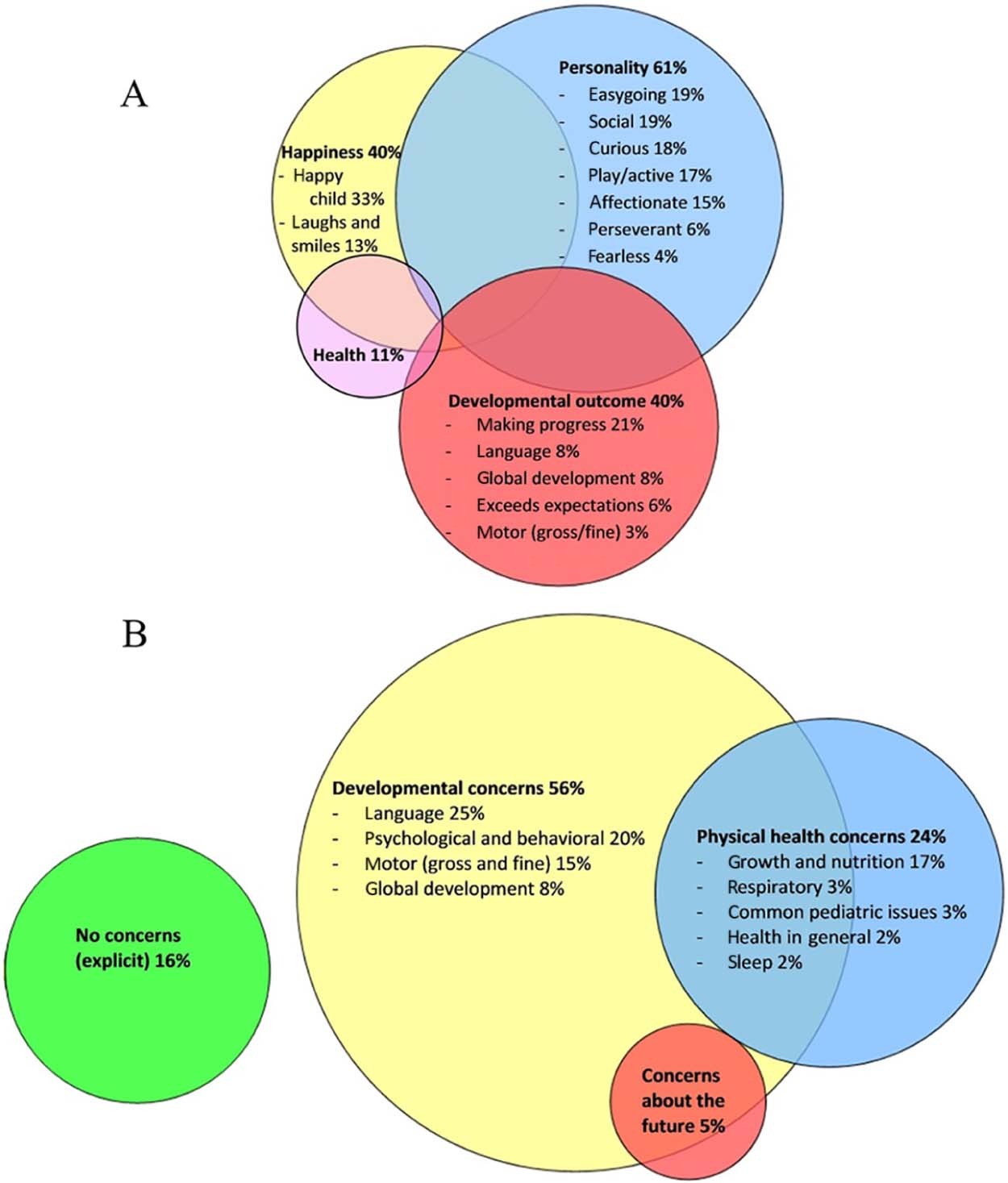
This is the first Venn diagram I can remember seeing in a medical publication, which makes me think that “modern maths” (as we called it 50 years ago) might not have been a waste of time after all (to be honest I loved maths, and I was rather good at it, unlike latin…).  The A diagram is the positive things that parents said, the B diagram shows their concerns. What I find perhaps most interesting in this publication is the lack of correlation between whether or not the baby actually had neurological impairment or developmental delay and the parents opinions/worries.

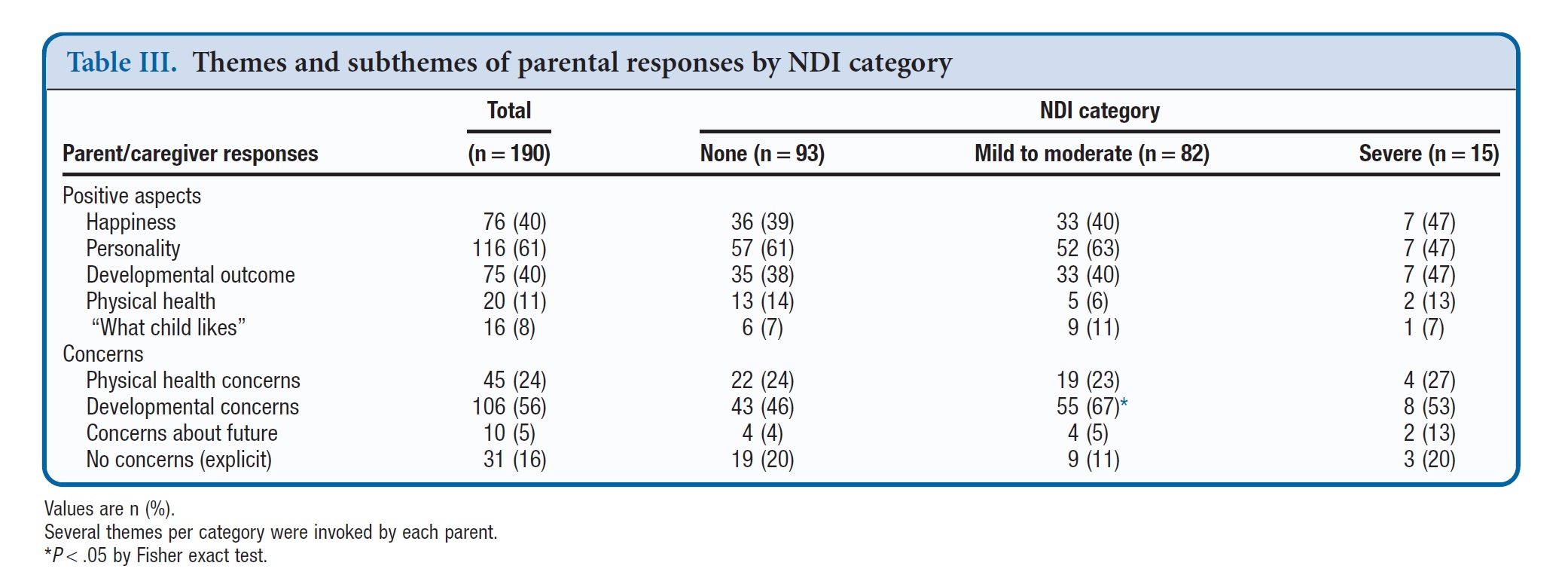
As you can see from this table, there was really no difference between the parents whose infants were doing well (by our usual medical criteria) and those who had serious issues (by our usual medical criteria) in their concerns or their positive evaluations. There are only 15 (out of 190) with what they call “severe NDI”, and among that small group there were similar responses to the other parents. The parents who were somewhat more likely to be worried about their child’s development were those in the “mild to moderate NDI” category, where 2/3 of the parents voiced this concern compared to about half of the none or severe categories.

I think the next step needs to be to ask a group of parents what they think we should be trying to measure as neonatal outcomes, both acutely and during follow-up. That next step is already being done, of course, one group that has been working on this is the COIN project, which stands for Core Outcomes In Neonatology, based in London (the UK version of London). You can see on their web page that they are developing a list of Core Outcomes, and the first stakeholder group on their list is “the parents of babies needing medical care”.

Posted in Neonatal Research | Tagged | 6 Comments

Regular universal antibiotics to reduce infant mortality?

This (Keenan JD, et al. Azithromycin to Reduce Childhood Mortality in Sub-Saharan Africa. The New England journal of medicine. 2018;378(17):1583-92 Open Access) is a new multicenter cluster randomized trial of giving all infants in a community regular azithromycin. If that sounds crazy, just wait… azithromycin (or placebo) was given to all the infants in the included communities twice a year, if they were between 1 and 59 months of age.  The study was based on observations that children in trachoma prevention trials (using azithromycin) had lower mortality; this study was designed to see if that was a real effect. Communities in Malawi, Tanzania and Niger were enrolled in this stunning, massive, effort, which included hundreds of thousands of infants.

The other stunning fact, that this study reminds us of, is the enormous post-neonatal infant mortality in these countries. In the country with the highest placebo mortality, Niger, the mortality rate was over 27 per 1000 patient years, that is nearly 3% of all their young kids die each year.

The intervention, azithromycin syrup in a single dose twice a year, was studied in the trial which was called MORDOR, which you may recognize from Lord of the Rings as Tolkien’s name for the kingdom of evil, which he derived from the old English word for murder morþor . I guess because the official language of Niger is French they tortured the acronym production machine until it came up with “Macrolides Oraux pour Réduire les Décès avec un Oeil sur la Résistance”.

The result of the trial was actually the opposite of morþor: there was a significant reduction in mortality, especially in Niger, and especially in the youngest kids, in whom the subgroup analysis showed that babies between 1 and 5 months of age had a 25% reduction in mortality with azithromycin compared to placebo. That is a reduction in mortality among all the infants in the community, which is the 3rd time I am going to use the word stunning in this post.

This intervention will probably have some impact on macrolide resistance, but with such infrequent dosing perhaps that will be minimal, and perhaps this might save many thousands of lives in the world’s poorest countries, if we can ensure that those at highest risk can have access. Azithromycin is quite cheap, and was provided for this Bill and Melinda Gates Foundation funded trial by Pfizer. I’d like to believe that their motivation was altruistic, and that they will provide azithromycin free or at production cost for future trials or usage, if the benefit can be shown to be maintained and that resistance does not become a problem. “you may say I’m a dreamer… but I’m not the only one

Posted in Neonatal Research | Tagged , | 2 Comments

Too much oxygen is bad for adults too!

The systematic review of the neonatal oxygen saturation targeting trials Askie LM, et al. Effects of targeting lower versus higher arterial oxygen saturations on death or disability in preterm infants. Cochrane database of systematic reviews (Online). 2017;4:Cd011190.
confirmed the increase in mortality with lower saturation targets (85 to 89%) compared to higher targets (91 to 95%) that was shown, in very preterm babies, by most of the individual trials, and showed very little heterogeneity between the trials. That review was limited to trials that enrolled patients at birth or soon after, and therefore excluded the first BOOST trial, and STOP-ROP. Those two trials enrolled children later in their hospital stay (for BOOST it was kids born before 30 weeks who still were on oxygen at 32 weeks, for STOP-ROP eligible babies had pre-threshold retinopathy and who needed oxygen to stay at or above 94%). They both randomly compared saturations in the low 90’s to saturations in the high 90’s

Despite the differences between the trials they both seemed to show somewhat worse pulmonary outcomes with higher saturations, including more babies on oxygen for longer, in STOP-ROP for example, at 3 months corrected age, well after the intervention had finished, there were 47% of the high saturation babies still on oxygen compared to 36% in the low saturation group. There were also twice as many babies still hospitalized at 3 months corrected (13% vs 7%), and more use of all the pulmonary medications reported. In the BOOST trial more babies went home on oxygen in the high saturation target group, but this could be predicted by trial design which maintained the target ranges for as long as the kids were in oxygen, so in the high saturation group it would be harder and take longer to be weaned off oxygen, by study design, They were also however, more likely to get steroids or diuretics, and more likely to be re-hospitalized during the first year of life and there were slightly more pulmonary deaths in the high saturation group. All of which suggests that targeting even higher saturations than the NeoPROM trials, and aiming for saturations above 94%, at least after the initial acute phase, might increase pulmonary oxygen toxicity enough to have an adverse clinical impact.


This new systematic review and meta-analysis (Chu DK, et al. Mortality and morbidity in acutely ill adults treated with liberal versus conservative oxygen therapy (IOTA): a systematic review and meta-analysis. The Lancet. 2018;391(10131):1693-705)
is one of a kind that I often criticise, studies of widely different patient populations are lumped together, so it doesn’t satisfy Barrington’s rule, that to be meta-analyzed patients should have been able to be eligible for each study. This review, however, searched for all studies of critically ill adults who were randomized to conservative or liberal oxygen strategies. It includes adults with a recent stroke, or septic shock or appendicitis, post-myocardial infarction or cardiac arrest. That makes me a bit sceptical about the applicability to all of those different groups, also the duration of the randomized intervention, and the actual oxygen concentrations administered where varied, although most of the conservative oxygen groups were on 21%. The authors found 25 randomized trials with a total of over 16000 patients, and overall, in the safety analysis, there was an increase in mortality. The benefit of doing a review like this is that you can get enough patients to find small changes in infrequent outcomes just by increasing the total numbers. In-hospital mortality was increased by 21%, which sound enormous, but in fact the increase was from about 3% to about 3.7%, 30 day mortality increased from 5.6% to 6.4%. Whether these differences really apply to all subgroups of patients is uncertain, but the review was not able to show any benefit of giving more oxygen.

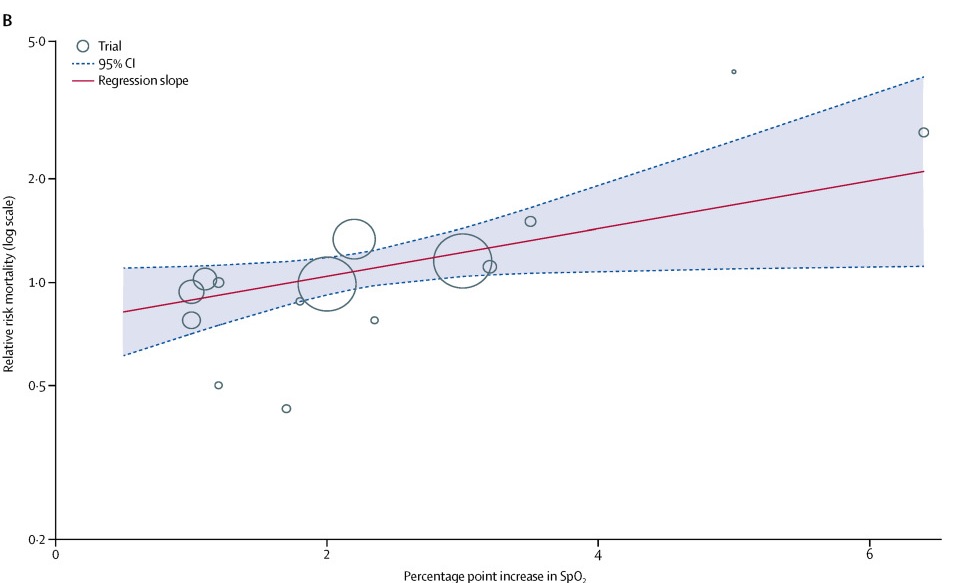
Another interesting finding from this review is that there seemed to be a dose effect, as saturations increased there was a greater effect on mortality, and the impact seemed to be  significant above a saturation of about 94 to 96%.

Although we know in babies that mortality is lower with a target range of 91 to 95% than a range of 85 to 89%, we don’t know if there is a range that would have even lower mortality. In adults with varying serious illnesses, the upper limit of what you should aim for is probably around 95%, if your baseline saturation is above or close to 95% you should probably leave well alone and not give oxygen.

There are adverse effects of hyperoxia, even in full term babies and in mature experimental newborn animals, with an increase in pulmonary reactivity, and a reduction in the response to nitric oxide, as well as the generation of free radicals, and potential adverse effects on cardiac function (see this review). I think that much of what is discussed in the editorial accompanying the new systematic review could be transposed to our patients. Although the dangers of hyperoxia in very preterm babies have been appreciated for years, the potential dangers in later preterm and term babies are less well appreciated.

Posted in Neonatal Research | Tagged , , , , | Leave a comment

Glucose gel for hypoglycemia in at-risk babies? Prophylaxis no, treatment yes!

In the ongoing story of how and when to treat lower than average blood sugars in at-risk newborn infants, some clarity for some points is emerging.

We know the following:

1. some babies have lower blood sugars than others (!)

2. some babies with prolonged very low blood sugars have poor long term outcomes

3. more minor “hypoglycemia” has statistical associations with poorer outcomes, but we have no idea if this is causative.

4. Being in an at-risk group increases risk of poor long term outcomes, even if you are never documented to be hypoglycemic.

4. we have no idea if aggressive blood sugar monitoring and intervention for lower than average blood sugars improves outcomes. The best data we have (from Harding’s group in New Zealand) suggest the opposite, they found no detectable benefit of being ‘aggressive’) See this blog post for a longer discussion

5. Babies with low blood sugars might have multiple interventions, be separated from their mothers, have their breast-feeding interrupted, have multiple painful heelstick procedures, and end up in the NICU with an iv infusion, and with parents who think their babies are abnormal.

5. We should as a result minimize potential harms from our monitoring, while ensuring safe blood sugar concentrations.


The glucose gel approach first studied in the Sugarbabies trial from New Zealand at least decreases the harms of treatment, and it is now clear that that benefit can be achieved in other centers.

Makker K, et al. Glucose Gel in Infants at Risk for Transitional Neonatal Hypoglycemia. American journal of perinatology. 2018.  This US study showed a reduction in glucose infusion rates, which in their hospital also required an NICU admission, and greatly increased hospital charges. The article includes a figure showing their protocol (the figure is a bit confusing as it shows both the before and after protocols, but with a bit of persistence you could create your own protocol from it).

Rawat M, et al. Oral Dextrose Gel Reduces the Need for Intravenous Dextrose Therapy in Neonatal Hypoglycemia. Biomed Hub. 2016;1(3). This is a report from Buffalo NY, which is freely available on-line and which showed a reduction in dextrose infusions and which also includes their protocol.

Ter M, et al. Implementation of dextrose gel in the management of neonatal hypoglycaemia. Journal of Paediatrics and Child Health. 2016. This study from Melbourne also showed a reduction in dextrose infusions, and describes their protocol, but doesn’t have a pretty coloured figure like the one from Buffalo.

Coors SM, et al. Prophylactic Dextrose Gel Does Not Prevent Neonatal Hypoglycemia: A Quasi-Experimental Pilot Study. The Journal of pediatrics. 2018. In this study the authors tried to prevent hypoglycemia, they selected some at-risk infants and gave them oral glucose gel after the first feed, but the incidence of hypoglycemia and NICU admission was the same between groups.

These oral gels are easily available as they are used by diabetics for hypoglycemic episodes, unfortunately they all have colorants, artificial flavours and other additives that our babies could do without, but a single use, or occasionally 2 or 3 uses, will probably not cause any harm to a full term baby. A preparation designed in a single dose sachet without additives for full term babies could probably have a big market. If anybody reads this and decides to create such a product, I expect a cut of the profits!

Posted in Neonatal Research | Tagged | 8 Comments

Its now or… later? A good question to ask ELVIS.

This study probably wins the prize for the best trial name in neonatal history, the Early or Late Ventricular Intervention Study, ELVIS.

de Vries LS, et al. Treatment thresholds for intervention in posthaemorrhagic ventricular dilation: a randomised controlled trial. Archives of Disease in Childhood – Fetal and Neonatal Edition. 2018. This is a very important trial comparing 2 approaches to post-hemorrhagic ventricular dilatation in babies of under 34 weeks gestation. Infants who had serious intraventricular or intracerebral hemorrhage and then had progressive ventricular dilatation were randomized when they reached the 97th percentile of ventricular width (as long as the anterior horn width was at least 6 mm). At that point they either had intervention immediately or waited until they reached 4 mm more than the 97th percentile (with an anterior horn width of >10mm).

The second intervention group was consistent with usual practice in many centers, but that threshold was based on very arbitrary criteria. There had never been a good trial to find out if that is the best time to intervene, but some observational data suggested that earlier intervention might lead to better long term outcomes, and, perhaps more surprisingly, fewer permanent VP shunts. de Vries LS, et al. Early versus late treatment of posthaemorrhagic ventricular dilatation: results of a retrospective study from five neonatal intensive care units in The Netherlands. Acta Paediatr. 2002;91(2):212-7.

In the early intervention group, infants had serial lumbar punctures (maximum of 3) and then a ventricular reservoir which was tapped up to twice a day to achieve stability of ventricular size, at less than the 97th percentile. If taps were still needed after 28 days, and the baby met other criteria for shunting, a permanent VP shunt was then inserted.

In the late intervention group the same approach was taken, but starting when the ventricular index was more than 4mm above the 97th percentile.

The primary outcome for this phase of the trial was death or VP shunt placement several dutch centers were involved as was Andy Whitelaw’s group in Bristol (I think Andy has retired now, but they still let him be the last author!) 126 babies were randomized, with similar characteristics in the 2 groups. In the early intervention group they therefore started treatment with lumbar punctures immediately, and 40 of the 62 in that group (not including the 2 deaths) then had a reservoir. In the late group 36 of the 58 who survived had serial lumbar punctures, and 27 then had a reservoir. 12 in the early group, and 14 in the late group had a ventriculo-peritoneal shunt.

This flow sheet should clarify those data.

As you can see there were fewer infants who had lumbar puncture, and fewer infants who had a reservoir, in the later intervention group, but about 1 in 5 of each group had a ventriculo-peritoneal shunt.

This increase in interventions could easily be justified if the long term outcomes are improved, those results will be coming, I would guess, within the next year or so. Until then we will have to keep asking “baby, what you want me to do?”

Posted in Neonatal Research | Tagged , | 5 Comments

Teaming up with parents and ex-premies to improve care for babies

On April the XXth I will be running 10 kilometers in the Scotia Bank run, as part of the PAF-Néonat team of Sainte Justine Hospital (PAF means Partenarait Famille).

We are raising funds for the partnering with families program, which involves parents in clinical care, research and education in our neonatal service.

On the PAF- running page, please take some time to look at runners’ testimonials. Some  children-runners are running for their brother who died in the NICU 12 years ago. Others are parents with their young premies. Others are young ex-premies, some with and others without disability. Others are ex-preemies, who are now adults, that are running. Their pictures and stories are moving.

And yes, some of the others are our own kids, Annie’s and mine and the kids of other wonderful providers from our unit and hospital.

We have a quite innovative program and want to expand it further.

To make a donation click on this link neonat-paf.ca, all of the funds raised go directly to support our program. Our program is important to us and to the families we care for.


Posted in Neonatal Research | Leave a comment