Hypocapnia in asphyxiated infants

Some of my posts are not necessarily going to be about very new publications, sometimes a clinical event or question stimulates me to review the literature, and I will share my findings with the readers.

Spontaneous hypocapnia is not rare in asphyxiated infants. Although it is possible to hyperventilate an infant more easily when their metabolism and CO2 production is reduced by hypothermia, they also frequently hyperventilate themselves. This may be in response so a systemic metabolic acidosis, but may go beyond that stimulus and lead to a systemic respiratory alkalosis. Exactly why this happens I am unsure, perhaps there is brain stem acidosis which over-drives respiration.

The well characterized neonatal rat carotid artery ligation and hypoxia model has similar responses. This model, developed by Dr R Vannucci, hyperventilates in response to metabolic acidosis, and will become spontaneously seriously hypocapnic. They may completely correct their acidosis with a mean PCO2 as low as 25 mmHg. In 1995 Dr Vannucci showed that just giving CO2 gas, as a 3, 6, or 9% mixture, prevented much of the brain damage, 3% gave normocapnia and reduced brain injury, the best effect was at 6% CO2 which caused mild hypercapnia (mean PCO2 about 56 mmHg), a slight reduction in the benefit was noted with 9% CO2, (mean PCO2 about 68 mmHg).

Vannucci RC, Towfighi J, Heitjan DF, Brucklacher RM: Carbon dioxide protects the perinatal brain from hypoxic-ischemic damage: An experimental study in the immature rat. Pediatrics 1995, 95(6):868-874. http://pediatrics.aappublications.org/content/95/6/868.full.pdf+html

Subsequently he showed that the rats with normocapnia and mild hypercapnia had better cardiac function and improved cerebral blood flow, and major improvements in cellular metabolism. http://www.nature.com/pr/journal/v42/n1/full/pr19972265a.html

Recent clinical studies show a link between hypocania and severity of brain damage in human infants also.

Pappas A, Shankaran S, Laptook AR, Langer JC, Bara R, Ehrenkranz RA, Goldberg RN, Das A, Higgins RD, Tyson JE et al: Hypocarbia and adverse outcome in neonatal hypoxic-ischemic encephalopathy. J Pediatr 2011, 158(5):752-758 e751. http://pediatrics.aappublications.org/content/95/6/868.full.pdf+html

Klinger G, Beyene J, Shah P, Perlman M: Do hyperoxaemia and hypocapnia add to the risk of brain injury after intrapartum asphyxia? Arch Dis Child Fetal Neonatal Ed 2005, 90(1):F49-52. http://fn.bmjjournals.com/content/90/1/F49.full

It therefore seems prudent to avoid inducing hypocapnia in asphyxiated infants. But what to do when they hyperventilate themselves? After weaning an infant to minimal respiratory support, even to endotracheal CPAP, and finding continuing hypocapnia, what to do next? There are 4 alternatives, either leave the situation as it is and accept hypocapnia, extubate the infant to see if the CO2 will increase a little, add a dead space to the ETT to elevate the CO2, or administer CO2 gas (the latter would be difficult as a source of medical grade CO2 might be difficult to find.) I have not in the past added a dead space in this circumstance. Would a trial be feasible?

Of course the animal model is not exactly what we are dealing with in asphyxiated babies, Vannucci et al give the CO2 during the hypoxic insult,  not afterward, but I think the combination of the animal data, the physiologic rationale, and the human observations make such a trial a reasonable idea.
Posted in Neonatal Research | Tagged | Leave a comment

Predicting outcomes in extremely preterm infants

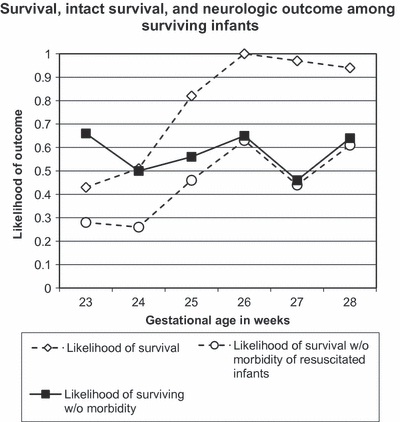
Extremely preterm infants (less than 28 weeks gestation) have an increased risk of adverse neurological or developmental outcomes. A new publication from the University of Chicago emphasizes a feature that has been shown before. That among survivors, there is little difference in the proportion with significant long term problems between 23 and 27 weeks gestation.

 Andrews B, Lagatta J, Chu A, Plesha-Troyke S, Schreiber M, Lantos J, Meadow W: The nonimpact of gestational age on neurodevelopmental outcome for ventilated survivors born at 23–28 weeks of gestation. Acta Paediatrica 2012, 101(6):574-578. http://onlinelibrary.wiley.com/doi/10.1111/j.1651-2227.2012.02609.x/abstract

The figure which illustrates this is shown above. The black boxes show the proportion of survivors who are without  major morbidity (defined as a score on the Bayley scales of infant development, either the mental development index or the psychomotor developmental index of less than 70, that is more than 2 SD below the mean). The authors also analyzed the data for more severe delays in development (scores less than 6o and less than 50) and found the same thing.

How this fits in with other studies

Other investigators have in the past shown similar things. It is possible that the failure of Andrews et al to find an impact of gestational age among survivors who were extremely preterm is due to a lack of power. It is also possible that evaluation of these children in later life could show differences according to the gestational week that they were born.

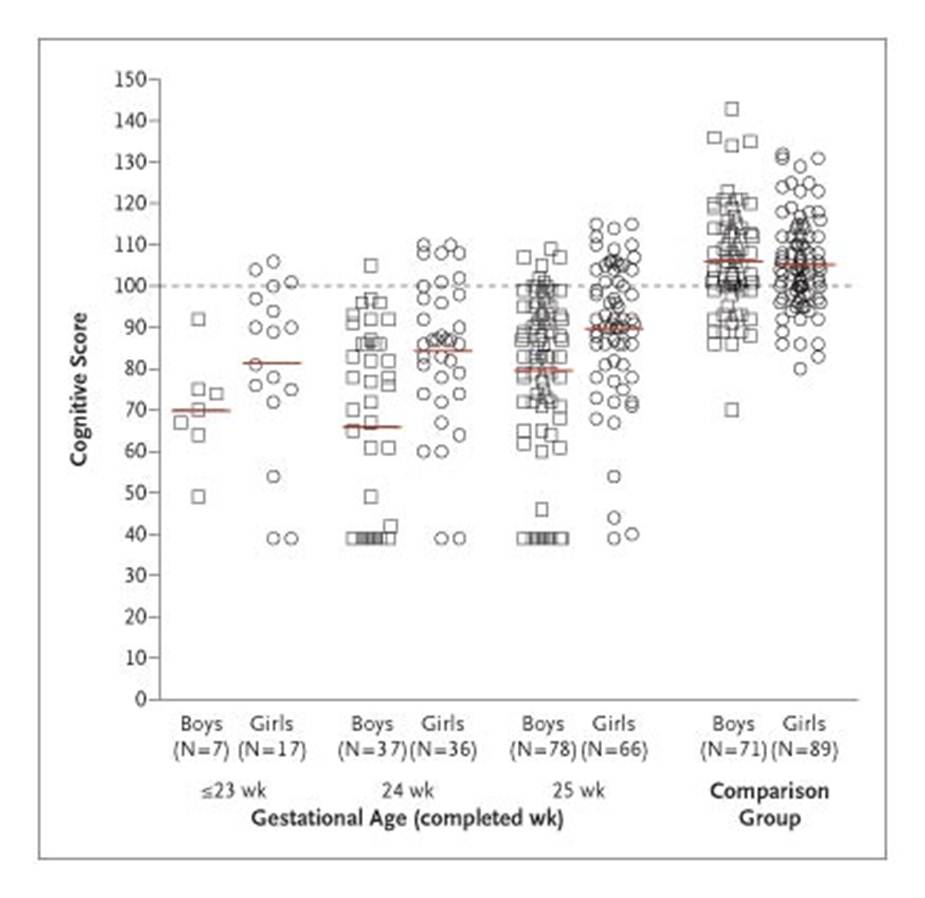
However data from larger cohorts, studied at later postnatal ages such as the EpiCure study, shows generally the same effect. Figure 1 from the 6 year neurologic and developmental outcomes of the EpiCure cohort is below.

Marlow N, Wolke D, Bracewell MA, Samara M, the EPICure Study Group: Neurologic and Developmental Disability at Six Years of Age after Extremely Preterm Birth. N Engl J Med 2005, 352(1):9-19. http://www.nejm.org/doi/full/10.1056/NEJMoa041367

Although the boys, and perhaps the girls appear to have slightly higher mean scores if born at 25 weeks than at 23 or 24 weeks gestation, the differences are not huge, and the numbers with very low scores appear to be about the same (and in fact are very few).

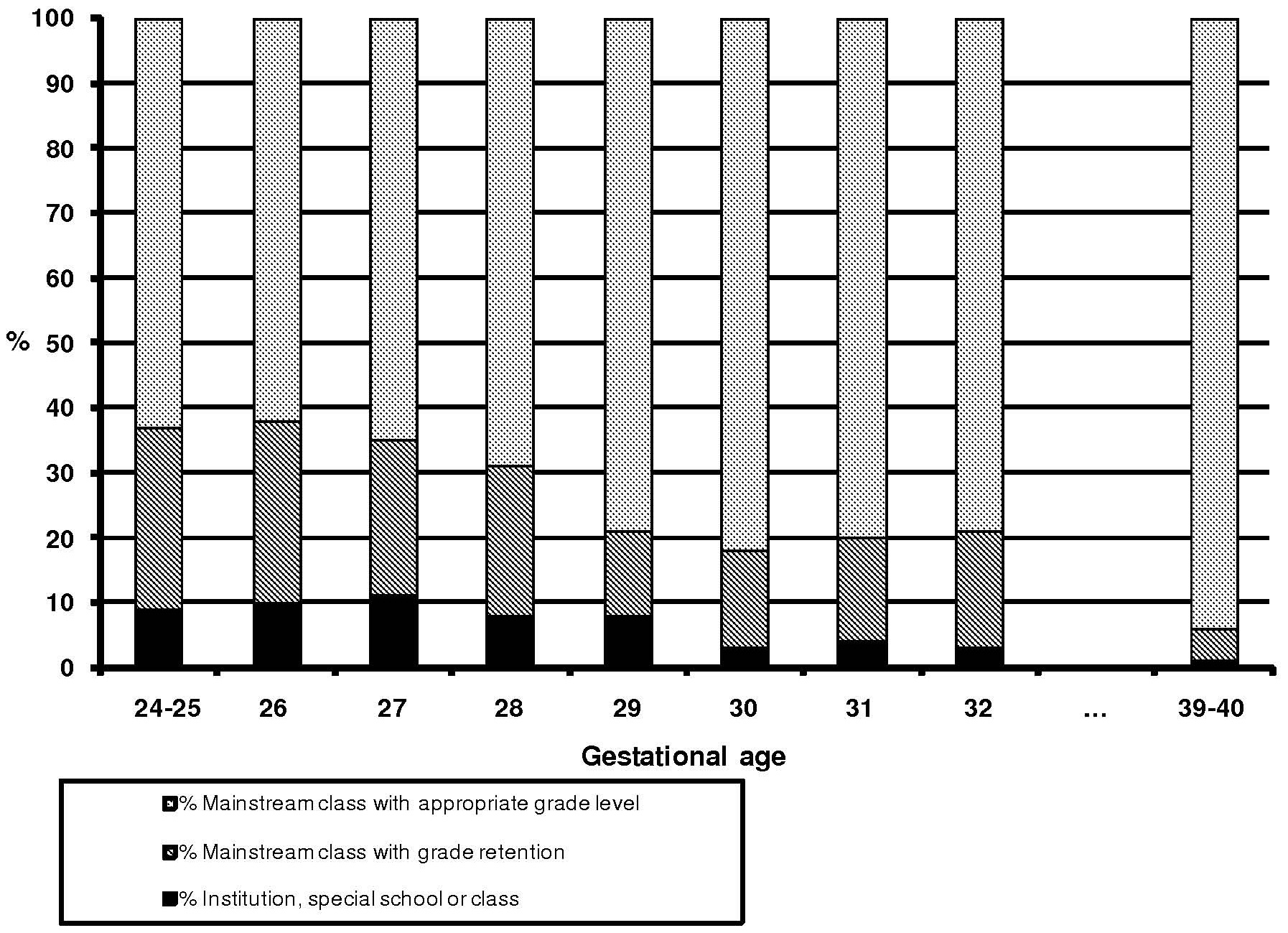
Similarly the Epipage study, a regional cohort from 9 french regions reported outcomes to 8 years of age of very preterm infants, some of whom were extremely preterm.

Larroque B, Ancel PY, Marchand-Martin L, Cambonie G, Fresson J, Pierrat V, Roze JC, Marpeau L, Thiriez G, Alberge C et al: Special care and school difficulties in 8-year-old very preterm children: the Epipage cohort study. PLoS One 2011, 6(7):e21361 .http://www.plosone.org/article/info%3Adoi%2F10.1371%2Fjournal.pone.0021361#pone.0021361-Larroque1

Using a different outcome measure (schooling difficulties) they again show no substantial difference among survivors between 24-25 weeks and 27 weeks. The total number in the extremely preterm cohort was about 300 initially, with only 10 born at 24 weeks gestation.

What are the implications of this?

As discussed by Andrews and her colleagues, these data should have an impact on how we talk to parents before an extremely preterm delivery. As they state: ‘If mortality in the NICU is the outcome that parents most fear, then physician counselling and public policy pronouncements that rely strongly on gestational age are epidemiologically and ethically appropriate. However, if survival of an infant with severe neurologic impairment is the outcome most feared, then reliance on gestational age appears to be misplaced.’

The authors state earlier in their discussion ‘Some parents find moral worth and emotional solace in ‘giving their child a chance’ and ‘not giving up without a fight’.’

They go on to suggest that for such parents the only negative outcome is survival with neurodevelopmental impairment, and here I would disagree. I don’t think this follows from the previous sentence. One could find moral worth in a trial of therapy, but still not necessarily feel that survival with neurodevelopmental impairment is a negative otucome. Survival with profound handicap may sometimes be considered worse than not surviving (although be aware that parents tend to evaluate the situations differently than health care workers: see Saigal et al below), but having a Bayley score of less than 70 at 2 years of age is not equivalent to profound handicap!

Saigal S, Stoskopf BL, Feeny D, Furlong W, Burrows E, Rosenbaum PL, al. e: Differences in preferences for neonatal outcomes among health care professionals, parents, and adolescents. JAMA : the journal of the American Medical Association 1999, 281(21):1991-1997. http://jama.ama-assn.org/cgi/reprint/281/21/1991.pdf)

Posted in Neonatal Research | Tagged | Leave a comment

Hand washing

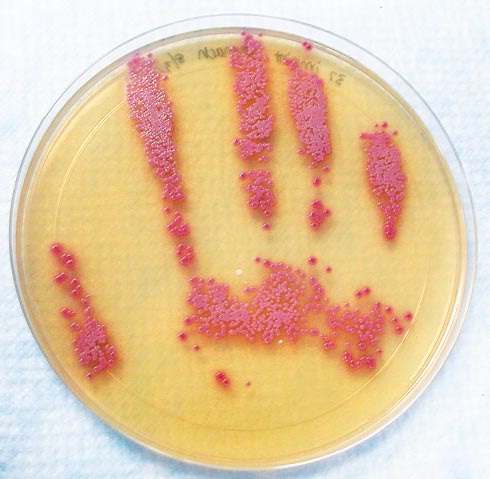
Sometimes our discussion of infection control become somewhat theoretical, we talk about frequencies and methodologies. Here are a sequence of images that are worth a thousand words. the first 2 are from a publication in the New England Journal of Medicine

Donskey CJ, Eckstein BC: The Hands Give It Away. New England Journal of Medicine 2009, 360(3):e3. http://www.nejm.org/doi/full/10.1056/NEJMicm0707259

Which shows the hand prints of a health care worker who had just palpated the abdomen of a patient. The pink colonies are Staphylococcus. the second image is after hand-washing.

Below is the story of a parent, taken from the   ‘Perinatal Quality Collaborative of North Carolina’ http://www.pqcnc.org/?q=node/12878 It is a very eloquent tale of the human costs of nosocomial infections.

I have sought and received permission for the reuse of these items.

Posted in Neonatal Research | Tagged | Leave a comment

Nutrition of very preterm babies

There is a ‘growing’ feeling that we don’t give enough protein to our preterm infants, especially during the enteral phases of nutrition. Fortified maternal breast milk use is associated with lower overall rates of weight gain, despite all its benefits. Also the emphasis on weight gain as the major outcome variable  may be misplaced. Body composition at term of former extremely low gestational age preterms is quite abnormal. A recent RCT investigated whether giving more protein in the fortifier would improve growth.

Miller J, Makrides M, Gibson RA, McPhee AJ, Stanford TE, Morris S, Ryan P, Collins CT: Effect of increasing protein content of human milk fortifier on growth in preterm infants born at <31 wk gestation: a randomized controlled trial. Am J Clin Nutr 2012, 95(3):648-655. http://www.ajcn.org/content/95/3/648

92 infants of less than 31 weeks were randomized, at the end of the study the higher protein infants weighed more, but the length and head circumference was not increased. This may have been a lack of power. So further larger trials will be required to figure out how to improve preterm infants growth and body composition.

An abstract presented at this years PAS meeting in Boston by our group [4510.111] Eliminating Postnatal Growth Restriction with an Aggressive TPN and feeding Protocol. Marianne Lapointe, Josee Mandeville, Keith Barrington, Annie Janvier. Neonatology, Sainte-Justine Hospital, University of Montreal, Montreal, QC, Canada. Showed that we have practically eliminated postnatal growth restriction by having an aggressive TPN and feeding protocol. But we certainly do still see infants who have a good weight, but their length is less than it should be.

Posted in Neonatal Research | Tagged , | Leave a comment

Pain relief for intramuscular injections

Sometimes we can’t avoid giving an IM injection, even though they are painful. Some vaccines should be given IM, and the routine needle in the thigh of every baby for vitamin K is a rite of passage, that has become standard everywhere. There has been very little study of analgesia for this procedure in the newborn, compared to studies of heelsticks, for example.

Liaw J-J, Zeng W-P, Yang L, Yuh Y-S, Yin T, Yang M-H. Nonnutritive Sucking and Oral Sucrose Relieve Neonatal Pain During Intramuscular Injection of Hepatitis Vaccine. Journal of Pain and Symptom Management. 2011;42(6):918-30. http://www.sciencedirect.com/science/article/pii/S0885392411001606

In the neonatal pain literature this is a fairly large study (165 babies in 3 groups, control NNS and sucrose) both the intervention groups were much better than the controls. For other procedures the combination of a soother and sucrose is better than either alone.

As a result, the standard of care should be to give sucrose and a soother before intramuscular injections.

But also, many intramuscular injections can be avoided. Vitamin K can be given intravenously to babies that have an IV, such as many preterm babies.

Finally a question, is it ethically appropriate to include untreated controls in a study of pain relief in the newborn?

Posted in Neonatal Research | Tagged , | Leave a comment

The microbiome of the preterm infant, how it relates to NEC

The intestinal flora of the preterm infant and how it relates to NEC.

The normal pattern of colonization of the intestine is disturbed by: prematurity; by caesarian delivery; by antibiotics; and by feeding formula rather than breast milk. The abnormal colonization of the intestine of the preterm may well be related to the pathogenesis of Necrotizing Enterocolitis. A previous study showed that preterm infants have a reduced variety of organisms in their bowel, and those who develop NEC seem to have an even more disturbed colonization, with a reduction in variety before the symptoms appear (Wang Y, Hoenig JD, Malin KJ, Qamar S, Petrof EO, Sun J, et al. 16S rRNA gene-based analysis of fecal microbiota from preterm infants with and without necrotizing enterocolitis. ISME J. 2009;3(8):944-54. http://www.nature.com/ismej/journal/v3/n8/full/ismej200937a.html)

A new study by Dr Joseph Neu’s group in Florida didn’t find reduced diversity but instead found that babies who develop NEC seem to have a different profile of colonizing organisms, and they may have identified a specific new pathogen which seems to become prominent in the 72 hours before the diagnosis of NEC.

Mai V, Young CM, Ukhanova M, Wang X, Sun Y, Casella G, et al. Fecal Microbiota in Premature Infants Prior to Necrotizing Enterocolitis. PLoS One. 2011;6(6):e20647. http://www.plosone.org/article/info%3Adoi%2F10.1371%2Fjournal.pone.0020647

In this study weekly stool samples were collected and analyzed with high throughput molecular techniques which can identify many thousands of strains. Some of the babies developed NEC, and the samples one week before and within 72 hours before the diagnosis were compared with controls, who did not get NEC.

One of the bacterial signatures detected more frequently in NEC cases (p<0.01) matched closest to γ-Proteobacteria. Although this sequence grouped to the well-studied Enterobacteriaceae family, it did not match any sequence in Genbank by more than 97%. Our observations suggest that abnormal patterns of microbiota and potentially a novel pathogen contribute to the etiology of NEC.

A very elegant series of studies in preterm pigs, (summarized in Siggers RH, Siggers J, Thymann T, Boye M, Sangild PT. Nutritional modulation of the gut microbiota and immune system in preterm neonates susceptible to necrotizing enterocolitis. The Journal of Nutritional Biochemistry. 2011;22(6):511-21. http://www.sciencedirect.com/science/article/pii/S0016508506003374 ) supports the role of Colostrum, abnormal gut colonization and enhanced immune responses in the preterm as factors in the development of NEC, and the role of probiotics in prevention.

Posted in Neonatal Research | Tagged , | Leave a comment

Pain relief and retinopathy screening, part 2.

My good friend Gene Dempsey (a neonatologist and clinical researcher in Cork) reminded me of their trial published in 2010, and suggested that the title of my previous post may be misleading. I guess I really don’t want readers to think that nothing works and therefore we should stop analgesic maneuvers before RoP screening exams. What I meant to imply is that no particular intervention abolishes pain responses. Using several interventions together does give some pain relief and should be standard. Even the local anesthetic eye drops while not very effective do show an effect when the data are analyzed in systematic review. Dr Dempsey gave me permission to copy his comments into a post:

I think the title of this section may be a little misleading. As you point out in the last pargraph, the combination of swaddling, oral sucrose and topical anaesthetic was associated with relatively low scores and I believe should be the standard for ROP screening. Whilst the review you highlight is good, I think the following review is as good

Sun X, Lemyre B, Barrowman N, O’Connor M. Pain management during eye examinations for retinopathy of prematurity in preterm infants: a systematic review.. Acta Paediatr. 2010 Mar;99(3):329-34. http://onlinelibrary.wiley.com/doi/10.1111/j.1651-2227.2009.01612.x/abstract.Also our own rct of sucrose use (O’Sullivan A, O’Connor M, Brosnahan D, McCreery K, Dempsey EM. Sweeten, soother and swaddle for retinopathy of prematurity screening: a randomised placebo controlled trial.. Arch Dis Child Fetal Neonatal Ed. 2010 Nov;95(6):F419-22 http://fn.bmj.com/content/95/6/F419.abstract) showed a reduction in pain scores during speculum insertion and indentation, was not included in Kandasamy review.

The Cochrane review of local anesthetic eye drops is in fact authored by Dr Dempsey. Dempsey E, McCreery K: Local anaesthetic eye drops for prevention of pain in preterm infants undergoing screening for retinopathy of prematurity. Cochrane Database Syst Rev 2011, 9(9):CD007645. http://onlinelibrary.wiley.com/doi/10.1002/14651858.CD007645.pub2/abstract

Posted in Neonatal Research | Tagged , , | Leave a comment

More on Probiotics

I received a comment from Colin Morley (everyone in neonatology knows who Colin is, for anyone else who is reading this, he is a neonatologist and researcher from Cambridge and Melbourne). I asked his permission to post it (with my reply which is below) and he kindly agreed:

My take on this is that at the moment it is a bit like saying antibiotics are good although there we have lots of data about individual antibiotics and specific infections.

The problems with probiotics are:

  • There are no well proven probiotic combinations available for prescription in the UK or Australia. I dont know about Canada.
  • We dont know which probiotic or combination to use.
  • We dont know the dose to give.
  • We dont know when to start.
  • We dont know when to finish.
  • Should they be given in the same way to breast milk fed or formula fed babies.
  • Although it may appear there are no infections with the probiotics this is possibly because they dont grow in standard blood culture media.

So I think we need more detailed specific studies to help us answer the above problems. I would not suggest people go to the local high street pharmacy and buy probiotics for their prems because they often do not contain what they say on the tin or in the dose stated.

Hopefully the Australian ProPrems trial data (1200 babies) will be available soon. Even with that number it has little power to show a believable difference in NEC so it is targeting infection, which is a nightmare, what is infection?

My response was as follows:

In Canada we do have preparations with good quality control approved by Health Canada (not specifically for preterms, but at least approved to be sold with an official number), made in approved factories etc.

My response to most of your other comments are that none of the questions will be answered by the ongoing trials. We need comparative trials.

I think the situation is a bit like hypothermia a few years ago, we knew it worked but the AAP refused to endorse treatment because we didn’t know how long to cool for or exactly what temperature. We still don’t know those things, but the widespread introduction of cooling was delayed and many babies suffered as a result.

It really doesn’t seem to matter which organism is used. In fact the intestine is colonized with different profiles of organisms around the world, as long as you have either a lactobacillus or a bifidobacterium in the stuff the effects seem to be about the same. But a streptococcus thermophiles or a saccharomyces doesn’t work (there are now 3 studies of saccharomyces, 1 published and 2 presented, none show an effect).

I agree that the difficulty culturing the bugs is a problem, but, even if there are some undetected infections, mortality is still reduced. The reported infections have been relatively minor and easy to treat.

The unreliability of mixtures bought in the health food stores in the UK and the USA is a huge problem for using them. A reliable preparation is essential.

Colin then replied further:

I have one more comment to your comments. Although comparative studies are theoretically a good idea they are going to be almost impossible if NEC is the outcome. If the rate of NEC is 7% then even an unlikely halving down to 3.5% is going to need thousands of babies.

What is needed is a good study with large numbers (many of the probiotic studies are too small and may be publication bias), a reasonable incidence of NEC say 7% (some of the trials have very high levels in the controls – 13.6%, 16.6%, 22.8% etc and so are probably not representative of what happens in most neonatal units) and a probiotic combination which has been shown to be consistent in composition and in number of bugs and is licensed by the national bodies like the FDA and Australian TGA. If we have that then we can be comfortable to proceed and treat all babies.

When I was in Taiwan I asked them what they did. I was told if the parents want probiotics they have to buy it from the local pharmacy!

I agree with the statement that we need reliable preparations. We are fortunate in Canada to have the Natural Product Authorization system.

It is certainly true that the sample sizes for comparative trials will be huge. There is an international group that has formed who are interested in setting up a registry for the cohort studies that are being done, with a long term goal to perform some comparative RCTs which will probably be cluster randomizations, to account for cross-colonization within an NICU. I think we need to set up networks to do studies such as those, with a simple data set to keep it manageable and less expensive.

Posted in Neonatal Research | Tagged | Leave a comment

Preventing Prematurity

We’ve known for a while that progesterones can reduce prematurity in certain situations. Intramuscular 17 hydroxy progesterone caproate reduces prematurity in women who have had a previous premature baby. (Meis’s article link below)

Now a systematic review of intravaginal progesterone administration shows that the frequency of preterm birth is reduced in women with a short cervix if they get treatment.  Using  the Individual patient data from 5 RCTs including 775 women Romero et al showed there were fewer preterm deliveries, and fewer extremely preterm deliveries. The relative risk of delivery before 28 weeks was 0.5, i.e. a 50% reduction. For every 18 women treated there would be 1 less infants born before 28 weeks gestation.

The therapy appears to be safe, effective and cheap. Routine cervical length screening and intervention should be standard of care.

Romero R, Nicolaides K, Conde-Agudelo A, Tabor A, O’Brien JM, Cetingoz E, et al. Vaginal progesterone in women with an asymptomatic sonographic short cervix in the midtrimester decreases preterm delivery and neonatal morbidity: a systematic review and metaanalysis of individual patient data. American Journal of Obstetrics and Gynecology. 2012;206(2):124.e1-.e19. http://www.sciencedirect.com/science/article/pii/S0002937811023581

Meis PJ, Klebanoff M, Thom E, Dombrowski MP, Sibai B, Moawad AH, et al. Prevention of Recurrent Preterm Delivery by 17 Alpha-Hydroxyprogesterone Caproate. N Engl J Med. 2003;348(24):2379. http://www.nejm.org/doi/full/10.1056/NEJMoa035140

Posted in Neonatal Research | Tagged , , | Leave a comment

Pain relief during retinopathy screening, nothing works very well.

Mandel R, Ali N, Chen J, Galic IJ, Levesque L: Nitrous oxide analgesia during retinopathy screening: a randomised controlled trial. Arch Dis Child Fetal Neonatal Ed 2012, 97(2):F83-87.
http://fn.bmj.com/content/97/2/F83

My colleagues and friends Romain Mandel and Nabeel Ali performed a blinded randomized trial of nitrous oxide (laughing gas) for analgesia during routine ophthalmologic eye screening for retinopathy of prematurity. They started the study while I was the chief at the Royal Victoria Hospital in Montreal, and I think the publication downplays what a pain it was to get all the procedures accepted. They had to scavenge the gases because we didn’t want anyone assisting the procedure to be anesthetized (a nurse or ophthalmologist falling over unconscious would have unblinded the trial). Despite what should have been a good administration of a good concentration of N2O, there was no apparent effect on pain responses. I was very happy that Drs Mandel and Ali pursued the trial, despite the difficulties, as I really thought it would work; but unfortunately, even with experienced gentle ophthalmologists, there was no difference in any of the pain indices.

This adds to the literature of things that don’t work very well for the pain responses to ophthalmologic exams. Including sucrose and topical anesthesia.  A recent systematic review noted that these measures are either wholly or relatively ineffective. Kandasamy Y, Smith R, Wright IMR, Hartley L. Pain relief for premature infants during ophthalmology assessment. Journal of American Association for Pediatric Ophthalmology and Strabismus. 2011;15(3):276-80.  http://www.sciencedirect.com/science/article/pii/S1091853111003326

On the other hand a humane approach I think should lead to the use of topical anesthetics even if they don’t work very well (until we find something that works better), and the pain scores in the Mandel et al study were lower than other studies, perhaps reflecting the fact that a combined approach with sucrose, topical agents and swaddling the infants was used in both groups. Allowing the baby to suck during the procedure seems to help a little, so a soother or bottle could be added. Maybe the best thing would be change the method of screening, there is some evidence that using a digital fundus camera leads to less tachycardia, (see Mukherjee et al) or, even better, just avoiding the use of a speculum (Mehta et al below).

Mukherjee AN, Watts P, Al-Madfai H, Manoj B, Roberts D: Impact of Retinopathy of Prematurity Screening Examination on Cardiorespiratory Indices: A Comparison of Indirect Ophthalmoscopy and Retcam Imaging. Ophthalmology 2006, 113(9):1547-1552.  http://www.sciencedirect.com/science/article/pii/S0161642006005641

Mehta M, Adams GGW, Bunce C, Xing W, Hill M: Pilot study of the systemic effects of three different screening methods used for retinopathy of prematurity. Early Human Development 2005, 81(4):355-360. http://www.sciencedirect.com/science/article/pii/S0378378204001562

Posted in Neonatal Research | Tagged , , | 1 Comment