Weekly updates #9

Avettand-Fenoel V, Marlin S, Vauloup-Fellous C, Loundon N, Francois M, Couloigner V, Rouillon I, Drouin-Garraud V, Laccourreye L, Denoyelle F et al: Congenital Cytomegalovirus Is the Second Most Frequent Cause of Bilateral Hearing Loss in Young French Children. J Pediatr 2012(0). When a baby fails a hearing screen, they should routinely be tested for CMV.

The following aren’t really neonatal, but each has a message for us I think.

Van den Bruel A, Thompson M, Buntinx F, Mant D: Clinicians’ gut feeling about serious infections in children: Observational study. Bmj 2012, 345(sep25 2):e6144-e6144. This is interesting, when clinicians were evaluating children for whether they had a serious infection or not, the clinical evaluation sometimes suggested a low risk, but the clinician had a “gut feeling” that something was not right (it seems that this was often when the parents were very anxious, or the child was lethargic and not laughing or was breathing funny). The gut feeling added significantly to the more objective clinical evaluation and picked up a few kids with serious infections. I don’t know quite what this means, or if it applies in the NICU, but its not unusual to have an experienced nurse tell me that the baby isn’t the way they usually are, without much that is really objective, and they are often right. It is very difficult or impossible to teach this, maybe someone will devise gut training sessions soon, probably we need a gut feeling simulator.

Mehta NM, Bechard LJ, Cahill N, Wang M, Day A, Duggan CP, Heyland DK: Nutritional practices and their relationship to clinical outcomes in critically ill children–an international multicenter cohort study*. Crit Care Med 2012, 40(7):2204-2211. This study looked at how well pediatric intensivists met the nutritional needs of their patients. They are lousy.  Worse than we (neonatologists) are. And the children who were most nutritionally compromised had higher mortality. Having a feeding protocol was the best way to improve the situation.

Yavchitz A, Boutron I, Bafeta A, Marroun I, Charles P, Mantz J, Ravaud P: Misrepresentation of randomized controlled trials in press releases and news coverage: A cohort study. PLoS Med 2012, 9(9):e1001308. People often complain about how skewed and over the top press coverage of medical research can be. In England the Daily Mail is often mocked as being a source of long lists of things which either cause or prevent cancer, with red wine and coffee being in both lists. Very often those stories are based on studies in  experimental rodents, or on cellular or molecular studies. Yaychitz and his co-workers looked into this and showed that “spin”  as they call it, in press reports, was indeed common, but the most common reason for the overblown press reports was overblown conclusions in the published abstract. You know the sort of thing, Resfertabarol was shown to block enzyme pgpgp3 in a mouse cancer cell line. last line of the abstract, “Resfertabarol holds promise to reduce mortality from cancer.” !

Posted in Neonatal Research | Leave a comment

Do blood transfusions improve feeding in anemic preterm Infants?

The possible benefits of blood transfusions in anemic preterm infants have never been well investigated. There is some reliable data about the outcomes of babies randomized to different goals of hemoglobin concentration (for example the PINT study Kirpalani H, Whyte RK, Andersen C, Asztalos EV, Heddle N, Blajchman MA, Peliowski A, Rios A, LaCorte M, Connelly R, Barrington K, Roberts RS. The premature infants in need of transfusion (pint) study: A randomized, controlled trial of a restrictive (low) versus liberal (high) transfusion threshold for extremely low birth weight infants. J Pediatr 2006, 149(3):301-307.) but little data about what clinical benefits may truly be expected in an anemic preterm infant if you are unsure whether to transfuse them or not.

A new observational study attempted to determine whether anemic preterm babies would suckle better after a transfusion. (Bromiker R, Kasinetz Y, Kaplan M, Hammerman C, Schimmel M, Medoff-Cooper B: Sucking improvement following blood transfusion for anemia of prematurity. Arch Pediatr Adolesc Med 2012, 166(10):1-5.) Unfortunately the analysis of their data is an object lesson in how not to analyze observational data. I will explain…

After measuring the outcome of interest, in this case it was suckling before and after a transfusion, measured with a special bottle as the number of sucks in a 5 minute period, the authors divided the data into those with lower than average suckling, and those with higher than average.What is entirely unsurprising is that the babies with lower than average suckling had an increase on the second measurement. This is a phenomenon known as the regression to the mean. It is something that happens with any data set. you can construct completely random data sets and find that the cases below average on the first measure will increase overall on the second measure. And vice versa, those above the average on the first measure will be lower overall on the second measure.

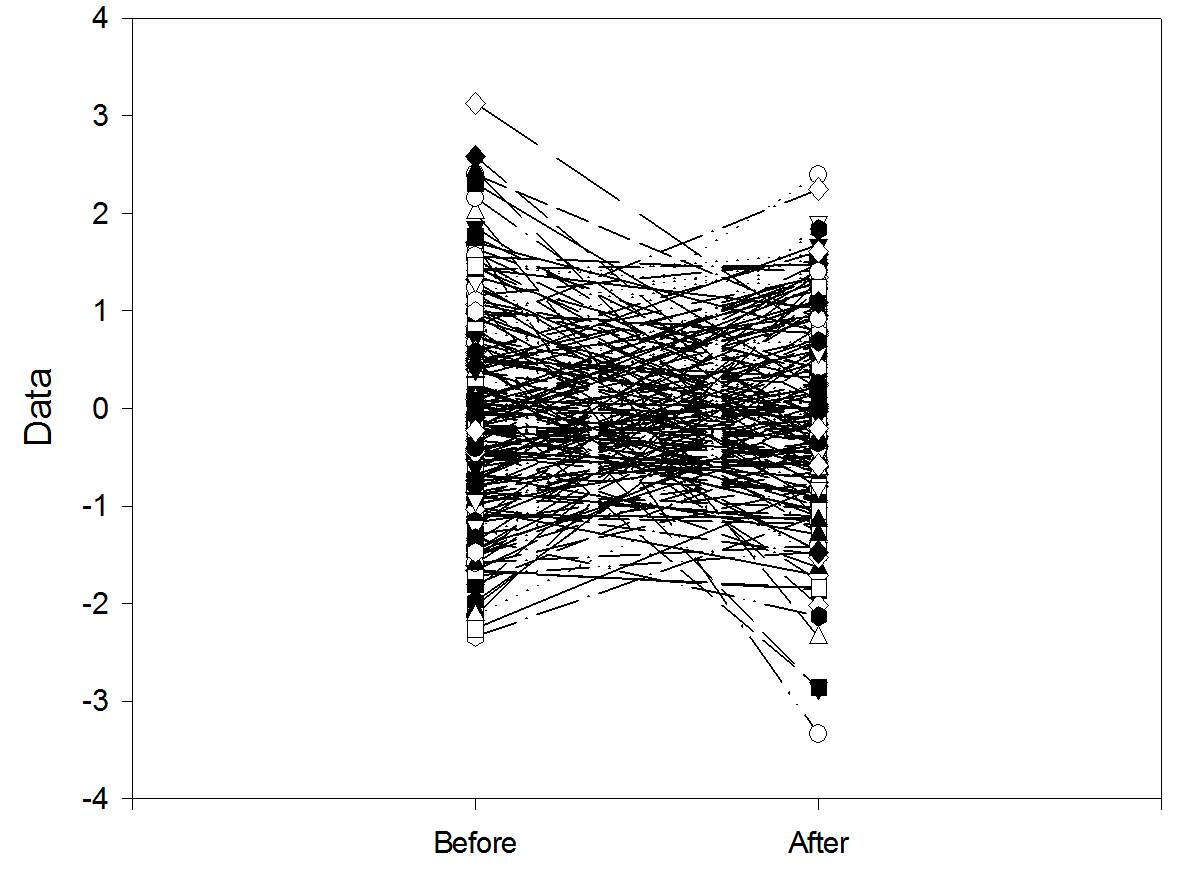
I did this below, I randomly generated 200 normally distributed numbers in column A, the mean is 0 and the SD is 1. In column B I put another randomly generated series of 200 numbers, same mean and SD. Then I joined the first number in column A to the first number in column B, and so on.

The next thing I did was to take out all those that had a value below the mean in column A, and their partner in column B.

Then if you do a paired t-test the p value is <0.001 !

Remember these are entirely random numbers! This is regression to the mean, and analyzing data in this way is a common error.

This phenomenon is also responsible for most of the placebo effect. Most demonstrations of the placebo effect are nothing to do with the healing capacity of the body, or the power of our brains to mislead us, they are just due to the simple arithmetic phenomenon I just showed. If you have more movement restriction than usual in your knee on the day you get the placebo, then the next day you will tend to be better!

Another feature of this phenomenon is that the more abnormal the initial value, the greater on average will be the change. So if I plot the data in the last graph in a different way, comparing column A to the change between A and B, you find that there is a significant correlation (r=0.56, p<0.0001).

To return to the paper about sucking after transfusion, there was NO overall difference before and after transfusion. Only when the babies with lower than average sucking before transfusion are analyzed separately was there an increase after transfusion. As you can also see in the results, those with a higher than average sucking before transfusion actually had a decrease! Which is exactly what you would expect if transfusion had no effect.

This is not the first time similar interpretations have been made regarding transfusion. A paper published in 1984 showed that babies who had poorer weight gain prior to transfusion had more weight gain after transfusion, again entirely compatible with regression to the mean. Now it is touchy to perform randomized trials of blood transfusion, which is why there are so few, I guess. But the only way to answer questions about the clinical efficacy of transfusion is to have controlled trials.

And it is obviously not just in this situation, a paper published in the New England Journal in 1983 on the effects of digoxin in infants with a VSD and circulatory congestion showed that the 6 babies with the lowest shortening fraction before digoxin had an increase in this measure, and the 15 with better pre-digoxin shortening fraction had a decrease. The appropriate interpretation should have been that digoxin had no measurable effect, but the paper was published as if there were 6 ‘responders’ to digoxin, and 15 non-responders. I don’t think there has ever been a substantial RCT of digoxin in infants with circulatory congestion, which is worrying as it is potentially toxic, and this type of paper, incorrectly interpreting the results, has the potential to mislead physicians for years to treat with an agent which may be ineffective.

The importance of Controlled trials to answer clinically important question such as these cannot be overstated.

Posted in Neonatal Research | Tagged | 2 Comments

Improving Nutrition in the very Preterm; more protein?

A new study published in Pediatrics looked at the question in the title of this post. Moya F, Sisk PM, Walsh KR, Berseth CL: A new liquid human milk fortifier and linear growth in preterm infants. Pediatrics 2012.  This was a modestly sized trial (n=140) comparing 2 human milk fortifiers from Mead-Johnson, one which may be their standard commercially available powdered one (it isn’t clearly stated), the other a new highly concentrated liquid fortifier. There are a number of problems with this study. 1. It was funded by Mead Johnson, and there is no statement as to who controls the data, nor whether the 2 authors who were not Mead-Johnson employees saw or analysed the raw data. 2. It is said to be a multicenter trial, but the number of centers and their identity are not revealed. 3. The concentration of the new liquid fortifier is not described, we are only told that 5 vials of fortifier were added to 100 mL of breast milk, but does that make 50 mL or 0.5 mL? Diluting the good stuff in breast milk as little as possible is why we mostly switched to powdered fortifiers, so we need to know! 4. A table in the publication is stated in the text to show the composition of the fortifiers, but actually shows estimated composition of preterm human milk plus fortifier, and they do not give a reference to where they chose the data about preterm human milk composition. 5. The power calculation is for 50 patients per group, but they enrolled 150 infants. 6. Neither of the 2 analyses performed were truly intention to treat, the first analysis excluded the 4 randomized infants who never got the fortifier (they call this “similar to intention to treat”), the second excluded more than half of the babies in each group according to how much fortifier they received. Even for the first of these analyses they excluded 17 controls and 23 liquid fortifier patients before the end of the study when they discontinued the fortifier, so the final weight gain and growth variables presented only refer to a selected sub-group of 58 and 51 infants for the first analysis and 32 and 24 infants for the second analysis. 7. Finally there was no difference in the primary outcome. The primary outcome was weight gain in g/kg/d over the 28 days of the study, and none of the analyses of this were different. This is therefore a negative trial. However the last sentence of the abstract, which is all many people will read, states “Benefits of LHMF include improvements in growth”. Not as shown here they don’t. The only thing that was significantly different according to the slightly less unreasonable analysis #1 was that, after 28 days, the 2/3 of the enrolled infants remaining in the analysis who got the liquid fortifier weighed 100 g more, and were 0.9 cm longer. One big problem with this data is that we don’t know whether this sub-sub-group had the same weights and head circumference in the 2 groups at the start of the study. The only baseline data are given for the groups as a whole, not for those who had an analysis of the primary outcomes. As there were so many babies who dropped out of the study before the primary outcome was measured we should at least be told what were the baseline measurements of the 2/3 who remained.

Now I actually think this was probably a good idea, to make a fortifier which ends up supplying more protein, which, I didn’t mention above, was the main difference in the final composition of the milk plus fortifier (3.2g/100mL compared to 2.6g/100mL) there were a few other minor differences (including 3 kcal/100ml more energy with the new stuff). I am not sure if a liquid is better than a powder or not. But I think Pediatrics has really made some poor decisions about publishing this in this form, we need to know the final weight, length, and head circumference of all the randomized babies, or at the very least all of those who started on the study intervention, and it should be clear in teh abstract that this was a negative study.

A much more important issue for future studies is data on body composition. We know that very preterm babies, if you use ‘optimal’ nutrition to avoid postnatal growth restriction, still end up short and fat; so we need to improve what we consider optimal nutrition, with the initial goal that preterm babies when they reach term should have the same body composition as a full term baby that is a few days old, and the eventual goal that long term metabolic and other outcomes should be equivalent. Now my reading of the recent literature is that to do this we need to give more protein, at least during the enteral nutrition stage of the babies’ stay, and particularly among breast fed babies. The evidence to support that reading is here and here and here.

One recent study that may have worried a few people is by Cynthia Blanco and colleagues. This very small study which was designed to look at short term effects of earlier, higher protein administration during TPN. Babies were randomized to 2 amino acid advancement regimes that were only different during the first 7 days of life, the 1st group got 0.5 g/kg/d on day 1 increasing to a max of 3, and the 2nd group received 2 g/kg/day increasing to 4. After day 7 everyone received 3.5 g/kg/d. The authors added follow up to the study, but were only able to examine 32 of the 51 surviving infants at 18 to 24 months.

Now some problems with this study are that their babies are normally seen at 0,3,6,12,18 months corrected age, and 24 months chronologic age. Results are reported at 18 to 24 months and it is not at all clear how many babies were seen at each of those 2 ages. In addition the statistics do not seem to have been adjusted for multiple comparisons, so the finding that prompted an editorial in the journal, that the Bayley MDI was a little lower (11 points different, p<0.03) in the high AA group at 18 months, is almost certainly not significant if the large number of comparisons is taken into account. In addition, the difference disappeared at 24 months! So although the interesting initial metabolic and balance studies in this RCT are of interest, I don’t think there is any evidence here of a harmful effect of the higher intravenous protein load in the first week of these very preterm babies.

What is the optimal and the maximal protein intake remains uncertain.

Posted in Neonatal Research | Tagged , | Leave a comment

Weekly Updates #8

Oei JL, Kingsbury A, Dhawan A, Burns L, Feller JM, Clews S, Falconer J, Abdel-Latif ME: Amphetamines, the pregnant woman and her children: a review. J Perinatol 2012, 32(10):737-747.  This review article notes the limited evidence about the perinatal effects of amphetamines, showing for example that there is probably an increase in placental abruption; but this finding may be due to the drug, or may be associated with poorer prenatal care. Similarly for the increased incidence of low birth weight, and we know almost nothing about long term outcomes. With the dramatic increases in amphetamine abuse in many countries, better studies are very much needed.

Morton J, Wong RJ, Hall JY, Pang WW, Lai CT, Lui J, Hartmann PE, Rhine WD: Combining hand techniques with electric pumping increases the caloric content of milk in mothers of preterm infants. J Perinatol 2012, 32(10):791-796. This observational study examined the milk composition of mothers who were combining pump expression of their milk with hand expression. Mothers who hand expressed more than 5 times a day in addition to pumping 8 times a day had more volume of milk, but also a higher calorie concentration. This is not necessarily how things normally happen, as a general rule mothers who produce more volume of milk for their term babies tend to produce milk with a higher water content, and thus lower calorie and protein concentration. In the very abnormal situation of expressing milk for preterm babies this may not always be true, and this study suggests that those women who are capable of following this demanding regime produced milk with more calories (and similar protein). I often tell my residents and fellows that we are fortunate that in nature it is the mothers who provide milk for their babies, if men had to pump their breasts 8 times a day, and then had express themselves in between, there would be a lot more formula fed preterm babies!!! The website of the Lucille Packard Children’s hospital at Stanford, which is the source of this study, have a number of resources for supporting breast feeding of mothers of preterm babies.

Porat S, Amsalem H, Shah PS, Murphy KE: Transabdominal amnioinfusion for preterm premature rupture of membranes: a systematic review and metaanalysis of randomized and observational studies. Am J Obstet Gynecol 2012(0). This systematic review of both RCTs and observational studies suggests that there is quite possibly a major benefit of routine regular amnioinfusion after preterm premature rupture of membranes, and that we should do a definitive large RCT to show for sure whether or not this is true.

Posted in Neonatal Research | Leave a comment

More sweetness, some light?

The latest NEJM has an article addressing an issue that I recently posted about, glucose control in the critically ill. This study was in 980 children less than 3 years of age who had undergone cardiac surgery in 2 centers in the US. They were randomized either to tight glucose control, aiming for 4.4 to 6.1 mmol/l, or standard care. Agus MS, Steil GM, Wypij D, Costello JM, Laussen PC, Langer M, Alexander JL, Scoppettuolo LA, Pigula FA, Charpie JR et al: Tight glycemic control versus standard care after pediatric cardiac surgery. N Engl J Med 2012, 367(13):1208-1219.

Standard care meant according to whatever the attending intensivist thought was a good idea, and only 9 of the controls received insulin. Now one feature of this study is that there were not that many controls who were very hyperglycaemic, about 2/3 of each group were above 6.1 at admission to the cardiac ICU, but most controls gradually came down to normal levels pretty quickly even without insulin. Which meant that the groups received the same total glucose infusion, and the same calories. The article is accompanied by an editorial from Brian Kavanagh, Kavanagh BP: Glucose in the icu — evidence, guidelines, and outcomes. New England Journal of Medicine 2012, 367(13):1259-1260who points out the hazards of writing guidelines, which sometimes turn out to be based on information later shown to be incorrect, as well as reviewing the current status of glucose control in the critically ill child or adult.

So what does this mean for the preterm? It is important to recognize that the mechanisms of hyperglycemia in the preterm are quite different. There is a relative insulin deficiency due to immature processing of proinsulin by the beta cells, and in addition there is a relative insulin resistance, shown by a failure to suppress glucose production during insulin infusion, this insulin resistance is probably due to an immaturity of the GLUT-4 insulin responsive glucose transporter. There is a good short review by Delphine Mitanchez which describes much of the physiology, and another more extensive (in French) by the same author here.

These factors lead to a much higher incidence of hyperglycemia in the extremely preterm, at much lower levels of glucose intake, which lasts much longer. So, as usual, you can’t extrapolate the results from older patients (even though 20% of the patients were less than 30 days old) to small preterm babies.

What the NEJM study also showed was a very low incidence of hypoglycemia in the intervention group, 3%, showing that you can achieve tight control relatively safely, in this study the intervention group had a continuous glucose monitor, but all the insulin dose decisions were based on a bedside glucose meter the results of which were “entered into a proportional–integral–derivative insulin-dosing algorithm on a Microsoft Excel spreadsheet displayed on a dedicated laptop computer at the patient’s bedside.” I have no idea what that means but it sounds high tech; so I am sure that Proportional Integrative Derivative is what we need!

Posted in Neonatal Research | Tagged , | Leave a comment

Outcomes of Prematurity… Pregnancy!

One very long term outcome study of premature infants has just been published by my colleagues from Sainte Justine: Boivin A, Luo Z-C, Audibert F, Mâsse B, Lefebvre F, Tessier R, Nuyt AM: Pregnancy complications among women born preterm. Canadian Medical Association Journal 2012. Using a linked data base approach, the authors examined what pregnancy complications were recorded among women who themselves had been born prematurely. They found that the more preterm the woman was born the higher the risk of pregnancy complications when she was pregnant herself. The complications examined were pre-eclampsia, gestational hypertension and gestational diabetes. and the risk of having at least one of these increased from 9.6% among women born at term to 17% among the very prematurely (before 32 weeks) born women during their first pregnancy. There are multiple possible explanations for this finding: it could be that there is a genetic component to these complications, and that the mothers of the included women had the same complications, which increased their chances of delivering prematurely. It could be that being born prematurely changes you cardiovascular development, or your insulin resistance profile (see Barker hypothesis).

Anne-Monique Nuyt and her co-workers also found that being Small for Gestational Age increased the same risks, and did so in an additive fashion across the groups of women, term, premature, and very premature.

This very interesting study has much stronger data than other previous attempts to investigate this issue, and includes over 7400 women who were born preterm and then delivered a baby (and 2 controls for each former preterm woman). I don’t think we should include this in our prenatal counselling guidelines! (Even though total disclosure of everything is the expected norm) but I do think it warrants some more thought and more investigation.

Posted in Neonatal Research | Tagged | Leave a comment

Weekly updates #7

Jain A, Deshpande P, Shah P: Peripherally inserted central catheter tip position and risk of associated complications in neonates. J Perinatol 2012. This retrospective cohort study showed more complications when catheters were mid-clavicular, in terms of infiltration, breakage and leaking, compared to brachiocephalic or SVC or IVC positions.

Sgro M, Campbell DM, Kandasamy S, Shah V: Incidence of chronic bilirubin encephalopathy in canada, 2007–2008. Pediatrics 2012. Even though it is rare, chronic after effects of kernicterus still occur in Canada,  with about 10 cases per year. Unfortunately this study was started 6 months after we published the guidelines for which  I was the primary author that recommended routine screening with structured follow up. Doesn’t seem to have worked! At least not yet.

Posted in Neonatal Research | Leave a comment

Sweet!

Very immature babies often become hyperglycemic during the first few days of life. How to respond (or prevent) this has been uncertain.

One problem in deciding on the best course of action is the multiple possible approaches that need to be compared:

One could: ignore the problem and do nothing directly to the blood sugar; reduce glucose intake; switch the calorie intake to another form; start insulin to prevent the most severe hyperglycemia, with various possible thresholds; or start insulin and aim for a normal blood sugar.

There is no standard approach, but I think that ignoring it isn’t an option, some babies become very severely hyperglycemic and as a result severely hyperosmolar, they occasionally develop osmotic diuresis. However, at what threshold you need to address the issue is quite unclear. Many of us start to react when the blood sugar is significantly elevated, in order to avoid either reducing the calorie intake too much or the risks of hypoglycemia if we start insulin.

Is this the right approach? We really don’t have a good answer in the preterm newborn. Even in adults where there are a number of important studies, the response is not exactly clear. A series of controlled studies from Leuven seemed to show a survival advantage of adults treated aggressively to achieve normoglycemia. This was followed by a pivotal multi-center trial (using a somewhat different protocol) that showed a survival disadvantage to aggressive maintenance of normoglycemia Nearly a 3% excess in mortality in the intervention group. And a few other trials also showing either no effect or a survival disadvantage.

So we come to one of the publications that have triggered this posting, a secondary analysis of that pivotal study, showing that hypoglycemia is a major risk factor for mortality . The NICE-SUGAR Study Investigators. Hypoglycemia and Risk of Death in Critically Ill Patients. New England Journal of Medicine 2012, 367(12):1108-1118. (Risk factor meaning, as usual, a characteristic which is significantly associated with the adverse outcome, not necessarily the cause of the adverse outcome.) This analysis showed that the increased risk of death with hypoglycemia occurred in both groups in the study (in fact the hazard ratio for death was greater in the controls than the insulin group). There is a nice review article accompanying the publication.

One of the other publications that interested me recently was the publication of a standard protocol for insulin therapy in pediatric patients (Chima RS, Schoettker PJ, Varadarajan KR, Kloppenborg E, Hutson TK, Brilli RJ, Repaske DR, Seid M: Reduction in hypoglycemic events in critically ill patients on continuous insulin following implementation of a treatment guideline. Quality management in health care 2012, 21(1):20-28). This before and after study showed much less hypoglycemia when a standard pre-printed protocol was introduced than in the historical controls. (3% compared to 36%).

The final recent paper that this post will refer to is the very well done small trial (n=88) by Jane Alsweiler and Colleagues in Auckland, New Zealand Alsweiler JM, Harding JE, Bloomfield FH: Tight Glycemic Control With Insulin in Hyperglycemic Preterm Babies: A Randomized Controlled Trial. Pediatrics 2012. They randomized very preterm infants of less than 1500 grams birth weight who became hyperglycemic (2 blood sugars more than 8.5 (that’s in modern units: millimoles per litre, for the americans)) to a target blood sugar of 4 to 6 or a target of 8 to 10, the ‘control group’ who were only treated with insulin if they met all of the following criteria: sugar > 10 mmol/L or persistent glycosuria >2+; tolerating <100 kcal/kg per day; >72 hours.    64% of the controls received insulin. So this is really an RCT comparing early to late insulin, and in the control group the authors were trying to get up to 100 kcal despite hyperglycemia, using insulin if they couldn’t get up to 100 kcal and have a blood sugar less than 10. The results showed more hypoglycemic episodes in the tight control group (more than 1/2 had at least one sugar below 2.6) than the controls (but 1/4 the controls still had hypoglycemia), the other differences between the groups were a greater growth in weight and head circumference in the tight control group, and a greater linear growth in the controls.

If I try to put this in the context of other literature (which is one big reason I write this blog) there are several other trials that have looked at blood sugar management in the preterm. The unsinkable Jack Sinclair (who is supposed to be retired, but you wouldn’t know it from his production of Cochrane Reviews) has co-authored 2 systematic reviews, one of prevention of hyperglycemia, the other of treatment. As for prevention of hypoglycemia, the only studies of insulin therapy appear to be the 2 trials of low dose routine insulin infusion accompanied by 20% glucose by Kathryn Beardsall (the first being a small pilot trial, the 2nd including nearly 200 babies per group). In neither of those studies was there a clinical benefit found, and there was much more hypoglycemia in the intervention group. The other studies are not very informative for clinically important outcomes.

As for the trials investigating how to treat hyperglycemia, Collins and co-workers compared giving insulin to not doing so, and Meetze compared giving insulin to reducing the glucose intake. Both small trials showed short term advantages of giving insulin, in terms of energy balance, growth, and in one trial reduced infections. Overall survival advantages or other clinically important outcomes are not available from these small studies.

So what makes most sense, given a lack of good evidence about clinically important outcomes? It doesn’t seem that ignoring the sugars is appropriate, infants with very high sugars will be hyperosmolar which opens the blood brain barrier to bilirubin and is a reported risk factor for intra-ventricular haemorrhage. In addition they lose many of their precious calories in the urine. We can reduce the chances of hyperglycemia a little by giving less sugar, but very preterm babies will still become hyperglycemic, and in addition will be less well nourished. If we give more lipid, starting earlier in life we can probably reduce the adverse effects of giving too little calories, but exceeding the basic metabolic requirements (between 70 to 80 kcal/kg/day) as fast as possible is appropriate and an aim to reach 100 calories/kg/day needed for growth is also reasonable. As we do this many very preterm infants will become hyperglycemic, over 6, and many will become very hyperglycemic, over 10. However, trying to prevent this with routine insulin therapy is risky and has not been shown to improve any outcomes.

Treating infants who have become very hyperglycemic with insulin rather than reducing their calorie intake seems to be generally well tolerated, and has growth benefits. Trying to reduce the glucose to normal with insulin is risky in terms of hypoglycemia, and doesn’t seem to do much good, compared to leaving the glucose a little high, say 8 to 10, which might be a better idea. Pre-printed standardised insulin protocols help older children to avoid hypoglycemia, and should be developed for the preterm infant, and trialed to see if we can safely reduce hypoglycemia, and control hyperglycemia.

Posted in Neonatal Research | Tagged , , | Leave a comment

CRPs; are they CRaP?

I was taught before asking for a test to always ask myself 2 questions.

What will I do if the result is negative?

What will I do if the result is positive?

The counsel was that if the 2 answers are the same: don’t do the test!

In neonatology we have for many years been trying to find accurate predictive tests for sepsis. In a child with possible clinical signs for sepsis, or a clinical situation that puts them at high risk, then an accurate test that could reduce antibiotic use, might be helpful. At present about 0.8% of cultures taken to rule out early onset sepsis, and 10% for late onset sepsis, are positive. So 99.2% and 90% of antibiotic courses do not help the infant, but select out resistant organisms. What we really need is a test which is rapidly positive, and specific for sepsis. A test which becomes positive the day after the antibiotics are already started, and which is sensitive but not specific is not much use to us.

It seems to be not much use in older children either. A publication in BMC Pediatrics reviewed the use of CRPs in neonates and older children in an acute care hospital. They showed that most of the tests did not have any impact on clinical management, and they cost a great deal of money.

They did not mention the blood loss, but in tiny preterm babies this can be a significant issue for any test we do. A blood test needing 0.6 mL of blood for example (such as the CRP requirement for the lab in our hospital) will often lead to the baby having substantially more than 0.6 mL taken, say 1 mL. And if repeated 10 times during a hospitalisation, lead to a substantial blood loss.

The Health Technology Assessment program in the UK is amazingly productive in many different areas of medicine. They have just published a systematic review of predictive tests for serious infections in children. Unfortunately for my purposes they excluded neonatal studies and patients under 1 month of age. But I am convinced they would find the same thing that they note in their discussion. ‘Both CRP and PCT offer similar diagnostic performance and are superior to WBCs. However, neither CRP nor PCT has sufficient diagnostic value to either confirm or exclude a serious infection, and thus their results must be interpreted in the light of clinical findings’.

Very often when CRP is requested, the answer to the 2 questions posed above will be ‘I will  start antibiotics and wait until the cultures are negative before stopping them’. If that is the case, save the money and reduce the blood loss!

Posted in Neonatal Research | Tagged , | 3 Comments

Homeopathy: not good medicine, not medicine at all!

You might be a little interested in a rapid response I wrote to an article in the BMJ from a family doctor in Glasgow. In that article the author had been touting the benefits of homeopathy as an intervention for patients who had nothing wrong with them! He also made some ridiculous negative comments about actual effective medicine, quoting distorted information from quacks.

Posted in Neonatal Research | Leave a comment