
Not with human milk based fortifier, but with probiotics.
This post is a sort of intersection between some of my recent posts, human-milk based fortifier does not appear to have a positive effect on the intestinal microbiome. But exogenous probiotics do.
A recent randomized trial was performed by the Winnipeg group. They took babies who were receiving mothers milk, who were supplemented with donor human milk when needed, and randomized them to either standard fortification with a bovine milk based fortifier, or to a fortifier derived from human milk (supplied by Prolacta). It was a small study (30 babies per group) powered for microbiome changes, not for clinical outcomes. Kumbhare SV, et al. Source of human milk (mother or donor) is more important than fortifier type (human or bovine) in shaping the preterm infant microbiome. Cell Rep Med. 2022;3(9):100712.
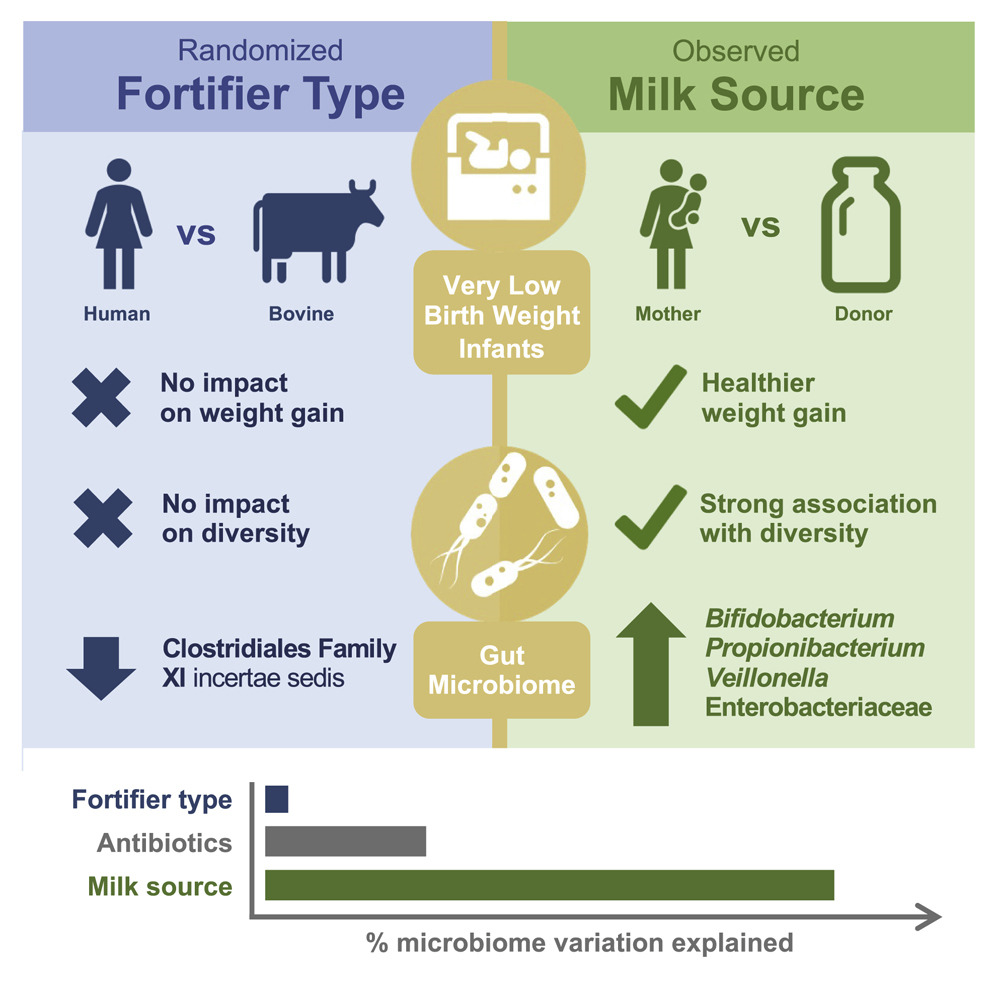
In this trial, babies did not receive exogenous probiotics. As you can see from the graphical abstract, which is a bit simplistic for an abstract of a scientific paper, but fine for a tag in a blog, they showed no difference in microbiome composition between the groups. In a secondary analysis, the major influence on microbiome development was how much mother’s own milk they received.
In this trial the babies did not receive exogenous probiotics, just what was in their mother’s milk, or in the environment. As should be obvious, the babies all developed an intestinal microbiome, which was strongly affected by the source of the main milk feeds, but not, it appears, by the fortifier that was added to the milk.
In contrast, several other studies have examined the effects of probiotic mixtures on the intestinal microbiome.
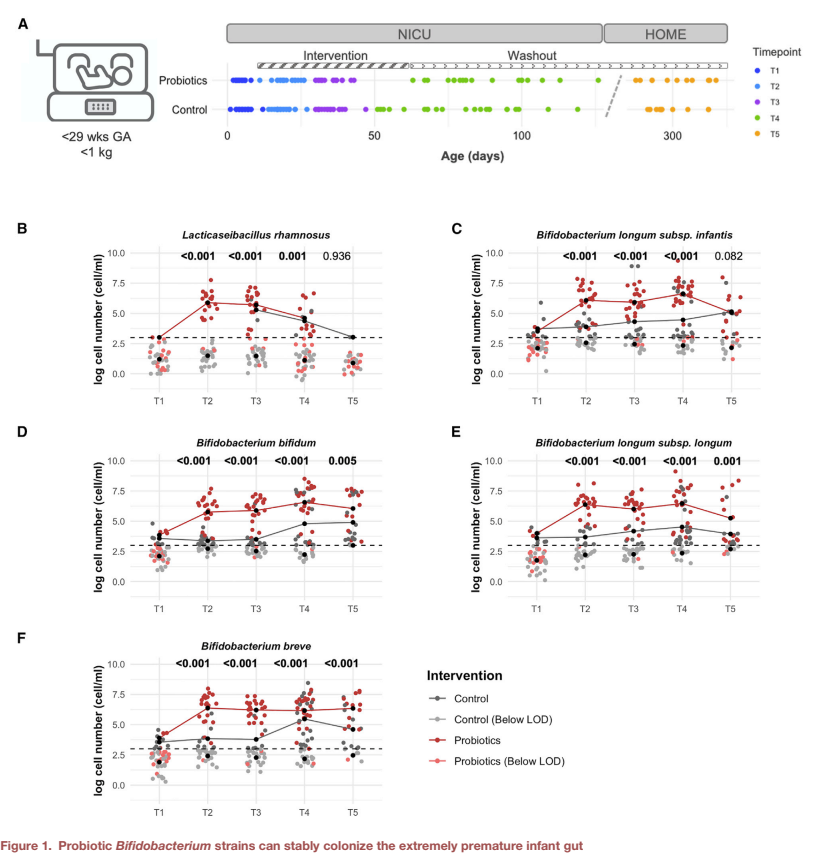
In this randomized trial, for example, (Samara J, et al. Supplementation with a probiotic mixture accelerates gut microbiome maturation and reduces intestinal inflammation in extremely preterm infants. Cell Host Microbe. 2022;30(5):696-711 e5) the investigators in Calgary showed major impacts on the development of the microbiome (with the same probiotic mixture that we use), in 57 babies <29 weeks gestation. Even without the probiotics, the control infants sometimes became colonized with some of the same bugs anyway. T1 was prior to probiotic administration, T2 and T3 were during treatment (or equivalent age) T4 was 2 weeks after the probiotic mixture was stopped and T5 was at 6 months of age.
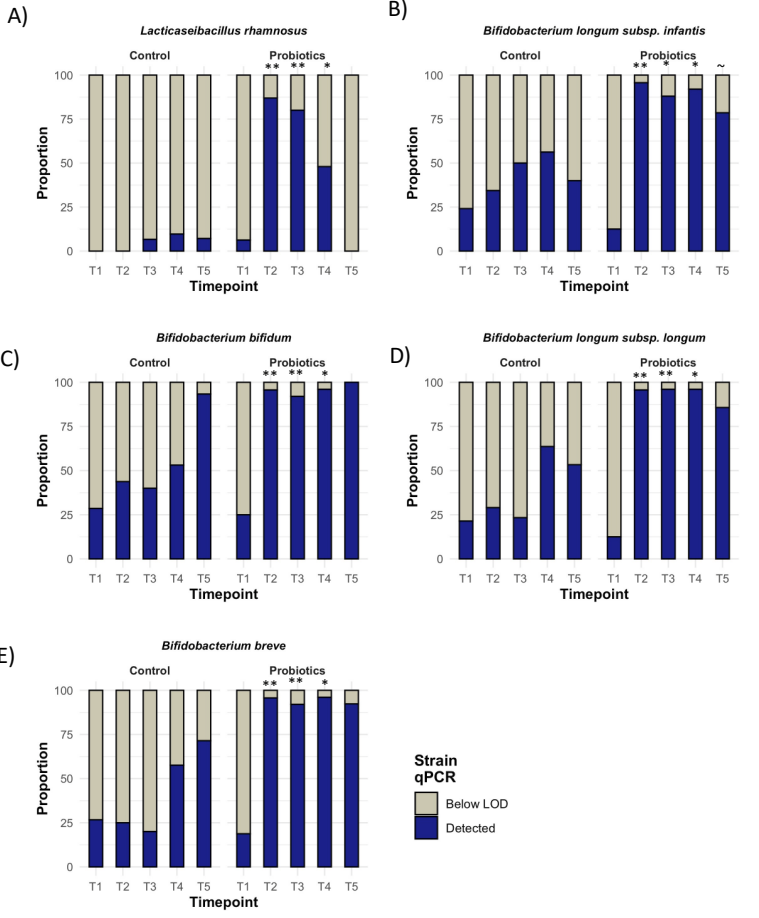
Another figure, from the supplemental data, shows the data more simply as the proportion of samples positive for each organism.
The authors of this study also note impacts of the probiotics on the GI microbiome beyond simply being present in the poop. As they put it, the probiotics “promote a microbial community with high interconnectivity and stability”. I don’t pretend to understand all of the complex analysis that they performed to come to this conclusion, but they did make some pretty graphics. In this graphic, they compare the microbiome composition, using something called the Bray-Curtis Dissimilarity, over those same time periods, then introduce intestinal microbiomes from healthy breastfed term babies, (about whom I struggled to find any details, eventually finding a note that they are a subset of data from another study, in Philadelphia, of vaginally delivered term babies which is investigating antibiotic impacts on the microbiome). The two curves at 1 week and 6 months, in the lower part of these figures, are identical curves from that other study.
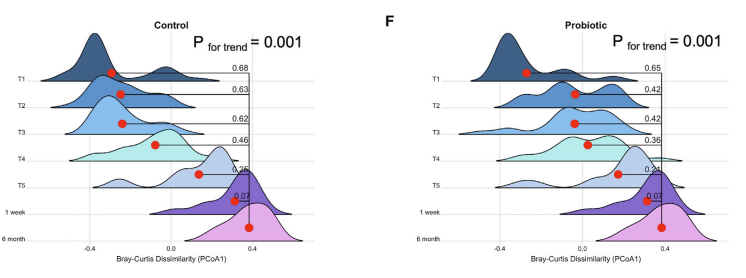
The probiotic treated babies were more similar to the healthy breastfed babies, from the first sample after receiving probiotics.
This probiotic mixture, given to very preterm babies has measurable, apparently positive, impacts on the intestinal microbiome. In the other study, Human-milk based fortifier had no measurable effects. What is absolutely sure, they all have a huge variety of bugs in their intestines!


 Neonatal Research