What to do with mild encephalopathy?

Therapeutic hypothermia improves the chances of babies with moderate or severe hypothermia of surviving without serious disability; referrals for evaluation for therapeutic hypothermia have exploded in our center, and many others, now that this advance is widely acknowledged. Many of the babies referred had a difficult start in life, needing resuscitation and having low umbilical cord blood pH, but have only mild encephalopathy, often with a combination of signs of Sarnat stage 1 and 2.

I actually think it is a mistake to believe that we can clearly classify infants into stage 1, 2 or 3 encephalopathy, although it is a very useful classification there are many babies that have some features of stage 2 and some of stage 3, or some of stage 1 and some of stage 2. We have developed a local evaluation system that will often give babies a stage of “1.7” for example, and then are not sure whether we should cool them or not. Are they a “mild” or a “moderate”?

In general, as the randomized trials show very little adverse effect, and the benefits are clear for moderate encephalopathy, we tend to cool babies who are possibly eligible. Occasionally a decision in the other direction has come back to haunt us, when a baby who seemed to just have classical stage 1 encephalopathy then has a convulsion at 12 hours of age (for example) and we have missed the boat.

One thing that has recently given me pause is the idea that induced hypothermia in non-asphyxiated animal models might have adverse effects on cerebral development. There is at least one study (in neonatal rats) showing a decrease in hippocampal cell proliferation following therapeutic hypothermia in non-asphyxiated animals. (I thought there was another study in piglets also, but I can’t find it right now (please send it to me if you find such an article)). If that is also the case in human babies, and there are adverse CNS effects in the non-asphyxiated, but beneficial effects in the asphyxiated, then there may be babies that we are currently treating with hypothermia who are not having a benefit, but may, rather, be having a negative effect.

But also, it may well be that mild encephalopathy is not as benign as we used to think. I was taught, based on good data (published by my mentor and great friend Neil Finer), that stage 1 encephalopathy did not increase impairment, stage 3 babies were all either dead or seriously impaired at 1 year of age, and stage 2 babies were in between (about 40% serious impairment). If stage 1, mild encephalopathy babies all do well, then we should spare them the rigours of therapeutic hypothermia, and the possible theoretical risks: is this true?

My concerns about this situation are obviously shared by others, there is an explosion of articles about babies with mild encephalopathy recently.

Murray DM, et al. Early EEG Grade and Outcome at 5 Years After Mild Neonatal Hypoxic Ischemic Encephalopathy. Pediatrics. 2016. This well-done study (from the great group in Cork) compared outcomes among 22 babies with mild encephalopathy who were evaluated at 5 years of age to 30 controls. The mild encephalopathy group had significantly lower IQ scores (99 on average) compared to the controls (mean=117, smart kids, the Irish!), the mean IQs for the moderate encephalopathy group were similar to the mild infants, but they had a range of other problems, so fewer of them were considered “non-impaired” at 5 years. The EEG at 24 hours (but not so much at 6 hours) helped to predict the full scale IQ at 5 years.

Gagne-Loranger M, et al. Newborns Referred for Therapeutic Hypothermia: Association between Initial Degree of Encephalopathy and Severity of Brain Injury (What About the Newborns with Mild Encephalopathy on Admission?). American journal of perinatology. 2016;33(2):195-202. This study from Pia Wintermark and the group at McGill (the second best group in Montreal ;-)), showed that, of the babies referred for possible hypothermia, there were 50 who had mild encephalopathy at admission who had an MRI, 20 of them had MRI abnormalities and 5 of those had very severe abnormalities. In the figure below BG/W score is a score for MRI abnormalities in the basal ganglia and white matter.

The authors note that many of the mild encephalopathy babies worsened clinically during the first hours of life.

Walsh BH, et al. The Frequency and Severity of Magnetic Resonance Imaging Abnormalities in Infants with Mild Neonatal Encephalopathy. The Journal of pediatrics. 2017. This study from Terrie Inder’s group in Boston examined the prevalence of MRI abnormalities among babies who were cooled; they had 48 babies with mild encephalopathy, more than half of whom had an MRI abnormality during the first week. They were just as likely to have watershed injuries as babies with more severe encephalopathy, but less likely to have basal ganglia injuries.

One thing that happens when you cool babies with mild encephalopathy is that they often appear uncomfortable, they are irritable and cry a great deal, and may seem to need sedation. We sometimes, therefore, consider interrupting the cooling, or add potentially toxic sedatives to their therapy. Sometimes the babies improve so much that they don’t have many signs of encephalopathy, and we think they no longer qualify for hypothermia. Although we don’t know for sure what to do for such babies, this study is informative. Lally PJ, et al. Residual brain injury after early discontinuation of cooling therapy in mild neonatal encephalopathy. Archives of disease in childhood Fetal and neonatal edition. 2017. This article reports 10 babies in whom hypothermia was discontinued early, in each case because they had improved so much they no longer seemed eligible for the treatment. Half of them nevertheless had MRI abnormalities, and 20% had abnormal long-term outcomes at 2 years of age.

Prempunpong C, et al. Prospective research on infants with mild encephalopathy: the PRIME study. J Perinatol. 2017. This is a prospective multi-center cohort of babies with mild encephalopathy who were not treated with hypothermia, led by my friend and former fellow Guilherme Sant’anna. Their definition of an adverse neurological outcome was an abnormal aEEG within the first 9 hours of life, an abnormal MRI, or an abnormal neurological exam at discharge. Of the 54 babies with adequate data, just over half, (n=28) had abnormalities.

I am still not sure how to put all this together. The studies used for my own training, when you examine the data more closely, do show, even 40 years ago, a small signal suggesting worse outcomes for babies who had mild, Sarnat stage 1, HIE.

This now seems to be confirmed. Mild encephalopathy following perinatal adverse events is probably not benign; even serious outcomes may sometimes follow. For the moment, I think if I am unsure about whether to cool a baby, and they have clear signs of being at least a Sarnat stage 1 HIE, then I will start therapeutic hypothermia, and try to continue for 72 hours. What to do for the babies that are very uncomfortable and seem to need sedation isn’t clear to me, I think a morphine infusion is probably the least toxic alternative, but I am not at all sure about that.

But…. the studies showing the greatest proportion of adversely affected infants after mild HIE are those of babies who were treated with hypothermia, when you compare them to studies of mild HIE babies who were not cooled.

One interpretation of this could be that hypothermia worsens the outcomes of mild HIE. Another might well be that we are good at selecting the babies, among the mildly affected, who are more severely impacted, and that we don’t cool the babies at lowest risk. This is always a problem with observational studies, causation is impossible to ascribe.

There is really only one way to answer these unknowns.

You probably don’t need to guess…

A large multi-center RCT of therapeutic hypothermia is essential; criteria for cooling in such a trial need to be exquisitely clearly defined, so that they can be applied prospectively for future generations.

Posted in Neonatal Research | Tagged , , | 7 Comments

The last word on delayed cord clamping in the preterm? part 3.

Lo and behold. Fogarty M, et al. Delayed Versus Early Umbilical Cord Clamping for Preterm Infants: A Systematic Review and Meta-Analysis. Am J Obstet Gynecol. 2017.

Some of the authors of the APTS trial have performed an updated systematic review, to put into context the results of their trial, which is exactly what should be done in such a circumstance. Their review includes the data from the trial I discussed in part 2, as they were available already (in the figure below they are listed as Duley 2016).

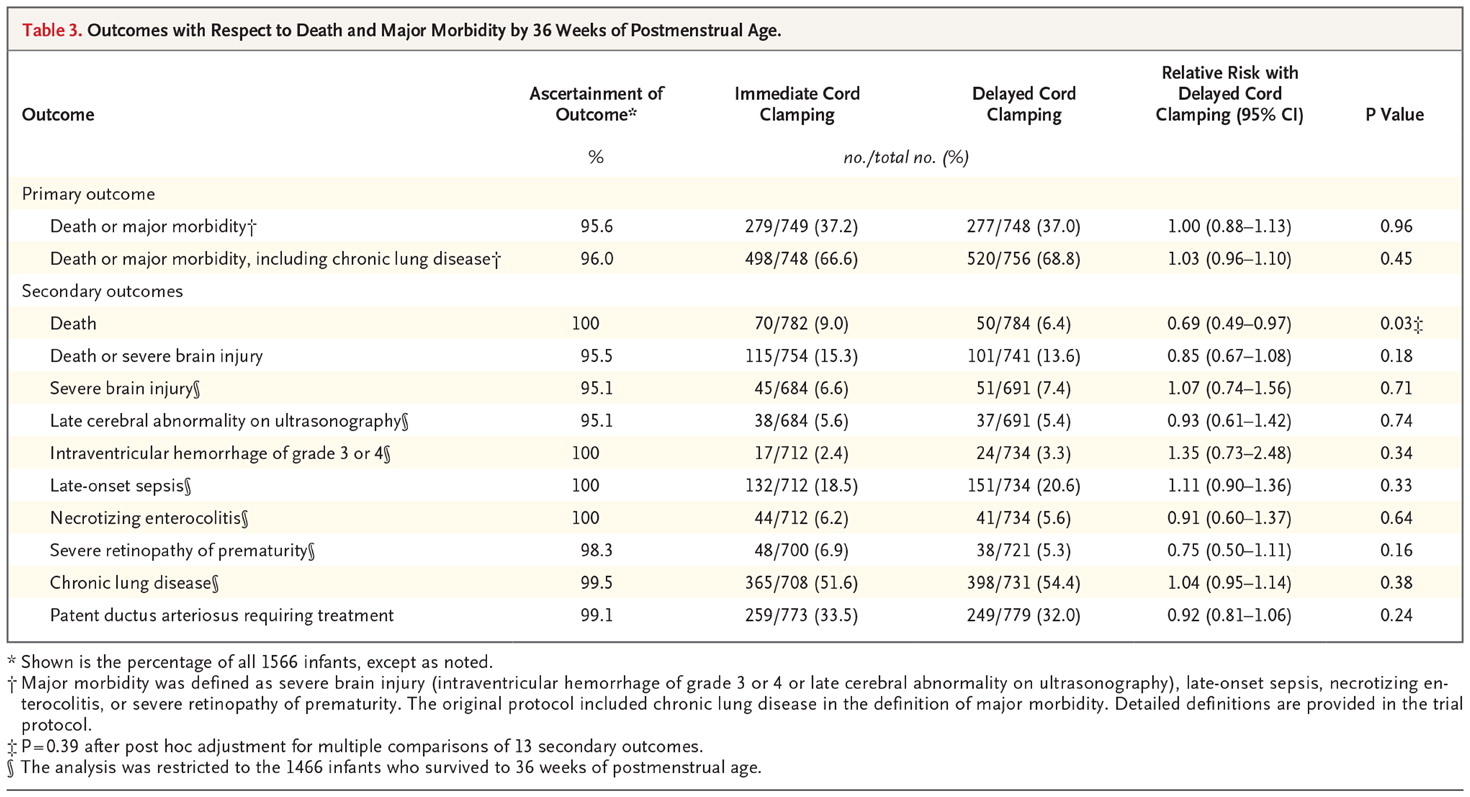
This review found 27 trials of delayed clamping that enrolled babies of less than 37 weeks gestation; most, as mentioned before, were tiny. When looking at the effects on mortality (for which there were 19 trials that reported the outcome) the results of the APTS trial were in fact not significant (at conventional levels of statistical significance) for death before discharge; which seems different to the published results, but the published results were for death before 36 weeks. As you can see from the figure below, death before discharge was 58 vs 79, rather than the 50 vs 70 for death before 36 weeks in the publication from the FPNEJM (the Formerly Prestigious New England Journal of Medicine); death before discharge had a relative risk of 0.73 95% CI 0.53 to 1.01.

There was little heterogeneity in the results,  and, as you can see here, the mortality results depend largely on the latest 2 trials, which together contribute 77% of the weight for the meta-analysis.

So where does this leave us? There is certainly no good evidence of a disadvantage of planning delayed clamping, compared to immediate clamping. Other outcomes: any IVH, severe IVH, PVL, a combination of serious persistent CNS abnormalities on ultrasound, late onset sepsis, NEC, RoP, were not different between early and late clamping. Hematocrit is increased by about 2.7%, and about 20% fewer babies receive a blood transfusion after delayed clamping. There are more babies with a hematocrit over 65% after delayed clamping, but no increase in partial exchange transfusions to treat them. Peak bilirubin levels are slightly higher after delayed clamping.

I remain a little sceptical about the advantages of delayed clamping beyond reducing transfusion requirements, the impact on mortality is basically from one trial (APTS) with an effect on mortality which might have been due to chance (p=0.07 from the Yates corrected chi-square), with a contribution from the Duley trial, with an individual p value of 0.12. I am should also sceptical about the relevance to my practice of a study such as Ranjit 2015, who only enrolled infants between 30 and 36+6/7 gestation who did not need resuscitation, but had a 10% mortality in the early clamping group.

For relatively uncommon events we often have to rely on systematic review to be confident about the impact of an intervention, but meta-analysis of multiple very small trials is known to be problematic, and often inflates the apparent impact of an intervention. I think though it is unlikely we will have more large trials of planned delayed clamping in the very preterm compared to early clamping. I did a quick search of clinicaltrials.gov and couldn’t find such a trial, there are, in contrast, trials comparing cord milking to delayed clamping.

Reassuring is the subgroup analysis of babies of less than 28 weeks gestation, which also showed a decrease in mortality (RR=0.7, 95% CI 0.51, 0.95), but that includes only 996 babies from 3 trials, (871 of whom were from APTS).

Why might delayed clamping reduce mortality without reducing individually any of the primary causes of mortality? It is possible that an improved perinatal adaptation could lead to more stable babies in the first hours of life that decreases a whole spectrum of later causes of death, but it is hard to understand why deaths from late onset sepsis would be reduced, for example.

In my opinion, if we take into account all the limitations in these data I am not absolutely convinced that delayed clamping leads to decreased mortality, but I think that, on balance, it probably does.

My take home message is that planned delayed cord clamping should now be the standard for the preterm infant. The benefits on reduction of transfusion without any harm detected for the baby or the mother, and a probable reduction in mortality, are important, and there is no signal for an adverse impact.

What next? The Duley trial was, of course, quite different to APTS, examining resuscitation with an intact placental circulation. The extra organization and equipment required for this approach should be justified, I believe, by a trial comparing A. planned delayed clamping at 1 minute but with clamping as soon as the baby is thought to need active resuscitation to B. planned delayed clamping at 2 minutes (or more) with active intervention as soon as thought necessary, the cord only being clamped early if there are technical obstacles.

I don’t think you should, ethically, randomize preterm babies to planned immediate clamping. The alternative would be to only randomize infants who were thought to need immediate intervention, and to compare immediate clamping to resuscitation with an intact cord, but that I think would be technically more difficult to do, and would probably require a waiver of consent.


Posted in Neonatal Research | Tagged , , , | 6 Comments

The last word on delayed cord clamping in the preterm? Part 2.

I mentioned the second trial I wanted to discuss at the beginning of part 1. Duley L, et al. Randomised trial of cord clamping and initial stabilisation at very preterm birth. Archives of disease in childhood Fetal and neonatal edition. 2017.

This trial compared immediate (<20 seconds) cord clamping to a minimum of 2 minute clamping for babies less than 32 weeks gestation; the delayed clamping group were placed on a firm surface that allowed medical interventions as necessary with the baby still attached to the umbilical cord and placenta. It was initially planned as a feasibility trial, the ability to perform a full trial being the major outcome for the study.

The authors extended the enrolment into this pilot trial while they tried to get funding for a larger RCT (unfortunately they were not succesful) so they ended up enrolling 270 babies who were randomized at less than 32 weeks and thought likely to deliver at less than 32 weeks. Two babies in each group actually delivered after 32 weeks, and some randomized babies (n=6) delivered at 36 weeks or later and were not included in the trial. Leaving a substantial sample size, for a pilot trial, of 270. As this was initially a pilot, to prove feasibility of a future larger trial, the planned analysis was changed to compare clinical outcomes between groups when the trial was extended. The main outcomes are said in the article to be “survival and intraventricular hemorrhage (all grades)”. They authors state that these were intended to be the primary outcomes for the future complete RCT, but the published protocol states that the primary outcome was to be ‘survival without neurosensory disability at 2 years of age’.

60% of the umbilical cords in the delayed clamping group were indeed clamped at 2 minutes or later, 22% were between 20 seconds and 2 minutes, leaving 18% (about 24 babies) who had early cord clamping in the babies randomized to attempted delayed clamping with stabilization measures with an intact cord. One of the commonest reasons for early clamping in babies randomized to delayed clamping was that the cord was too short, a factor that apparently became less frequent with increasing experience.

Almost all of the delayed clamping group were clamped between 2 and 2.5 minutes, but several did go on quite a bit longer, up to 4 minutes, and one brave team clamped the cord of a baby at about 7 minutes.

Similar to the APTS trial, there is really no sign of a signal for a significant benefit of delayed clamping for IVH, severe IVH, NEC, treatment for retinopathy or sepsis.

There were fewer deaths with delayed clamping, although they had relatively lower power, and the results may have been due to chance, 15/135 died with early clamping, 7/135 died in the group randomized to delayed clamping, Relative Risk 0.47 (95% Confidence Intervals 0.20 to 1.11). As with the APTS trial, causes of death were quite varied, and the gestational ages of the babies who died included some relatively mature babies.

Here is table 3 with the mortality figures and causes.

There were somewhat fewer babies receiving blood transfusions in the delayed clamping group, 52% with early clamping and 47% with late, no increase in the use of phototherapy, very slightly more NEC (8 cases early clamping, 5 cases late clamping), and slightly less culture positive sepsis (33 cases early clamping, 30 cases late clamping). Severe IVH was practically identical between groups.

An interesting trial, congratulations to the team for organizing the ability to do this trial, and for extending the enrolment to achieve a reasonable sample size, as I mentioned before this is the second largest trial of delayed clamping in the preterm. Individually, this trial shows no clear evidence of benefit, and no evidence of harm, a further trial of this approach is warranted, the question now will be what should the control group be for a future trial, given the APTS trial results? Should it be early clamping, or delayed clamping at 60 seconds unless the babies need resuscitation (like the intervention group in APTS)?

I think the first thing that is needed is a new systematic review, with meta-analysis where appropriate. So on to part 3!


Posted in Neonatal Research | Tagged , , | Leave a comment

The last word on delayed cord clamping for preterms? Part 1.

The APTS (Australian placental transfusion study) trial has just appeared on line. This was a high-quality multicenter, international RCT of immediate cord clamping (less than 10 seconds) compared to delayed clamping (60 seconds) for babies born less than 32 weeks gestation. (Tarnow-Mordi W, et al. Delayed versus Immediate Cord Clamping in Preterm Infants. the FPNEJM 2017.)

Another trial arriving almost simultaneously is a smaller trial from the UK, which compared cord clamping at less than 20 seconds to clamping at at least 2 minutes, with reuscitation staring with the cord intact in the intervention group. (Duley L, et al. Randomised trial of cord clamping and initial stabilisation at very preterm birth. Archives of disease in childhood Fetal and neonatal edition. 2017.) I will come back to that trial in part 2.

The benefits of delayed cord clamping for term babies are quite obvious from the RCTs, and basically show a significantly improved Hemoglobin/Iron status for the first year of life, which seems to lead to some improvement in fine motor function, in the long term, with no important down-side. The higher bilirubin levels among late-clamped babies do not lead to more phototherapy, if modern restrictive phototherapy guideline are followed.

The only real disadvantage is that it is much harder to give blood to a public cord blood bank after delayed clamping. Public banks have been the source of stem cells for bone marrow transplants for hundreds of children (and as far as I know adults as well) so this should not be dismissed…

For the preterm baby I thought that much of the evidence had been over-hyped, with claims of reduced IVH, and reduced NEC, based on tiny numbers from tiny trials, with no robust evidence of benefit, apart from higher hemoglobins, probably leading to fewer transfusions. What we really needed was a large RCT with enough power to answer questions about  efficacy and safety.

The APTS trial gives that power, with over 1500 babies randomized, and, although much smaller, the trial from England is the second largest trial, with over 260 babies. The remaining trials that have been quoted as the justification for the worldwide movement for delayed clamping in the preterm, have mostly been tiny, with sample sizes between 32 and 200.

What did the APTS trial show? Speaking in the strictest sense it showed no difference between groups in the primary outcome. The primary outcome was a composite outcome of death, serious brain injury, late-onset sepsis, necrotising enterocolitis or severe retinopathy. When the study was planned bronchopulmonary dysplasia was also part of the primary outcome, but with changes in practice the authors found that the incidence of “BPD” was much higher than expected (many babies were on respiratory support with positive pressure and 21% oxygen at 36 weeks post-menstrual age), so during the trial, before the final data were analysed, BPD was deleted from the composite outcome. When you look at the individual components of the composite outcome, there is no sign of a benefit for any of the components of that composite, except one, that is mortality.

When only one part of a composite outcome is positive, but it is much less frequent than the remaining parts, the overall composite may well be negative. This is one of the problems with composite outcomes, you can actually lose power for the most important part of the composite, whereas these composites are usually being used to try to increase power!

The outcome of death should therefore strictly be considered to be a secondary outcome, and therefore treated with some scepticism. I’ll come back to this point.

Also important is the fact that 26% of the delayed clamping group did not get 60 seconds of delay, which was most often due to concerns about the neonatal status (70% of the time). This was unavoidable given the design, as most centers were not resuscitating babies with the cord intact. 20% of the delayed clamping group got the cord clamped before 30 seconds, the other 6% who did not follow protocol it was between 30 and 60 seconds.

It would be interesting to have a “per-protocol” analysis of mortality results, which I would guess would show a greater difference between groups, as babies who had the delayed clamping interrupted because of concerns about neonatal status might well have a higher mortality. There is an analysis of the per-protocol effects on the primary outcome (in the supplementary appendix) which shows a difference (which may just be due to chance, p=0.2) : 37% with immediate clamping, and 33% with delayed clamping, but no mention of the components of that outcome.

There is also a report of the causes of death in the supplementary appendix, causes which cover the entire range of causes of death among very preterm babies. The biggest single cause was septicemia, which was also the cause that showed the biggest difference between groups, 2.2% immediate clamping, and 0.5% delayed clamping.

There is also an analysis in detail of head ultrasound findings which show no tendency to be different in any aspect between groups.

Finally there were many fewer babies who needed blood transfusions with the delayed clamping (61% with immediate clamping, 52% with delayed clamping) but more babies with polycythemia (2% had hematocrit >65% with immediate clamping, 6% with delayed clamping, 1% over 70% immediate, 2% with delayed). There was no clinically important difference in bilirubin concentrations (mean was 3 micromoles higher with delayed).

Overall then, a potential decrease in mortality, a decrease in the number of babies receiving transfusion, with a very small increase in polycythemia, which was probably not due to chance (p<0.001).

What to do with these results? Well, as yet there is no signal for a clinically important harm of delayed cord clamping; with the proviso that babies who are intended to have delayed cord clamping may often have the cord clamped early. I think that a clinical approach planning for delayed clamping at, or perhaps after 60 seconds, is consistent with the best evidence, it will decrease the number of babies receiving transfusions, and might decrease mortality.

We also need an updated systematic review and meta-analysis. But for that you will have to wait for part 3!

Posted in Neonatal Research | Tagged , , | 2 Comments

Guidelines to help parents who have lost one of twins

Many readers of this blog will recognize the name of Nick Embleton as someone who has done a great deal of nutrition research, and research into the intestinal microbiome of very preterm infants.

He also has a major interest in parents’ experiences of perinatal loss; his group has studied parents who suffered the loss of a twin. This is an unfortunately common experience in the NICU, twins and higher order multiples are much more likely to be born prematurely (for triplets it is actually quite rare to be born at full term), and for one twin to die, while the other is still being cared for in the NICU, happens frequently.

Richards J, et al. Mothers’ perspectives on the perinatal loss of a co-twin: a qualitative study. BMC Pregnancy Childbirth. 2015;15:143.
Richards J, et al. Health professionals’ perspectives on bereavement following loss from a twin pregnancy: a qualitative study. J Perinatol. 2016;36(7):529-32.

I remember as a young neonatologist (and yes, I can remember that far back) when this happened, we thought it was kind, when baby “Smith 1” died, that baby “Smith 2” should just become baby “Smith”. Motivated by concern for the parents, and not wanting to emphasize the loss of the other twin each time we talked about the surviving twin, we basically effaced the memory of the dead twin from our conversation.

I now think that was a major error, and this research confirms that thought.

Although we were trying to decrease the pain of parents who were going through the loss of one twin, while still trying to care for the surviving twin (or triplet(s)); I think it was likely often experienced as trying to erase the memory of one of their babies. In my NICU we now make great efforts to use the first, given, name of each baby (unless the parents haven’t yet decided), and talk about the babies among ourselves using both given and family names. I think that is a better way to refer to our patients, and stops the avoidance, we don’t call the surviving baby “Smith twin 2”, but “John Smith”, and acknowledge the death of baby “Jane Smith”. I think over the years we have come to understand many things which mark the experience of parents who have lost one of twins.

But what really makes a difference to parents going through this cruelly painful experience; to have to remain in the NICU where one baby has died, while caring for another who might still be very sick?

The studies from Newcastle shed some light on that experience.

Here is one quote from the mothers’ paper :

What I got a lot of … the doctor at the time really quite upset me… she often said to me, ‘At least you’ve still got one’, and that was one of the worst things that anyone could possibly say. ‘You’ve still got [surviving twin] though’ and I know I’m really grateful I still have[surviving twin] but that’s like saying to someone that has a child of four and six and the six year old one dies, ‘well you’ve still got the other one, so that’s ok’. And it was really quite upsetting. I knew that she didn’t mean it in any nasty way’.

From comments like that, and a thematic, qualitative, analysis of interviews with 14 mothers who had lost one of twins (some before birth, others after) the team have developed guidelines for helping mothers in such a situation. The concept of “grief on hold’ is, I think, really important. These mothers don’t feel like they can really grieve the dead baby, as they are trying to hold it together for the emotional needs of the surviving infant.

The guidelines they have developed are available on their website, together with films made with parents speaking about their loss, and downloadable resources, available in several languages, including the pdf of a slide presentation, and a 2 page leaflet for parents.  http://www.neonatalbutterflyproject.org

Posted in Neonatal Research | Tagged , , | 2 Comments

Antibiotics are dangerous, unless you actually need them.

In response to my previous post Claus Klingenberg wrote a comment in which he mentioned a recent systematic review that he had published with a group of colleagues. This review of a small number of RCTs (9) and a larger number of observational studies (38) examined the effects of prolonging or broadening the spectrum of antibiotic therapy on individual risks such as NEC and later fungal sepsis, and how those complications impact mortality. (Esaiassen E, et al. Antibiotic exposure in neonates and early adverse outcomes: a systematic review and meta-analysis. J Antimicrob Chemother. 2017;72(7):1858-70).

The RCTs were generally comparisons of different antibiotic regimes, apart from one of routine antibiotics vs no antibiotics. The observational studies were also mostly short vs long courses, and narrow vs broad spectrum. They found:

Prolonged antibiotic exposure in uninfected preterm infants is associated with an increased risk of NEC and/or death, and broad-spectrum antibiotic exposure is associated with an increased risk of IFI.

The authors of the review appropriately did not calculate a pooled Odds Ratio, as the studies are too heterogeneous, but the individual ORs for NEC and/or death range from 1.3 to 7.7, they include numerous observational studies with over 5,000 babies. The studies of invasive fungal infection show in most instances, and particularly in larger studies, an association with the use of third generation cephalopsorins or carbapenems. Specifically among preterm infants, there is an increase in all-cause mortality when antibiotics are given for longer periods in babies with negative cultures.


Posted in Neonatal Research | Tagged , , , | Leave a comment

A negative view of culture-negative sepsis

I have now posted quite a few times about ways to reduce antibiotic use in the NICU, and in the term baby nursery.

One thing that would help to reduce unnecessary usage is to abandon the idea that culture-negative sepsis is an entity that needs to be treated with antibiotics. I well remember a pair of mono-chorionic twins from several years ago that had identical presentations of early-onset sepsis with shock in the first few hours of life. One had a blood culture positive for E. Coli, the other had negative cultures. Presumably the cytokine/inflammatory response in the bacteremic twin had been shared with his brother through anastomotic channels. Treating such an inflammatory response syndrome with antibiotics is unlikely to improve outcome.

A great perspectives article recently published on-line in Pediatrics (Cantey JB, Baird SD. Ending the Culture of Culture-Negative Sepsis in the Neonatal ICU. Pediatrics. 2017) reviews the reasoning many people use to continue antibiotics in the face of negative cultures. They note the following:

1. if a culture of at least 1 mL is obtained before starting antibiotics, the sensitivity of detecting organisms down to a bacterial density of 4 CFU/mL is close to 100%, and is probably even better with the newest culture techniques.

2. Infants with negative cultures at 36 to 48 hours who have their antibiotics stopped virtually never need further treatment.

3. Infants who have negative cultures after maternal antibiotic therapy were either not infected or have been adequately treated. This is not a reason for continuing antibiotics.

4. Ancillary tests (CRP, procalcitonin, and the like) are of no use for deciding if a baby is septic, they have poor positive predictive value, and are non-specific.

5. Our clinical opinion as to the likelihood of sepsis is very poorly predictive of true sepsis.

“Culture negative sepsis” may indeed exist, the example I gave above is one situation which you could call by that name, viral infections, leading to an inflammatory response, are another. Neither situation is likely to benefit from prolonged antibiotic therapy.

The authors conclude that we need to learn to trust our blood cultures

Put simply, if the bacteria cannot grow in the blood culture bottle (an ideal medium at an ideal temperature, free of antibiotics, complement, or phagocytes), then why would they grow effectively in the infant’s bloodstream? As we learn more about the adverse effects of antibiotic exposure on short- and long-term neonatal outcomes, it becomes increasingly clear that prolonged antibiotic therapy for suspected sepsis is a luxury our infants cannot afford.

If you have access, I urge you to read this well-reasoned and well-written piece, and take its message to heart. Prolonged antibiotic therapy in the face of negative cultures increases the risk of later sepsis, and of necrotizing enterocolitis. Killing probiotic organisms in the gut with antibiotics allows the overgrowth of pathogens which can then wreak havoc.

I think we should have a rule that antibiotics are always stopped after 36 hours. Continuing them would then need a definitive decision, which would be easy if the cultures are positive, and should almost always be a decision to not restart in the face of negative blood cultures.

Posted in Neonatal Research | Tagged , | 7 Comments

Volume guarantee, does it guarantee volume?

I published an abstract somewhere, a while a go, that was called “Volume guarantee does not guarantee volume”. It was a summary of the results of a short-term cross-over trial which showed that tidal volumes stays quite variable when you switch from pressure limited ventilation to volume-guarantee, using the Babylog.

The reason of course is that respiratory efforts vary from breath to breath, so a system designed to measure the tidal volume delivered and then adjust the pressures for the next breath, is bound to be always playing catch-up. Sometimes the variability is small, sometimes, when the baby is irritable or crying, for example, the variability can be quite substantial.

In true volume-controlled ventilation the machines deliver a fixed volume into the ventilator circuit for each breath; there actually was at one time a neonatal ventilator that did this, the old Bourns LS104, which I am old enough to have actually used (in my animal lab). The problem with such machines is that the compressible volume of the ventilator circuit is substantially greater than the volume of a baby’s lungs, so any minor change in lung compliance (the ventilator circuit has, of course, an unchanging compliance) can lead to dramatic changes in the actual pulmonary tidal volume received by the infant. If compliance deteriorates significantly you can end up ventilating just the ventilator circuit, and not the baby. In contrast improvements in compliance can lead to dramatic increases in the volumes delivered to the baby, and excessive, damaging inhalational volumes. The Bourns LS104 was associated with worse pulmonary outcomes and went off the market.

Safe volume ventilation in newborns must be determined by the volume actually entering (or leaving) the lungs of the baby, and measured at the endotracheal tube. Some of the trials of “volume targeted ventilation” (including the 2 of the largest ones included in the Cochrane review) in the newborn have used the Siemens Servo 300c in PRVC mode, which measured the volume delivered at the ventilator end of the circuit. Volumes selected for those trials were determined by watching the babies chest move and selecting a volume which gave good chest movement, which varied between 5 and 15 ml/kg. You really cannot call that volume targeted ventilation, and such studies should be considered separately in systematic reviews of volume targeted ventilation in the newborn. In fact if you take those trials out of the systematic reviews, the evidence base for a clinically significant benefit of volume targeted ventilation is rather weak with not many more than 100 patients on volume ventilation and 100 with pressure limited ventilation (even though I personally think it is likely to be an improvement over pressure limited ventilation).

So a system that adjusts pressures in order to get the target volume, will always have tidal volumes which are variable (unless your patient is apneic or paralyzed). In contrast, a system which targets a particular pressure (standard neonatal ventilators that is) will likely have even higher variations in volume, including potentially damaging breaths with excessive inspiratory volumes.

Overall, volume guarantee systems should therefore have fewer breaths which are seriously excessive (or indeed breaths which are much too small). Is that really true? There are numerous small short-term cross-over studies that demonstrate that indeed there are fewer excessive tidal volumes with the babylog or VN500 systems. In part this is also likely to be due to another safety feature in VG ventilation, at least with the Drager systems, that once the volume passes a particular threshold (for the babylog/VN500 that is 130% of the set tidal volume) the inhalation is terminated, and circuit pressure returns to the set PEEP.

How good are the machines at consistently delivering the desired tidal volume? A new publication from David Tingay and his group from the children’s hospital in Melbourne examined this with the SLE 5000.

Farrell O, et al. Volume guaranteed? Accuracy of a volume-targeted ventilation mode in infants. Archives of disease in childhood Fetal and neonatal edition. 2017.

They showed with an extensive data collection in 100 babies, with millions of inflations recorded, that tidal volumes were close to the desired tidal volumes with narrow confidence intervals.

One thing I noted that seemed a bit strange however, is from their figure 1.

(A) Bland-Altman plot of VTset and expiratory tidal volume (VTe) . Solid black line denotes the bias, dashed black lines denote the 95% CI of the limits of agreement. (B) Relationship between VTset and VTe; y=0.736x+1.073 (r=0.34, p<0.0001; linear regression). Solid black line represents the line of best fit and dotted black lines represent 95% CI bands. To ease visual interpretation of figures, and after seeking statistical advice, symbols represent the average values for each infant rather than all values analysed (maximum 90 000/infant)

The dots on the graphs represent the average values from individual patients, who had a median of over 80,000 inflations per patient. Therefore over a large number of inflations some babies had average delivered tidal volumes that were up to 3 mL/kg less, or nearly 2 mL/kg more, than the desired tidal volume, if I interpret graph A correctly. I can understand that sometimes the pressure limit is being hit frequently, limiting the administered pressures and therefore the tidal volume, and that this could lead to smaller average tidal volumes than the set volume; but I find it hard to understand why tidal volumes would be consistently larger than the set volume over a large number of inflations, shouldn’t the ventilator have reduced the pressures to lead to smaller tidal volume? I guess it is possible that the ventilator had reduced the peak pressure down to a minimum (PEEP) and the baby was spontaneously generating volumes higher than the set volume. It would be nice to know if these explanations are correct.

Other findings were that it seems that CO2 is probably truly more stable during volume targeted ventilation, and that the latest algorithm for leak adjusting the inflations seemed to work better that the older algorithm, and indeed worked quite well up to an ETT leak of 30%.

Posted in Neonatal Research | 1 Comment

When good journals print nonsense. (And good doctors too).

It is hard to believe the drivel some people are prepared to countenance just because it is supposed to be very old drivel. Chen KL, et al. Acupuncture in the neonatal intensive care unit-using ancient medicine to help today’s babies: a review. J Perinatol. 2017;37(7):749-56.

Starting with the questionable premise that acupuncture has been in use for ‘thousands’ of years (a brief summary of the recent history of Acupuncture can be found here)., the authors of this article promote its investigation for pain control in the newborn’. Even if the earliest known possible references to acupuncture (which date from about 100 BCE) do really refer to what we now know as acupuncture, the fact that it is an old system is not necessarily in its favour. For it is based on pre-scientific theories of how bodies work, and the manipulation of non-existent energies (Xi) that flow through non-existent meridians, we would be better to remain extremely sceptical that sticking needles anywhere in the body would have distant effects on specific illnesses, or indeed any reproducible effect at all.

Fortunately we have ditched just about all of “traditional western medicine”, which was also based on a similarly profound lack of understanding of anatomy and of physiology.

What is clear from published research is that there are sometimes small effects of acupuncture, which are reproduced regardless of the site that the needles are stuck into, and that you can get the same effects without sticking the needle in at all. The better a study is designed, the lesser the effects of acupuncture. In studies with complete blinding, using sham acupuncture at random sites in control groups, the small effects of acupuncture are usually identical to the small effects of sham controls. (See here for a review of systematic reviews of acupuncture for pain control which concludes “Numerous reviews have produced little convincing evidence that acupuncture is effective in reducing pain. Serious adverse events, including deaths, continue to be reported”).

Some people have promoted these small effects as evidence that acupuncture harnesses the “placebo effect” (as if that was a good thing) what it really is, is evidence that it does not have a real effect.

Using acupuncture, of any variety, including shining lights on “acupuncture points”, is a totally unethical thing to do in an investigation of pain control in the newborn. To perform a painful procedure and test acupuncture against a known effective analgesic is an idea that should horrify anyone who cares about pain in babies.

The articles quoted in this review include ridiculous nonsense such as the “demonstration of active acupuncture points” in the ears of babies with neonatal abstinence syndrome. The demonstration of these non-existent points is often made with a “machine that goes ping”,

which is what was done in the study they refer to. These are galvanometers of various designs, which are used as  supposed identifiers of acupuncture points, they have never been shown to do anything except go “ping”. It is hard to believe that anyone could swallow the idea that there is a specific point in the ear that can be needled to create specific effects elsewhere in the body, based on totally imaginary “homunculi” like this one.

Far from being thousands of years old, auricular acupuncture was made up in France in the 1950’s. The “machines that go ping” measure electrical conductivity of the skin, which varies according to the angle of the implement, the pressure applied, and how much the skin is stretched: such machines have never been demonstrated to detect any real structure or phenomenon.

Despite its total lack of scientific justification there are unfortunately a couple of studies in newborn infants that have been performed. They, not surprisingly, showed no effect of laser acupuncture or of acupuncture accompanied by electrical stimulation. One of the studies, examining the analgesic effect of laser acupuncture, compared laser acupuncture alone to sucrose alone before heel lancing in newborns, the infants in the sucrose group had less pain; that is a truly unethical trial.

We must not start exposing newborn infants to painful procedures in order to investigate the impact of this nonsense. Acupuncture is nothing more than a theatrical placebo, which is unlikely to impress a newborn infant. As Colquhoun and Novella note “A small excess of positive results after thousands of trials is most consistent with an inactive intervention. The small excess is predicted by poor study design and publication bias…The best controlled studies show a clear pattern, with acupuncture the outcome does not depend on needle location or even needle insertion. Since these variables are those that define acupuncture, the only sensible conclusion is that acupuncture does not work.”

If you can get this nonsense published in a normally high quality journal, maybe I should write a review article about ear candling, or the benefits of homeopathy: or maybe I should set up an “alternative medicine NICU”, it would probably be as effective as Mitchell and Webb’s emergency room.

Posted in Neonatal Research | Tagged | 1 Comment

Not neonatology; trip to Western Canada.

I have just returned from summer vacation, we were very fortunate with the weather and with the wildlife viewing. I have put 2 new pages up of my photos under the “Photos” item on the menu at the top of this page. Wildlife of the Canadian Rockies, and Wildlife of the West Coast, Vancouver Island.

One photo I am quite pleased with is of a Purple Martin mother feeding her chick, that had grown to be a similar size to her. It was the first time I had seen Purple Martins, (unfortunately there were no males around), and I caught the moment when the mother deposited the meal right at the back of the young ones mouth. In this sequence  you can see her approaching the noisily demanding chick, then, with the nictitating membrane over her eye, plunging her beak into the chick’s mouth, and then, without pausing, she flew off again to find more food for her hungry charge. Exhausting being a new parent.

Posted in Not neonatology | 4 Comments