More on Probiotics

I received a comment from Colin Morley (everyone in neonatology knows who Colin is, for anyone else who is reading this, he is a neonatologist and researcher from Cambridge and Melbourne). I asked his permission to post it (with my reply which is below) and he kindly agreed:

My take on this is that at the moment it is a bit like saying antibiotics are good although there we have lots of data about individual antibiotics and specific infections.

The problems with probiotics are:

  • There are no well proven probiotic combinations available for prescription in the UK or Australia. I dont know about Canada.
  • We dont know which probiotic or combination to use.
  • We dont know the dose to give.
  • We dont know when to start.
  • We dont know when to finish.
  • Should they be given in the same way to breast milk fed or formula fed babies.
  • Although it may appear there are no infections with the probiotics this is possibly because they dont grow in standard blood culture media.

So I think we need more detailed specific studies to help us answer the above problems. I would not suggest people go to the local high street pharmacy and buy probiotics for their prems because they often do not contain what they say on the tin or in the dose stated.

Hopefully the Australian ProPrems trial data (1200 babies) will be available soon. Even with that number it has little power to show a believable difference in NEC so it is targeting infection, which is a nightmare, what is infection?

My response was as follows:

In Canada we do have preparations with good quality control approved by Health Canada (not specifically for preterms, but at least approved to be sold with an official number), made in approved factories etc.

My response to most of your other comments are that none of the questions will be answered by the ongoing trials. We need comparative trials.

I think the situation is a bit like hypothermia a few years ago, we knew it worked but the AAP refused to endorse treatment because we didn’t know how long to cool for or exactly what temperature. We still don’t know those things, but the widespread introduction of cooling was delayed and many babies suffered as a result.

It really doesn’t seem to matter which organism is used. In fact the intestine is colonized with different profiles of organisms around the world, as long as you have either a lactobacillus or a bifidobacterium in the stuff the effects seem to be about the same. But a streptococcus thermophiles or a saccharomyces doesn’t work (there are now 3 studies of saccharomyces, 1 published and 2 presented, none show an effect).

I agree that the difficulty culturing the bugs is a problem, but, even if there are some undetected infections, mortality is still reduced. The reported infections have been relatively minor and easy to treat.

The unreliability of mixtures bought in the health food stores in the UK and the USA is a huge problem for using them. A reliable preparation is essential.

Colin then replied further:

I have one more comment to your comments. Although comparative studies are theoretically a good idea they are going to be almost impossible if NEC is the outcome. If the rate of NEC is 7% then even an unlikely halving down to 3.5% is going to need thousands of babies.

What is needed is a good study with large numbers (many of the probiotic studies are too small and may be publication bias), a reasonable incidence of NEC say 7% (some of the trials have very high levels in the controls – 13.6%, 16.6%, 22.8% etc and so are probably not representative of what happens in most neonatal units) and a probiotic combination which has been shown to be consistent in composition and in number of bugs and is licensed by the national bodies like the FDA and Australian TGA. If we have that then we can be comfortable to proceed and treat all babies.

When I was in Taiwan I asked them what they did. I was told if the parents want probiotics they have to buy it from the local pharmacy!

I agree with the statement that we need reliable preparations. We are fortunate in Canada to have the Natural Product Authorization system.

It is certainly true that the sample sizes for comparative trials will be huge. There is an international group that has formed who are interested in setting up a registry for the cohort studies that are being done, with a long term goal to perform some comparative RCTs which will probably be cluster randomizations, to account for cross-colonization within an NICU. I think we need to set up networks to do studies such as those, with a simple data set to keep it manageable and less expensive.
Posted in Neonatal Research | Tagged | Leave a comment

Preventing Prematurity

We’ve known for a while that progesterones can reduce prematurity in certain situations. Intramuscular 17 hydroxy progesterone caproate reduces prematurity in women who have had a previous premature baby. (Meis’s article link below)

Now a systematic review of intravaginal progesterone administration shows that the frequency of preterm birth is reduced in women with a short cervix if they get treatment.  Using  the Individual patient data from 5 RCTs including 775 women Romero et al showed there were fewer preterm deliveries, and fewer extremely preterm deliveries. The relative risk of delivery before 28 weeks was 0.5, i.e. a 50% reduction. For every 18 women treated there would be 1 less infants born before 28 weeks gestation.

The therapy appears to be safe, effective and cheap. Routine cervical length screening and intervention should be standard of care.

Romero R, Nicolaides K, Conde-Agudelo A, Tabor A, O’Brien JM, Cetingoz E, et al. Vaginal progesterone in women with an asymptomatic sonographic short cervix in the midtrimester decreases preterm delivery and neonatal morbidity: a systematic review and metaanalysis of individual patient data. American Journal of Obstetrics and Gynecology. 2012;206(2):124.e1-.e19. http://www.sciencedirect.com/science/article/pii/S0002937811023581

Meis PJ, Klebanoff M, Thom E, Dombrowski MP, Sibai B, Moawad AH, et al. Prevention of Recurrent Preterm Delivery by 17 Alpha-Hydroxyprogesterone Caproate. N Engl J Med. 2003;348(24):2379. http://www.nejm.org/doi/full/10.1056/NEJMoa035140

Posted in Neonatal Research | Tagged , , | Leave a comment

Pain relief during retinopathy screening, nothing works very well.

Mandel R, Ali N, Chen J, Galic IJ, Levesque L: Nitrous oxide analgesia during retinopathy screening: a randomised controlled trial. Arch Dis Child Fetal Neonatal Ed 2012, 97(2):F83-87.
http://fn.bmj.com/content/97/2/F83

My colleagues and friends Romain Mandel and Nabeel Ali performed a blinded randomized trial of nitrous oxide (laughing gas) for analgesia during routine ophthalmologic eye screening for retinopathy of prematurity. They started the study while I was the chief at the Royal Victoria Hospital in Montreal, and I think the publication downplays what a pain it was to get all the procedures accepted. They had to scavenge the gases because we didn’t want anyone assisting the procedure to be anesthetized (a nurse or ophthalmologist falling over unconscious would have unblinded the trial). Despite what should have been a good administration of a good concentration of N2O, there was no apparent effect on pain responses. I was very happy that Drs Mandel and Ali pursued the trial, despite the difficulties, as I really thought it would work; but unfortunately, even with experienced gentle ophthalmologists, there was no difference in any of the pain indices.

This adds to the literature of things that don’t work very well for the pain responses to ophthalmologic exams. Including sucrose and topical anesthesia.  A recent systematic review noted that these measures are either wholly or relatively ineffective. Kandasamy Y, Smith R, Wright IMR, Hartley L. Pain relief for premature infants during ophthalmology assessment. Journal of American Association for Pediatric Ophthalmology and Strabismus. 2011;15(3):276-80.  http://www.sciencedirect.com/science/article/pii/S1091853111003326

On the other hand a humane approach I think should lead to the use of topical anesthetics even if they don’t work very well (until we find something that works better), and the pain scores in the Mandel et al study were lower than other studies, perhaps reflecting the fact that a combined approach with sucrose, topical agents and swaddling the infants was used in both groups. Allowing the baby to suck during the procedure seems to help a little, so a soother or bottle could be added. Maybe the best thing would be change the method of screening, there is some evidence that using a digital fundus camera leads to less tachycardia, (see Mukherjee et al) or, even better, just avoiding the use of a speculum (Mehta et al below).

Mukherjee AN, Watts P, Al-Madfai H, Manoj B, Roberts D: Impact of Retinopathy of Prematurity Screening Examination on Cardiorespiratory Indices: A Comparison of Indirect Ophthalmoscopy and Retcam Imaging. Ophthalmology 2006, 113(9):1547-1552.  http://www.sciencedirect.com/science/article/pii/S0161642006005641

Mehta M, Adams GGW, Bunce C, Xing W, Hill M: Pilot study of the systemic effects of three different screening methods used for retinopathy of prematurity. Early Human Development 2005, 81(4):355-360. http://www.sciencedirect.com/science/article/pii/S0378378204001562

Posted in Neonatal Research | Tagged , , | 1 Comment

Probiotics to Prevent NEC: Why aren’t we saving babies yet?

The latest systematic review of Probiotics to Prevent NEC in Preterm infants Wang Q, Dong J, Zhu Y: Probiotic supplement reduces risk of necrotizing enterocolitis and mortality in preterm very low-birth-weight infants: an updated meta-analysis of 20 randomized, controlled trials. J Pediatr Surg 2012, 47(1):241-248. http://www.sciencedirect.com/science/article/pii/S0022346811008360

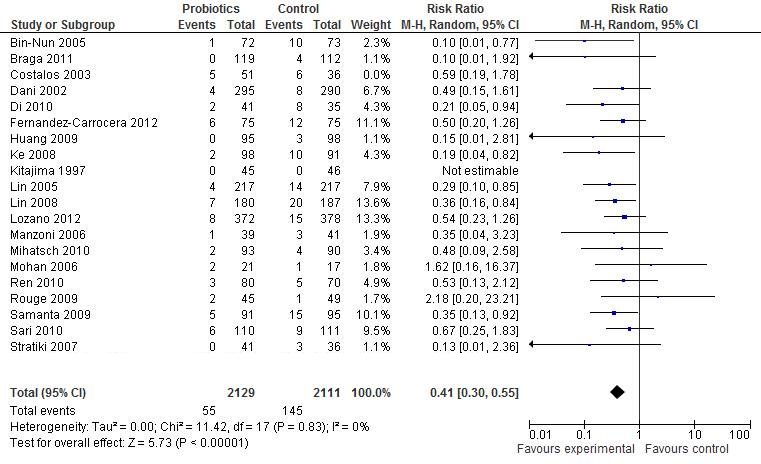
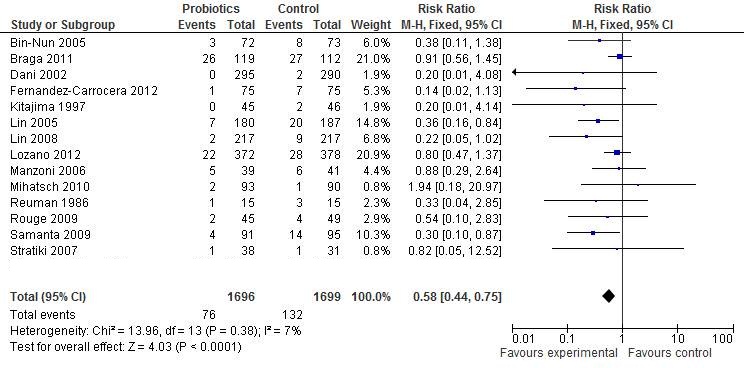
With the addition of 4 studies in the Chinese literature this review which now includes over 4000 babies confirms a reduction in NEC, by 67%, and a reduction in mortality of 44%. Unfortunately there was no further data regarding mortality added by the Chinese trials.

At the recent Pediatric Academic Societies meeting in Boston 2012, the results of another trial were presented (Rojas M and Lozano J). Mario Rojas and the Columbian Neonatal research Collaborative have done a number of very nice trials; this one in relatively low risk babies, showed less NEC and fewer deaths. Their primary outcome was mortality and nosocomial infection, which was not statistically significantly affected by probiotics.

Just as I was about to ‘go live’ with this blog, yet another trial has been published, this small trial had 75 infants per group of less than 1500 g birth weight. They had fewer cases of NEC and fewer deaths with a probiotic mixture compared to the controls.

Fernández-Carrocera LA, Solis-Herrera A, Cabanillas-Ayón M, Gallardo-Sarmiento RB, García-Pérez CS, Montaño-Rodríguez R, Echániz-Aviles MOL: Double-blind, randomised clinical assay to evaluate the efficacy of probiotics in preterm newborns weighing less than 1500 g in the prevention of necrotising enterocolitis. Archives of Disease in Childhood – Fetal and Neonatal Edition 2012http://fn.bmj.com/content/early/2012/05/03/archdischild-2011-300435.full

So I just did an update of the meta-analysis, taking out Paolo Manzoni’s important Lactoferrin trial, as there were 3 groups and it’s too complicated to think about what to do with those data when I am on call. I also took out the Costalos study as it was a Saccharomyces, that is a probiotic fungus, and clearly different to the other studies. As you can see the RR for NEC is 0.41 with very tight confidence intervals. Similarly there is a reduction in death of 42%, with a 95% confidence of the true reduction in death being between 56% and 25%.

There are no reported adverse events in any of the studies.

What more will it take to make this routine therapy in at-risk infants?

Posted in Neonatal Research | Tagged , | 2 Comments

Can we study Hypotension in Extremely Preterm Infants?

Dr Beau Batton and colleagues from the NICHD network have just published a paper detailing their attempt, and failure, to design a trial of early hypotension treatment. The design looks fine on paper, but when they tried to do the trial there were numerous road blocks. One arm of the trial included hydrocortisone, so babies receiving prophylactic indomethacin were excluded, which was a practice that changed after design of the study.  There were fewer hypotensive babies than expected. But even of the eligible babies, only 17% were enrolled.

Establishing equipoise will be a major problem in doing trials, but it is very important that we answer the questions about how to treat hypotension in extremely preterm infants.

The link on the side bar to the HIP trial will take you to the website for our trial, which will be starting soon, which will try and answer the question ‘among infants less than 28 weeks gestation who have a low blood pressure and good clinical perfusion in the first 3 days of life, does treatment with dopamine compared to placebo improve the chances of surviving to 36 weeks without a serious brain injury?’

Batton BJ, Li L, Newman NS, Das A, Watterberg KL, Yoder BA, Faix RG, Laughon MM, Van Meurs KP, Carlo WA et al: Feasibility Study of Early Blood Pressure Management in Extremely Preterm Infants. J Pediatr 2012(epub before print).http://www.sciencedirect.com/science/article/pii/S0022347612000339

Vain NE, Barrington KJ: Feasibility of Evaluating Treatment of Early Hypotension in Extremely Low Birth Weight Infants. J Pediatr 2012(epub before print).http://www.sciencedirect.com/science/article/pii/S0022347612002326

Posted in Neonatal Research | Tagged , | Leave a comment

Hello Newborn World!

For many years I have been screening a number of websites, contents pages of pediatrics and general journals, and other services to add references to my personal database, and also to send out reading lists to fellows, nurse practitioners and others who might be interested (or not).

So why not make it into a blog, thought I.

Here it is, please let me know if you find it helpful.

Posted in Neonatal Research | 2 Comments