Does the way we feed babies affect Necrotizing Enterocolitis?

There is a widespread feeling that the method of introduction and advancement of feeds affects the frequency of necrotizing enterocolitis (known as NEC). Multiple observational studies have been published that seem to support this fear. However when we search for randomized controlled trials comparing feeding practices it is almost impossible to find any support for this idea.

One example is a nice new multicenter RCT called the ADEPT trial (Leaf A, Dorling J, Kempley S, McCormick K, Mannix P, Linsell L, Juszczak E, Brocklehurst P, Abnormal Doppler Enteral Prescription Trial Collaborative G: Early or delayed enteral feeding for preterm growth-restricted infants: A randomized trial. Pediatrics 2012, 129(5):e1260-1268. http://pediatrics.aappublications.org/content/129/5/e1260.long). This trial was enrolled 402 preterm infants with an increased risk of NEC. The risk was increased because they were growth restricted, and had abnormal antenatal dopplers. The increase in risk was born out in the results; the threshold gestational age for eligibility was 35 weeks, and the actual mean gestational age was about 31 weeks in each group, so you would suppose normally that the risk was lower than for say a group of babies of 28 weeks gestation, yet there was a 18% rate of NEC in one group and 15% in the other. If we just examine the stage 2 and 3 NEC, ie those often referred to as ‘definite’ NEC, there were 17 in the early feeding group and 18 in the late feeding group. The difference in feeding practices was as follows, the early feeding group were started on feeds at 24 to 48 hours, the late group had 5 days of not being fed, and started at 120 to 144 hours. Apart from the delay, the feeding protocol was then the same in both groups.

Obviously if you delay feeds the babies are liable to reach full feeds later, which was shown, the babies are also likely to have more prolonged IV feeding, and more complications of IV feeding, including cholestasis and secondary infections. All of these were shown, but the increase in infections was not statistically significant.

So the delay in introducing feeds only caused morbidity, with no benefit.

How about other studies of a similar intervention? Another much smaller study of infants with abnormal dopplers and delayed feeding, (Karagianni P, Briana DD, Mitsiakos G, Elias A, Theodoridis T, Chatziioannidis E, Kyriakidou M, Nikolaidis N: Early versus delayed minimal enteral feeding and risk for necrotizing enterocolitis in preterm growth-restricted infants with abnormal antenatal doppler results Amer J Perinatol 2010, 27:367-373. https://www.thieme-connect.com/ejournals/html/10.1055/s-0029-1243310) randomized 80 babies to start feeds either at < 6 days or at 6 days or more. The early group started on average on day 2 the late group on day 7. This was, as acknowledged by the authors an under-powered pilot study, nevertheless they showed no benefit.

A Cochrane review of 5 trials comparing early to delayed introduction of feeds in the preterm, including these 2 (the others did not select by the presence of growth restriction, but by birth weight alone), also found no evidence of benefit of delaying the introduction of feeds. (reference 1 below)

How about the rate of advancement of feeds? There are 4 trials that have compared advancing feeds at a goal of 20 mL/kg/d or less to a more rapid 30 mL/kg/d or more, also reviewed in a Cochrane review. No evidence of a benefit of slow advancement was found. These rapid versus slow trials were all in babies who were fed within the first 5 days of birth, and the total number of babies randomized is about 500. (Reference 2 below)

It is interesting that in the ADEPT trial mentioned above, by Alison Leaf and her colleagues, they used a feeding advancement regime that was slower than even the slow feeding protocol in those previous RCTs, that is after starting feeds they had a goal to advance feeds by about 11 mL/kg/d in the smallest babies less than 600 g birth weight, becoming more rapid with the larger babies up to a maximum of about 15 mL/kg/d in the babies over  1250 g.

Finally what about ‘trophic’ feeds. Should we start with trophic feeding of a small volume for a while before we start to progress the feeds? Given how widespread this practice is, it is remarkable how weak the evidence base for any benefit is. Most of the trials of trophic feeding have compared trophic feeds to remaining nil by mouth; the Cochrane review of 9 trials involving over 750 infants really doesn’t show any benefit, neither in age of achieving full feeds, nor in any clinically important outcomes, including NEC. (Reference 3 below)

I think the only trial which has ever shown a possible effect of a feeding protocol on NEC is a trial by Carol Berseth, published in 2003 . That study randomized infants, when they were due to start feeds, to either trophic feeding or immediate advancement of feeds, by 20 mL/kg/day. The study was designed to enter 250 infants but was stopped early (after 144 babies) as there were 7 cases of NEC in the immediate advancement group and 1 case in the trophic feeding group. Stopping studies early is always a potential problem, especially in an unblinded study, where the outcome is based on interpretation of a clinical state and an abdominal x-ray. Of note in that study the average age of starting feeds was over 9 days in each group. My interpretation of this is that if you keep babies nil by mouth for too long, you might possibly need to feed them more slowly when you start.

So overall then, there is little or no evidence to support keeping very preterm babies fasting during the first couple of days of life, even if they are growth restricted and had abnormal antenatal doppler studies. When you start feeds there is little evidence to support trophic feeds, and little evidence to support immediate advancement of feeds either, but when you start to advance it doesn’t seem to matter how fast you advance. This really is one clinical neonatal problem that has far more opinion than data, but in general there is no good evidence that how we feed babies has any influence on NEC. It is probably much more related to whether we give breast milk, what organisms we get colonized with, the avoidance of prolonged antibiotic courses and broad spectrum antibiotics, and avoidance of gastric acid reduction.
1: Morgan J, Young L, McGuire W. Delayed introduction of progressive enteral
feeds to prevent necrotising enterocolitis in very low birth weight infants.
Cochrane Database Syst Rev. 2011 Mar 16;(3):CD001970.

2: Morgan J, Young L, McGuire W. Slow advancement of enteral feed volumes to
prevent necrotising enterocolitis in very low birth weight infants. Cochrane
Database Syst Rev. 2011 Mar 16;(3):CD001241.

3: Bombell S, McGuire W. Early trophic feeding for very low birth weight infants.
Cochrane Database Syst Rev. 2009 Jul 8;(3):CD000504.
 

Posted in Neonatal Research | Tagged , , , | Leave a comment

What do babies die of in resource poor countries?

Two very recent publications about neonatal mortality in resource poor countries. The first is from 6 different low resource countries and one medium resource country (Argentina) the authors presented the birth weight, gestational age and age at death of babies who died (Belizán JM, McClure EM, Goudar SS, Pasha O, Esamai F, Patel A, Chomba E, Garces A, Wright LL, Koso-Thomas M et al: Neonatal Death in Low- to Middle-Income Countries: A Global Network Study. Amer J Perinatol 2012(EFirst) https://www.thieme-connect.de/DOI/DOI?10.1055/s-0032-1314885). They show that around half of the deaths are of low birth weight infants, around a third of those being very low birth weight (less than 1500g), the remaining 46% of the deaths are of course normal birth weight (over 2500 g), gestational age at birth was also important, but a slightly higher percentage were considered term, 54%. The majority of babies who died did so early, 52% on the first day of life, followed by another third by the end of the first week.

The cause of death was not reported in that publication, but we know from other sources that the term babies will have died primarily of asphyxia followed by, as a second most frequent cause, by infection, the preterm infants will have died of complications of prematurity. I know that isn’t very specific, but prematurity is often listed as the cause of death in studies from low income countries, presumably a combination of hypothermia, hypoglycemia, respiratory distress, asphyxia and infections are involved in those babies.

Another study from North-East Vietnam had an very similar age at death and distribution of birth weights, and they did attempt to determine the cause of death (Nga NT, Hoa DTP, Målqvist M, Persson L-Å, Ewald U: Causes of neonatal death: results from NeoKIP community-based trial in Quang Ninh province, Vietnam. Acta Paediatrica 2012, 101(4):368-373 http://onlinelibrary.wiley.com/doi/10.1111/j.1651-2227.2011.02513.x/abstract). Causes of death were determined from post death interviews with the mother. The most frequent cause was prematurity/low birth weight, closely followed by birth asphyxia and then infections.

These studies confirm the necessity of resuscitation training, (check out http://helpingbabiesbreathe.org/ ) and basic neonatal care, (check out http://www.healthynewbornnetwork.org/) to improve global neonatal survival. These programs could make an enormous difference for neonatal mortality in the world.

Survival of premature babies in low resource countries could be dramatically improved by the use of antenatal steroids, hand washing, cord care with chlorhexidine, kangaroo care. All of which are cheap and the main pre-requisite is education.

Currently the Millennium Development Goal 4, a reduction in child mortality by 2 thirds, is behind schedule. Although mortality has decreased, it is not sufficient to achieve the goal. Neonatal deaths are currently 41% of all the deaths below 5 years. The only way to make progress in reducing child mortality and approach MDG 4 is by reducing neonatal mortality.

Posted in Neonatal Research | Tagged , | Leave a comment

What next for birth asphyxia?

Now that therapeutic hypothermia has been proven effective and safe for infants with Hypoxic Ischemic Encephalopathy, one might ask what next? We still are not sure if it is of any value to cool infants after 6 hours of age, or if a different duration and different temperature might be preferable. Given the efficacy of hypothermia we will need trials to address those issues. We should also determine whether cooling infants who are slightly preterm is useful, as they are not currently eligible but might benefit.

Other additional therapies also should be examined, to my mind there are 4 that are of interest: allopurinol, erythropoietin, phenobarbitone, and xenon.

As for allopurinol a new publication describes the outcomes at long term of infants enrolled in 2 similar trials. Joepe Kaandorp and associates (Kaandorp JJ, van Bel F, Veen S, Derks JB, Groenendaal F, Rijken M, Roze E, Venema MMU, Rademaker CM, Bos AF et al: Long-term neuroprotective effects of allopurinol after moderate perinatal asphyxia: follow-up of two randomised controlled trials. Archives of Disease in Childhood – Fetal and Neonatal Edition 2012, 97(3):F162-F166 http://fn.bmj.com/content/97/3/F162.abstract) collected long term follow up to 4 to 8 years of age from infants in the 2 trials in Holland, both trials were very small and were, generally speaking, negative. Other studies have suggested some biochemical benefit in terms of interrupting the oxidative stress associated with reperfusion. These 2 studies showed no clinical benefit, but were very underpowered. Combining the studies does suggest that perhaps there was some long term benefit; again, even combined the studies were underpowered, but there is a hint that maybe we should be studying allopurinol. There is one other RCT that I am aware of, that also primarily examined biochemical effects of allopurinol, it was also underpowered, but the authors (Gunes T, Ozturk MA, Koklu E, Kose K, Gunes I: Effect of Allopurinol Supplementation on Nitric Oxide Levels in Asphyxiated Newborns. Pediatric Neurology 2007, 36(1):17-24 http://www.sciencedirect.com/science/article/pii/S0887899406004875) showed a possible clinical and biochemical positive effect of allopurinol. Now in none of these studies were the infants treated with whole body cooling, but these studies do suggest that investigations of allopurinol given as soon as a potential cooling candidate is identified, might be beneficial.

How might this work? Well allopurinol is an inhibitor of xanthine oxidase which is involved in the production of superoxide during reperfusion, so a reduction in reperfusion-reoxygenation injury is the putative mechanism.

Allopurinol is readily available and cheap, with a good safety profile, also important issues in deciding where to go next.

How about erythropoietin? A recent article reviews the neuroprotective potential of this molecule. (Subirós N, del Barco DG, Coro-Antich RM: Erythropoietin: still on the neuroprotection road. Therapeutic Advances in Neurological Disorders 2012, 5(3):161-173. http://tan.sagepub.com/content/5/3/161.abstract) Other pre-clinical articles and reviews also suggest that erythropoietin may have a role in HIE in newborn babies. In addition another very underpowered study in newborn infants, (15 babies per group: Elmahdy H, El-Mashad A-R, El-Bahrawy H, El-Gohary T, El-Barbary A, Aly H: Human Recombinant Erythropoietin in Asphyxia Neonatorum: Pilot Trial. Pediatrics 2010, 125(5):e1135-1142 http://pediatrics.aappublications.org/content/125/5/e1135.abstract ) also suggested some positive effects, but again there was no use of therapeutic hypothermia in either group in that trial. A much larger (but still underpowered) Chinese study (n=167) was also positive (Zhu C, Kang W, Xu F, Cheng X, Zhang Z, Jia L, Ji L, Guo X, Xiong H, Simbruner G et al: Erythropoietin Improved Neurologic Outcomes in Newborns With Hypoxic-Ischemic Encephalopathy. Pediatrics 2009, 124(2):e218-e226 http://pediatrics.aappublications.org/content/124/2/e218.abstract) with a reduction in adverse long term outcomes.

Erythropoietin has multiple potentially neuroprotective effects, including a reduction in apoptosis, protection from glutamate neurotoxicity, and promotion of angiogenesis and neurogenesis, among other effects. It is again, easily available, and in the doses required for newborn infants, cheap.

Phenobarbitone? Phenobarb is an anticonvulsant which decreases brain oxygen requirements, and has been shown to reduce adverse outcomes in asphyxiated infants in one small trial when given in high dose before the occurrence of seizures. (Hall RT, Hall FK, Daily DK: High-dose phenobarbital therapy in term newborn infants with severe perinatal asphyxia: a randomized, prospective study with three-year follow-up. J Pediatr 1998, 132(2):345-348http://www.sciencedirect.com/science/article/pii/S0022347698704585 ). Interestingly in that trial, phenobarbitone wasn’t very good at preventing seizures! There was an improvement in outcomes at 3 years of age, with a few infants lost to follow-up, which in a trial of only 40 babies, even a few losses to follow up could be potentially important. Other trials of phenobarbitone have not reported follow up, and other barbiturates are not necessarily equivalent. Phenobarbitone is also cheap, readily available (most of the time, there have been some problems with availability over the last few years) and is often given anyway to infants with asphyxia. It may reduce the time it takes to make a baby hypothermic, probably because of a reduction in metabolic rate.

Finally xenon has been the focus of a great deal of activity. It is thought to act mostly as an anesthetic agent, but it is very expensive, so special equipment is required to scavenge and recycle the gas. Why xenon has been investigated rather than other neuroprotective agents is not entirely clear to me, it does appear promising in animal models (for example: Faulkner S, Bainbridge A, Kato T, Chandrasekaran M, Kapetanakis AB, Hristova M, Liu M, Evans S, De Vita E, Kelen D et al: Xenon augmented hypothermia reduces early lactate/N-acetylaspartate and cell death in perinatal asphyxia. Annals of Neurology 2011, 70(1):133-150 http://onlinelibrary.wiley.com/doi/10.1002/ana.22387/abstract). A recent study in rats even gave the agent to the mother before birth in a perinatal asphyxia model, and seemed to show some benefit. (Yang T, Zhuang L, Rei Fidalgo AM, Petrides E, Terrando N, Wu X, Sanders RD, Robertson NJ, Johnson MR, Maze M et al: Xenon and Sevoflurane Provide Analgesia during Labor and Fetal Brain Protection in a Perinatal Rat Model of Hypoxia-Ischemia. PLoS One 2012, 7(5):e37020 http://www.plosone.org/article/info%3Adoi%2F10.1371%2Fjournal.pone.0037020) In contrast to the other agents discussed, it will be long time before enough centers could have the equipment an expertise to use this agent. Also in contrast with the other agents, xenon has been investigated in combination with hypothermia, and seems to give additional benefit in the animal models.


Posted in Neonatal Research | Tagged , , | 2 Comments

Perinatal outcomes of IVF twins

Another post about twins and IVF. I’ll back off soon, I promise. A systematic review published just last year notes that the outcomes of twins conceived after IVF is worse than those who are conceived naturally. (Rossi AC, D’Addario V. Neonatal outcomes of assisted and naturally conceived twins: systematic review and meta-analysis. J Perinat Med. 2011;39(5):489-93. http://www.degruyter.com/view/j/jpme.2011.39.issue-5/jpm.2011.058/jpm.2011.058.xml)

One of the problems with doing this kind of analysis is that twins after IVF are almost all fraternal, rather than identical. Identical twins that are monochorionic almost all have anastomoses in the placental circulation, which is probably the main cause for the increase in morbidity and mortality among identical twins, compared to fraternal twins.

So to look at the outcomes of twins after IVF you need to compare just non-identical twins, which is not necessarily obvious at birth, unless the twins are of different sex. (There are a few identical twins after IVF, the frequency of identical twins is increased compared to spontaneous twins, I guess messing around with embryos makes them a bit more likely to divide in two).

When you do this analysis you find that there are more twins born prematurely after IVF, there are more born extremely prematurely, there are more very low birth weight, and there is more perinatal mortality among IVF twins than among non-identical twins conceived spontaneously. And of course all of those outcomes are much higher than among singeltons, either IVF or spontaneously conceived.

Why is this? Well there is some data that primigravidae who have twins deliver earlier than multigravidae. (That is even true for women having their first baby when they are just having one, the average duration of the first pregnancy is about 1 week more than the average duration of  subsequent pregnancies). So the major difference between women having twins after IVF and those with a spontaneous conception, is principally because most of the IVF mothers have not had a baby before, so they deliver even earlier, and have more complications of prematurity.

Posted in Neonatal Research | Tagged , , | Leave a comment

Twins and triplets five times more likely to die within first year

Twins and triplets five times more likely to die within first year | Society | The Guardian.

To most of us in neonatology, this news item, published in the Guardian, based on data from the UK national database,  is no real surprise. (I write this as an uncle of twins who are great, thanks very much, but they are well out of the first year of life).

A target of 24% multiple deliveries after IVF in the UK, as mentioned in this news item is PATHETIC.

The Canadian IVF centres, outside of Quebec,  have an equally pathetic goal of 26%.

It is not difficult to attain 5% or less, it just requires some political will, we have achieved under 5% twins in Quebec (after IVF) within the first year of a provincial IVF program. The Swedes have less than 5% for many years, even the Aussies, (yes even the Aussies) with a less draconian approach, are down to just over 8%. We need a global approach, with an acceptable limit of multiple gestation of maybe 4% after IVF, and zero triplets.

This is achievable! Babies will benefit. Only the vested financial interests will suffer.

Posted in Neonatal Research | Leave a comment

When to deliver twins?

A new RCT from Australia randomized 235 mothers carrying twins to be either delivered at 37 weeks gestation, or allowed to continue for at least another week (Dodd J, Crowther C, Haslam R, Robinson J, for the Twins Timing of Birth Trial G: Elective birth at 37 weeks of gestation versus standard care for women with an uncomplicated twin pregnancy at term: The twins timing of birth randomised trial. BJOG 2012, 119(8):964-974 http://onlinelibrary.wiley.com/doi/10.1111/j.1471-0528.2012.03356.x/abstract).

The primary outcome variable was a composite of fetal/neonatal death or one of a number of serious morbidities, including asphyxia, immature lung disease, and fetal growth restriction ❤rd percentile. This is probably reasonable in general terms, but as with most composite outcomes the components are not of equivalent clinical importance, and clearly in this case are not mutually exclusive. A birth weight ❤rd centile is not of the same significance as asphyxia with encephalopathy.

Also, despite being a difficult trial that will most likely not be repeated, the power was not adequate to address the issue of respiratory distress and pulmonary hypertension as a result of cesarean section without labour at 37 weeks. They did not achieve the planned sample size, of about double the actual size, because of “lack of ongoing funding”. I can’t even tell from the article how many actually had a c/s without labour although half of the early delivery group (86% actually delivered between 37 weeks and 37 + 4 days, the rest before 38 weeks) had a labour induction, presumably the majority of the others had an elective section. As the serious respiratory complications are relatively uncommon, the study would have had to be much bigger to examine this effect.

However they did show that, if you wait and deliver most women after 38 weeks, twins aren’t growing very well at this point, and more of them fall below the 3rd %le, increasing from 3% in the early group to 10% in the “standard care” group. No consequences of being SGA, such as hypoglycemia are reported.

(of note there are a few irritating errors in the manuscript, including: the authors refer to stage 3 and stage 4 encephalopathy, and give the reference to Sarnat and Sarnat’s paper, which only describes 3 stages of course; the graph showing the distribution of gestational ages at delivery shows well over 100% of the early delivery mothers delivered before 38 weeks!).

The overall conclusion I guess is that there isn’t much obvious advantage to waiting until after 38 weeks to deliver twins, if you do you will have more babies fall below the 3rd %le. We could really have done with a much bigger trial that could have better addressed the respiratory risks, and focused on the mothers who did not get an induction, as having a trial of labour markedly reduces the respiratory consequences of being a little early, even if you are then delivered by c/s., but I won’t hold me breath for that to happen. We need some further very large observational studies to tell us a little more about those risks.

Finally you should note the frequency of assisted reproduction among the pregnancies, about 18% were the result of “assisted conception” a far higher rate than assisted conception among singletons, which is about 4% in Australia. They still have some way to go to control this adverse consequence of ART (although their latest report shows that they have been very effective at reducing the multiple pregnancy rate to about 8%), it is much worse in the rest of North America outside of Quebec the frequency of twins and tripets after IVF is about 30%. Here in Quebec we have reduced twin rates after ART from about 30% which is where we were a couple of years ago to under 5%. This can be done with a combination of government funding and strict regulation.

Posted in Neonatal Research | Tagged , , | 2 Comments

What is heteroresistance?

Recent cases of coagulase negative staphylococci, that were very difficult to eradicate, have led to an assessment of whether the phenomenon of heteroresistance may play a part. To be honest, for me this is entirely new; I was not aware of this phenomenon until very recently.

The idea is that colonies of the organisms involved in an infection have subpopulations that have much less susceptibility to antibiotics, in this instance to vancomycin. In the lab the germ will test sensitive to the antibiotic, but in reality it will be very difficult to eradicate the bug. In fact, what is seen is that about 1 in 100,000 to one in 1 million of the germs are more resistant to the antibiotic, if you sub-culture the susceptible strain you will again find that the germ is sensitive, but there is again a subgroup of about 1 in 100,000 to 1 in 1 million organisms that are much more resistant. Now, I hate not understanding things (except theoretical physics that I have accepted that I will never understand (but according to Richard Feynman, that is just fine because no-one does*)) so if anyone can explain the molecular basis of this, please let me know what is happening.

Anyway… these bugs seem to be sensitive on standard lab testing, but when specific ‘other tests’ are performed, there is again a subgroup that are resistant. It may be the first stage in evolution of antibiotic resistance.

A recent publication from France reports a very worrying trend of increased prevalence of heteroresistant coagulase negative staph (often referred to as CoNS). (Rasigade JP, Raulin O, Picaud JC, Tellini C, Bes M, Grando J, Ben Said M, Claris O, Etienne J, Tigaud S et al: Methicillin-resistant staphylococcus capitis with reduced vancomycin susceptibility causes late-onset sepsis in intensive care neonates. PLoS One 2012, 7(2):e31548.
http://www.plosone.org/article/info%3Adoi%2F10.1371%2Fjournal.pone.0031548#pone.0031548-Ng1)  The two other publications from NICUs that I have seen, also report this as a feature of S capitis, but in other patient populations, by which I mean adults, the phenomenon can affect not just capitis, but other CoNS species, such as S epidermidis and S hominis. And indeed the phenomenon was first noted with S aureus.

Clinically what is evident is persistent bacteremia despite good vancomycin serum concentrations, and often despite removal of central lines (Van Der Zwet WC, Debets-Ossenkopp YJ, Reinders E, Kapi M, Savelkoul PHM, Van Elburg RM, Hiramatsu K, Vandenbroucke-Grauls CMJE: Nosocomial spread of a staphylococcus capitis strain with heteroresistance to vancomycin in a neonatal intensive care unit. Journal of Clinical Microbiology 2002, 40(7):2520-2525.
http://jcm.asm.org/content/40/7/2520.abstract).

What to do about this is not yet totally clear, the first thing to do is to recognize it; standard sensitivity techniques do not work, specialized approaches are required. Once identified, do we just push up the vancomycin levels or add (or change to) other antibiotics, agents such as linezolid, daptomycin and tigecycline may be indicated. None of which I know much about, but linezolid use in the newborn has been reported a few times; there is some data about kinetics and toxicity, and it has been successful in clearing persistently positive cultures in reported cases, with low toxicity. There are reported cases of neutropenia in older patients, this has not been the case in newborns and young children and there are now reports of more than a couple of hundred young children and newborns treated with Linezolid in whom there was surveillance for neutropenia.

Linezolid is sometimes referred to as being bacteriostatic, but in reality the distinction between ‘static and ‘cidal antibiotics is of little clinical significance, if any. It is generally accepted that bactericidal activity may be important for treating meningitis and endocarditis, for other infections there is no proven advantage. Indeed the distinction between bactericidal and bacteriostatic drugs is quite unclear, many bacteriostatic drugs do kill bacteria, and bactericidal drugs often do not kill 100% of the germs within 24 hours. (Pankey GA, Sabath LD: Clinical relevance of bacteriostatic versus bactericidal mechanisms of action in the treatment of gram-positive bacterial infections. Clinical Infectious Diseases 2004, 38(6):864-870.
http://cid.oxfordjournals.org/content/38/6/864.abstract).

The paper that I referred to above, from Van Der Zwet, reports clonal spread of a heteroresistant CoNS in their NICU over a 4 year period until it was finally recognized. The prolonged positive cultures that are seen in such cases are a real worry, infants who have prolonged inflammation as a result of delay in eradication of CoNS have worse long term developmental outcomes, possibly as a result of the effects of the inflammatory mediators over a long period on the brain.

The important factors for our babies appear to be:

1. do whatever you can to reduce the prevalence of nosocomial sepsis.

2. that includes removing lines and reducing the duration of broad spectrum coverage

3. Make everyone wash their hands (this should be considered MANDATORY, anyone not washing their hands before touching a baby should be fired)

4. do whatever you can to reduce the prevalence of nososcomial… (OK I know I can be annoying at times)

5. when you have CoNS, consider testing for heteroresistance

6. eliminate the more resistant organisms with something (probably with one of the new antibiotics, but with the certain understanding that one day those fancy, (I hesitate to say clever because there is no intelligence required, it is just evolution) staph will become resistant to the new one as well).

7. Make everyone wash their hands, CoNS appear in the blood stream of our tiny fragile babies because they were on the skin of a health care worker, and the health care worker touched something, a tube, a catheter or the abdominal skin of a baby, without washing their hands well enough.

8. Make everyone wash their hands.

Isn’t it weird that in the same post I can talk about quantum physics and about how much we need to wash our hands?

* ‘If you think you understand quantum theory, you don’t understand quantum theory’. A frequently re-quoted quote, but it is not certain that he ever said it…

Posted in Neonatal Research | Tagged , | 1 Comment

Trying harder

One interesting recent publication, that I think may describe a phenomenon in medicine that has not previously been described, is from the NICHD network. This publication noted that there is a great deal of variation in outcomes, specifically survival without major morbidity, among NICUs in the network (Smith PB, Ambalavanan N, Li L, Cotten CM, Laughon M, Walsh MC, Das A, Bell EF, Carlo WA, Stoll BJ et al: Approach to Infants Born at 22 to 24 Weeks’ Gestation: Relationship to Outcomes of More-Mature Infants. Pediatrics 2012.
http://pediatrics.aappublications.org/content/129/6/e1508.long). As others have previously noted, the variation between units is bigger than the effect size of almost any recent neonatal innovation, nitric oxide or surfactant for example.

What this publication did was to compare the outcomes of different NICUS for babies which are all treated actively in all the units, that is babies of 25 weeks gestation and higher. They noted the above mentioned differences. They then examined the ways in which more immature (less than 25 weeks) infants were treated. What they noted were major differences in performance of cesarean sections at 22, 23 or 24 weeks, provision of antenatal steroids and active resuscitation in the delivery room. What they showed was that centers which were more active at 22 to 24 weeks gestation, had better survival without morbidity among the more mature infants, than centers that were less active with the extremely immature babies.

There are a few possible explanations: it could be that centers that were more active attracted lower risk mothers and babies; it could be that, as the mother and fetus progress from 23 to 26 weeks gestation, an active center has a more positive and active attitude all along the spectrum; it could be that being more active with the most difficult babies makes you better at dealing with babies who have fewer acute problems; it could be that centers that are less active at 22 to 24 weeks are more likely to withdraw care from more mature babies (most of the difference was in death, not other complications). I think from looking at the data that the latter seems less likely, but as the mode of death was not reported we can’t be sure.

My own bias from doing this job for many years is that, as you try harder at 23 weeks, you get much better at looking after 25 week infants. That may not be true, but it is consistent with my experience, and I am not sure if it has ever been shown in other domains of medicine. It makes sense that if you are prepared to operate on the most complicated neonatal heat diseases you will have better results with the more straight forward ones, if you try hardest to salvage severe trauma victims, the more moderately injured ones will be easier to save.

Does anyone know if there are data in other fields that are consistent with this guess? My gut feeling is that such data exist, but I don’t know about them.

Posted in Neonatal Research | 1 Comment

EEGs for preterm infants: Predicting Long Term Outcomes part 3

In some parts of the world EEGs are frequently performed in very preterm infants in the first few days of life as a screening test, and occasionally used to redirect care if abnormalities are found. Is this justified?

Are there abnormalities which are visible shortly after birth which are good predictors of profoundly abnormal long term disabilities? Is there some other valuable reason for performing routine EEG in preterm infants? The literature here is fortunately not huge (at least fortunate for someone wanting to review it!) compared to some other issues.

If we search for inception cohort studies of EEG in the first week of life in defined groups  of at risk preterm infants, with good follow up rates and adequate description of outcomes, we find relatively few studies. (Now of course EEGs may be required for evaluation of certain clinical findings, particularly possible seizures, I am talking about routine EEG for prognostication here, I am also talking about traditional multi-channel EEG, there will be another post sometime about amplitude integrated EEG).

There are two main findings on EEG which have been evaluated, background patterns and sharp transients, particularly rolandic sharp waves.

Generally speaking, there does not seem to be much evidence that background patterns are very predictive of long term outcomes. Now the background EEG patterns of the preterm infants are discontinuous. Periods of quiescence are interspersed with bursts of activity. The duration of the periods of suppression can be quatified as the interburst interval, and several papers have proposed norms for the duration of the IBI and of the bursts; unfortunately the norms proposed vary widely from one publication to the next, for example at 25 weeks an IBI of more than 30 seconds, 45, 60 and 90 seconds have all been proposed as abnormal.

One relatively recent study by Le Bihannic  (Le Bihannic A, Beauvais K, Busnel A, de Barace C, Furby A: Prognostic value of EEG in very premature newborns. Archives of Disease in Childhood – Fetal and Neonatal Edition 2012, 97(2):F106-F109 http://fn.bmj.com/content/97/2/F106.abstract) exemplifies some of the problems with this literature, they report EEG findings and outcomes of 61 infants of between 25 and 29 weeks gestation, 9 surviving infants from the same time period were not included. The follow up was of various durations and standardized testing was only done if the neurologist’s initial assessment found a problem (which I think is fine if you are only worried about serious long term consequences), there is no clear definition of severe or moderate impairment, except that the severely impaired children did not go to normal school, and moderate impairment included attention deficit, hyperactivity, and dyspraxia. The frequency of moderate and severe sequelae was well over 50%; 36, compared with 25 who were ‘normal’. The reported findings were that a dysmature EEG at some point during the hospitalisation had a reasonably good Positive Predictive Value for the combined outcome of severe or moderate sequelae. Now when moderately severe sequelae includes clumsiness (dyspraxia) I am not sure of the usefulness of this for clinical prediction, especially as the abnormalities on EEG were often only evident just prior to discharge at term equivalent age.

Another study from about 6 years ago, although with a relatively small sample of 32 preterm infants, also throws doubt onto the usefulness of term equivalent age EEG, (Randò T, Ricci D, Luciano R, Frisone M, Baranello G, Tonelli T, Pane M, Romagnoli C, Tortorolo G, Mercuri E et al: Prognostic value of EEG performed at term age in preterm infants. Child’s Nervous System 2006, 22(3):263-269.http://www.springerlink.com/content/l4914u8506086276)  background patterns at term were only weakly associated with long term problems. This paper notes some of the difficulties in interpreting the literature with previous studies describing with delayed maturation in the preterm EEG compared to term infants, equivalent maturation, or advanced maturation. 

Let us consider sharp transients on the other hand: temporal sharp transients are frequently seen in infants with all sort of major and minor problems including parenchymal injuries seen on ultrasound, they are only important it seems if they persist after the first week or so, and are numerous and high voltage. There is also some evidence that positive rolandic sharp waves, especially if of high voltage and frequent, are associated periventricular leukomlacia. With several studies suggesting they are very specific for PVL’, but the diagnosis of PVL is not always clearly defined, often persistent periventricular echodensity is included, which has a very poor inter-rater reliability. They are also said to be associated with the later development of abnormal motor function. But abnormal motor function in the largest series, from Marret and colleagues was a prospective cohort of 417 infants less than 33 weeks gestation who survived to be seen at 1 year (Marret S, Parain D, Menard JF, Blanc T, Devaux AM, Ensel P, et al. Prognostic value of neonatal electroencephalography in premature newborns less than 33 weeks of gestational age. Electroencephalography and Clinical Neurophysiology. 1997;102(3):178-85 http://www.sciencedirect.com/science/article/pii/S0013469496956556). Abnormal was described as either mild distal hypertonia or diplegia or tetraplegia at 12 months of age, and was seen in 108 infants. This is an extremely high incidence of PVL and of movement disorders in a relatively low risk population, making any external relevance questionable. Certainly the severity of some of these diagnoses must be questioned. There is also no evidence of a link between the rolandic sharp waves and cognitive outcomes.

Finally both PVL by these definitions and the rolandic sharp waves seem to be becoming less frequent, the paper by Le Bihannic noted above only found 2 EEGs with the finding.

One thing I haven’t discussed is seizures. Seizures are found occasionally in infants in these studies, and are usually associated with a poorer prognosis. Seizures are difficult to diagnose clinically in the preterm (and in the term infant) (Malone A, Ryan CA, Fitzgerald A, Burgoyne L, Connolly S, Boylan GB. Interobserver agreement in neonatal seizure identification. Epilepsia. 2009;50(9):2097-101. http://onlinelibrary.wiley.com/doi/10.1111/j.1528-1167.2009.02132.x/abstract.) and are often under-diagnosed and mis-diagnosed.  More accurate diagnosis should lead to more appropriate treatment, and, one would hope, better outcomes (although that is not certain). So studies focused on seizure diagnosis and therapy have a potential to actually improve, rather than just attempt to predict, clinical outcomes.

So overall I don’t think there is enough evidence of accurate prediction of outcomes to warrant routine EEG monitoring of the preterm infant for that purpose, rolandic sharp waves if frequent (I didn’t go into it but there are 2 types and only type 1 seem important) may be highly predictive of PVL, but a confirmation of PVL with imaging would be required anyway, and they don’t correlate well with severity of outcome.

Posted in Neonatal Research | Tagged , | Leave a comment

Pulmonary compliance changes after surfactant

This blog is a bit different: not a review of a recent publication, but rather a teaching point for my junior trainees (and maybe some seniors).

The question is this: when you have preterm infant with typical HMD and respiratory distress in the first few hours of life to whom you give surfactant; what happens to pulmonary compliance? Try not to look at the answer until your knee has jerked and you have made your choice.

The correct answer is not it increases but ‘it depends’ (that is often the correct answer) but on what?

If you answered it depends on whether you are referring to static or dynamic compliance, then you clearly have either some insight into pulmonary physiology, or you made a lucky guess. Let me explain a bit more:

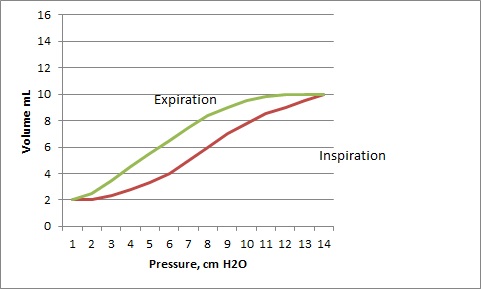
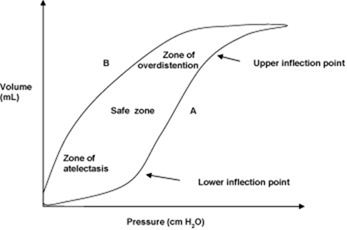
Static compliance is measured when there is no gas flow (hence static) and to produce the complete pressure volume loop the applied pressure should be taken down to zero. This gives the typical curve with its hysteresis.

When you look at the display on a modern neonatal ventilator what you see is nothing like the curve shown above, what you see looks more like a dynamic pressure-volume curve (of course it does, that is what it is!)

Dynamic compliance is measured during tidal breathing (or tidal ventilation) so delays in gas movement as a result of airway (or endotracheal tube) resistance are important, and the curves look quite different.

The dynamic Pressure-Volume Curve looks like this

  • The usual effect of giving surfactant is an improvement of STATIC lung compliance. (Stenson BJ, Glover RM, Parry GJ, Wilkie RA, Laing IA, Tarnow-Mordi WO: Static respiratory compliance in the newborn. III: Early changes after exogenous surfactant treatment. Arch Dis Child Fetal Neonatal Ed 1994, 70(1):F19-24. http://fn.bmj.com/content/70/1/F19.long)
  • Now if static compliance is improved: and you make no changes on the ventilator, that is you have the same PEEP, then end-expiratory lung volume is higher.
  • This shifts the lung up the pressure-volume curve, and the end-inspiratory portion is likely to be on a flatter part of the curve

A before and after look at Static compliance loops during surfactant treatment look like this:

BEFORE, An applied pressure increasing from 0 to 13 cmH2O gives a volume of 8 mL.

CLstat = 8mL/13 cm H2O before surfactant: 0.66 mL/cmH2O

AFTER, An applied pressure increasing from 0 to 13 cmH2O gives a volume of 11 mL

CLstat = 11mL/13 cm H2O after surfactant: 0.85 mL/cmH20

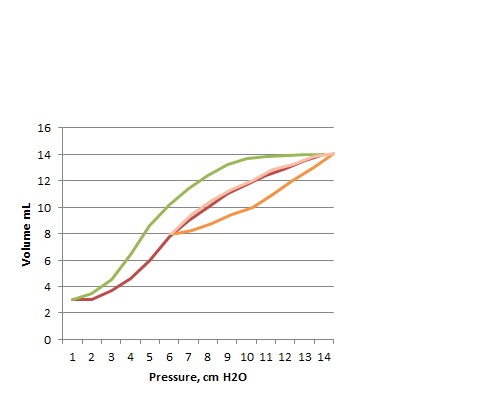
But during tidal ventilation what we see and measure are DYNAMIC loops, such as these before and after loops below.

Pre-surfactant

And Post-Surfactant

If you look at the pressure volume loops on the front of your new fancy ventilator, that cost an extra 10,000 dollars for you to have pressure volume loops displayed, they will look like this, that is, there is no difference between pre and post surfactant loops. What you will also always see is that the end-expiratory lung volume is zero. Neonatal ventilator graphics reset to zero at the end of each breath, this has to be so, because of ETT leaks, if the graphics did not reset they would soon disappear off the screen.

So now we see that the Dynamic compliance CLdyn is 6 mL/8 cmH2O both before and after surfactant.

If we superimpose these dynamic loops on the same static curves that I constructed above you can see what has happened:

The first is Pre-surfactant:

The next is post surfactant:

The end-expiratory lung volume is higher, the tidal ventilation is now occurring at a higher part of the Static pressure volume relationship, and therefore at a flatter part. So if you measure dynamic compliance shortly after giving surfactant and before making any ventilator changes you see no improvement, this has been demonstrated multiple times. Here is one example of dynamic compliance before and 1 hour after surfactant therapy. (Couser R, Ferrara T, Ebert J, al. e: Effects of exogenous surfactant therapy on dynamic compliance during mechanical breathing in preterm infants with hyaline membrane disease. The Journal of Pediatrics 1990, 116(1):119-124. http://www.sciencedirect.com/science/article/pii/S0022347605816609)

  Surfactant Control
  Before After Before After
Compliance (ml/cm H20/kg) mean (SD) 0.43 (0.21) 0.45 (0.45) 0.33 (0.14) 0.33 (0.13)

This means that you cannot use the pulmonary graphics to determine whether the PEEP is optimal or if the baby is ready to wean. A better way to determine whether the surfactant has had an effect is simply to watch the FiO2; as the figure in Ben Stenson’s article referenced above shows, the decrease in FiO2 occurs at the same time as the improvement in Static Compliance. So when the FiO2 falls, reduce the PEEP: you will immediately afterward see the pip fall (on volume ventilation) or the volume increase (on pressure ventilation), and now you will be able to note the improvement in compliance.

Infants who reduce to 21% after surfactant can be managed with a reduction in PEEP to as low as 3 cmH2O (Dimitriou G, Greenough A, Laubscher B: Appropriate positive end expiratory pressure level in surfactant-treated preterm infants. Eur J Pediatr 1999, 158:888-891 http://www.springerlink.com/content/jumq39g0c58auql7/?MUD=MP) or even to 2 cmH2O (Sandberg KL, Silberberg AR
What Is the Best Positive End Expiratory Pressure (PEEP) in Ventilated Low Birth Weight Infants? PAS-meeting abstracts 2009, #3858.115).

Please don’t tell me that this is ‘below physiologic PEEP’ as many residents have told me in the past. There is no such thing as physiologic PEEP. Positive pressure ventilation is not physiologic. The physiologic pressure in the airways at the end of expiration is zero. If it were not so, it would not be the end of expiration.

So the actual optimal PEEP would be what allows airways and airspaces to stay patent, and at the same time avoids overdistension. It is unlikely that there is one pressure which will suit all babies, but PEEP which is very low can be optimal for some babies, you can tell if you have gone too low when the FiO2 starts to increase again.

So when you give surfactant, don’t expect a change in the pressure volume loops, expect the FiO2 to decrease, when this occurs decrease the PEEP, and if the baby stays in 21% you can decrease to 3 cmH2O. Then get the baby extubated!


Posted in Neonatal Research | Tagged , , | 3 Comments